really expensive legal researchers

Lindner v Rawlins 2015

http://www.familylaw.co.uk/news_and_comment/lindner-v-rawlins-2015-ewca-civ-51#.VNymu_msVic


In this case, the Court of Appeal were dealing with an appeal from a husband relating to divorce proceedings about a Judge’s refusal to order the police to provide him with information / a statement.  There had been a complaint from the wife (or the wife’s new partner, hence the husband’s interest) about an allegation of criminal damage to a Sky tv satellite dish.

The husband had done a lot of legal research, but was sadly relying on the Civil Procedure Rules and a case called Durham County Council v Dunn [2012] EWCA Civ 1654 which relates to the duties of disclosure and inspection owed by one party in litigation to the other.  Neither were really relevant in this case, which was Family Procedure Rules and relating to an order for disclosure against a third party.  I personally think that the husband had made a pretty decent fist of assembling his case, he’d just started from the wrong assumptions.

The Court of Appeal refused the appeal, but this is the relevant bit and why it is worth reporting.

The second observation is in no way a criticism of the husband who presented his case to us courteously and as comprehensively as he could. Nevertheless, the fact that he was not represented meant that he had approached it on a mistaken basis. The task that would normally have been fulfilled by the parties’ legal representatives, of finding relevant documents amongst the material presented, and researching the law and its application to the facts of the case, had to be done by the judges of the Court of Appeal instead. This is not a satisfactory state of affairs as the time taken to attend to this is considerable and cannot be spared in what is already a very busy court.


And

I agree with the judgment of Black LJ. I also wish, wholeheartedly, to endorse her observation at [32]. The procedural issue with which this appeal is concerned is technical and unusual. The husband could not be expected to have mastered this area of the law in order to be able to present his appeal in a way that assisted the court. The wife was neither present nor represented. Yet again, the court was without any legal assistance and had to spend time researching the law for itself then attempting to apply it to the relevant facts in order to arrive at the correct legal answer. To do the latter exercise meant that the court itself had to trawl through a large amount of documents in the file. All this involves an expensive use of judicial time, which is in short supply as it is. Money may have been saved from the legal aid funds, but an equal amount of expense, if not more, has been incurred in terms of the costs of judges’ and court time. The result is that there is, in fact, no economy at all. Worse, this way of dealing with cases runs the risk that a correct result will not be reached because the court does not have the legal assistance of counsel that it should have and the court has no other legal assistance available to it.


It is quite easy to read this as a kicking to Chris[tian] Gray-ling and the devillish torments he has assembled for justice in his Red Room (and there’s an image you will be stuck with for the rest of the day, sorry), but I’m not quite sure that it is.

We don’t specifically get told what the husband does for a living, but we do know that there is a matrimonial home of a size for a family of four (husband, wife, two kids) and that it is in the Bromley area (because that was the original Court), so one might hazard a guess that to obtain and sustain a mortgage both parties would probably fall outside of the income limits for legal aid, even before the reforms. The husband is clearly bright and capable – one might criticise him for focussing his intellect in the wrong direction rather than moving on, but that’s by the by.


If I were staking money on it, it would be that this husband would not have qualified for free legal advice and representation even before Chris Grayling got his hands on the legal reins and made his changes of course.

If this was supposed to be an economy though, it isn’t. The Legal Aid Agency might have saved a few thousand in legal fees for someone to research and advise the husband (and they’d have advised against an appeal) but the taxpayer overall has lost out because three very senior Judges had to spend valuable time researching and working out the proper basis for the appeal and whether or not it should be granted.


Lasting power of attorney – revocation.

Re SB 2015 http://www.bailii.org/ew/cases/EWCOP/2015/7.html is another case heard by Senior Judge Lush, involving a person who signed a Lasting Power of Attorney, giving her sons the ability to manage her financial affairs on her behalf when she lost capacity.

It is a GOOD thing to have a Lasting Power of Attorney, particularly if you know that you are suffering from an illness which is going to rob you of the capacity to make decisions for yourself. Much better that those decisions be made by someone you love and trust, rather than by strangers or a Court.

It therefore annoys me massively when the people given that trust misuse it like this man.

b) BB had used £19,038.69 of his mother’s money to pay his farm suppliers.

(c) BB had invested a further £24,000 of his mother’s funds in a biomass boiler at his farm.

(d) although SB owns two investment properties, the rental income from them had not found its way into her accounts.


BB’s response?

On 7 October 2014 BB filed an acknowledgment of service in which he stated that he objected to the application. He said:

“I truly believe that we still have the best interest of our Mum at heart both her welfare & finances.”

The Lasting Power of Attorney gave the son the right to manage his mother’s affair FOR HER, and for her benefit. It was not a right to spend what he was assuming was his inheritance whilst she was still alive. If she had wanted to give him this money whilst she had capacity, that would be fine, but she had not made that decision. This is dipping into (well, more plunging than dipping) his mother’s money for his own benefit.

For those who criticise the existence of the Court of Protection (and there are flaws with it, it isn’t perfect), what is your alternative for this? Let the son rob his mother blind?

The cases about sterilisation and C-sections and deprivation of liberty are the ones that get the headlines, but these financial exploitation cases are the real bread and butter of Court of Protection work. It is desperately sad that when money comes into the picture, some people are prepared to abuse the trust placed in them and use their parents money as if it were their own.


Hope my legs don’t break


We’ve all had times when we have had a document to prepare – a skeleton that seems to grow in size and weight until it could only be the skeleton of a mammoth or terrible lizard, a position statement where your position makes no sense, a case summary where you feel like you are loading ammunition into other people’s guns for them, perhaps even a best man’s speech (hi Shah).

Having found this, I will try not to bitch about having a different document to prepare. This was a speech that William Safire was asked to write for President Nixon.  (I already like William Safire, because he argues that it is wrong to say that “Jim munched a hot dog” because you can’t munch anything that doesn’t make a crunching noise)

At the time, Buzz Aldrin and Neil Armstrong were on the moon and the world was watching. The third astronaut, the one with an unenviable job, was orbiting the moon thousands of miles above them. His name was Michael COLLINS (dumb error changed)

One of his jobs was that if the Eagle lander couldn’t take off again, he was to leave the other two astronauts on the moon and come home.  No glory, just an unspeakable thing to have to do. Leaving his colleagues to their certain death. This was a real genuine possibility – you simply couldn’t do a dry run of whether that lander could take off as expected, you just had to hope.

And President Nixon needed a speech, in case that happened, and the two men who were America’s great heroes had to be left up there on the moon. No prospect of rescue. They would have to starve, run out of air, or just take their helmets off and surrender. He asked William Safire to write the speech. It had to be a good one, obviously, because of the awful tragedy that would have occured. It would have to give praise to the astronauts, but also hope for the future. And it had to be a speech that the author, although he had put his heart and soul into it, had to hope would never, ever be used.


Here it is. I honestly think it hits the mark in every regard.  It emerged 30 years later, in a bunch of documents released about the Nixon administration. Heaven knows, there probably weren’t a lot of documents from the Nixon administration that could lift up your soul and improve your view of human endeavour, but this is one.


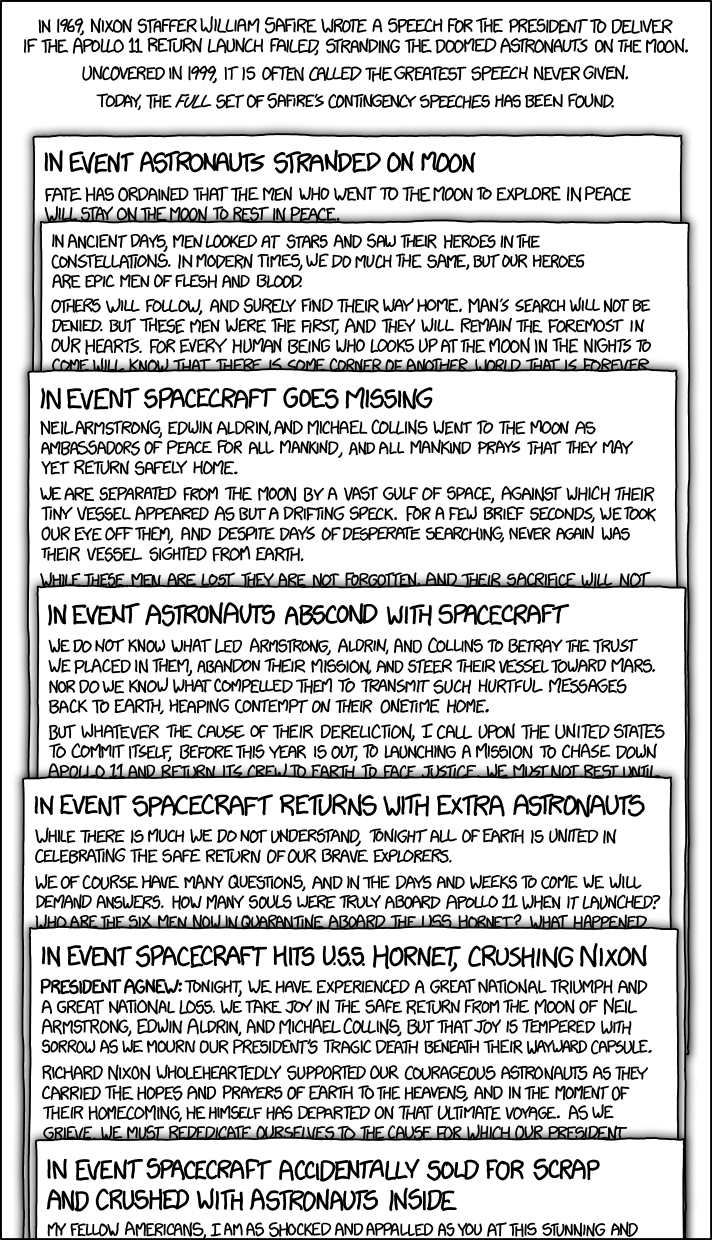
Fate has ordained that the men who went to the moon to explore in peace will stay on the moon to rest in peace.

These brave men, Neil Armstrong and Edwin Aldrin, know that there is no hope for their recovery. But they also know that there is hope for mankind in their sacrifice.

These two men are laying down their lives in mankind’s most noble goal: the search for truth and understanding.

They will be mourned by their families and friends; they will be mourned by their nation; they will be mourned by the people of the world; they will be mourned by a Mother Earth that dared send two of her sons into the unknown.

In their exploration, they stirred the people of the world to feel as one; in their sacrifice, they bind more tightly the brotherhood of man.

In ancient days, men looked at stars and saw their heroes in the constellations. In modern times, we do much the same, but our heroes are epic men of flesh and blood.

Others will follow, and surely find their way home. Man’s search will not be denied. But these men were the first, and they will remain the foremost in our hearts.

For every human being who looks up at the moon in the nights to come will know that there is some corner of another world that is forever mankind.


(I had not been aware of this until I saw the xkcd cartoon today, but I liked it sufficiently to want to share it with all of you. )


Looks like I picked a bad day to give up not being a veracity assessor


Wigan BC v M (veracity assessments) 2015 http://www.bailii.org/ew/cases/EWFC/HCJ/2015/8.html


Veracity assessments, if you don’t know, is where you have an expert, usually a psychologist, to look at the video interviews of a child’s allegations of abuse and to advise the Court as to the features of that interview that indicate whether reliance can be placed on them.  They went through a brief spell of being popular, and then became unpopular – largely because they go to the ultimate decision of the Judge.  The Judge’s function is to decide who is telling the truth and who is lying, and thus on some level it is a bit of a cop-out to ask an expert to give them the answer.

[There is quite a lot of good research about human beings ability to assess whether people are lying, and we really are quite bad at it. The one I have in mind was specifically about whether a six year old on a video is telling the truth about whether or not they touched a particular toy – and most people who had some ‘professional’ stake in deciding whether or not people are liars did worse than the group of students who did the same exercise as a control group. In fact, people generally do reasonably well when estimating that a statement is true, and are actually slightly worse than chance when estimating that a statement is a lie.  The ‘signs’ that most of us think will be present in a liar actually correlate very badly with actual lying

In a minority of studies, accuracy in detecting lies was computed separately from accuracy in detecting truth. Where this did occur, results show a truth-bias, that is, judges are more likely to consider that messages are truthful than deceptive and, as a result, truthful messages are identified with relatively high accuracy (67%) and deceptive messages with relatively low accuracy (44%). In fact, 44% is below the level of chance, and peoplewould be more accurate at detecting lies if they simply guessed.  http://eprints.port.ac.uk/23/1/SAMJAP.pdf  “Detecting true lies”  Portsmouth University study ]

This is the first veracity assessment case I’ve seen in a few years, and certainly the first one since the test for an expert became ‘necessary to resolve the proceedings justly’

To be fair to the expert in the case, he did exactly what was asked of him and pretty much concluded that there wasn’t a need for a specific veracity assessment  “I have seen nothing to suggest that what these children say requires interpretations by an expert, beyond the accommodation of the factors identified in this report. I hope that I have set out the significant factors and possibilities in this case in such a way that weight can be placed on relevant factors, including any new information that emerges.”


In the end, nobody relied on the report, and the Judge at final hearing, Jackson J, indicated that the parties had been premature in seeking such an assessment.  The child in question was a capable witness who could have been called and had questions put to them, and that was a much better way of getting to the truth than having an expert look at things.

The Judge expressed doubts about whether a veracity assessment could meet the current test for expert reports – it might be informative, or useful, but it could hardly be necessary.

Veracity assessments / validation exercises

  1. Having received short submissions from the parties and having consulted the current experience of colleagues, I believe that three principles can be identified:

    1) As a matter of law, there is no bar on the admission of expert evidence about whether evidence is or is not likely to be true. That was the conclusion of the Court of Appeal in Re M and R (Child Abuse: Evidence) [1996] 2 FLR 195, interpreting Section 3 of the Civil Evidence Act 1972. It held that expert evidence dealing with issues, including the ultimate issue, was admissible, subject to the overriding requirement of relevance, which, together with questions of weight, was a matter for the judge. At page 210, Butler-Sloss LJ said: “The modern view is to regulate such matters by way of weight, rather than admissibility. But when the judge is of the opinion that the witness’s expertise is still required to assist him to answer the ultimate questions (including, where appropriate, credibility) then the judge can safely and gratefully rely on such evidence, while never losing sight of the fact that the final decision is for him.”2) The Court of Appeal left open the question of whether and to what extent the court had a power to exclude evidence that was admissible and potentially relevant. That question has now been answered by FPR 2010 Rule 25.4 which dictates that expert evidence can only be adduced if it is necessary to assist the court to resolve the proceedings. The fact that expert evidence is admissible and might be relevant or even helpful in a general way is not enough.

    3) In my view, cases in which it will be necessary to seek expert evidence of this sort will nowadays be rare. While the decision must rest on the facts of the individual case, judicial awareness of these issues has greatly increased, from the Cleveland Inquiry in 1987 to the most recent iteration of the principles of Achieving Best Evidence in 2011. In the two decades since Re M and R (above), understanding has naturally moved on. The process continues to evolve, with the final report of the Children and Vulnerable Witnesses Working Group set up in 2014 by the President of the Family Division expected shortly. The overall result is that judges have been trained in and are expected to be familiar with the assessment of evidence of this kind. The court is only likely to be persuaded that it needs expert advice if it concludes that its ability to interpret the evidence might otherwise be inadequate.

  2. I note that in D v B & Others [2006] EWHC 2987 (Fam), Mr Stephen (now HHJ) Wildblood QC said that “Personally I find veracity evidence of assistance in many cases in this field of exceptional difficulty.” In that case, matters had gone awry after the veracity expert went far beyond her proper remit and then changed her opinion after leaving the witness box. It might be seen as an extreme illustration of the potential pitfalls of admitting evidence of this kind.
  3. I also note the observations of Baker J in A London Borough Council v K [2009] EWHC 850 (Fam):

    “… this case has, to my mind, demonstrated that veracity or validity assessments have a limited role to play in family proceedings. They are, so far as I am aware, unused in criminal proceedings in this country, and I see strong arguments for imposing restrictions on their use in family cases as well. … there is a danger that some courts, faced with these difficult decisions, will subconsciously defer to the apparent expert. That danger has been recognised in a number of cases in which the courts have emphasised the discrete roles of the expert and the court. In the case of the veracity expert, the danger is particularly acute. The ultimate judge of veracity, i.e. where the truth lies, is the judge and the judge alone. He cannot delegate that decision to any expert. I acknowledge that a child psychiatrist… may be able to point out some features of a child’s account that add or detract from authenticity… But, in my experience, many of these features should be obvious to judges in any event. No expert, however experienced and however well briefed about the case, will be in a position to say where the truth lies. Only the judge sees and hears all the evidence.”

  4. I entirely agree with that statement of principle. I acknowledge that judges, however experienced, benefit from the knowledge that experts bring, but that knowledge can be absorbed through judicial training and awareness of the well-known protocols of good practice; it does not have to be imparted case by case with the attendant expense that is bound to arise.
  5. In the present case, the parties now accept that the children’s evidence should have been studied before the question of a ‘veracity’ or ‘validation’ assessment was considered, and that if that course had been taken, it is unlikely that the application would have been made, let alone granted. I agree. In the event, the parties did not refer to the resulting report during the fact-finding hearing, nor did I do so when determining the veracity of the children’s allegations.


If your assessment of my veracity when I claimed in the title to be a veracity assessor was that I was lying, then congratulations, you were right. You might want to consider becoming a veracity assessor. Or you might not, given that you’re not going to get any instructions.


[I can see some scope for a veracity assessment where there is something about the child’s  background which makes them give their responses in a way that would be consistent with them being a liar when compared with an average person from England, but is more about their culture or disability, but I think that’s more about an assessment of child’s presentation or functioning than about veracity per se]


NB, a voracity assessment might be a very different thing, and there might still be a place for those…

Is the Child Protection system fit for purpose – a conference on 1st June


This conference has been set up by members of the Transparency Project   http://transparencyproject.org.uk/  of which I am a tiny part  (a cog who is not pulling his weight at the moment)


You may know Lucy Reed from Pink Tape http://www.pinktape.co.uk , or Sarah Philimore from Child Protection Resource http://www.childprotectionresource.org.uk/ who are the driving force behind this conference. They are the Mary Berry / Paul Hollywood combo – not necessarily in that order.  Many of you may also know Jerry Lonsdale,  who is like the James Bond of the MacKenzie Friend world. And there are many other cool people involved – I’m particularly looking forward to hearing from Sir Mark Hedley and  Kristy Seddon (who is a remarkably impressive care leaver)

So this conference is open to anyone – lawyers, Judges, journalists, social workers, guardians, experts and most importantly real people.

It is going to be like the Glastonbury of family justice. As such, for the small bit I am doing, I will be writing in a blue counsel’s notebook with it behind my back, then with my pen in my teeth and finally setting fire to the notebook.


Policing Parents? Protecting Children? Promoting Adoption?

Do we get the child protection system we deserve

The Transparency Project is pleased to announce a multi-discliplinary conference, on 1st June 2015, which will discuss the different views and perspectives from experts, lawyers, social workers, parents and care leavers in an attempt to re-position the current unhealthily polarised debate around the child protection system.

We will be joined by Dr Lauren Devine of UWE who is currently undertaking research into the evidence base for our current system and by Brigid Featherstone, co-author of ‘Re Imagining Child Protection’.

The conference will take place at the NCVO facilities, near Kings Cross in London

Register for tickets – until Feb 28th 2015.

To register for tickets, please email sarah.phillimore@stjohnschambers.co.uk.

Please let us know which afternoon workshop you would like to attend and if you want a vegetarian meal option.

We want to keep costs low but need to charge to cover costs of venue hire and catering. Lunch and refreshments will be available on the day.

Professionals 5 + years PQE £100/Professionals 0-5 years PQE £50 – discount of 20% if 3 or more members of the same organisation book together.

Waged £30

Unwaged £5

We will be seeking accreditation for CPD points for both the Bar and solicitors.

Topics for afternoon discussion

Suggestions are coming in for the issues most likely to require debate/discussion. Please feel free to contact us to add more.

  • Section 20 agreements – the drift and delay problems. Are there adequate mechanisms in place for review of these? What’s the IRO doing?
  • The anti-authority parent – does disagreeing with or failing to co-operate with a social worker equate to being a ‘bad parent’? What can be done to improve relationships between parents and social workers? These issues are highlighted in the recent Hertfordshire case and discussions over at suesspicious minds.
  • Risk of future emotional harmRe B [2013] is this an acceptable basis for removing children for adoption?
  • Perception of experts as independent – what should happen if experts in a case are on a ‘paid retainer’ with a LA? also an issue raised in the Hertfordshire case above.
  • Problems with ‘working together’ – example of recent disjunction between family and housing law discussed by Nearly Legal. How do we make sure family courts have the best information about issues they may not be familiar with nor fully understand?
  • Opening up the family courts – the impact on children. Is it likely to be a serious as some fear? What lessons can we learn from other jurisdictions?
  • Impact on care proceedings of the rise of litigants in person – what can be done to improve position for people who won’t get legal aid? see discussions by John Bolch on Marilyn Stowe’s blog.
  • Funding for therapeutic intervention- what options should or could be available for parents who are advised they need lengthy therapy/counselling?
  • How is the UK system viewed in Europe? – note the recent report ‘Social services in Europe: legislation and practice of the removal of children from their families in Council of Europe member States’, in particular para 74 which criticises the refusal of the UK system to reverse adoption orders as a ‘misunderstanding’ of what is in the best interests of a child.

Timetable

9.15-9.45 Registration
9.45 -10.00 Introduction and welcome Sir Mark Hedley
10.00-10.30 Evaluation of the Evidence Base for current practice Dr Lauren Devine UWE
10.30-11.00 Re-Imagining Child Protection Brigid Featherstone
11.00-11.30 Coffee break
11.30-12.00 Expert reports and assessments; new directions for 2015. Lisa Wolfe and colleagues
12.00-12.30 Care leavers’ perspectives Kirsty Seddon
12.30-1.15 Parents’ perspectives on the system Introduction by Jerry Londsdale .
1.15-2.00 Lunch Invitations to complete a ‘next steps’ questionnaire online.
2.00 – 3.15 Parallel discussion groups/workshops See below
2.45-3.15 refreshments and informal discussions Post-it note ‘instant’ feedback wall
3.15-4.15 Top table panel lead Q&A discussion Top table of morning’s plenary speakers
4.15 – 4.30 Closing summary, distil the day and key outcomes – call to action? Sarah Phillimore
PM parallel discussion groups/workshops from 2pm to 3.15pm

A. Intervention versus interference: To what extent should we safeguard? Northumbria University.
B. Family Law Toolkit: how language influences outcomes, achieving best evidence. Update on case law when adoption is ‘necessary’; advice on appeal, Legal aid and exceptional funding, ‘hidden LiPs’ and issues of transparency Alice Twaite, Sarah Phillimore, Lucy Reed and Dr Kate Harrington
C. Therapeutic interventions and community support Angela Markham, Jane Auld, National Parenting Initiative, Families In Care
D. Is good enough, good enough? – expectations around parents with learning disabilities, what kind of support needed? Beth Tarleton and Nadine Tilbury, University of Bristol

forced sterilisation

I normally canter through a judgment, picking out the salient bits, but I think this one really needs to be read in full to appreciate it. It would not be fair for me to look at individual passages.

This is a follow-up to this piece

Barbecue tongs and police being given power to force entry to a home


In which Cobb J, sitting in the Court of Protection, gave a ruling that a caesarean section was in a woman’s best interests and even that the police could force entry. It was a very unusual case.

This follow up is the same Judge, in the same Court, considering whether the woman, who lacked capacity to make decisions for herself, should be sterilised without her consent. And again whether there could be powers to forcibly enter her home, remove her and take her to hospital.  The Court do decide that these things are in her best interests.

There’s no getting away from this, the fact that a Court even have these powers makes anyone feel uncomfortable.  Critics of the system have the right to say that this feels wholly and utterly wrong, no matter how carefully it is explored.  It does end up smacking of eugenics, and the nasty side of eugenics at that. Even thinking for a minute about how terrifying it must be for this woman when the police knock down her door and she is taken to hospital for surgery she doesn’t want and doesn’t understand makes your flesh crawl.

My personal take is that I think Cobb J gives a very careful and thoughtful judgment and tries to balance the competing factors.  Parliament have given the Court of Protection this authority to make such decisions, and if they have to be made, doing it in the way Cobb J has done is the best way to do it. I think he is also right to set out that this is a truly exceptional case, with truly exceptional facts – all efforts to engage and develop the woman’s understanding about the health risks to her of further pregnancies were unsuccessful, and the health risks are life-threatening.  But we have sadly seen that unique and exceptional cases do sometimes end up being used in ones that are slightly less so, and on and on until authorities bear little resemblance to the original case.


The Mental Health Trust and DD 2015  http://www.bailii.org/ew/cases/EWCOP/2015/4.html


Even if you end up disagreeing with Cobb J’s decision (and I think you’re perfectly entitled to – this is one of those really moral and ethical arguments) please do him the courtesy of reading the judgment first. It must be a thankless job having to make decisions like this.

Justice Swiss style


[Although this is ham-fisted satire, all of the quotations from the Parliament Public Accounts Committee report on legal aid reforms are actually true. They really did say this stuff]


The Lord Chancellor today, whilst standing in front of one of the four surviving copies of Magna Carta and drawing on it with a thick black crayon, announced the latest reforms to the English justice system.


“Having been criticised by the Public Accounts Committee for our current reforms, it has become clear to me that I have been too timid, and the time has come to introduce the Swiss model of justice”


http://www.familylaw.co.uk/news_and_comment/legal-aid-reforms-not-based-on-evidence-claims-report


Gems in the Public Accounts Committee critique of the last set of reforms include :-


‘Almost two years after the reforms, the Ministry is still playing catch up: it does not know if those still eligible are able to access legal aid; and it does not understand the link between the price it pays for legal aid and the quality of advice being given. Perhaps most worryingly of all, it does not understand, and has shown little interest in, the knock-on costs of its reforms across the public sector. It therefore does not know whether the projected £300 million spending reduction in its own budget is outweighed by additional costs elsewhere. The Department therefore does not know whether the savings in the civil legal aid budget represent value for money.’


And


The Ministry admits that it still has little understanding of why people go to court and how and why people access legal aid.


And


Contrary to its assurances to Parliament, the Ministry does not know whether people who are eligible for legal aid are able to get it.


And


“In short, there is not a lot the Ministry does know.”


So, what exactly is the Swiss model that the Lord Chancellor plans to roll out? Here are his words in his speech, which was sent out with his annotations in italics.


“People have said to me that my reforms have rolled back the clock to Victorian times, that these are Nineteenth Century policies. To which I say – that’s a start. But we can do more. Let’s go right back to the Fourteenth Century.


The Swiss people are known for their watch-making, ski-resorts, banking and their fine chocolate – any product the Swiss make is intricate, rich with quality and with precise smooth workings. [Note – stay away from any reference to cheese, in case people suggest the policy is ‘full of holes’]


This sort of quality is exactly what I intend to bring to the English justice system when I borrow from the Swiss system. Fourteenth Century style.


“Let’s get medieval on their ass”   [Note – has Tarantino got back to us with clearance for that quote yet? If not, use air quote fingers when saying it]


Why, do you know that at the moment, the amount that we spend on justice every year would be enough to pay for every single illegal immigrant to live in Disneyland Paris for ten years and that our fat-cat legal aid lawyers earn more in a week than Pablo Picasso earned in his entire lifetime. The pensions for many of these snout-in-the-trough lawyers mean that in practice, they are able to retire before they have even finished taking their A Levels. [Note – do not get lured into providing a source for these ‘statistics’]


We can do better, we must do better and we will do better. Let us look to the Swiss and their innovations in law [Note, ignore the Geneva Convention – oh , sorry the Americans have already beaten us to it in ignoring that]


From now on, our system of people in wigs talking Latin and Judges ruling against me will be replaced by a smooth as silk Swiss model.


Any person accused by the state of doing anything naughty will be brought to the nearest town square, and given a crossbow. There, they will attempt to shoot an apple off the head of their eldest child without harming a hair on their head.


The same model will apply in all civil claims, probate, divorces, and family claims. Get the kid in, put the apple in place, shoot that off .

If successful, they will win the case.   (unless they have brought a judicial review against me, in which case the apple will be a grape, held between the teeth of their eldest child. And the eldest child will be on a bouncy castle. And the claimant will have to make the shot whilst on a unicycle. After nine pints of snakebite. In the dark. Left-handed. Best out of fifteen. Whilst being tickled. )


But, you say to me, won’t introducing this marvellous new Swiss system require a huge capital investment to make the changes? Can we afford to go Swiss?


We can’t afford NOT to go Swiss, is what I say.


I have anticipated that. By selling off all of our Court buildings and forcibly retiring all Judges and sacking all lawyers apart from the ones I use, the Government can fund apples and crossbow bolts and still achieve a 99% saving on the current budget. And Golden Delicious have already made a lucrative sponsorship offer, with the possibility of partnership with Granny Smith also on the horizon.


The Swiss system has the additional benefit in that there are no appeals. If the accused /claimant cannot make the shot, then the case is over. Also the taxpayer will not have to fund the accused’s dependent children during the period of imprisonment.


There may be some on-costs of mopping for any trials that don’t end in a not guilty verdict, but we have been approached by a Countess Bathory and some Romanian aristocrats who are interested in bulk purchase of blood, which ought to recoup those costs.


I know that looney left-wing do-gooders and vested interests may be saying to themselves “Hey Chris, using first born children as apple-holding instruments of justice and risking their lives just to save costs – that’s cruel”


And I say to those do-gooders – you know the old saying “If you can’t do the time, do lots and lots of archery practice before you do the crime”


The Swiss model, when we tested and rolled it out in Nottingham, did have two minor flaws. The first was that for childless offenders, it was something of a licence to wreak havoc – but many parts of that city are no longer burning. The second was that Phil the Power Taylor is now a criminal overlord whom the law is powerless to touch, having been acquitted nineteen separate times, and who with his band of merry darters is stealing most of the cost savings that the scheme managed to implement.


Nonetheless, I am satisfied that a national rollout will solve all of these problems and that the new justice system will no longer be an ‘arrowing experience. [pause for laughs and warm applause. Resist any request by journalists to put an apple on own head]


[Musical references for this piece would be either Pulling Mussels from the shell by Squeeze “Behind the chalet, my holiday’s complete, and I feel like William Tell, Maid Marian on her tiptoed feet”     or the more frenetic Bug powder dust by Bomb the Bass/Justin Warfield “I always hit the apple when I’m going to shoot / so you can call me William Tell or Agent Cooper to boot” and later on the wonderful   “I got a splinter though, damn, you know man it hurt / I got a Vegemite sandwich from Men at Work”


They’re both great, listen to both of them. ]


https://www.youtube.com/watch?v=AAHueb8j0wI&index=10&list=PLfFETal_82YoiPI3WtDcTpJZhHskPgRvp     – I recommend LOUD and at home.


CSI President : Appeal


I was a bit surprised to see that public money was spent appealing the President’s decision in Re Z Children 2014  which I wrote about here:-

CSI : President


The case involved a dad who wouldn’t give a DNA sample, but was in prison for murder. The police had two DNA samples – a DNA sample of the perpetrators blood from the crime scene and the one dad gave that matched it. They were prevented by law in giving the second one to the Court to be used as a paternity test sample. The President decided that they weren’t prevented in law in giving the first sample (which we all know is a match and is dad’s DNA)

I actually thought it was a very clever and intricate solution and one that won’t really cause problems for later cases.


Nonetheless, it was appealed, and the Court of Appeal over-ruled the President.


Re X and Z Another  http://www.bailii.org/ew/cases/EWCA/Civ/2015/34.html

As a result, any samples held by the police ought to only be used for the purposes of criminal law enforcement.

If you were hoping for the President to get a come-uppance, this judgment is not it. The closest they come to a criticism is this bit:-

35. Parliament cannot, when replacing Part V of PACE in 2012, have intended that Part II DNA profiles could be used outside the sphere of criminal law enforcement but that Part V DNA data could not be so used. That would be arbitrary and would make no sense. The court should be very slow to impute to Parliament an intention to legislate so as to produce results which are arbitrary and irrational.

  1. In order to avoid such absurdity and to reflect Parliament’s clear intention in POFA to legislate to remove the incompatibility between English law and the requirements of the Convention, I consider that section 22 should be construed in a way which is consistent with the scheme of Part V. That is to say, section 22 should be construed as meaning that, if the police consider that it is necessary to retain Part II DNA material for criminal law enforcement purposes, they may not use it for any other purpose


Given that the Court of Appeal didn’t like the President’s somewhat elastic use of statutory construction (stretch it as far as you can unless it actually snaps) he is perhaps fortunate that all of the parties in Re  X (a child: Surrogacy) 2014 liked his decision (and hence weren’t going to appeal it), because that one for me went beyond snapping point.


Conjurers and children’s birthday parties


When the President decided that a valid interpretation of THIS piece of statute

“the applicants must apply for the order during the period of 6 months beginning with the day on which the child is born.”

was

“unless the Court is okay with it”


The President doesn’t lose many though – this one and Cheshire West are the only ones that I can remember.  (And I have some sympathy for him on this one, I think it was a child-focussed attempt to resolve a problem)

Moving on up yeah, now I’m out of the darkness

This is a personal post, not a legal one, so feel free to skip it.  Don’t worry, it is not about to be some Angela’s Ashes style disclosure that will curdle your milk on your breakfast cereal, though it is about my childhood, there are no significant harm issues.


When I was eleven, my teacher taught us a lesson about Louis Braille, the man who invented Braille language for the blind. My teacher told us that Louis Braille had gone blind in one eye due to an accident with an awl, doing woodwork when a splinter went into his eye. He then told us that years later, Louis Braille once rubbed his blind eye and then rubbed his good eye with the same hand without thinking about it and it made him blind in both eyes.  [This is not quite true – there was an infection from the wound as a result of the first injury, but it had nothing to do with rubbing it]

This story meant that until about twenty-five, I would only ever touch my left eye with my left hand, and vice versa, to make sure that if I went blind, it would only be in one eye. Thanks teach!

I was very afraid as a child of going blind. I still am, to be honest. I used to test myself by putting a tie around my head so that I couldn’t see, and trying to do basic everyday tasks – getting dressed, brushing my teeth, going downstairs, making breakfast. I knew the dimensions of my home, how many paces from bed to door, how high the doorhandle was, how many steps from my door to the top of the stairs, with my eyes closed.  I even tried to teach myself Braille whilst I still had my sight, figuring that it would be easier.

When I was twelve, we had an eye test at school. And I failed it. I should have seen it coming, in retrospect. I was able to answer any question asked aloud, or written in a textbook, but I never put my hand up for any question written on the blackboard. And when we were out in a car and my dad said “Look! can you see that kestrel?”  I never could, but I just nodded excitedly and pretended. The eye testing people told me that I’d have to wear glasses for a little bit, just to fix my eyes and that wearing glasses would make my eyes better so I wouldn’t need them.  Lies.

When I came out of that eye test and I knew I’d have to wear glasses, I knew that my life was ruined. I didn’t take it well, I was not a brave little soldier. A week later, I stopped being Andrew and became “specky four-eyes”  or “brainbox” or “Professor”.  I hated every moment of wearing those glasses, becoming just a kid who wears glasses and not me any more.

A year later, I went for the repeat eye test, and I had just one goal – getting a pass and not having to wear them anymore. So when I went in the room, I immediately memorized the board. It worked up until they revolved it, at which point my ability to read tiny, tiny writing mysteriously vanished. I would have to do better next year. So I upped my game. I had memorized not only the first board, but all of the later boards that I had seen when they had put lenses on.  Turns out, it is harder to fool optometrists than you think it would be.

Wearing glasses made me very shy.  In case this is feeling a bit self-pitying, I’ll show that I have some perspective. There was a kid in my class who had lost his arm somehow, and if you gave him 50p, he would take his artificial arm off and let you touch his stump. He had a lot more to be sorry about than I did – so I’m just trying to tell you how it felt for me then. I know it wasn’t really that bad.

I’m still shy today, to be honest. A lot more shy than anyone would imagine, and that’s because when I went to college and was surrounded by a peer group of strangers, who didn’t only know me as “specky four eyes”, didn’t know me at all, I had an important revelation. “None of these people know that you’re shy”, I thought, “so you get to pretend that you’re someone who isn’t. Who would you like to be? And just be them”

So I found some really good masks to put on, and eventually, the people I was pretending to be sort of became the people I was.  I was also really lucky to be born into a generation where glasses and being brainy and being interested in smart stuff went from being things that would marginalise you and get you bullied if you mentioned them to suddenly becoming cool. I’ve been waiting about ten years for the old world order to be restored and for people to start picking on geeks again, but it turns out we won.  Thank you Joss Whedon!

Anyway, about three weeks ago, I noticed that I wasn’t able to read magazines properly. I was doing a sort of dance with them, moving them back and forth until I could see the print, then it would go. And then it turned into books. And then I noticed that I was actually reading better without my glasses than with them.  I’m thirty years older now than when I was faking those eye tests, so I wasn’t thinking “My god, I’m finally fixed, I don’t need glasses any more”  – but I was back to thinking those terrible things about having to navigate the world without sight.

It turns out that I just need varifocals. I’m not going blind, I’m just old. Officially old. But it was something of an emotional day, stirring up all those old thoughts, and I just thought for once I would share them.

I was blind, but now I see, as Primal Scream sang.

Unfortunate and woeful – Local Authority failings


This is a High Court case in which the Judge (Keehan J) was very (and rightly) critical of the Local Authority, including criticism that when they were asked for explanations of their conduct prior to and during the proceedings those explanations were not satisfactory and amounted to not much more than attempts to defend the indefensible.


Northamptonshire and DS 2014


http://www.bailii.org/ew/cases/EWHC/Fam/2015/199.html


The case ended with a child, DS, being placed with his maternal grandparents in Latvia.


It began, as cock-ups so often do, with a section 20 agreement. There were some legitimate concerns that DS would be at risk in the care of his mother and his mother was asked to agree to place him in ‘voluntary’ foster care. This happened when he was 15 days old.


The Local Authority did not properly think about care proceedings until five months later, and even worse than that, having decided that care proceedings were the right thing to do, did not then issue them until five months after that.


The care proceedings were plagued by delay, most if not all being ascribed to the Local Authority, ending up with a child spending nearly two years in foster care when there were grandparents who were eventually able to care for him.


The Guardian and mother issued claims for Human Rights damages on behalf of the child, and the LA by the time of the final hearing were accepting that they had violated the child’s human rights in all of these human rights claims:-


(a) The local authority failed to take any protective action to safeguard the child despite having concerns that he was at risk of suffering significant harm between 15 and 30 January 2013, in breach of his article 6 and 8 rights.

(b) Whilst the child was accommodated pursuant to section 20 CA on 30 January 2013, a decision to initiate proceedings was not made until 23 May 2013 and an application for a care order was not made until 5 November 2013. Over this period of 11 months the child was without access to any independent representation of his welfare interests and had no access to any remedy or recourse and no person was exercising parental responsibility for him, in breach of the child’s article 6, 8 and 13 rights. *

(c) The local authority, by its acts or omissions, caused or contributed to a series of delays in the filing of necessary evidence during the course of the care proceedings and the final evidence filed for hearing in October 2014 was inadequate and incomplete, in breach of the child’s and mother’s article 6 rights.

(d) The delays and general mismanagement of the case by the local authority has been seriously prejudicial to the child’s welfare and the child’s and mother’s ability to enjoy a family life with a member of his extended family prior to November 2014, which may have irredeemable consequences for the child’s future welfare and development. Such failures were in breach of the child’s article 8 rights.

(e) The child and mother were subject to a high turnover of social workers and locum social workers with conduct of his case file leading to a lack of cohesive, comprehensive management and care for a significant period of time and in breach of the child’s and mother’s article 6 rights and prejudicial to their article 8 rights.

(f) The local authority failed to organise contact between the child and his mother in accordance with an explicit order of the court and the advice of the Children’s Guardian for a significant period of time and poor organisation and communication by the local authority led to various sessions of contact being cancelled. Such failures were in breach of the child’s and mother’s article 8 rights.


*you don’t often hear of article 13 rights, but it was a good call in this case:-


Everyone whose rights and freedoms as set forth in this Convention are violated shall have an effective remedy before a national authority notwithstanding that the violation has been committed by persons acting in an official capacity.


There wasn’t an effective remedy until the LA issued the care proceedings that should have begun in February at worst, but instead started in November.


A package amounting to £17,000 was agreed by the Local Authority and approved by the Court.


Looking at some of the particular criticisms made by the Court:-


Inexperience of the worker and delay in issuing


I cannot begin to understand why an inexperienced social worker who was not familiar with care proceedings was allocated as a social worker for a 15 day old baby. I do not understand why it took until August to provide her with support or why senior managers did not intervene in this case. It is wholly inexcusable for a local authority to take three months to decide to issue care proceedings in respect of a very young baby and then a further five months to issue care proceedings. The fact that the parents are Latvian and that close family members lived abroad, provides no explanation less still an excuse for the extraordinary delay in this case.


The changes in social worker


I appreciate that social services’ departments have difficulties recruiting and retaining social workers but it is deeply worrying that over the course of these proceedings DS has been allocated no less than eight different social workers. It is evident to me that neither the social workers, nor the senior managers at Northampton Children’s Services Department had DS’s welfare best interests at the forefront of their minds. Worse still they did nothing to promote them. Their chaotic approach to this young baby’s care and future life was dismal.


The section 20 agreement


The use of the provisions of s.20 Children Act 1989 to accommodate was, in my judgment, seriously abused by the local authority in this case. I cannot conceive of circumstances where it would be appropriate to use those provisions to remove a very young baby from the care of its mother, save in the most exceptional of circumstances and where the removal is intended to be for a matter of days at most.


The accommodation of DS under a s.20 agreement deprived him of the benefit of having an independent children’s guardian to represent and safeguard his interests. Further, it deprived the court of the ability to control the planning for the child and to prevent or reduce unnecessary and avoidable delay in securing a permanent placement for the child at the earliest possible time.


Whether the s20 ‘consent’ was really meaningful consent


On 30 January the local authority concluded that DS was at risk of harm in the care of his mother and secured her agreement to him being placed with foster carers. I question how effective that consent was when it was sought without the mother having the benefit of an interpreter.


And overall


The catalogue of errors, omissions, delays and serial breaches of court orders in this matter is truly lamentable. They would be serious enough in respect of an older child but they are appalling in respect of a 15 day old baby. Each day, each week and each month in his young life is exceedingly precious. Where so young a child is removed from the care of his mother or father his case must be afforded the highest priority by the local authority.


None of this is good. It is, in fact, deeply bad.


Critics of the family justice system, and there are many, are entitled to point to a case like this and say that this is what goes on. The parents in this case, and the child in this case, were badly let down by professionals and there were systemic failures to put things right.


It is only a small crumb of comfort that this was a case in which the Judge dealing with it was prepared to be tenacious and forensic about those failures, with a view to preventing them happening to other unfortunate families.


As the Judge says at the end


I trust that the events of the first 23 months of DS’s life will not have a detrimental impact on his future development and his emotional and psychological well being. There is a real risk they will do so.