Author Archives: suesspiciousminds

Consent to adoption where the parent is themselves still a child

An exceptionally sad and legally difficult case, handled with care and delicacy by all involved.

Re S (Child as Parent: Adoption: Consent) [2017] EWHC 2729 (Fam)
http://www.bailii.org/ew/cases/EWHC/Fam/2017/2729.html

2.S is a young person; she is under 16 years of age. S suffers from developmental delay and learning disabilities. Approximately 12 weeks ago, S gave birth to a baby (T). T was delivered by caesarean section under general anaesthetic. The putative father of the baby is an adult.


3.S wishes nothing to do with the baby, T. She has not seen T. She has not named T. She did not want to know the gender of T, but has recently discovered this by accident; S then wanted to know T’s given name. S does not want the father to have anything to do with T. T was placed with foster-to-adopt carers directly from the hospital, accommodated under section 20 Children Act 1989 (‘CA 1989’) with S’s agreement. S wishes for T to be adopted, as soon as possible

This is an unusual case in that everyone in the room was very clear that the outcome for T would be adoption and that this was the right thing for T, but the difficulty was in how to get there.


5.All parties agree that the ultimate outcome of the current legal process is overwhelmingly likely to be the adoption of T. The route by which that objective is reached is more contentious.

6.The central issue for determination is S’s competence to consent to the placement of T for adoption, and T’s adoption; in the event of S’s incompetence on this issue, I am asked to consider the route by which T’s legal status can be secured. That issue, and the associated issues arising on these facts, have been broken down as follows (taking them in the chronological and I believe logical sequence in which they arise):

i) By what test does the court assess generally the competence of a child as a decision-maker?

ii) Can a child parent give consent to accommodation of their child (under section 20 Children Act 1989), even if assessed to lack competence in other domains, including litigation competence in associated / simultaneous adoption or placement proceedings?

iii) What is the test for establishing the competence of a child parent to consent to the placement and/or adoption of their baby?

iv) Should steps be taken to help the child parent to reach a competent decision?

v) In what factual circumstances is the section 31(2) CA 1989 ‘threshold’ likely to be met in relation to a relinquished baby, so as to found jurisdiction for the making of a placement order under section 21(2)(b) ACA 2002?

vi) Where a placement order is refused on the basis that the grounds in section 21(2) of the ACA 2002 are not established, and where there is also no valid consent to adoption, either because the child parent is not competent, or she declines to give consent, how does the court proceed towards adoption for the baby?

There was an argument as to exactly how much understanding S would need to have (or reach) about what adoption involves – does she need to understand what a Placement Order is and what an adoption order is?

If I may say so (and I may, because this is my blog), Bridget Dolan QC makes one of the best points I have ever seen in relation to that


36.Although not cited in argument, I further remind myself of the comments of Chadwick LJ in the Court of Appeal in Masterman-Lister v Brutton & Co (No 1) [2002] EWCA Civ 1889, [2003] 1 WLR 1511: at [79]:

“a person should not be held unable to understand the information relevant to a decision if he can understand an explanation of that information in broad terms and simple language”

So, says Ms Dolan, it is not necessary for S to understand all the peripheral and non-salient information in the adoption consent form in order to be declared capacitous. Nor does she even need fully to understand the legal distinctions between placement for adoption under a placement order and not under a placement order. Indeed, Ms Dolan herself relies in this regard on Re A (Adoption: Agreement: Procedure) at [43] where Thorpe LJ observes that the differences between freeing and adoption are:

“… complex in their inter-relationship and it is not to be expected that social workers should have a complete grasp of the distinction between the two, or always to signify the distinction in their discussion with their clients” (my emphasis).

If social workers are not expected to understand the complexities of the legislation (or its predecessor) or explain the distinction accurately to the parents with whom they are working, asks Ms Dolan, why should a person under the age of 16 be expected to be able to grasp them in order to be declared capacitous?

If I may quote from Kite Man :- “Hell yeah”

HELL YEAH

I don’t think it is generally considered becoming to mic-drop after making an awesome point in the High Court, but I think it was warranted for that.

Did I mention “Hell yeah” before I dropped that? Oh, you can’t hear me now…

Cobb J helpfully draws together some guidance on what exactly a person should be able to understand when agreeing to s20 accommodation, and what exactly a person should be able to understand when agreeing to adoption. This is extremely clear and helpful. Of course.

60.I see considerable merit in borrowing key aspects of MCA 2005 and importing them into the assessment of Gillick competence of a young person at common law, in order to maintain a consistency of approach to the assessment of capacity of adult decision-makers and children decision-makers. Just as the capacity threshold should not be set artificially high under the MCA 2005, nor should it be for children. It follows that in order to satisfy the Gillick test in this context the child parent should be able to demonstrate ‘sufficient’ understanding of the ‘salient’ facts around adoption; she should understand the essential “nature and quality of the transaction”[12] and should not need to be concerned with the peripheral.

61.It will, however, be necessary for the competent child decision-maker to demonstrate a ‘full understanding’ of the essential implications of adoption when exercising her decision-making, for the independent Cafcass officer to be satisfied that the consent is valid. If consent is offered under section 19 and/or section 20, it will be necessary for a form to be signed, even if not in the precise format of that identified by PD5A. I accept that on an issue as significant and life-changing as adoption, there is a greater onus on ensuring that the child understands and is able to weigh the information than if the decision was of a lesser magnitude (see Baker J said in CC v KK & STCC [2012] EWHC 2136 (COP) (§69)). This view is consistent with the Mental Capacity Code, which provides at para.4.19:

“… a person might need more detailed information or access to advice, depending on the decision that needs to be made. If a decision could have serious or grave consequences, it is even more important that a person understands the information relevant to that decision” (emphasis added).
62.By way of summary and conclusion, I distil the following principles from my analysis above:

i) The test of competence for decision-making of a young person is that set out in the House of Lords decision of Gillick v West Norfolk and Wisbech Area Health Authority [1985] 3 WLR 830, [1986] 1 AC 112 (“Gillick”) (“a sufficient understanding and intelligence to enable him or her to understand fully what is proposed”); in this regard, the child should be able to:

a) Understand the nature and implications of the decision and the process of implementing that decision;

b) Understand the implications of not pursuing the decision;

c) Retain the information long enough for the decision-making process to take place;

d) Be of sufficient intelligence and maturity to weigh up the information and arrive at a decision;

e) Be able to communicate that decision.

ii) The determination of a child’s competence must be decision-specific and child-specific; It is necessary to consider the specific factual context when evaluating competence;

iii) Just because a child lacks litigation competence in (for example) care or placement order proceedings does not mean that she lacks subject matter competence in relation to consent to section 20 CA 1989 accommodation of her baby, or indeed to the adoption of the baby;

iv) The assessment of competence must be made on the evidence available;

v) When considering the issue of Gillick competence of a child parent, an important distinction must be drawn between the determination of competence to make the decision, and the exercise by that young person of their competent decision making;

vi) The relevant information that a child under 16 would need to be able to understand, retain and weigh up in order to have competency to consent to the section 20 accommodation of a child would be:

a) That the child will be staying with someone chosen by the local authority, probably a foster carer;

b) That the parent can change her mind about the arrangements, and request the child back from accommodation at any time;

c) That the parent will be able to see the child

vii) The salient or “sufficient” information which is required to be understood by the child parent regarding extra-familial adoption is limited to the fundamental legal consequences of the same; this would be:

a) Your child will have new legal parents, and will no longer be your son or daughter in law;

b) Adoption is final, and non-reversible;

c) During the process, other people (including social workers from the adoption agency) will be making decisions for the child, including who can see the child, and with whom the child will live;

d) You may obtain legal advice if you wish before taking the decision;

e) The child will live with a different family forever; you will (probably) not be able to choose the adopters;

f) You will have no right to see your child or have contact with your child; it is highly likely that direct contact with your child will cease, and any indirect contact will be limited;

g) The child may later trace you, but contact will only be re-established if the child wants this;

h) There are generally two stages to adoption; the child being placed with another family for adoption, and being formally adopted;

i) For a limited period of time you may change your mind; once placed for adoption, your right to change your mind is limited, and is lost when an adoption order is made.

viii) When determining the competence of a child parent in these circumstances, “all practicable steps to help” her, as the decision-maker, to make the decision, must have been taken; a young person under the age of 16 will be treated as understanding the information relevant to a decision if she is able to understand an explanation of it given to her in a way which is appropriate to her circumstances (using simple language, visual aids or any other means).

ix) The decision to consent to adoption is significant and life-changing; there is a greater onus on ensuring that at the decision-making stage the child understands and is able to weigh the information;

x) Before exercising her decision-making, the child parent should freely and fully understand the information set out on the consent forms (which information is drawn from the ACA 2002 and from the Regulations); the information should be conveyed and explained to the young person in an age-appropriate way; there is no expectation that the young person would be able to understand the precise language of the consent forms;

xi) The question whether the threshold criteria is established in a relinquished baby case (section 21(2)) ACA 2002) is one of fact;

xii) If there is any doubt about the competence of a child parent to give consent to adoption or placement for adoption, the issue should be referred to a court.

The Court also say that the person can be helped in their comprehension and understanding – obviously considerable care needs to be taken not to lead or influence any decision.

41.When determining capacity under the MCA 2005, a court must be satisfied that “all practicable steps to help” the decision-maker to make the decision have been taken (section 1(3) MCA 2005). I see no real reason to take a different approach, indeed every reason to follow the approach, in relation to a child parent in these circumstances. Adapting the language of section 3(2) MCA 2005, a young person under the age of 16 will be treated as understanding the information relevant to a decision if she is able to understand an explanation of it given to her in a way which is appropriate to her circumstances (using simple language, visual aids or any other means).

42.While there were differences of emphasis in argument on this point, all parties before me appear to agree that it would indeed be reasonable to give S some age-appropriate information about adoption in an age-appropriate way in order to enhance her decision-making potential. This should not, in my view, involve a lengthy programme of class-room teaching, or anything of that sort; it may in fact be done in one reasonably informal session, but it would probably be better done in two or more sessions over a short period, to give her the chance to assimilate the information and improve her understanding of it. The information shared with S in this exercise should not violate her clear desire to know nothing specific about T nor T’s situation.


43.This approach enhances S’s right to exercise autonomous decision-making under Article 8 ECHR; this is a matter of considerable importance, given the significance of the issue for both S and T.

In this case, the Court directed an assessment of capacity to look at all of these issues. The Court had to look at whether threshold would be met IF the mother did not have capacity to agree to adoption (since the alternative legal route requires that threshold is established)

44.There is a dispute between the Local Authority on the one side, and the respondents (the mother and child, through their guardians) on the other, as to whether the threshold criteria are established for the purposes of section 21(2)(b) ACA 2002; it is clear that neither section 21(2)(a) nor (c) are satisfied.

45.This raises, essentially, a question of fact. I have not in fact been asked to decide the question of fact, but have been addressed on the issue, and consider it right to express my view.

46.Relinquished baby cases fall into a special category of public law cases, where conventional concepts (if I may so describe them) of harm, significant harm, and likelihood of harm do not generally arise. The question, therefore, is whether, and if so in what circumstances, a relinquished baby would be the subject of a care or placement order. The decision of Cazalet J in Re M (Care Order)(Parental Responsibility) [1996] 2 FLR 84 is an example of a case where the threshold was found to have been met; this case concerned a baby boy who was only a few days old and was abandoned in a hold-all on the steps of a health centre. Cazalet J found the threshold proved under section 31(2) CA 1989, saying:

“the very fact of abandonment establishes that M [the child] was suffering from significant harm immediately before the rescue operation was carried out by the two workers from the clinic. To leave a child a few days old, alone and abandoned as occurred here, with all the risks that such entails, shows in the clear terms a complete dereliction of parental responsibility. ‘Harm’ means ‘ill-treatment or the impairment of health or development’ (see s?31(9) of the Children Act 1989). To abandon a child in the manner in which M was abandoned must constitute ill-treatment. Accordingly, I consider that M was suffering from significant harm immediately prior to being found by the clinic workers”

Cazalet J further found that M was likely to suffer significant harm by reason of knowing nothing of his parentage, background or origins.
47.In Re M & N (Twins: Relinquished Babies: Parentage) [2017] EWFC 31, I found the ‘threshold’ (under section 21(2)(b) ACA 2002) established in relation to relinquished twins, having concluded that the mother had made few preparations for their future care (see [8]) and had been only intermittently co-operative with health professionals; both parents had abrogated responsibility for the children (see [26]), without any ostensible regard for their well-being. In that case, no party argued that the threshold was not met.

48.By contrast, in Re AO, Baker J concluded that the threshold was not made out, where the parent had made reasonable arrangements for the welfare of the relinquished baby. He said this at [19]:

“… the fact that the mother has given up her baby does not by itself satisfy the threshold criteria under section 31. When a baby has been simply abandoned on a doorstep, it is likely that criteria will be satisfied – each case will, as always, turn on its own facts. In cases where the mother has reached the difficult decision that she cannot keep the baby, notified the local authority in advance, and made responsible plans for the relinquishment of the baby in a way which minimises the risk of harm, it is in my judgment unlikely to be the case that the threshold criteria will be satisfied. It is likely that a baby deprived of her mother’s care will suffer some form of harm but that will be diminished if the baby is swiftly moved to another carer in a planned way. Even when a baby suffers harm from being deprived of her mother’s care, it does not follow in these circumstances that the harm can be described as being attributable to the care given to the child not being what it would be reasonable to expect a parent to give. A mother who concludes that she cannot care for her baby, and who notifies the authorities and makes responsible plans for relinquished in the baby at birth, is not, in my judgment, acting unreasonably”.

In the preceding judgment in the same case dealing with jurisdiction issues (Re JL & AO (Babies Relinquished for Adoption) [2016] EWHC 440 (Fam) at [50]), Baker J had made the point (reinforced above) that the relinquished baby may be caught by the threshold criteria, but it all depends on the individual facts and the circumstances of the singular case.
49.In this case, the Local Authority assert that the threshold is made out under section 21 ACA 2002. They rely on a combination of factors including the lack of a relationship between mother and child, the lack of contact or interest in the child’s welfare, and the assertion that “the mother has rejected the child outright with vehemence”.

50.Mr. Spencer and Miss Cavanagh dispute that the threshold is established in this case; they reject the proposition that T has suffered harm or is likely to suffer harm. They point to the reasonableness of the mother’s decision-making, which she has reached in concert with the social workers from the moment she knew she was pregnant. They argue that, while each case must be viewed on its own facts, the facts here are closer to those described by Baker J in Re AO than I described in Re M&N.

51.Having reflected on the material before me, I am inclined to agree with Mr. Spencer and Miss Cavanagh. This is a case in which for some time before T’s birth, S had made reasonable plans for her baby; unlike the mother in Re M&N she prepared for the birth of her baby, and co-operated with the professionals both before and after the birth. She participated, doubtless at considerable personal distress, to ante-natal screenings and checks over a number of weeks. That she has been clear in her wish to have nothing to do with T now does not represent her dereliction of parental responsibility, but an exercise of it.

52.I do not propose formally to rule on this issue, as the hearing had not been set up for me to hear factual evidence on the threshold point. But I rather suspect that the undisputed facts are sufficiently well-established on the papers as to render such exercise unnecessary, and the provisional view I have articulated above will be enough to allow the parties to chart the way forward.

So IF mother lacks capacity to consent to adoption AND threshold is not met on the facts of the case, what is left?

Well, a private adoption is mooted, but that’s not straightforward either. It really depends whether the carers (who are foster-to-adopt carers) are considered as prospective adopters (when they can apply after 10 weeks) or foster carers (who would have to wait for a year) and that’s not a straightforward thing to resolve.

Where a placement order is refused on the basis that the grounds in section 21(2) of the ACA 2002 are not established, and where there is also no valid consent to adoption, either because the child parent is not competent, or she declines to give consent, how does the court proceed towards adoption for the baby?
53.The first point to note is that while the court can declare that an adult has, or does not have, capacity to consent to adoption, the court cannot actually give consent to adoption on behalf of the incapacitous adult parent (see section 27(1)(e)/(f) MCA 2005).

54.In the circumstances posed by this question (which Miss Cavanagh submits is a real likelihood on these facts) it is suggested that the adoption could proceed as a private adoption on these facts under section 44 (see [12] above), with the prospective adopters serving notice of intention to adopt, and within that application, the court may dispense with the consent of the mother under section 47(2)(c) on the basis that T’s welfare demands it. Although there is a reasonable argument that T has been placed with her current carers as adopters (see generally on this Re A (Children) (Adoption: Scottish Children’s Hearing) [2017] EWHC 1293 (Fam); [2017] 4 WLR 1), there are two likely difficulties in that approach

i) There is an argument that T was placed with the foster-to-adopt carers straight from hospital “otherwise than as prospective adopters” (see section 44(8)(a));

ii) T’s consent to this placement was obtained within 6 weeks of T’s birth and is therefore ineffective as a consent to placement for adoption[11].

It seems possible for me to order the placement of T with the foster-to-adopt carers under section 42(2)(a), but the better option may be, as Miss Cavanagh proposes, that the section 44 route is deployed by which an adoption application could be issued, and S’s consent dealt with in that context.
55.Mr. Spencer, who like Miss Cavanagh contemplates the outcome posed by the question above, proposes that if the statutory route does not lead to a satisfactory answer, the court could invoke the inherent jurisdiction to ‘regularise the position’ and authorise the placement of T with the proposed adopters. For my part, I am satisfied on the current facts, that there is a sufficient prospect that the provisions of Chapter 3 of the ACA 2002 discussed above will offer a solution in this case; if S’s consent is not, or cannot be, validly given to T’s adoption or placement for adoption, I shall hear further argument on the precise route-map to the outcome to which all aspire.

What this judgment is not

Once in a while, I come across a line in a judgment that makes me pull up sharply. Whilst my eyes rove over the screen full of Brussels II and run of the mill sets of care proceedings, every now and then you find a diamond in a sea of coal.
This is one of those.

18.What this judgment is not – Although I realise it may seem somewhat odd to include a paragraph under that heading I consider that it is necessary to do so.

Okay, you had me at hello.

This is a judgment by His Honour Judge Wildblood QC

Re ABC (A child) 2017
http://www.bailii.org/ew/cases/EWFC/OJ/2017/B75.html

So, what is this judgment not?
Therefore this judgment is not:

i) A determination by me of the merit of the grandmother’s complaints. The Local Authority, in its submissions, stresses that point whilst, at the same time, having made submissions and filed evidence to suggest that the complaints are not valid (see the submission and the social worker’s statement that were filed for 20th October 2017). I also note that, in the case of re B [2004] EWHC 411 (Fam) the now President, Sir James Munby was in a not dissimilar position (see para 49 of the judgment). As I stressed on 20th October 2017, the issue is not whether the grandmother’s complaints are correct for I am not in a position to decide that. The question is whether the grandmother should have the right to tell her story and now, whether as part of the telling of it, the Local Authority should be named.

ii) A means of stimulating public debate. My job as a Circuit Judge is to apply the law to the facts that are relevant to the issue before me. I have read the whole of the judgment in very recent case of Re B [2017] EWCA Civ 1579 and note, in particular, what is said in paragraph 27.

iii) An attempt by me at setting any sort of precedent or guidance even on a local scale. Not only would general guidance be way beyond my station or pay-grade. It would also be presumptuous and wrong. There is no new point of law or principle that arises in this case and my decision is entirely case specific. The decision that I have to make requires a very careful judgment call. As the President himself said in A v Ward [2010] EWHC 16 (Fam): ‘The present dispute is only part of an on-going debate as to where in the family justice system the lines should be drawn, where the balance should be struck, as between the often starkly opposed arguments, on the one side in favour of preserving the traditional privacy and confidentiality of family proceedings and on the other side in favour of greater ‘transparency’, to use the vogue expression. My duty here is to determine the present case according to law – that is, the law as it is, not the law as some might wish it to be’.

iv) An attempt by me to push or contain the boundaries of transparency. Not only do I have no interest in doing that but it is not for me to do.

Flipping that question round, it appears that what the judgment IS is a decision about whether a grandmother in care proceedings who put herself forward as a carer should be allowed to publish her complaint about her allegations of mistreatment by the Local Authority AND subsequently whether the Local Authority should be named.

2.At a hearing on the 6th October 2017 I made a special guardianship order in favour of a grandmother in relation to her grandchild. At that hearing she expressed profound dissatisfaction about the way in which she had been assessed and treated by the Local Authority during the currency of the proceedings. The parents each supported the grandmother in what she said. The guardian had filed a report supporting some of the points that the grandmother raised also. The Local Authority did not agree with what the grandmother said.

3.The grandmother, who is a litigant in person, stated that she wished to make her story known to others. I explained to her the availability of the complaints procedure under Section 26(3) of The Children Act 1989 but explored with her whether she was seeking to publish an anonymised account of the statement that she read out in court that day. She told (the Court) that she was.

So the complaint, if allowed to be published, must be read in the context that the Court have not resolved one way or the other whether it is a justified complaint. The Court have not had to rule on whether she is right or wrong. The Court did place the child with her, and made a Special Guardianship Order, but did not give a judgment about her specific complaints.

The Judge did rule that the Local Authority in question were wrong in their analysis of the legal position. It’s quite common for Local Authorities to operate under the same misconception (in fact, if you don’t actually have the authorities in front of you to analyse, I’d say that conservatively 95% of Local Authority lawyers (including myself from time to time) would have fallen into exactly the same trap. It is one of those areas where what we all think the law is does not equate with what the law actually is.

19.The law that applies – As the Local Authority submission suggests, the answer to the issues before me do not lie in statute. Although there are statutory restrictions on the publication of information from family proceedings heard in private (e.g. in section 12 of the Administration of Justice Act 1960 and section 97 of The Children Act 1989) those restrictions are, in any event, subject to any specific leave given by the court in a particular case. The same applies to the resultant restrictions that arise under Chapter 7 of Part 12 of Family Procedure Rules 2010 and PD 12G of those rules.

20.Where proceedings have come to an end Section 97 (2) of the 1989 Act does not operate and Section 12 of the 1960 Act does not operate to prevent disclosure of the names of parties to proceedings held in private. In the case of Re B (A Child) (Disclosure) [2004] EWHC 411 (Fam), [2004] 2FLR 142 (which I cite below) there is an analysis of just this very point but I do wish to cite paragraph 24 of the decision of the President, as he now is, in A v Ward [2010] EWHC 16 (Fam) immediately:

‘It is convenient to start with what I said in British Broadcasting Corporation v Cafcass Legal and others [2007] EWHC 616 (Fam), [2007] 2 FLR 765, at para [12]: “It was – correctly – common ground between counsel that: (i) The care proceedings in relation to William having come to an end, the restrictions imposed by s 97(2) of the Children Act 1989 no longer operate: Clayton v Clayton [2006] EWCA Civ 878, [2006] Fam 83, [2007] 1 FLR 11. (ii) The only relevant statutory restrictions are those imposed by s 12 of the Administration of Justice Act 1960. (iii) Section 12, although it … imposes restrictions upon discussion of the facts and evidence in the case, does not prevent publication of the names of the parties, the child or the witnesses: Re B (A Child) (Disclosure) [2004] EWHC 411 (Fam), [2004] 2 FLR 142. (iv) Accordingly, unless I agree to exercise the ‘disclosure jurisdiction’ (see Re B (A Child) (Disclosure) [2004] EWHC 411 (Fam), [2004] 2 FLR 142, at [84]) [nothing] … (to the extent that it contains … material the disclosure of which would otherwise constitute a breach of s 12 of the Administration of Justice Act 1960) can be published, and unless I decide to exercise the ‘restraint jurisdiction’ there will be nothing to prevent the public identification of the social workers, the police officer, the treating doctors and the expert witnesses.” [25]. No-one dissents from what I went on to say (at para [13]) namely that: “both the disclosure jurisdiction and the restraint jurisdiction have to be exercised in accordance with the principles explained by Lord Steyn in In Re S (A Child) (Identification: Restrictions on Publication) [2004] UKHL 47, [2005] 1 AC 593, sub nom Re S (Identification: Restrictions on Publication) [2005] 1 FLR 591, at [17], and by Sir Mark Potter P in A Local Authority v W, L, W, T and R (by the Children’s Guardian) [2005] EWHC 1564 (Fam), [2006] 1 FLR 1, at para [53], that is, by a ‘parallel analysis’ of those of the various rights protected by the European Convention for the Protection of Human Rights and Fundamental Freedoms 1950 (the Convention), which are engaged, leading to an ‘ultimate balancing test’ reflecting the Convention principle of proportionality’.
21.I cite that passage (and more, later, from Re B) because the Local Authority’s submission appears to me to be advanced on a fundamental misunderstanding of the law as it applies to the naming of the Local Authority. The Local Authority submitted, on that and the other issues, that ‘these proceedings were brought under The Children Act 1989 and were heard in private. Publication of information relating to the proceedings, unless specifically authorised by a court, is a contempt of court’. The whole of the submission that was written by the Local Authority appears to be based on that erroneous contention and, further, makes no mention of the point that arises from the above passage from A v Ward and the passages that I cite below from Re B and other cases. As was the case in Re B, the boot has been put on the wrong foot by the Local Authority.

And therefore there was no reason why the grandmother could not share her story. The sole issue for litigation was whether she should be prevented from naming the Local Authority concerned.
Why in general should local authorities be named in judgments? The press made the following representations


29.I also find it very helpful that the officers of the press have made the following submission: ‘The case of B: X Council v B is also relevant – see http://www.familylawweek.co.uk/site.aspx?i=ed866 In that case [at para 14 onwards] Mr Justice Munby said as follows:

14 “There will, of course, be cases where a local authority is not identified, even where it has been the subject of stringent judicial criticism. A recent example is Re X (Emergency Protection Orders) [2006] EWHC 510 (Fam), [2006] 2 FLR 701. But current practice shows that local authorities involved in care cases are increasingly being identified. In addition to the two cases I have already referred to, other recent examples can be found in British Broadcasting Company v Rochdale Metropolitan Borough Council and X and Y [2005] EWHC 2862 (Fam), [2007] 1 FLR 101, Re Webster, Norfolk County Council v Webster and others [2006] EWHC 2733 (Fam), [2007] 1 FLR 1146, Oldham MBC v GW, PW and KPW (A Child) [2007] EWHC 136 (Fam) and Re Ward, British Broadcasting Corporation v Cafcass Legal and others [2007] EWHC 616 (Fam). No doubt there are others.

15. I propose to adopt the same approach here as that which I set out in Re B. Is there some proper basis for continuing the local authority’s anonymity? In my judgment there is not.

16. In the first place, as the local authority very frankly accepts, whatever anonymity it enjoys is somewhat precarious, given the fact that the solicitors in the case have all been publicly identified. More importantly, however, I cannot see that there is any need to preserve the local authority’s anonymity in order to protect the children’s privacy and identities. Disclosure of the name of the local authority is not of itself going to lead to the identification of the children. In this respect the case is no different from Re B and Re X.
17. The real reason why the local authority seeks to perpetuate its anonymity is more to do with the interests of the local authority itself (and, no doubt, the important interests of its employees) than with the interests of the children. That is not a criticism of the local authority’s stance. It is simply a statement of the realities.

18. I can understand the local authority’s concern that if anonymity is lifted the local authority (or its employees) may be exposed to ill-informed criticism based, it may be, on misunderstanding or misrepresentation of the facts. But if such criticism exceeds what is lawful there are other remedies available to the local authority. The fear of such criticism, however justified that fear may be, and however unjustified the criticism, is not of itself a justification for affording a local authority anonymity. On the contrary, the powers exercisable by local authorities under Parts IV and V of the Children Act 1989 are potentially so drastic in their possible consequences that there is a powerful public interest in those who exercise such powers being publicly identified so that they can be held publicly accountable. The arguments in favour of publicity – in favour of openness, public scrutiny and public accountability – are particularly compelling in the context of public law care proceedings: see Re X, Barnet LBC v Y and X [2006] 2 FLR 998 at para [166].

19. Moreover, and as Lord Steyn pointed out in R v Secretary of State for the Home Department ex p Simms [2000] 2 AC 115 at page 126, freedom of expression is instrumentally important inasmuch as it “facilitates the exposure of errors in the governance and administration of justice of the country.” How can such errors be exposed, how can public authorities be held accountable, if allowed to shelter behind a judicially sanctioned anonymity? This is particularly so where, as in the present case, a public authority has been exposed to criticism. I accept, as the local authority correctly points out, that many – indeed most – of the matters in dispute in this case were never the subject of any final judicial determination, but the fact remains that in certain respects I was, as my judgment shows, critical of the local authority. And that is a factor which must weigh significantly in the balance: see Re X, Barnet LBC v Y and X [2006] 2 FLR 998 at para [174].

20. In my judgment the balance here comes down clearly in favour of the local authority being identified.”
30.Further, they submit as follows: ‘As recognised in section 20 of the President’s Practice Guidance of January 2014 – Publication of Judgments, where a judge gives permission for a judgment to be published the public authority should be named in the judgment unless there are compelling reasons why they should not be so named. We would therefore wish to make the point that in published family judgments, it is highly unusual for a council not to be named’.

31.Finally, there are many other points of assistance from the decision of A v Ward [ibid] but I would wish to make mention of the following:

i) Professionals who give evidence, including social workers, cannot assume that they will do so under a cloak of confidentiality. There are very obvious reasons why that is so. Balcombe LJ said in Re Manda [1993] Fam 183 at p195: “if social workers and others in a like position believe that the evidence they give in child proceedings will in all circumstances remain confidential, then the sooner they are disabused of that belief, the better.”

ii) Proceedings where there are suggestions that a child might be adopted (as there were here) raise issues of exceptional gravity which are of great public interest and concern. ‘It must never be forgotten that, with the state’s abandonment of the right to impose capital sentences, orders of the kind which judges of this Division are typically invited to make in public law proceedings are amongst the most drastic that any judge in any jurisdiction is ever empowered to make. It is a terrible thing to say to any parent – particularly, perhaps, to a mother – that he or she is to lose their child for ever’ – see Re L (Care: Assessment: Fair Trial) [2002] EWHC 1379 (Fam), [2002] 2 FLR 730, at para [150].

iii) In Para 133 of the judgment, the President said this: ‘the law has to have regard to current realities and one of those realities, unhappily, is a decreasing confidence in some quarters in the family justice system – something which although it is often linked to strident complaints about so-called ‘secret justice’ is too much of the time based upon ignorance, misunderstanding, misrepresentation or worse. The maintenance of public confidence in the judicial system is central to the values which underlie both Article 6 and Article 10 and something which, in my judgment, has to be brought into account as a very weighty factor in any application of the balancing exercise. And where the lack of public confidence is caused even if only in part by misunderstanding or, on occasions, the peddling of falsehoods, then there is surely a resonance, even for the family justice system, in what Brandeis J said so many years ago. I have in mind, of course, not merely what he said in Whitney v California (1927) 274 US 357 at page 77: “If there be time to expose through discussion the falsehood and fallacies, to avert the evil by the processes of education, the remedy to be applied is more speech, not enforced silence.” I have in mind also his extra-judicial observation that, and I paraphrase, the remedy for such ills is not the enforced silence of judicially conferred anonymity but rather the disinfectant power of exposure to forensic sunlight.

In the particular case, the arguments against naming the LA were as follows:-

The principal arguments that have been advanced are these:

i) Naming the Local Authority will increase the risk of the family being identified. The guardian, without analysing the point at all in any of the submissions, relies on this point. The Local Authority relies on it heavily. On behalf of the guardian it is submitted: ‘The Guardian’s view on balance is that disclosure of the identity of the local authority in this case will increase the risk of so called “jigsaw identification” of the child and its family’. She does not evaluate the risk. Nor does the Local Authority.

ii) The grandmother has a right of complaint under section 26(3) of the 1989 Act. The guardian submits: ‘The Guardian questions the motivation and proportionality of naming the local authority in this case. The grandmother of course has an avenue to complain about specific issues through the complaints procedure under S.26 of the Children Act 1989. She feels that the issue of assessment of Special Guardian’s is an issue of national public interest and that there is a need to open up the dialogue regarding assessment of kinship carers generally in respect of transparency, support and preparation through the assessment process. It is not an issue confined to this local authority’.

iii) On the facts of the case, one of the family members involved, it is said, is unlikely to be able to understand the need for confidentiality and would be likely to respond indiscreetly to press enquiry.

iv) A refusal to allow the Local Authority to be named is a ‘minor interference with Article 10 rights and is consistent with existing legislation’.

v) Disclosure of the identity of the Local Authority would lead to the Local Authority having to issue a response and that, in turn, would lead to ‘an unseemly and unhelpful trial by media’ and an ‘increased risk of jigsaw identification of the child’.

vi) Adverse publicity when no findings have been made against the Local Authority ‘would run the risk of making retention and recruitment of social workers more difficult and, therefore, of damaging the service provided for children in the area’. Although I was not referred to it, I do bear in mind what is said by McFarlane LJ in Re W [2016] EWCA Civ 1140 at paragraph 88 and onwards.

vii) The points of principle of public importance are those that the grandmother wishes to raise in relation to how family members are treated when they seek to care for family children in care proceedings. The naming of the Local Authority is not necessary for those issues to be aired.

And the arguments deployed in favour OF naming the Local Authority


The main arguments advanced are:

i) Those that arise from the authorities that I set out above. I will not repeat them. Within the submissions of the press was this: ‘The clear starting point is that a public body can have no expectation of anonymity in any reports that are permitted unless there is some justification for departure from the default position – it is for the Local Authority to make out a case, not for a journalist to establish a positive public interest in identifying the LA. Local Authorities are routinely identified in judgments’.

ii) The arguments about the suggested risk of jigsaw identification are advanced without analysis of fact or research. The reality is that, in the immediate locality of the grandmother, it will be easy for those who know the family to identify it even on the basis of the anonymised statement; the identification of the Local Authority will add nothing to that. The further reality is that, amongst the grandmother’s close friends and family, her story will already be apparent. For others, living in other areas of the Local Authority (e.g. the north of the Local Authority area) the naming of the Local Authority will not help at all in identifying the family. On a national level, naming the Local Authority area will be a matter of no significance at all to people from other areas (e.g. Birmingham or Newcastle-on-Tyne) and could not be taken as identifying the family. Given the demography, geography and population of the Local Authority identification is unlikely to take place beyond those who are likely already to know the family’s identity. I note this submission of the Press officers (which shows the extent of their researches in my opinion): ‘The fact the infant will be in the care of its grandmother is also not significant enough to identify this family. Such an arrangement is neither unusual, nor unexpected in this country. The 2011 census puts the number of children in England being cared for by a family member at 153,000, and of those, around 76,000 are being looked after by a grandparent (https://www.grandparentsplus.org.uk/kinship-care-state-of-the-nation-2016). In 2017, it was reported in Community Care magazine that since 2010 there had been a 220% rise in special guardianship orders (http://www.communitycare.co.uk/2017/04/27/special-guardianship-orders-used-safely/). It is, we suggest, safe to assume that a good proportion of those being appointed as special guardians are grandparents’.

iii) The difficulty that the member of the family may have in dealing with the issues discreetly will arise whether the Local Authority is named or not. Naming the Local Authority does not increase or decrease the risk that the family member will be identified within the local community.

iv) It is utterly wrong in fact and principle to say that the non-disclosure order sought is only a minor interference with the grandmother’s Article 10 rights. The Local Authority’s approach seems to be based on its misunderstanding of the principles of law (i.e., in Re B language, on which foot the boot is) and also its failure to consider any of the relevant decisions of the President that I have set out above. To say to this grandmother that she was not allowed to name the Local Authority involved would be a very major interference with her right to expression under the Convention.

v) Insofar as there is a risk of identification, that risk is outbalanced by the importance of the freedom of expression enshrined by Article 10 (1). Further, the grandmother (who will be caring for the child and is an intelligent woman) and the mother both support that identification. I consider that their submissions about the Article 8 rights of their own family carry significant weight.

vi) There is a real and genuine interest within the local community in knowing how its Local Authority is acting. That is part of the democratic process. Members of a local community, like this grandmother, should be able to raise their complaints and concerns about local institutions.

vii) It would be quite wrong to try to limit the grandmother to the use of the procedure under Section 26(3) of the 1989 Act or any other complaints procedure. It is for the Local Authority to justify non-disclosure of its name and it is not for the Local Authority to dictate the means by which the grandmother exercises her Article 10 rights. By way of example – could it really be said in the Crown Court that someone who wished to complain about the treatment she had received in a prosecution must exhaust the police complaints procedure first?

viii) The suggestion that naming the Local Authority will result in a trial by media is riddled with errors of principle and fact. First, the press are the eyes and ears of society and press reporting cannot be swept aside on the basis of trial by media. Second, the emotive term ‘trial by media’ is not apposite – the issue is whether a member of the public should be able to voice a complaint against a local and public institution. Third, the extent to which there is a dispute within the public domain will depend on how the Local Authority chooses to conduct any response within the ambit of the law. Fourth, even without naming the Local Authority, it is highly foreseeable that some form of response will be made by the Local Authority and any response that is given should not be conducted by it behind a veil of anonymity.

ix) The court must not be seen to act as a shield for other public institutions.

x) There is no attempt by anyone involved in this case to identify specific social workers in the material that is made public. Naming the Local Authority does not mean that it becomes necessary to name the individual social worker and I have had no requests or suggestions that this should occur.

xi) The issues of importance are not confined to those relating to the treatment of family members in care proceedings. The issues that arise will be of most interest to those who live in the locality of this Local Authority and relate to how the authority is performing. Local issues matter (see the passage in from Re S above).

The Court felt that the case for naming the Local Authority was overwhelming (and having allowed a brief period to allow them to consider whether to appeal) and therefore named them.

36.Opinion on naming the Local Authority – In my opinion the arguments in favour of naming the Local Authority are overwhelming. I do not think that the Local Authority has got anywhere near justifying the non-disclosure of its identity. I accept each of the arguments advanced in support of that disclosure in the terms that I have set out above and consider that the authorities that I have cited point very strongly to it being ordered. I depart from the views of the guardian and of the Local Authority for the reasons stated within the accepted arguments that I have set out above in favour of disclosure. I do not think that the Local Authority or the guardian has given the issues or principles covered by this judgment sufficient or correct analysis.

The grandmother’s statement is appended to the judgment – again, the caveat is that these are the things that she wished to say about how she felt she was treated, and they are not a set of judicial findings.

Contextual statement as drafted by the parties

This statement is written by a capable and educated grandmother who has successfully raised her own family as a single parent and recently put herself forward to be assessed as a Special Guardian for her infant grandchild. The circumstances were such that it was not going to be possible for the parents to care for the baby and the alternative would have been an adoptive placement.

It can be seen that she felt unsupported through the assessment and that it was a difficult and protracted process. While rigorous assessment is of course important in the process of considering family members as prospective special guardians, what this grandmother writes raises important questions about whether there needs to be a re-evaluation by local authorities nationally of how family members putting themselves forward in these situations can be better prepared, informed and supported through the process.

The grandmother’s statement

These are the facts that I would like to disclose to the press, concerning my experiences during the assessments for a Special Guardianship Application and the events that have followed.

This has been an extraordinary experience to me, even though in the course of my life I have previously had to face some remarkably difficult challenges .It is important to me that some good should come from what has happened in this case, to this baby, her parents and to me.

It has seemed that the local authority is unused to being questioned or called to account for their conduct, decisions or even their misinformation. Emails are frequently not acknowledged, questions not answered most of the time. When false information or advice is given it leads to a great deal of anxiety and sometimes extra costs. This has happened throughout this process. Yet no one takes responsibility for their actions. It struck me that social workers are unused to the clients they work with demanding to be treated with respect, honesty and efficiency. There is a reliance on procedure without examining the particulars of a situation.

The reasoning which led to the local authority initial decision to contradict their very positive first report about me was a very narrow interpretation of my character and behaviour. It seemed there was only one way to show commitment and as I had expressed it a different way I was not committed. It was put to me that I had failed because I had not wanted to take the baby straight home from hospital. That I ought to be expressing that I wanted her. I reason that this is a vast decision for anyone to make, and that to respond purely emotionally or instinctively would be a less appropriate way to decide. I have been very open about my deliberations and judged negatively for that. Instead of helping to explore and understand, pejorative notes were taken and not discussed with me to further understand. I was even required to sort out all the typo errors in the first report which is most unprofessional.

I have responded robustly to the addendum report. I would add, however, that I was shocked by the references to identity and attachment, which do not bear examination. Indeed, I felt obliged to explain the meaning of a smile in small babies to the independent social worker such was the degree of her misunderstanding of this. As a final flourish, it was put to me by her that I ought to express commitment in the absence of clear health understanding or a financial assessment, which I felt was an outrageous transfer of responsibility from the local authority to me for their failings.

A complex issue which I feel has been inappropriately dealt with is the baby’s health. Both her parents have health difficulties which may complicate her future health. They may also have a huge impact on my capacity to cope in the future. The local authority followed their set routines in this area and failed completely to respond to my concerns that I needed to have as much knowledge as possible. This desire to have information was to guide my decision but also to ensure the best care now for this vulnerable child. Early investigations would have led to greater understanding. For example, a simple blood test could have been informative on one aspect of this. I fail to believe that this is not possible in complex cases.

A financial assessment is an integral part of this process. I have been given numerous accounts of how this works, how no finance would be offered, that I was ineligible even for assessment. I had to use voluntary agencies and research on line for the facts. The first social worker simply failed to turn up for an appointment to assess me. The baby’s social worker took a few notes and didn’t tell me the outcome though indirectly I was informed I was ineligible as I have some savings, which is completely incorrect. Ultimately, after explaining the process to the uncommunicative unit responsible, I have been offered some support. Following further unacknowledged emails to add information to my case, which explained my understanding of the assessment guidelines, further support has been offered. Is this an acceptable way for this to be conducted? It has led me to have to delay giving notice to my employer until I had discussed the outcome with a solicitor, leaving the baby in care for weeks longer.

There have been unexplained delays, which cannot be helpful for a baby awaiting a permanent placement. Weeks would pass without explanation, or even communication. Was this a suitable case for a newly qualified social worker who would move on, to be followed, by a part time person who would be away on leave without informing those concerned?

I have wondered how this would have ended if I had been a less vocal, expressive or determined person. I am under no doubt that this baby may have been adopted, that others may be, because many people who find themselves in this position do not have the personal resources to cope effectively. It has left me utterly exhausted and feeling shattered by the lack of kindness and understanding I experienced in such a painful context. To add insult to injury, I am accused of being problematically subject to stress by the social worker for the baby in her final statement.

I need to put this process behind me. I will, but I would hope that by airing these facts that those concerned might improve their practice. The central cog in this process needs to be well informed, efficient and dare I say kind, in such a sensitive situation. Their actions have cost me around £700 in legal fees which ought not to have been needed. I could have left this court with no financial support if I had not undertaken to investigate independently and share my knowledge with the local authority, to press for adherence to the D of E guidelines.

Ultimately, and above all, this baby has remained far longer than was justifiable, in foster care. Her parents have experienced a protracted agony of uncertainty. And, we go forward without full medical understanding. I would like to pay tribute to the exemplary care of the foster mother who has loved and cared for this baby and to the Guardian for her faith in my integrity.

The Order of Special Guardianship has now been made. I will love and care for this baby in every way. She will enjoy contact with her parents and develop a positive sense of Identity, drawing on the love of her family and our wonderful friends.


Parents can consent to restriction of liberty for children under 18, Court of Appeal rules

This appeal overturns Keehan J’s decision that whilst a parent could consent to a foster care arrangement that involves a restriction of liberty for a child under 16 (which thus means that it does not require either Secure Accommodation or court authorisation), they cannot do so for a child aged 16-17 and 363 days.

Re D (A child) 2017

http://www.bailii.org/ew/cases/EWCA/Civ/2017/1695.html

The Court of Appeal considered things very carefully and in huge detail. I don’t have time for the detailed analysis that the case merits, but it is an important decision, so people need to know it. The Court of Appeal felt, looking at things closely, that there was no magic in the age 16 when dealing with young people who lack capacity.

84.This has an important corollary. Given that there is no longer any ‘magic’ in the age of 16, given the principle that ‘Gillick capacity’ is ‘child-specific’, the reality is that, in any particular context, one child may have ‘Gillick capacity’ at the age of 15, while another may not have acquired ‘Gillick capacity’ at the age of 16 and another may not have acquired ‘Gillick capacity’ even by the time he or she reaches the age of 18: cf, In Re R (A Minor) (Wardship: Consent to Treatment) [1992] Fam 11, pages 24, 26.

128.In my judgment, in the context with which we are here concerned (see paragraphs 84-85 above), parental responsibility is, in principle, exercisable in relation to a 16- or 17-year old child who, for whatever reason, lacks ‘Gillick capacity’.

Consider a dentist, who is deciding whether to treat someone who is not an adult. If a 7 year old says “I don’t want you to take my teeth out” the dentist will of course look to the parent to say yes or no, and won’t take the child’s views as being final. If a 15 year old says that, the dentist may try to encourage and persuade, but can’t really just operate against the 15 year old’s will, and nor can they just take parental consent. The 16 year old with capacity has autonomy over their own body and mouth. BUT if the parents come with a 16 year old and explain that as a result of special needs, the young person lacks capacity, the dentist would probably be able to take the parental consent as being valid. The parents are exercising parental responsibility for a young person who does not have Gillick competence to make their own decisions (even though they are of an age where most young people would be)

I’m not sure that I agree with this conclusion, and I feel that it has some issues with Lord Kerr’s formulation in Cheshire West.

“77 The question whether one is restricted (as a matter of actuality) is determined by comparing the extent of your actual freedom with someone of your age and station whose freedom is not limited. Thus a teenager of the same age and familial background as MIG and MEG is the relevant comparator for them. If one compares their state with a person of similar age and full capacity it is clear that their liberty is in fact circumscribed. They may not be conscious, much less resentful, of the constraint but, objectively, limitations on their freedom are in place.

78 All children are (or should be) subject to some level of restraint. This adjusts with their maturation and change in circumstances. If MIG and MEG had the same freedom from constraint as would any child or young person of similar age, their liberty would not be restricted, whatever their level of disability. As a matter of objective fact, however, constraints beyond those which apply to young people of full ability are – and have to be – applied to them. There is therefore a restriction of liberty in their cases. Because the restriction of liberty is – and must remain – a constant feature of their lives, the restriction amounts to a deprivation of liberty.

79 Very young children, of course, because of their youth and dependence on others, have – an objectively ascertainable – curtailment of their liberty but this is a condition common to all children of tender age. There is no question, therefore, of suggesting that infant children are deprived of their liberty in the normal family setting. A comparator for a young child is not a fully matured adult, or even a partly mature adolescent. While they were very young, therefore, MIG and MEG’s liberty was not restricted. It is because they can – and must – now be compared to children of their own age and relative maturity who are free from disability and who have access (whether they have recourse to that or not) to a range of freedoms which MIG and MEG cannot have resort to that MIG and MEG are deprived of liberty.”

And later

157.The ECHR enshrines the rights of the citizen, but its principal purpose and function is the protection of rights by engaging the State. The Convention is not an academic exercise. Key questions in every case where the Convention is invoked are: on the facts, is there an obligation for the State to become involved? Are the domestic laws and procedures apt to engage the State when necessary, and to protect the citizen’s rights? But these are questions to be asked and answered of the domestic law, for our purposes the common law.

158.It should be no surprise that the common law has provided the answer here. Although it is not necessary for the decision in this case, I also agree with the President that the question whether there is “confinement” should be approached in the careful way analysed by Lord Kerr in Cheshire West, at paragraphs 77 to 79. A three year-old child must be restrained for her own safety if walking near a busy road, or playing near a bonfire. This restraint would be unlawful if exercised over an adult. But it is lawful if exercised by any adult looking after the child. In my view, there is no need for an elaborate analysis of delegated parental responsibility to explain this. In such circumstances, restraint to keep the child safe lawfully could (and normally should) be exercised by any nearby adult. The true analysis is that explained by Lord Kerr. For all present purposes, “confinement” means not simply “confining” a young child to a playpen or by closing a door, but something more: an interruption or curtailment of the freedom of action normally to be ascribed to a child of that age and understanding. In most of the myriad instances in life where children are restrained in one way or another – by being compelled unwillingly to go to school, go to bed at a given time and so forth – there can be no question of their being “confined” so as to fulfil the first limb of the test in Storck.

159.Where there is confinement in the sense I have indicated, so that there may be a need for the State to engage to prevent possible abuse, the questions then become whether parental rights (and duties) can justify the confinement, and whether the State may have an obligation, to be discharged by local authorities and perhaps by the courts, to intervene. Excessively cautious or strict parenting, leading, let us say, to a fourteen year-old who is prevented from ever leaving the house save to be transported to and from school by a parent, might be a case of “confinement”. Other more extreme examples clearly would do so. Then the issue of whether the confinement is justified may arise. It will be evident that such cases are highly fact-specific and that the State will accord great flexibility to parents in caring for their children. That flexibility must reflect the facts, including the “discretion” of the child.

It rather seems to me that the nuts and bolts of Cheshire West are that one compares whether the restrictions on a child are part and parcel of family life or above and beyond that, not by comparing X child with one of similar needs and circumstances but with a child of a similar age. And that means that it would NOT be reasonable for a foster parent to lock the bedroom door of a 17 year old or restrain them if they tried to leave the home, and it doesn’t become reasonable just because X happens to lack capacity and needs those restrictions to keep them safe.

The Court of Appeal have clearly spent hours and hours on this, and my gut feeling is just my gut feeling, so it would be utterly wrong of me to try to argue that the Court of Appeal are wrong here.

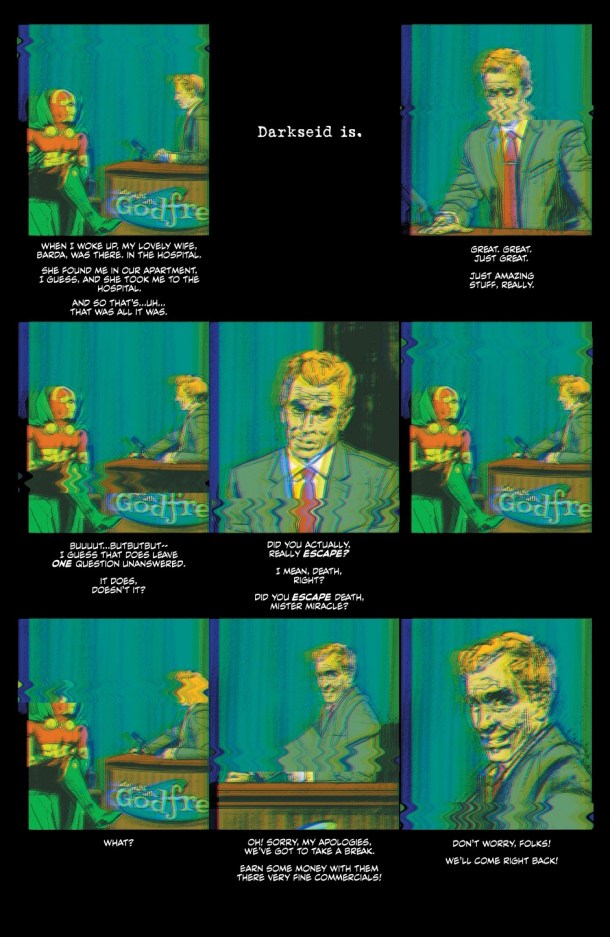
Re D is the law now. Re D is.

Re D is.

Re D is

Re D is

(And if you aren’t reading Tom King and Mitch Gerard’s “Mister Miracle”, can I urge you to do that in the strongest possible terms? It is a mark of how great they currently are that the only work to compare to it this year is the same creative team’s run on Batman. )

The Court of Appeal stress that if a Local Authority are relying on parental consent to authorise a restrictive regime in foster care, they can’t simply rely on generic section 20 consent to authorise this.

149.Finally (paras 126-128), Keehan J rejected the local authority’s contention that the parents’ consent to D being accommodated pursuant to section 20 of the Children Act 1989 was a valid consent to D’s confinement at the residential unit. He disagreed with Mostyn J’s analysis in Re RK (Minor: Deprivation of Liberty) [2010] COPLR Con Vol 1047. Furthermore, he said (para 128):

“the “consent” is to the child being accommodated. It cannot be inferred that that consent means that those with parental responsibility have consented to whatever placement the local authority considers, from time to time, appropriate.”
150.I agree with Keehan J that the mere fact that a child is being accommodated by a local authority pursuant to section 20 does not, of itself, constitute a parental consent for Nielsen purposes to the particular confinement in question. In the first place it needs to be borne in mind that parental consent is not, in law, an essential pre-requisite to a local authority’s use of section 20: see Williams and another v Hackney London Borough Council [2017] EWCA Civ 26, [2017] 3 WLR 59. Moreover, even where there is such consent, there remains the powerful point made by Keehan J: to what precisely have the parents consented? That is a matter of fact to be decided in light of all the circumstances of the particular case. Here, as we have seen, Keehan J, found (see paragraph 9 above) that his parents had agreed to D’s being placed at Placement B just as he had earlier found (paragraph 107 above) that they had previously agreed to his being placed at Hospital B. I can see no basis for challenging either of those findings of fact.

(I’m not at all sure now of the status of Keehan J’s previous assertion that whilst parents can consent to restriction of liberty in foster care under s20, they can’t do so under ICOs because the threshold has been found to be crossed. That wasn’t in the case that was appealed, and it has always seemed to me a rather arbitrary distinction. I can’t see that the Court of Appeal look at this, but it is a long judgment, I may have missed it.)

Re D is.

Someone had blundered


I’ve written many times about how unusual it is for a Court to revoke an adoption order. If memory serves, I have only found four examples before – one last year where the adopters physically abused the child who returned to birth mother and who felt very strongly about wanting the order revoked, one where a step-parent adoption was made where the mother had not told the birth father that she was terminally ill and if he had known that he would not have consented and I can’t remember the details of the other two – they were both from the 1970s.


This is the fifth one.  Which also, bizarrely, became the sixth one as well. This child may well, in due course, have the unusual and unique history of being adopted twice by the same people.


RE J (A Minor: Revocation of Adoption) 2017

http://www.bailii.org/ew/cases/EWHC/Fam/2017/2704.html

And it is just frankly, a mistake.

It seems that there was a hearing before a Circuit Judge. The mother attended, wanting to oppose the adoption. There was no social worker present, and it appeared that the Judge became muddled as to what application she was dealing with.


  1. The appropriate course might have been to impress on the mother the complexity of her application and her need to seek legal advice and/or representation. In any event, given the emphasis on ‘due process’ which operates, by definition, reciprocally between the parties, the mother ought to have been required to file evidence and directions given accordingly. From this, would have stemmed further directions for a statement in response by the Local Authority, appointment of a CAFCASS guardian and an inter partes re-listed hearing.


  1. It is abundantly clear, I regret to say, that the Judge became confused as to what application she was hearing and what procedure she was following. The Judge adjourned to consider her decision, handing down a written judgment on 3 October 2017. Very properly the Judge addressed the criteria in Section 47(5), concluding that the mother had failed to demonstrate sufficient change to justify ‘reopening the issue of the plan for [J]’. She observed that J was happily placed with devoted carers and that his placement ‘has offered a boost to his positive development’ and that ‘with every week that passes he is progressing well’. The Judge went on to note that the mother’s own assertion that she had stopped drinking alcohol (one of the causes of her parenting deficits) for a period of three months was insufficient to establish the first element of the test in Section 47. Judge Penna noted ‘there is a substantial risk that I would be setting her up to fail’. The Judge went on to consider the benefits of J’s placement in the context of the wider discretionary exercise and concluded that J’s mother had ‘not shown sufficient change for me to grant her leave to oppose the adoption’.
  2. Had the Judge stopped there all might have been well but, inexplicably she proceeded to grant an adoption order to the applicants, at this first directions hearing. She manifestly had insufficient material before her to make the Order which is perhaps the most draconian in the Family law canon. This was a complete aberration and plainly flawed. The Judgment was handed down on the 9 October 2017, circulated both to the parties and to the Registrar General, in order to make an entry in the Adopted Children Register in the form specified by regulations. It must be stated unambiguously that the Order provided that ‘the child is adopted by [K] and [N], the applicants.’ Finally, the Court directed that the entry in the Register of Live Births be marked with the word Adopted. As I understand it, J’s carers now believe him to be their adopted son.


When the Local Authority legal department received the order, they immediately realised that something had gone wrong. They contacted the Judge, who realised her mistake, but compounded the error by revoking the Adoption Order (which she did not have power to do. She perhaps had not realised that she was exceeding her power and also that this was only the fifth time that an adoption order had been revoked)


  1. A number of basic principles need reiteration. Once a child is adopted this entirely severs all legal ties with the birth family and introduces a new legal parental relationship with the adopter’s family. The Court does not make an adoption order unless it is satisfied both that nothing else will do and, for the particular child, nothing else is better. It follows, that the Court will be similarly cautious when contemplating a revocation of an adoption order which is intended to be final and lifelong. Such revocations were described by Pauffley J in PK the Mr & Mrs K [2015] EWHC 2316 (Fam) as ‘highly exceptional and very particular’. Their ‘exceptional’ nature has been repeatedly emphasised see Re. B (Adoption: Jurisdiction to set aside) [1995] Fam 239, Re. Webster v Norfolk County Council and the Children (by their children’s guardian) [2009] EWCA Civ 59, Re. W (Inherent Jurisdiction: Permission Application: Revocation and Adoption Order) [2013] 2 FLR 1609. I draw the inference that Judge Penna revoked the Order in recognition of her error on the basis of the facts and chronology that I have outlined. They permit of no other interpretation. The Judge did not set out her reasoning in any additional judgment.
  2. More problematically, the process of revocation requires the High Court to invoke its inherent jurisdiction. This signals both the rarity of the Order and, inevitably, its unavailability to Judge Penna sitting in the County Court. As it transpired, before the Order was drafted, or sealed, the matter came to the attention of HHJ Newton, the Designated Family Judge. Judge Newton informed me of the situation and transferred the case to me on 23 October 2017. Judge Newton’s prompt action was doubtless driven by her recognition of the real potential for distress to both the birth parents and the adopters in consequence of what has occurred. An equally swift response is therefore required from me. I have not requested the attendance of the parties and have been able properly to deal with this case administratively,
  3. It strikes me that there are two equally legitimate alternatives here, either to refer the matter to the Court of Appeal or to address it myself in this Court. The latter course has the obvious attraction of avoiding delay. Primarily however, I have come to the conclusion that as Judge Penna’s purported Revocation Order was outside her powers, thus plainly void and as it was intercepted before being drawn or sealed, consideration of revocation may properly be addressed in the High Court. On the facts of this case, probably uniquely, I am also satisfied that the Court can and indeed should consider revoking the Order of its own motion.
  4. For the reasons which are set out above, I consider the circumstances in which this adoption order was made are ‘highly exceptional and very particular’ to use Pauffley J’s elegant and succinct phase. Whilst the Law Reports do not reveal this situation as having occurred before, there are some similarities with Re. K (Adoption & Wardship) [1997] 2 FLR 221. There the Court of Appeal indicated that where an adoption procedure had been fatally flawed, an application to revoke should be made to the High Court. Here there was, in short, a complete absence of due process and a wholesale abandonment of correct procedure and guidance. That is a clear basis upon which to consider whether the Order should be revoked.
  5. I am profoundly conscious of the impact of my decision on both the birth parents and the prospective adopters both of whom will be distressed and unsettled by this uncertainty. I would however, emphasise one important and, in my judgment, inalienable right, namely, that of J to know in the future that the process by which he may have been permanently separated from his family was characterised by fairness, detailed scrutiny and integrity.


So, this was not the finest hour of the family Court.  But by way of scant consolation, I will tell you all about an Australian Court, where the Court was deciding whether a fall from a horse constituted a “motor accident”  (the horse was startled by a car horn and bolted).  The judgment in the case was 138 pages long, which seems long, but perhaps it was warranted. What was NOT warranted, was the Judge reading the whole thing aloud to the parties, a process which took 17 HOURS.

FOUR FULL DAYS of listening to a judgment.


And the Judge in question, to keep the suspense going, didn’t hint at the result until part way through day three.

I appreciate that I am a sad legal geek, and there are many judgments that I really enjoy reading. But even I would baulk at sitting and listening to someone read out a judgment over 17 hours.

If Mr Justice Peter Jackson was delivering a judgment on conjoined twins, one of whom was a Jehovah’s Witness and one who was Plymouth Brethern and there were allegations of Fabricated or Induced Illness, AND the Judge had managed to deliver the judgment via séance with Richard Burton reading it out loud on his behalf (with occasional bursts of Peter Sellers doing voices of any witness who was quoted verbatim), I’d still have had enough after a day. Four days would be excessive even for that.

Judge Criticized for Reading 138-Page Opinion From the Bench


And oh, by the way, the Judge in that case was overturned on appeal, so a complete waste of four days.


https://www.caselaw.nsw.gov.au/decision/58ec7f40e4b0e71e17f58abe


It is also of concern, as Payne JA has pointed out, that the primary judge made, at best, minor reference in his reasons to the framework within which the legal questions posed for consideration fell


If you’ve made me sit and listen for four full days, I don’t expect the legal framework to have only been given MINOR REFERENCE….


For his own amusement

“It was a bright cold April day and the clocks were striking thirteen”

“Hale knew, before he had been in Brighton three hours, that they meant to murder him”
“All this happened, more or less”
“It was a queer, sultry summer, the summer they electrocuted the Rosenbergs and I didn’t know what I was doing in New York”

Those are great opening lines (1984, Brighton Rock, Slaughterhouse Five and The Bell Jar, respectively)

This is one of the best opening lines in a judgment I’ve ever seen.

“First of all, my decisions. I find proven the following facts, and I am taking them in chronological order, as regards the BB gun incident, I find as a fact that F deliberately shot W with the BB gun for his own amusement”

Tell me you’re not hooked.

The words were crafted by His Honour Deputy Circuit Judge Brasse (This is my first time with one of his judgments, and he has sky-rocketed to very high up on my list of Judges that are always worth reading)

Kent County Council v A,B,C and D (Children : Weight to be attached to evidence of child after flawed ABE interviews) (Rev 1) [2017] EWFC B72 (01 March 2017)

http://www.bailii.org/ew/cases/EWFC/OJ/2017/B72.html

The case involves a lot of findings about sexual abuse, which I’m not going to put into the blog. I don’t have a strong enough stomach for them. And I’m conscious that this blog comes into people’s email in boxes, often early in the morning. So I have spared you all the grim stuff. It’s very grim.

For those who don’t know, a BB gun is commonly known in England as an air rifle. It uses compressed air to fire small pellets. Those pellets can, if the range is wrong, pierce the skin or cause fractures. No normal human being would shoot one at a child.

179. A in her statement says that F was playing with an airgun at their home when he shot W with a pellet in the stomach. On 28 September a teaching assistant, noticed when she was changing for swimming that W had suffered a bruise to her hip. When asked how it happened she stated that she was clumsy and did not know. W then showed the teaching assistant another mark on her lower back. Then she stated that F had shot her there with a BB gun pellet. This was reported to H, the deputy head teacher, on 29 September 2015. She spoke to W, and W recounted that F had been in his bedroom, he had got the BB gun and shot her in the back last week. They were standing next to the bed and he had told her to put on her Mum’s jacket and then had shot her. She did not want to say that it hurt as she gets into trouble for being “mouthy”. H asked her if she had told her mother and W said that she had, and her mother told her that she should not have let F do it.

180. H liaised with 1B from the Social Services Department. At a joint visit by a social worker and DC Mitchell, both spoke to her. She said she got on well with F and did not want to get him into trouble. She said they had been playing a game. She told Detective Constable Mitchell that F had asked her to go into the bathroom and told her to put on her mother’s jacket and then had shot her. The police report made by Detective Constable Mitchell states that W became upset when she recounted this incident. She said that the injury had hurt at the time but she had not wanted to say anything as she “is always getting into trouble for being mouthy”. Later she told her mother, who became cross with her, telling her that she should not have allowed F to do this to her. W said that at the time of the incident the Mother was not present.

181. She gave a more detailed account. She said: “We were playing. I was standing in Mum’s and F’s bedroom playing the shooting game. It’s a BB gun with little white bullets. He was having fun with me. It hit the bottom left of my back and made me cry.” She said that he, F, had “belly flopped” her to try to make her feel better, but it did not work. She said that later that day, playing the same game, he had shot X, but he had protected his leg with a towel. X was hurt on the arm.

182. When the Mother was spoken to, she confirmed that there were BB guns in the house, kept in her bedroom where the children were not allowed to enter. They were not locked away and kept loaded (highly careless with young children around). She recalled an incident when she had heard W cry. She stated that she had not been aware that F had shot W. She seemed to think that Y, then only three years old, had been responsible. She denied that W had ever mentioned to her that F had shot her. She said that F suffered from schizophrenia, which is not true, and Asperger’s Syndrome, which is possibly true, but was brilliant with the children. The Mother reported that the air guns had been removed from the home to F’s parents’ address. In her recent statement A said that when she was questioned at the time she panicked as she did not want to lose the children. She lied and denied that F caused the injury and alleged instead that X had done it. She may have meant Y; that is who she is recorded to have blamed.

183. F was questioned by the police and social workers. He denied using the BB gun in the house or hurting W.

If possible, it is even more distasteful that father sought to deflect blame for this appalling behaviour onto an innocent three year old child.

274. My findings of fact are as follows. Number 3, as regards the BB gun incident, I find as a fact that F deliberately shot W with the gun for his own amusement. Although, as I find, he told her to wear her mother’s jacket to soften the impact of the bullet, it was a grossly irresponsible act which could have caused very serious harm. I find that both the Mother and F punished W for reporting it by angrily scolding her and sending her to stay with Q. It demonstrated the Mother’s inability to protect the child from harm and a willingness to prioritise the interests of her relationship with F above the safety of the child. This was in itself a traumatic experience and did lasting harm by making W very reluctant to confide in professionals assigned to safeguard and promote her welfare, and hence made her more vulnerable to further abuse.

Almost every factual issue in the case was disputed and fell to be decided by the Judge, who provides a master-class in how to deal with disputes in a wide variety of areas. Too many to be completely covered by this blog, so I’m going to pick out a few.

38. The court should take into account the inherent probability or improbability of the relevant alleged incidents. The court, in addition, must not, however, guess or speculate or draw inferences from what are still only suspicions rather than proven facts. Mr Johnson forcefully made the point that in this case there were a number of unproven allegations against his client and this was not the French Revolution where people are found guilty of suspected offences. Mr Johnson’s point is that past allegations are only relevant if proven. He is right. If established, they may well provide evidence of propensity. The Court may, however, arrive at reasonable conclusions based on proven facts.

45. The child’s statements, whilst they must be taken seriously, must not be assumed to be true. The use of the word “disclosure” should not be used in relation to them; they remain allegations until and unless they are proven.

46. There is statutory guidance in Achieving Best Evidence in Criminal Proceedings (March 2011 Edition) which should be followed when conducting the initial questioning of a child to see if there is a matter to be made the subject of recorded interview, and then on how to conduct the recorded interview itself. The guidance lays emphasis on the need for planning; the recording of all decisions to follow, or not to follow specific guidance, or any other matter which materially affects the interview; and on the manner of interviewing a child witness. In this regard the guidance requires the interviewers to explain to the child the ground rules of the interview; to establish whether the child knows the difference between truth and lies; and to allow the child to provide free flowing narrative at their own pace and in their own language, aided rather than directed by the contents and manner of the questioning. Thus, leading questions should be generally avoided; questions should be kept short, taking one fact at a time; and allow the child time to answer.

47. In general, interviews should be conducted as soon as possible after the initial allegation. There should rarely be more than one interview. The responses of the child should not be led or pressured from him. Questions should be simple, factual, and interviews should be kept as short as possible in keeping with the age and concentration span of the child.

48. Mr. Justice Macdonald in AS v TH and BC and NC and SH [2016] EWHC 532 (Fam) stressed the importance of compliance. At paragraph 52, in reviewing the effect of the relevant authorities, he said that “where there has…been a failure to follow the interviewing guidelines, the court is not compelled to disregard altogether the evidence obtained in interview, but may rely on it together with other independent material to form a conclusion. However, where the court finds that no evidential weight can be attached to the interview the court may only come to a conclusion that relies on the content of the interviews where it has comprehensively reviewed all the other evidence”. This I have endeavoured to do in this case.

49. In Re E (A Child) 2016 EWCA, what emerges from judgement of Lord Justice McFarlane at paragraph 98 is that where there have been numerous and substantial deviations from good practice by police in carrying out the ABE exercise, these need to addressed and analysed to assess their effect on the reliability of the evidence obtained. I have found that guidance of particular help in this case.

50. The evidence of X regarding sexual abuse and W regarding the air gun incident is hearsay, which is admissible in children proceedings pursuant to the Children (Admissibility of Hearsay Evidence) Order 1993. But great caution is needed as the evidence cannot be tested by cross-examination. What weight can be placed upon it should be assessed by having regard to the factors set out in section 4 of the Civil Evidence Act 1995, which applies to family proceedings. Section 114 (2) of the Criminal Justice Act 2003 applies only to criminal proceedings, but is also apposite to any fact finding exercise based on hearsay evidence.

51. I remind myself of section 1 of the Civil Evidence Act 1995. The Act begins with a caution, because it made a radical inroad into the rule that hearsay was inadmissible. Section 4 then gives useful guidance to the court on how to estimate the weight to be given to hearsay evidence. Weight is a legal concept. It means the importance that a tribunal of fact places on a piece of relevant evidence. There is no need to weigh irrelevant evidence. A single piece of evidence can outweigh other evidence. Section 4 sets out that ‘the court shall have regard to any circumstances from which any inference can reasonably be drawn as to the reliability or otherwise of the evidence’. Subsection (2) sets out a list and I have each of those factors very much in mind when I weigh evidence of those witnesses who did not give evidence in court. I have directed myself that the factors within section 4 do not comprise an exclusive list, and section 114 (2) of the Criminal Justice Act 2003 lists other factors not included in section 4 of the Civil Evidence Act 1995. I have incorporated those factors when considering the evidence in this judgment too.

On the issue of allegations that the mother continued a relationship with father after learning that he was accused of horrendous sexual abuse of her children, the allegations were in part from identifications and sightings of them together and in part from social media (remember, even following the recent blog post about monitoring of social media that the evidence is admissible even where it is alleged to have been unlawfully obtained – I don’t see any allegation in this case that it was, so let us not make any assumptions either way)


Facebook entries

91. Both Mother and F have Facebook accounts. If a person posts a message or photograph on Facebook his friends, people who have agreed to share their Facebook with him and communicate with him by Facebook, can indicate the degree of their approbation on his Facebook account page by a thumbs-up sign which means that they like it, or a heart sign if they love it. Facebook pages can be closed to prying eyes of the outside world by privacy settings, but F’s is left open so that the social worker has been able to visit his page and see who has approved his postings. F said that he “unfriended” A after his bail conditions were imposed on 12 February 2016, and she says she blocked him from her Facebook account around that time, but nonetheless she reappeared as his Facebook friend thereafter and proactively sent approbating signs to his postings.

92. What the undisputed evidence has established is that A thus remained his Facebook friend until at least December 2016 and approved his postings (which included on 16 February 2016 photographs of Y and Z taken on 2 February 2016), once in June 2016, three times in August 2016 and on 20 November 2016. As I shall later explain, from September 2016 onwards she accepted what X had alleged against F was true. On 20 October 2016 she shared with F on his Facebook page a photo of X taken on 20 October 2016, and this was the anniversary of the photo, well after she had accepted the truth of X’s allegations. Furthermore, it was done just five days before the start of this hearing and a month after the Mother had signed a statement saying that she now believed that F had sexually abused her son.

93. A gave various explanations. Before anyone became aware of the approbations in relation to the “like” sign sent by her on 20 November 2016, she said that she did not realise that she had approved F’s postings. Then, when the earlier postings were discovered by the social worker sitting in court using her own smartphone and were shown to the Mother, she agreed that she was aware that she was sending her approval postings to put up on F’s page. When asked why, after she knew what he had done to her children, she was prepared to send a thumbs up and on one occasion a heart to his Facebook page showing that she liked or loved his postings, she said: “It’s not a crime to like someone’s postings.”

94. F says that he was the passive recipient of these communications from the Mother. He did not check his account to see who sent him communications. She was proactive but he was not, and there is no evidence that he ever replied to the Mother. But in my judgment a reasonable parent who believed her child had been sexually abused by another would not approve anything the perpetrator posted on Facebook. She would not wish to communicate with him or even his Facebook page at all, for any reason. It implies either that she did not really believe he was the perpetrator or did not care. It also makes it more likely that she was in touch with F in other ways as well, as Facebook communications must often be one facet of a more rounded relationship.

On the alleged sightings of the parents together, the Judge gives an immaculate summing up of the relevant law

96. This is a disputed identification case. The court must direct itself in accordance with the Court of Appeal’s guidance in R v Turnbull [1997] QB 224. In this case an important issue turns substantially on the correctness of one or more identifications of F being with the Mother, which they allege to be mistaken. In such a case it is imperative that the judge should warn himself of the special need for caution before making a decision on the basis of the correctness of the identifications. Additionally, the judge should remind himself as to the reason for the need for such a warning, namely that a convincing and honest witness can be a mistaken witness. Secondly, the judge should direct himself to examine closely the circumstances in which the identification by each witness was made, and some of these circumstances may include, for example: for how long was the accused under observation by the witness; at what distance was the witness from the accused; what length of time elapsed between the original observation and the subsequent identification to the police or Social Services? The judge should also remind himself of any specific weaknesses which have appeared in the identification evidence.

97. As for recognition, it is commonly accepted that recognition is more reliable than identification of a stranger. However, even when the witness appears to recognise someone who he knows, the judge should remind himself that mistakes in recognition of close relatives and friends are sometimes made.

98. The quality of the evidence. If the quality is good and remains good at the close of the case having heard all the evidence, the danger of a mistaken identification is lessened, but the poorer the quality the greater the danger. When ,in the judgment of the trial judge ,the quality of the identification evidence is poor, the judge should not rely on the identification evidence unless there is other evidence which goes to support the correctness of the identification. The trial judge needs to identify to himself the evidence which he believes is capable of supporting the evidence of identification.

As we can see from the title of the piece, flaws in the ABE process were a particularly striking feature of the case (I’m snipping out the graphic details about the nature of the alleged – and now proven – abuse.

Admitted breach of ABE guidelines

229. On that day Detective Constable Carter and Detective Constable Farmer interviewed X, the former asking the questions. DC Farmer agreed that they had been instructed by a superior to get on with the interview, leaving them no time to plan it properly. She admitted that they had failed to observe the ABE guidelines in four important respects; she made no excuse and could offer no explanation. One possible explanation that emerges from the interview itself is that X was so willing, ready and able to give his account, in their eagerness to hear it they forgot these fundamentals.

230. Planning: although the importance of planning the interview is stressed in paragraph 2.1 of the guidance, none was done and there was no record of a plan, as required by paragraph 2.222. Intermediary: no consideration was given to the need or otherwise of one, as required by paragraph 2.94. At the outset of the interview the guidance provides for the establishing of a rapport with a child by talking about mutual topics and importantly explaining ground rules. As the guidance says at paragraph 3.12, the interview is an alien situation. What will happen will need explanation. This was done, albeit very briefly. As the interview proceeded it became apparent that X had picked up the ground rules without questioning – video recording, et cetera – which showed that he was an intelligent child.

231. The evidential effect of failure to address the difference between truth and lies

232. The officers failed altogether to establish whether X knew the difference between truth and lies. It was admitted that this failure went to the heart of the reliability of the ABE interview. The stage at which the witness is asked to distinguish truth and lies is an important safeguard and guarantee of reliability, but it is not the only one. The video recording itself gives the court a chance to examine the child’s statements in detail. The quality and pace of the questioning is a very important feature of the interview. In this case it was good. The surrounding evidence gives the court a chance to check the facts. It is clear from extraneous evidence, for instance regarding the BB gun incident and a subsequent interview on 26 February 2016, that he, X, did understand the difference between lies and truth because he admitted to telling a lie. Ultimately the court’s assessment of the substance of his account is the most important test of whether this is a made up or truthful account. It is important to have these failures in mind, however, when evaluating the weight to be given to X’s statements and I have kept them in mind as I have done so.

233. In this interview X seemed relaxed and happy to talk to the officers. It was a relatively short interview, fifteen minutes or so, and there was no sign that X ever tired or flagged. He was asked to give his name and age, he was told that the purpose of the interview was to have a little chat with him. He was reminded of two cameras on the wall and knew that they showed him and April Farmer. He was told of the microphone, it would be recorded on DVD. He seemed to understand all of this. He was told that 1A was a social worker. He agreed he knew her role was to keep him safe. He went through the members of his family and the living arrangements in the home and in the bed and breakfast. I am fully satisfied that X very quickly grasped the purpose of the interview. He plainly understood that it was being recorded. He was familiar with the technology of DVDs. He knew what he was going to be asked about, as became very quickly apparent.

234. I am fully satisfied he knew the difference between truth and lies, as was demonstrated over and over again before, during and after this interview, as I have commented in the course of this judgment. So I conclude that although the truth and lies routine, important as it is, was not gone through, its lack of itself did not substantially impair the quality of the evidence obtained in the interview.

235. The initial questions about his family and home were concordant with the ABE guidance in that they helped put him at ease. What is notable is that it was X who hastened the interview to reach its point: an investigation of his allegations

(details omitted)

242. I comment: (1) the ground rules were established. In my view they often take too long. Detective Constable Farmer agreed with that point of view. (2) The truth and lies routine was missed out but, as I have already commented, there is abundant evidence that X knew the difference. (3) It is striking that the allegation made against F by X was volunteered after an unrelated question. (4) The interview was relatively short. (5) X was able to concentrate. The social worker’s assessment at page C84 of the evidence was that: “X was able to follow instructions, concentrate for long periods and show respect.” In my judgment that was borne out by his behaviour in the interview. The questions were generally short questions containing single subjects. (6) As regards a description of the events recounted, they were naturalistic and realistic. (7) It was not implausible that F abused the other children as reported by X, believing that they would not speak out, and X could have seen the adults engaged in sexual intercourse, including fellatio. Reference to F doing it to himself, as I mentioned earlier, must have been reference to masturbation, a part of the sexual routine. (8) As to numbers and times, he was only six years old and unschooled. (9) If he told the Mother – this is very serious – instead of reporting the behaviour of F towards X to the police, as she had promised X she would, she did the opposite and alleged to the police that X had lied. In my judgment this was the supreme betrayal.

Second Interview

243. After the Mother’s claim that X had lied, he was interviewed again on 26 February 2016, this time with Detective Constable Farmer. Once again Miss Farmer admits frankly she forewent the ground rules, the truth and lies routine prescribed by the guidance. During this interview X’s demeanour was altogether different to that of the first interview. He was restless, fidgety, moved around the room, often hid his face behind a folding game board and his answers were often rambling, digressive and incoherent, revealing an internal confusion and anxiety which had not been present at all during the first interview. This was a little boy who was manifestly uneasy, struggling with the shame of confessing that he had told terrible lies about F, or alternatively lying against his will or better nature that his original account had been untrue.

244. The interview began with the day of the week, his name, age and identifying the names and roles of the adults present, the location of the police station and the functionalities of the interview room and the camera. They quickly got to the point. Question: “Do you remember the last time?” Answer: “Yeah.” Question: “You spoke to Marie,” that is Detective Constable Cutter, “can you remember what you said to her? Who did you talk about to her?” Answer: “It’s not true.” I comment that it came out so quickly it was clear that he knew that that was what he was there to say, but whether or not that was true is the issue. Question: “What do you mean?” Answer: “It’s not true because I saw it on TV.” This is a striking answer; it suggested extreme pornography seen on TV in the bed and breakfast hotel. This was also a suggestion made by F in his interview about how X could have come by the knowledge of such sexual behaviour, but this suggestion has, as I have already observed, been retracted by Mother.

245. X could not remember the day he saw it but said he was in bed at the time. He slept next to the TV. Asked to describe what he saw, he said he saw some rudeness. Question: “Who was on the TV.” Answer: “It looked like my Dad but it was on the TV.” He wanted the interviewer to believe that what he had seen was only a TV show. He was then asked to describe what he saw on the TV and his account became increasingly implausible as an explanation for having said that [details omitted]. Question: “Was anyone else on the TV?” Answer: “A lady danced with him. They wore swimming costumes. The man wore a marry costume,” clothes in which you get married. He was unable to explain what he meant by his earlier assertion there was rudeness. Asked where was his mother, he said nowhere, and then in the shower, and his Dad was cooking and W was in bed. So he was describing in fact an innocent TV show about marriage or swimming when he, W, Z, Y and F were going about routine activities. He was unable to describe the rudeness at all. This sounded like a mere embellishment to give some force to his original assertion that the lie he had told about F was something he had learned from seeing a TV show. He described Dad cooking a “burger meal” for dinner. Then he said he saw Dad flipping pancakes.

246. He was brought back to the point. Question: “So you said you had seen something on TV, what you told us about. Was that true?” Answer: “That always be true.” Question: “What you said about F.” X did not respond, he seemed to be squirming. Question: “So when you said you saw something on TV, why do you say that?” Answer: “I get confused.” He was then asked when he previously spoke to Marie Cutter and told her what had happened with F, was that the truth? Answer – at this point X was hiding his face behind the board and needed to be asked to lower it for the camera. He said: “Yeah.” He was asked if anyone had spoken to him about it. He said: “My Mum didn’t – told me to, I told her.” He was asked: “What do you mean?” He said: “The truth.” He was asked who told him to tell the truth and he said no-one. He was reminded that he had just said that “your Mum didn’t tell you. What did you say? Your Mum.” Answer: “Didn’t tell me to tell the truth. I telled (sic) her.” He was asked: “What is the truth?” and he said: “It’s the truth of what we are doing right now.” He said that he had talked to his Mum about telling the truth, and she had said: “If you want to do it then everyone said back me up, they are.” He elaborated: “They’re going actually give me money.” “Who?” Answer: “Mum.” “What for?” Answer: “For telling the truth.”

248. I comment that X’s comment of why he had lied is so implausible as to be unbelievable. It had all the hallmarks of imperfect coaching, where he had remembered to insist that he had previously lied but could not explain why he had lied at all or how he had got the detail and graphic information which he had used in the earlier lie. He sounded as though he was telling the truth when he said several times, in explanation for his confusing account, that he was confused. He certainly sounded and looked confused. His account of talking to his mother and insisting that he told her he had lied sounded scripted. X, when he was determined to tell the officers that he had lied and he had confessed to lying to his mother, tried to take control of the interview, volunteering the information, but he was utterly confused when he tried to substantiate this retraction. There were moments when he provided plausible explanations for his retraction: his mother had spoken to him; she had promised him that everyone would back him up; and she had offered a bribe of money. Most significantly, when asked if he had indeed told the truth during the first interview, he said: “Yeah.”

249. This interview was an unconvincing retraction of the very clearly stated accusation made during the first interview. It being entirely unconvincing, it tends to support the truth of the account given by X in his first ABE interview, which he found far easier to relate. As in the first interview, X was not asked whether he knew the difference between lies and truth. The importance of this is to give him a chance to demonstrate this knowledge. But he had demonstrated this knowledge on other occasions: (1) the BB gun incident, he had originally claimed to have shot W, then confessed that F had done it; (2) the subject of the difference between truth and lies had been given prominence by his mother in the days after the first interview; (3) in the second interview the subject matter was about truth and lies, and he showed he knew the difference; (4) H, who knew him very well, and 1A had both found him to be a truthful child.

After a detailed and thorough analysis of the evidence and the disputes, and making a number of very serious findings against the father the Judge concluded this:-

291. I shall direct there be a transcript of this judgment and it should be sent to the Kent Constabulary. I recommend that the CPS consider the question of charging F under section 5 of the Sexual Offences Act 2003, the rape of a child under the age of thirteen, with rape of X and his siblings. The ABE interviews of X taken together were the most compelling evidence of his guilt. The second interview, the so called retraction, strengthened rather than weakened the effect of the first. The Mother’s evidence of the pressure she put on X to retract is important explanatory evidence. The contents of F’s own interview under caution further supports the reliability of X’s evidence. Under the recently introduced system of ground rules hearings, intermediaries and pre-recorded cross-examination of the child, a prosecution would be viable and in the public interest.

292. Additionally, I recommend that the Kent Constabulary consider applying for a Sexual Risk Order under section 122A-K of the Sexual Offences Act 2003 as amended by the Anti-Social Behaviour, Crime and Policing Act 2014 Schedule 5 paragraph 4, as it is necessary to protect vulnerable women and their children from physical and psychological harm from F. The prohibition runs for not less than two years and in my judgment it is likely to be required for much longer. That is the judgment of the court.

Forty tons of Toblerone

Relocation cases bore me, so I would have skipped over this one. But it was Justice Peter Jackson, who is generally worth reading. And it has an unusual wrinkle. Stick with it.

The argument in the case was whether a 15 year old and 13 year old should go and live with their father in Switzerland, or stay with mother in England. The parties clearly have money – whether they have more money than sense is a matter for readers to draw their own conclusions about.

S v S (Relocation) 2017

http://www.bailii.org/ew/cases/EWHC/Fam/2017/2345.html


35.I record that the legal costs globally in this case are outrageously high. The estimates that I have been given concern only these proceedings relating to the boys. They do not concern the other costs that the parties are responsible for in relation to the divorce and any financial aspects. The father estimates his costs of this application at £493,000. He has also paid or taken responsibility for costs of £174,000 in relation to the children’s costs, so taken together with the mother’s costs, the total comes to some £938,000 of which the father is already responsible for two thirds of a million.

2.What does have to be remembered is that the court can only work with the material with which it is provided. Often, as here, it is not possible to produce a truly good outcome but only to choose the one which is least bad. In a case of this kind, where a family has every conceivable material advantage, it is easy to forget the old truth that money cannot buy you happiness. It certainly has not done for this family. Instead, the pursuit and accumulation of wealth that has created conditions that have left everyone spoilt for choice and thoroughly miserable. The fact that the family has spent just shy of £1 million on these proceedings, proceedings of no particular complexity that only began in April, is fairly typical. This is not empty moralising. If the parents and children cannot return to a more considerate, a more normal way of behaving, the future is bleak whatever the court may decide. In saying this, I am not only speaking to the parents but also to the three children who are old enough in their own ways to do their bit to repair the damage that has been caused.

That led me to do a google search for ‘costs to hire a private jet’ by way of comparison, which if nothing else, should get me more glamorous pop up ads. You can hire a private jet to take you to Nice for £10,000. So let’s say Switzerland is about the same. The father could have flown the children to Switzerland by private jet every weekend (and back) 32 times for what he’s paid lawyers to argue about the case. As the youngest child has 250 weekends left of his childhood, that does leave a bit of a shortfall, but (whisper it) there are cheaper methods of transporting children to Switzerland.

You can buy a 4.5kg bar of Toblerone for £75. So dad could have bought 8893 huge bars of Toblerone. THAT’S FORTY TONS of Toblerone, people.

(If anyone wants to pay me for my legal advice in Toblerone, I am willing to negotiate. I would give a discount for Terry’s Chocolate Orange…)

Anyway, the real purpose of the blog post is the bit that sneaks into that paragraph on costs

He has also paid or taken responsibility for costs of £174,000 in relation to the children’s costs

The children, if they are of sufficient age and understanding, are entitled to seek their own legal advice, and they can, if they make an application be represented in the proceedings. The solicitors have to get paid, and there would be no legal aid for children in private law proceedings who instruct their own solicitor (i.e there’s not a court-appointed Guardian) so someone has to pay it.

The Judge is not critical of the solicitors involved (who are very experienced and expert in these international cases) but it is an unusual circumstance for one party to litigation funding the children’s own lawyers. More so when you learn that the mother says that she didn’t know that the children were having consultations with their own lawyers and did not know that they were going off to meet with them. Nobody has done anything WRONG here, but it being an issue that I’ve not encountered before, it does throw up some interesting questions.

It feels a bit weird that one parent pays the legal costs of the child. That feels a bit conflict-y, no matter how much effort everyone puts in to ensure that there is no conflict between independence of the advice and the person who is paying for that advice. It feels a bit Sussex Justices – there may be nothing wrong whatsoever happening, but if you were on the other side of that equation, would you feel that this is entirely fair?

28.I now add a coda concerning the impact of the legal representation of these children upon their welfare. The sequence of events concerning the children’s lawyers is this; in February 2016 the father’s Russian lawyer, prompted by his English solicitor, contacted Ms Hutchinson who happened to be in Russia at the time. In March 2016, on her return Ms Hutchinson met the boys in a café close to their school, unknown to the mother. Dawson Cornwell’s fees were paid by the father and nothing happened until a year later. In March and April 2017 when the father’s first application was issued, the boys communicated a number of times with Ms Hutchinson and her colleague, Ms Fleetwood, by social media. In April Ms Fleetwood met D at the school without the mother’s knowledge. She wrote to the mother’s solicitors subsequently that D had made her aware of the relocation application that the father had now issued; in fact Dawson Cornwell had learned about this from the father’s solicitors a fortnight earlier.

29.In May 2017, the boys came to court and later that month they were joined as parties by Pauffley J. In June 2017, the boys met their solicitors at Dawson Cornwell’s offices twice with the knowledge of the parents, and in July 2017 they met the solicitors and counsel locally to their home with the knowledge of both parents.

30.The mother understandably complains that, entirely without her knowledge and at a time when she was having difficulty parenting the children, the father was funding a legal team for the boys, now to the tune of £174,000. She says that this just added to the other ways in which the father was undermining her authority.

31. At my request, Mr Vine QC has addressed the duties of solicitors in these circumstances in a short position statement. That reads as follows:

“In so far as there is further clarification on the obligations of a child’s solicitor in this difficult area:

(1) The Solicitor’s Regulatory Authority (SRA) Code of Conduct secures the obligations to act with integrity (Mandatory Principle 2), not to allow the solicitor’s independence to be compromised (Mandatory Principle 3), and to protect the client’s interests (Mandatory Principle 4 and Chapter 1.1);

(2) The Solicitor’s Regulatory Authority (SRA) Code of Conduct further requires the solicitor to keep the client’s affairs confidential unless disclosure is required or permitted by law or the client consents (Chapter 4.1);

(3) The SRA Practice Note Acting in the absence of a children’s guardian suggests the solicitor is mindful of a guardian’s PD16A duties;

(4) As a matter of general principle, parental right yields to the child’s right to make his own decisions when he reaches a sufficient understanding and intelligence to be capable of making up his own mind on the matter requiring decision, Gillick v West Norfolk and Wisbech Area Health Authority [1986] AC 11, Lord Scarman at 186;

(5) On familiar principles, a child has an Article 8 right to respect for their privacy in the setting of client/professional information;

(6) Again on familiar principles, a child has a right to confidentiality in the same setting;

(7) The entire area of a child’s Article 12 UNCRC right to participation in proceedings concerning them is one that continues to evolve, Re W (A Child) [2016] EWCA Civ 1051, Black LJ §26 and Re F (Children) [2016] EWCA Civ 546, Sir James Munby P §41.

There would appear to be no direct guidance on the obligations in question, and the answer must be that the obligations will depend upon the nature of the information presented and the instructions given to the solicitor by the child, and their judgment as to their child client’s best interests. Information relating to child protection or the safety of others will generate a more obvious response than information relating to a private dispute.

The child’s solicitor is in a delicate position, calling for sensitivity to the competing interests of the child and parent.”

32.I agree with all of that and I particularly wish to record that the lawyers acting for these two children are among the leading experts in representing children, particularly in international cases. However, I am left with a sense of unease. I am not sure that Mr Vine’s analysis, correct as far as it goes, is the whole picture. There is a tension between the right of children to receive legal advice and the need for parents to know what is happening in children’s lives so that they can look after them properly. For the lawyers to be having secret meetings with children in cafés and at school without the knowledge of their primary carer inevitably leaves a sour taste. How, for example, is the school to react? Is it right that one parent should know what is happening and pay for it while the other is left in the dark? These are also child welfare issues that need further thought but, having identified them, I say no more about it on this occasion.

The boys are actually moving to Switzerland as a result of the case, so in so far as spending two thirds of a million pounds on lawyers could ever be said to be money well spent, perhaps this was. Come to think of it, where would you even KEEP forty tons of Toblerone?

Magical sparkle powers – a sparkle too far?

Regular readers will know that when I read the phrase “The Court’s powers under the inherent jurisdiction are theoretically limitless” it makes me bristle, and hence my coining the name “magical sparkle powers” for the use of these, to remind ourselves that the Court is effectively inventing powers for itself out of thin air.

As is established law, Princess Kenny MAY use her magical sparkle powers to get the Black Friday Bundaroo

The problem I have with it is not that the Court have used the inherent jurisdiction as a way to solve a particularly thorny legal problem on an individual case, it is that this then gets used as an authority for “well, we could do THAT with our magical sparkle powers, so THIS is only a further stride along that path” and then THIS gets used as authority for taking another stride to THE OTHER. It is the stepping stone issue.

So a while back, the President ruled that the inherent jurisdiction could be extended to protect vulnerable adults, and then someone else ruled that his decision was authority for protecting adults with vulnerabilities, and then someone else ruled that THAT decision was authority for protecting adults who didn’t seem to have any vulnerabilities but whom the Court wanted to protect

And then we end up with this
http://www.bailii.org/ew/cases/EWFC/HCJ/2017/65.html

Mahzar v Lord Chancellor 2017

Mr Mazar is a 26 year old man with muscular dystrophy. He has no mental health problems and he has capacity. Part of his physical illness is that he needs apparatus to breath through, and this apparatus needs to be suctioned four to five times every hour. Without this, he could be at risk of serious injury or death. Mr Mazar wanted to be in his own home for this procedure rather than be detained in hospital – he says that his family members have had training in the procedure. That may be contentious – I don’t know whether th

I don’t know the ins and outs of why Mr Mazar came to that conclusion, but we don’t NEED to know. If he is an adult, with capacity to make his own decisions and does not have a mental health disorder, he is entitled to say that he does not want to be admitted to hospital. That’s his right. He is entitled to say that even if all of the medical opinion is that this is dangerous and stupid. Even if it might lead to his death.

What actually happened was that the Trust applied to the High Court for permission under the inherent jurisdiction to not only treat him against his will, but for police officers to enter his home and remove him by force if necessary to take him to hospital.

2. The order complained of is as follows:

“(I) It is lawful for the police and any medical professionals, as are required, to enter [address] (the property) and use reasonable and proportionate force to do so.

(2) It is lawful for the police and any medical professionals, as are required, to remove Mr Aamir Mazhar from the property and to convey him to an ambulance.

(3) It is lawful for the ambulance service, together with any other medical professionals and police as are required, to convey Mr Aamir Mazhar to the Queen Elizabeth Hospital, Birmingham.

(4) It is lawful until further order for Mr Aamir Mazhar to be deprived of his liberty at the Queen Elizabeth Hospital, Birmingham for the purposes of receiving care and treatment from his arrival on 22 April 2016 and then to be conveyed to the specialist respiratory centre at Guy’s Hospital, London until suitable care can be put in place for him at home, or to be transferred to an alternative specialist respiratory unit.

(5) The matter shall be listed for urgent hearing on the first available date after 25 April 2016 (upon application to the Clerk Rules (sic)).

(6) There be leave to serve this order without a Court seal until 16:00 on Monday 25th April 2016.”

It was an out of hours application, without any notice to Mr Mazhar or his family and they were therefore not present or represented at the hearing.

The pleaded consequence of the order made by Mostyn J is the forcible and what is described as the highly distressing removal of Mr Mazhar from his family home at 3 am on Saturday 23 April 2016 by two police officers and the ambulance service. Mr Mazhar was and is a young man who has the capacity to make decisions for himself. It is submitted on his behalf that there was no basis in law for the order to be made or for the actions taken in accordance with it.

7. Mr Mazhar seeks to argue that the inherent jurisdiction cannot be used to detain a person who is not of unsound mind for the purposes of article 5(1)(e) of the Convention and that a vulnerable person’s alleged incapacity as a result of duress or undue influence is not a basis to make orders in that jurisdiction that are other than facilitative of the person recovering, retaining or exercising his capacity. His removal and detention were accordingly unlawful and in breach of article 5. He also seeks to argue that his article 6 rights were engaged such that the absence of any challenge by the judge to his capacity and/or the evidence of the NHS Trust and the absence of any opportunity to challenge those matters himself or though his family or representatives before the order was executed was an unfair process. He says that his article 8 right to respect for family and private life was engaged and that the order was neither necessary nor in accordance with the law.

Mr Mazhar sought damages against the Trust, who settled out of Court. He also made a Human Rights Act claim against the Lord Chancellor for breach of article 5 (that he was unlawfully deprived of his liberty), article 8 (that his right to private and family life was breached) and article 6 (that such a fundamental decision was taken without any challenge to the application being made.

The Lord Chancellor concedes that Mr Mazhar was deprived of his liberty when he was removed from his home and taken to hospital and accepts that he was not a person of unsound mind within the meaning of article 5(1)(e) at the date of the order. He does not however accept that the broader proposition that the inherent jurisdiction is limited in the way suggested on behalf of Mr Mazhar and in particular that it can only be used to facilitate the re-establishment of autonomy. He argues that its use to detain and remove a person who has mental capacity to make decisions about his care (but who is a vulnerable adult) to a safe place such as a hospital is a well recognised jurisdiction which acts as a safety net to protect persons who fall outside the scope of the Mental Capacity Act 2005. He contends that use of the jurisdiction to detain is neither arbitrary nor unlawful because there are procedural safeguards ie it is a procedure prescribed by law, governed by Rules of Court, Practice Directions and Guidance. It is clearly established by case law which is sufficiently accessible and foreseeable with advice and the jurisdiction’s flexibility is reasoned and justified so that, for example, where detention is permitted there are rigorous safeguards that include regular review.

9. The Lord Chancellor does not accept that there were procedural failings such that the detention was unlawful within the meaning of article 5 of the Convention or unfair at common law. He avers that in any event the threshold of ‘gross and obvious irregularity’ is not met. The procedural protections for anyone deprived of their liberty are the lex specialis of article 5(4) and provide equivalent protection to article 6 which the Lord Chancellor submits is not engaged. Any breach of article 8, which is not admitted, is justified by being in accordance with the law, necessary and proportionate.

So who is right?

It is a really important point. As the High Court repeatedly says – the powers under the inherent jurisdiction are theoretically limitless – so on the face of it Mostyn J had the power to make that order, even though Mr Mazhar was of sound mind and had capacity to make his own decision.

Is that really right?

If the law is going to authorise police officers to come into your home and remove you by force and take you to hospital and detain you there while you have treatment that you have not consented to, that seems to me rather a big deal – particularly as there’s no clarity at all about what hurdles the Trust ought to have to meet to establish that – if Mr Mazhar lacked capacity there would be a statutory framework as to what the Court would need to consider and a mechanism for challenge.

So I was reading this case with great interest to see what was decided about whether or not the inherent jurisdiction really does give Mostyn J or other Judges the power to make such a dramatic order – without Mr Mazhar even being told about it in advance and having the opportunity to have his say.

The order was made on a specific evidential basis which was recorded in the recitals to the order. It is important to acknowledge that this prima facie evidential basis was the evidence, at that stage unchallenged because the application was made without notice, which the judge had available to him and which he decided was sufficient to lead to the order that he made. It is part of Mr Mazhar’s claim against the Lord Chancellor that the judge should not have accepted the evidence without an opportunity being given at that stage for challenge and, in any event, that it was insufficient in law to justify the order made. It is also important to acknowledge that some of the evidence provided to the judge was wrong and may have been untruthful. The difference between the recorded prima facie evidence and the agreed facts is stark. The claim against the NHS Trust which deals with those issues has been settled and it is not for this court to give judgment on the failings of the NHS Trust. Some of those failings are however apparent in the differences revealed between the recitals and the agreed facts. The implications are very worrying indeed.

Sadly, the Court doesn’t answer that at all. Instead we get reams of paragraphs about why the challenge to the order of the High Court can’t be by HRA claim or claim for vicarious liability on the part of the Lord Chancellor, and judicial immunity, and this is all absolutely right, but still very frustrating.

43. Lord Denning MR described the principle of judicial immunity in Sirros v Moore [1975] QB 118 at 132D:

“Ever since the year 1613, if not before, it has been accepted in our law that no action is maintainable against a judge for anything said or done by him in the excess of a jurisdiction which belongs to him. The words which he speaks are protected by an absolute privilege. The orders which he gives, and the sentences which he imposes, cannot be made the subject of civil proceedings against him. No matter that the judge was under some gross error or ignorance, or was actuated by envy, hatred or malice, and all uncharitableness, he is not liable to an action. The remedy of the party aggrieved is to appeal to the Court of Appeal or to apply for habeas corpus or a writ of error or certiorari, or take some such step to reverse his ruling. Of course, if the judge has accepted bribes or been in the least degree corrupt, or has perverted the course of justice, he can be punished in the criminal courts. That apart, however, a judge is not liable to an action in damages. The reason is not because the judge has any privilege to make mistakes or do wrong. It is so that he should be able to do his duty with complete independence and free from fear. It was well state by Lord Tenterden CJ in Garnett v Ferrand (1867) 6 B&C 611 625:

“This freedom from action or question at the suit of an individual is given by the law to the judges, not so much for their own sake as for the sake of the public, and for the advancement of justice, that being free from actions, they may be free in thought and independent in judgment, as all who are to administer justice ought to be”

All of this is particularly frustrating, because the Lord Chancellor had in June submitted a position statement to the effect that judicial immunity was not going to be relied upon as a defence, and then rescinded that and relied on it successfully

If Mr Mazhar wants to find out whether Mostyn J really did have the power to make that order under the inherent jurisdiction, his mechanism is an appeal of the order, not a HRA claim.

Conclusion:

78. The consequence is that I have come to the conclusion that there is nothing in the HRA (taken together with either the CPR or the FPR) that provides a power in a court or tribunal to make a declaration against the Crown in respect of a judicial act. Furthermore, the HRA has not modified the constitutional principle of judicial immunity. Likewise, the Crown is not to be held to vicariously liable for the acts of the judiciary with the consequence that the claim for a declaration is not justiciable in the Courts of England and Wales. A claim for damages against the Crown is available to Mr Mazhar for the limited purpose of compensating him for an article 5(5) breach but the forum for such a claim where the judicial act is that of a judge of the High Court cannot be a court of co-ordinate jurisdiction. On the facts of this case, the only court that can consider a damages claim is the Court of Appeal.

79. If Mr Mazhar wants to pursue his challenge to the order of Mostyn J he must do so on appeal

Annoyingly, Mr Mazhar gave evidence at the hearing, when the case turned completely on legal argument rather than his evidence, so it was unfortunate that he was put through the experience of giving evidence when the judicial immunity point was the real heart of the case.

I hope that he does want to find out and that an appeal will be brought.

That’s not to say that I think Mostyn J got this spectacularly wrong or was off on a frolic of his own – this sort of application and this sort of order is a natural extension of where the legal authorities on inherent jurisdiction are eventually going to take us. I’d be very keen to find out if the Court of Appeal think that there IS a line in the sand that needs to be drawn on inherent jurisdiction and where that line might be.

I don’t think that the law SHOULD have allowed Mr Mazhar to have police officers enter his home and remove him by force and detain him in hospital for treatment that he had a right to refuse. But I think that the law MAY say that this is within the Court’s jurisdiction and powers. I hope that even then, the Court of Appeal may have something to say about the safeguards that ought to be put in place about how such wide-ranging and sweeping powers need to be managed to respect a person’s article 5, 6 and 8 rights.

If police came to my door, forced entry and removed me from my home to hospital for treatment that I’d said I didn’t want, just because doctors thought my decision was stupid and went before a Judge on their own without putting my side of the story, I wouldn’t be satisfied to be told that the Court’s magical sparkle powers make all of this okay. It isn’t okay.

Nods and becks and wreathed smiles

In this case, the President of the Family Division deals with the thirty-fifth case where a fertility clinic had failed to complete the paperwork properly, meaning that people who thought they were a child’s legal parents were not, and had to go to Court at considerable stress and expense to put this right.

Re P, Q, R, S,T and U 2017
http://www.bailii.org/ew/cases/EWHC/Fam/2017/2532.html

(This episode of Sesame Street is brought to you today by far too many letters)

The clinic in question sent letters out to the people who had conceived a child with flawed paperwork, following the realisation and reporting of the first such case Re A 2015

12.No-one before me seeks to justify, either in terms of their tone or in relation to their legal content, the letters sent out by Dr X on 15 March 2016. I also have concerns about the form of letter sent out on 28 April 2016. My concerns relate to (i) the focus on “clarifying” the parent’s “intention” and (ii) the indication that a statement “clarify[ing] what your intention was … may not give you legal certainty or resolve any potential problems with legal parenthood” (emphasis added). The point is very simple. Although “intention” is a necessary it is not a sufficient condition for acquiring parenthood. For, as I very recently observed, in Re the Human Fertilisation and Embryology Act 2008 (Case AK) [2017] EWHC 1154 (Fam), para 20, it is the presence or absence of consent in writing – and, I should emphasise, such a consent given before the relevant treatment – which is ultimately determinative:

“As In re A demonstrates, the ultimate question is whether X has, within the meaning of sections 44(1)(a) and 44(2) of the 2008 Act, “given … a notice [in writing .. signed by [X]] stating that [X] consents to [X] being treated as the parent of any child resulting from treatment provided to [Y].”

Moreover, the word “may” was, it seems to me, insufficient in circumstances which surely demanded plain words rather than “Nods, and becks, and wreathed smiles.”

You do have to admire a Judge who, whilst admonishing someone for not using plain words, throws in a bit of Milton poetry containing the word “becks” which is not in wide circulation other than when referring to German lager. A beck, in this context is a gesture designed to attract attention (as if you were trying to catch the eye of a waiter) and is where we get the expression “At his beck and call”

The line before “Nods, and becks, and wreathed smiles” in the poem is “Quips and cranks, and wanton wiles” which I am going to claim as an accurate description of my site. If only I were launching it today, I’d have that as the tag-line.

“Cranks” in the Milton poem, means ‘clever or fanciful speech, whims, caprice’ and not what you thought I meant.

Oh, also “wreathed smiles” just means to have a big smile on your face – I had originally taken this to be a sinister or thin-lipped smile because of the negative connotation that wreath has now, but I guess it is more in the laurel wreath or Christmas wreath sense rather than a funeral wreath.

I am beginning to think that Milton is not the best source for plain speaking that everyone can readily understand…

As ever, I am ashamed that I did not have a proper classical education. If I had, then I too would scatter allusions to Homer and Milton around as though this was commonplace on the Clapham omnibus. The only Milton I was exposed to in my school days was on the last day of term when we were allowed to bring in Ker-Plunk by Milton Bradley Games. [Tin-Can Alley was the best thing for someone to bring in, because there was a rifle that shot light at toy tin cans, making them jump into the air. Awesome-sauce. I only really know Milton now from the ‘better to serve in Heaven than to reign in Hell’ line and that only from Neil Gaiman’s Sandman)

Anyway, what emerged in the case was a practice of patients being asked to sign declarations kept by the clinic that they MEANT to be joint parents, and thus avoiding the need to go to Court AND more importantly that the HFEA was wrongly passing on to clinics this suggestion.

The President was rightly not in the slightest bit keen on that, and stressed that this practice emerged AFTER Re A, which clearly demonstrated that Court orders were required to fix the mess caused by these clinics.

13.My real concern is that there appears to be an impression in some quarters that the kind of problems which have characterised all the many cases which I have had to deal with – Re the Human Fertilisation and Embryology Act 2008 (Case AK) was the thirty-fifth such case in which I have given judgment – can sometimes be resolved appropriately without obtaining an order of the court. This, in my judgment, is a highly problematic, indeed dangerous, view. I need briefly to explain why.

14.I venture to repeat at this point what I said in in In re A and others (Legal Parenthood: Written Consents) [2015] EWHC 2602 (Fam), [2016] 1 WLR 1325, para 3:

“The question of who, in law, is or are the parent(s) of a child born as a result of treatment carried out under this legislation … is, as a moment’s reflection will make obvious, a question of the most fundamental gravity and importance. What, after all, to any child, to any parent, never mind to future generations and indeed to society at large, can be more important, emotionally, psychologically, socially and legally, than the answer to the question: Who is my parent? Is this my child?”
15.Legally the issue has the potential to arise – possibly, I emphasise, years or even decades in the future – in a variety of contexts. Family lawyers will of course be alert to the risk of future breakdown in the parental relationship, perhaps triggering private law proceedings under the Children Act 1989 in which the precise legal status of a parent may be challenged. But we need also to be aware that the existence or otherwise of the legal relationship of parent and child may become relevant in the future in relation to such matters as citizenship and nationality or – and possibly decades in the future when both parents are dead and therefore unable to give evidence – in relation to matters of succession and inheritance.

16.In what is now a long line of cases involving applications for parental orders in accordance with section 54 of the 2008 Act, Theis J has emphasised the importance of the need for such orders. There is, of course, a significant difference between the two types of case, because whereas a parental order has, as has been said, a “transformative” effect, and creates legal rights, the declaration granted in the present type of case is, as the word suggests, merely declaratory of existing legal rights. But that does not mean that there is no advantage to be gained by obtaining such a declaration. Far from it: a declaration of status granted by the High Court after appropriately stringent investigations, and after, as is invariably done, notice of the proceedings has been given both to the Attorney General and to the Secretary of State, has an effect in law and reality which far transcends any purely private transaction or agreement between the parents. To adopt, mutatis mutandis, some words used by Theis J in J v G [2013] EWHC 1432 (Fam), para 28, quoting from the parental order reporter in that case:

“A parental order allows the reality for [the children] to be formalised now and bestows a sense of finality and completeness. It closes the door on official challenges to the intended parents’ authority and paves the way for the future without … further anxiety.”

Similarly, a declaration puts matters on a secure legal footing. It affords both child and parent lifelong security. It puts beyond future dispute, whether by public bodies or private individuals, the child’s legal relationship with the parent as being, indeed, his legal parent.
17.There is one final matter to which I need to draw attention. The witness statement filed on behalf of the HFEA by Nick Jones, its Director of Compliance and Information, included the following:

“Ms Walsh [she was the Senior Inspector who, with colleagues, undertook the inspection of the clinic in March 2016] has set out in her statement the facts and circumstances surrounding Care Manchester’s ill-advised decision to try resolving the parenthood issues by getting patients to sign a declaration. As Ms Walsh has said, we were not aware that the clinic intended doing this until after they had already sent out a number of those declarations to patients. Whilst we were not aware of Care Manchester’s intentions to use this declaration, following the judgment in the Alphabet case [In re A] we had been informed by a number of clinics that on legal advice, they were asking a small number of patients to complete declarations.

These clinics told us that some patients had, having been fully informed of the potential consequences and impact of the consent failings, said that they did not wish to go through any legal process in order to become the legal parents of their own children. Understandably, some patients were affronted at the suggestion that they were not legally the parents of their children. In such cases, a small number of clinics informed us that on legal advice, they had asked these patients to complete a declaration. These clinics and a legal advisor acting for several clinics, told us that the purpose of this declaration was to record the intentions of the couple at the time of their treatment, that is, a way of confirming that at the time that the couple had treatment, and notwithstanding any anomalies in their consent forms, they had intended to have treatment together and for both to be the legal parents of the children born from such treatment.

Clinics told us that this was a measure their legal advice suggested they put in place in order that in the future, should these couples separate, for example, and have to grapple with issues around the custody and care of their children, the clinics would have these signed declarations which could be relied on at that time, albeit with uncertainty as to the status of such a declaration. Whilst I expressed some concern about such an approach, and felt unease, I was assured the clinics did so on the basis of legal advice, and then only in those cases where patients had said that they did not wish to go through a court process in order to become the legal parents of their children. Having advised clinics to take their own legal advice, and now having done so, I felt we were not in a position to question that advice. Similarly, not having any method of communicating with this group of patients directly and also taking it on trust and good faith that the legal advice was sound and that clinics were acting in the interests of their patients, we felt we could not question the clinic’s approach and the decision these patients had taken to sign declarations.”
18.For reasons which by now will be apparent, Mr Jones was, as it seems to me, well justified in having those concerns and feeling that unease. But I am bound to say that it seems, and not merely with the priceless benefit of hindsight, unfortunate that the HFEA was not more questioning of what it understood was the advice being given at a time, I emphasise, after I had given judgment in In re A. I appreciate that the HFEA was not privy to the detail of any of that advice, but in the light of its understanding, as explained by Mr Jones, of what advice was being given, it might be thought that alarm bells should have been ringing and that the HFEA should have been more questioning, both privately and more publicly, as to the appropriateness and wisdom of the advice it understood was being given. I do not suggest that the HFEA should necessarily have commissioned legal advice itself on the point, but might it not have been better if it had circulated guidance to clinics, setting out what it understood to be happening, stressing that it was for individual clinics to obtain such legal advice as they might think appropriate, but saying that it did have concerns about the appropriateness of the advice which it understood certain clinics had received and perhaps briefly explaining why.

Checking Facebook – social workers and social media

I happened to read the Community Care piece on social workers and social media this week. I think it is a good piece, it is here

Why and how social workers should use social media

But I mentioned on Twitter that this paragraph troubled me

3. But debates continue about the impact of social media on the confidentiality of service users, and how information shared publicly on social media should be used by social workers, says Birchall. “If a social worker visited a home and saw a dangerous person who should not be present in the family home, they would be wrong not to act on this, but if they looked at a service user’s profile on social media and found out the same information there’s a sense that this breaches the service user’s confidentiality, even though the information is public. There are strong feelings on both sides of the argument. It’s a new world and we’re just getting to grips [with it].”

I mentioned that this is in contravention of the published guidance about members of the State looking at the social media of members of the public (even where the social media is on public settings and open to anyone to view)

Not in any sense a criticism of the author, or Community Care – the guidance has obviously gone under the radar, but it is important

It seems that many people didn’t know about this guidance from the Office of Surveillance Commissioners

http://www.publiclawtoday.co.uk/local-government/information-law/344-information-law/31202-public-authorities-and-surveillance

Extract from OSC Procedures & Guidance document

Covert surveillance of Social Networking Sites (SNS)

288. The fact that digital investigation is routine or easy to conduct does not reduce the need for authorisation. Care must be taken to understand how the SNS being used works. Authorising Officers must not be tempted to assume that one service provider is the same as another or that the services provided by a single provider are the same.

288.1 Whilst it is the responsibility of an individual to set privacy settings to protect unsolicited access to private information, and even though data may be deemed published and no longer under the control of the author, it is unwise to regard it as ―open source, or publicly available; the author has a reasonable expectation of privacy if access controls are applied. In some cases data may be deemed private communication still in transmission (instant messages for example). Where privacy settings are available but not applied the data may be considered open source and an authorisation is not usually required. Repeat viewing of ―open source sites may constitute directed surveillance on a case by case basis and this should be borne in mind.

288.2 Providing there is no warrant authorising interception in accordance with section 48(4) of the 2000 Act, if it is necessary and proportionate for a public authority to breach covertly access controls, the minimum requirement is an authorisation for directed surveillance. An authorisation for the use and conduct of a CHIS is necessary if a relationship is established or maintained by a member of a public authority or by a person acting on its behalf (i.e. the activity is more than mere reading of the site‘s content).

288.3 It is not unlawful for a member of a public authority to set up a false identity but it is inadvisable for a member of a public authority to do so for a covert purpose without an authorisation for directed surveillance when private information is likely to be obtained. The SRO should be satisfied that there is a process in place to ensure compliance with the legislation. Using photographs of other persons without their permission to support the false identity infringes other laws.

288.4 A member of a public authority should not adopt the identity of a person known, or likely to be known, to the subject of interest or users of the site without authorisation, and without the consent of the person whose identity is used, and without considering the protection of that person. The consent must be explicit (i.e. the person from whom consent is sought must agree (preferably in writing) what is and is not to be done).

So this is guidance to members of the State (such as social workers) as to when they can view social media without consent of the author or going to obtain Regulation of Investigatory Power Act (RIPA) authorisation in the form of a warrant from a Magistrate. (which they are highly unlikely to get)

If a parent has privacy settings, then the ONLY way to view it is with the person’s explicit consent OR a warrant under RIPA from a Magistrate. Anything else is an offence.

The guidance is VERY plain that using dummy or fake accounts to gain access to another person’s social media presence is ‘inadvisable’

The tricky bit is here

Where privacy settings are available but not applied the data may be considered open source and an authorisation is not usually required. Repeat viewing of ―open source sites may constitute directed surveillance on a case by case basis and this should be borne in mind.

(It’s not clear about where privacy settings are NOT available, but as Facebook, Twitter, Instagram and all dating websites have privacy settings, I don’t think this is going to come up very often. Maybe if the parent is posting a lot on Reddit…. )

What this says is that even where a person has no privacy settings on their social media and it is ‘open source’ – i.e available to anyone to go and look at, “REPEAT viewing of open source sites MAY constitute directed surveillance on a case by case basis” (and if it does, RIPA authorisation would be needed)

Note that

Amendments to the Regulation of Investigatory Powers (Directed Surveillance and Covert Human Intelligence Sources) Order 2010 (“the 2010 Order”) mean that a local authority can now only grant an authorisation under RIPA for the use of directed surveillance where the local authority is investigating particular types of criminal offences. These are criminal offences which attract a maximum custodial sentence of 6 months or more or relate to the underage sale of alcohol or tobacco.

And therefore, if in an individual case, the REPEAT viewing of open source social media by someone working for a local authority DOES count as directed surveillance, it will be unlawful. Because a Local Authority can only do this with authorisation, and the authorisation can only be given for investigating particular types of criminal offences (and the “we were doing it to prevent child abuse/drug misuse won’t cut it. Sale of cigarettes to children in a shop is the sort of thing that is okay for getting a warrant for directed surveillance – that sort of hidden camera thing)

And conducting unauthorised direct surveillance is an offence under RIPA. So serious stuff.

What’s REPEAT viewing?

Well, the guidance doesn’t say REPEATED (which implies multiple occasions) and my best guess is that REPEAT means what it says on the tin, more than once.

Any social worker that accesses a parents social media presence (even if they are available to the public) more than once, is at risk of committing the criminal offence under RIPA and having their actions potentially actionable in damages. Local Authorities are obliged to follow the guidance, they can’t just choose to ignore it.

During the Twitter discussion, some people felt that if a parent chooses to publish the material for the public (and doesn’t make use of the privacy settings) then they have effectively waived their privacy. They have, in so far as members of the public are concerned. Any member of the public can go and look at their social media presence.

But an agent of the State can’t do make REPEAT viewings of it, even if the accounts are open to the public. (and no, you can’t just take off your social work hat and put on your member of the public hat)

I look at it this way. The street outside your front door is open to the public – just like your social media account on no privacy settings. Anyone can stand in that street. If they stand there, they can see your front door, and if you don’t close your curtains, can see into your house. But if it is a member of the State doing that, they either need your permission or an authorisation to conduct surveillance without your permission.

It’s the same here – just because you’ve left your curtains open doesn’t mean that the social worker can stand outside your house in a public road and look through your window whenever they want.

As we can see from the case below, failure to obtain the evidence legally doesn’t make it inadmissible, and the family Court won’t be the place to punish any offence under RIPA (that will be a criminal court, boys and girls, so think on)

But I would imagine that representations would be made that if a social worker has made repeat viewings of social media, and not taken this guidance into account, that their assessment is tainted by this and their evidence should be viewed with caution. Whether or not Judges accept those representations is a different question.

Watching the detectives

Until there’s more clarity on this, given that it is a criminal offence, the advice must be ONCE without consent is as far as it is safe to go. I would also counsel against anyone immediately thinking “well, as long as I only do it once, there are seven workers in my team, so we can get seven bites at it” . If there’s even a tiny risk that what you are doing may be a criminal offence, don’t mess around with taking that risk.

If you get explicit consent from the parent “I’d like to look at your Facebook profile” “Yes, I agree to that”, then you are good. Otherwise, once is the only safe number.

There’s a tricky grey area where a parent has posted something they shouldn’t have done on social media and have been asked to take it down or something defamatory – how can that now be checked? I think the parent would have to consent. (or directed by the Court to produce evidence to show that the offending remarks have been removed)

Thanks a million


The blog passed its one millionth visitor yesterday. Which for me is pretty mind boggling, considering that when I started it, I didn’t know if anyone would ever see it.  So huge thanks to all the people who have read it, told others, commented or tweeted. All of you have made this happen. Big love for all of you


Andrew


(Not Sue)