Ostriching and adverse inferences

The law in relation to decisions not to engage with assessments and the consequences that may flow from this

I ended up scratching my head about this issue about a month ago – where a parent doesn’t engage with assessments and doesn’t provide samples for drug testing, what can the Court do about it? It seemed a very obvious answer that the Court would be invited to draw adverse inferences from the failure to cooperate, but I couldn’t easily lay my hands on the authority for that proposition. It turned out to be more elusive than I had imagined, so having done the research and written it up, it was rather vexing to receive an email minutes later to say that the parent was now willing to engage rendering all my hard work pointless.

So, waste not want not. At the very least it might save someone else having to do all the legwork.

1. The starting point is that under the Children Act 1989 and civil proceedings generally, the burden of proof in any allegation falls upon the party making it, and the standard of proof is the balance of probability. Thus, in care proceedings, it will be the task of the Applicant to establish that it is more likely than not that the parent’s behaviour, history or failings amount to behaviour that it is not reasonable to expect a parent to provide and that it amounted to either causing the child significant harm or establishes a likelihood of significant harm in the future.

2. In a case where the allegation is, say, mental health instability or substance misuse, it is not a burden on the parent to demonstrate that their mental health is now fine, or that they are no longer using heroin. (This misapprehension works its way quite regularly into language used outside Court – “This mother needs to show me that she’s changed” and so on, but it is not a legal burden on the mother at all.)

3. If the Local Authority satisfy the Court that an assessment under Part 25 is necessary to establish the history and prognosis of mother’s mental health, or the current status of abstinence from or usage of substances in order to make confident predictions about the future, what happens where a parent declines to participate?

4. The Court of Appeal in S (Children) [2006] EWCA Civ 981 http://www.familylawweek.co.uk/site.aspx?i=ed1435 addressed particularly where the limits are in the family Court of compelling parents to produce evidence.

5. 23. I move, therefore, from the clear need for the court to receive the disputed evidence to the manner by which it should do so. I have no doubt that the submission is correctly made on behalf of the father, and today correctly conceded on behalf of the local authority, that the court cannot compel a party, against his will, to procure the evidence of a person not already a witness in proceedings. A party can be permitted to file evidence which he wishes to file; and, in civil proceedings, he can be compelled to file evidence from himself. He cannot, however, be compelled to file evidence to be collected by him from a third party; for he has no power to compel the third party to co-operate in enabling him to comply with the order against him. So, yes, the father is right: he should not have been subject to purported compulsion to file a report by his psychiatrist. The judge seems to have recognised as much when, in judgment, he observed “although it does not seem to me that the father can be forced to, the evidence from [the father’s psychiatrist] can be obtained now.” Notwithstanding his doubts the judge for some reason proceeded in his actual order to direct the father to file a report from the psychiatrist.

6. A parent can be compelled to provide a statement from themselves within care proceedings (there is no “right to silence” as a result of s98(2) and failure to produce a statement as directed could be treated as contempt and breach of an order and punishable by committal Re LR (Children ) 2013 http://www.familylawweek.co.uk/site.aspx?i=ed117035 )

7. There is, however, a right to silence, when the application is for committal, and the parent must be informed by the Judge that he or she does not HAVE to go into the witness box and is entitled to decline the option of giving evidence. The Court of Appeal confirmed in Khawaja v Popat & Anor [2016] EWCA Civ 362 that the Court can draw adverse inferences from the parents decision to exercise that right to silence (this is NOT the case in criminal law, but is the case in civil law)

http://www.bailii.org/ew/cases/EWCA/Civ/2016/362.html

27.As the proceedings led potentially to a criminal penalty, the appellant could not be compelled to give evidence. He could have remained completely silent and could have addressed submissions as to the strength or weakness of the evidence adduced by the respondent. However, he took a half-way course. He provided two affidavits in explanation, but he declined (as was his right) to have that evidence put to the test in cross-examination.

28. It might have been unwise for the judge to say to the appellant so bluntly that “…the reality is that if you don’t go in the witness-box it is likely that I will infer that you won’t go in the witness-box because you know you are lying…”. However, it seems to me that his overall remarks to the appellant, at the end of Mr Roseman’s opening of the case for the respondents, were correctly in accord with the law and practice as reflected in paragraph 81.28.4 of Civil Procedure 2015 Vol. 1 (p.2460) as follows:

“A person accused of contempt, like the defendant in a criminal trial, has the right to remain silent (Comet Products UK Ltd. v Hawkex Plastics Ltd. [1971] 2 QB 67, CA). It is the duty of the court to ensure that the accused person is made aware of that right and also of the risk that adverse inferences may be drawn from his silence (Interplayer Ltd. v Thorogood [2014] EWCA Civ 1511, CA…)…”
29.It is entirely clear from the transcript of the judge’s exchanges with Mr Roseman that he recognised fully the burden of proof that was upon the respondents and the standard of proof required to discharge that burden. The judge pressed Mr Roseman closely upon the evidence adduced in support of the application. I do not accept Mr Hendron’s submission that the judge concluded that the appellant’s silence on its own proved his guilt (contrary to the principles emerging from R v Cowan [1996] 1 Cr App R 1 at 7). The judge was conspicuously aware of the burden resting upon the respondents throughout. In my judgment, it seems clear that the judge recognised that the respondents’ evidence produced a case for the appellant to answer; he found the explanations given in the appellant’s affidavit evidence unsatisfactory and in the absence of oral evidence he drew the inference open to him that the appellant’s explanations were untrue.

30.It seems to me further that the law and practice as briefly stated in Civil Procedure (Loc. Cit. supra), and applied by the judge, is entirely consistent with the jurisprudence of the European Court of Human Rights, as reflected (for example) by the following passage from the judgment in Murray v UK [1996] ECHR 18731/91 at paragraph 47:

“On the one hand, it is self-evident that it is incompatible with the immunities under consideration to base a conviction solely or mainly on the accused’s silence or on a refusal to answer questions or to give evidence himself. On the other hand, the Court deems it equally obvious that these immunities cannot and should not prevent that the accused’s silence, in situations which clearly call for an explanation from him, be taken into account in assessing the persuasiveness of the evidence adduced by the prosecution.”

“Wherever the line between these two extremes is to be drawn, it follows from this understanding of “the right to silence” that the question whether the right is absolute must be answered in the negative.”

“It cannot be said therefore that an accused’s decision to remain silent throughout criminal proceedings should necessarily have no implications when the trial court seeks to evaluate the evidence against him. In particular, as the Government have pointed out, established international standards in this area, while providing for the right to silence and the privilege against self-incrimination, are silent on this point.”

“Whether the drawing of adverse inferences from an accused’s silence infringes Article 6 is a matter to be determined in the light of all the circumstances of the case, having particular regard to the situations where inferences may be drawn, the weight attached to them by the national courts in their assessment of the evidence and the degree of compulsion inherent in the situation.”

8. If a parent has within their possession and control documents or evidence, this can also be ordered to be produced. But the thrust of the passage in Re S 2006 above is that a parent cannot be compelled to participate in a psychiatric assessment if they do not consent. The Court has no power to compel them to do so.

9. However, the Court of Appeal provided a recommendation for such a scenario :-


24. It must be remembered, however, that the request for an order that the father should file a report from the psychiatrist was only the fall-back application made on behalf of the local authority. Their primary application was for an order for the disclosure of the records held by the psychiatrist and the linked records held by the father’s GP. Granted the relevance of the father’s psychiatric condition, that application was in my view unanswerable. In the ordinary case, in which the medical records are held by the doctors, the appropriate direction would have been to grant leave to the local authority to issue what in the Division we still have to call subpoenas duces tecum and ad testificandum, returnable either at the outset of the substantive fact-finding hearing or, surely more conveniently, at a prior review hearing, at which the doctor or doctors can produce the records to the court and answer such questions as will enable the parties both to make sense of them and, more broadly, to collect from them the focussed information about the parent’s likely condition at the time of the event. In this case, however, we are given to understand that the medical records are already in the possession of the father; and so in my view there is no impediment to a straightforward order for his immediate disclosure of them to all other parties. To that order I would attach permission to the local authority and the guardian, if so minded, to show the records to a psychiatrist of their own choosing; and, having studied the records and perhaps having instructed a psychiatrist to educate them about their significance, the local authority and/or the guardian will be free at the next review hearing to ask for leave to issue a subpoena ad testificandum against the father’s psychiatrist. I have to say that, once the court in care proceedings has decided in principle that such information should be obtained and once the parent has had the benefit of legal advice, this cumbersome method of obtaining it is usually circumvented by his agreeing, as a recital to the order, to procure a report from the psychiatrist upon the matters ruled to be relevant. Perhaps, now that this appeal is reaching its end and now that he can be given further and clearer advice, the father will be amenable to that elementary level of co-operation. But we should not count on it. It follows that I propose that the local authority’s cross-appeal and, insofar as it relates to the direction that the father should file a psychiatric report, the father’s appeal should be allowed; and that the orders which I have indicated should be substituted for the direction made by the judge. In all other respects the father’s appeal should in my view be dismissed.

9. The Court does, therefore, have jurisdiction to compel production of the medical records and can, if a party has made an application under Part 25 for an expert, direct that the expert report on a paperwork basis, considering said records. (And the Court of Appeal express hope that given that scenario, a parent would reflect that a report might be more favourable and balanced and nuanced if the expert has the benefit of speaking to them about these issues and thus change their mind about participation)

10.However, such an option is not available with drug or alcohol testing. If the parent is not consenting to the production of samples, alternate methods of collecting the samples cannot be used.

11. The issue therefore is whether the Court is entitled to draw adverse inferences or conclusions (specifically – does the decision by a parent not to consent to providing a sample amount to evidence that the tests if undertaken would demonstrate something unfavourable to the parents case?)

12. The High Court in RE O (CARE PROCEEDINGS: EVIDENCE)
[2003] EWHC 2011 (Fam) considered the issue of adverse inferences where a parent declined to give evidence at all or refused to answer particular questions

13. As a general rule, and clearly every case will depend in its own
particular facts, where a parent declines to answer questions or, as here, give
evidence, the court ought usually to draw the inference that the allegations are
true.

13. A decision not to consent to provide samples for the purpose of alcohol or drug testing is not strictly a parent declining to give evidence, but rather a parent declining to provide additional evidence which might establish things one way or another.

14. It might be analogous to the refusal to submit to DNA testing in paternity cases. The Court in those cases are entitled to draw ‘such inferences, if any, from that fact as appear proper in the circumstances’ (s23(1) Family Law Reform Act 1969) – the Court of Appeal ruled in Re G (Parentage : Blood Sample) 1997 1 FLR 360 that where a putative father refused to submit to blood tests then a forensic inference should be drawn and since the forensic process was advanced by the truth being told in court, those who obstruct that process will have an adverse inference drawn against them.

15. Whilst this is a helpful illustration, as the statute in question specifically provides in s23(1) the Court’s power to draw inferences, and the Children Act 1989 does not, it does not provide a definitive answer.

16. The Supreme Court, dealing with an ancillary relief case, considered the issue more broadly, in Prest v Petrodel 2013 https://www.supremecourt.uk/cases/docs/uksc-2013-0004-judgment.pdf

44. In British Railways Board v Herrington [1972] AC 877, 930-931, Lord Diplock, dealing with the liability of a railway undertaking for injury suffered by trespassers on the line, said:
“The appellants, who are a public corporation, elected to call no witnesses, thus depriving the court of any positive evidence as to whether the condition of the fence and the adjacent terrain had been noticed by any particular servant of theirs or as to what he or any other of their servants either thought or did about it. This is a legitimate tactical move under our adversarial system of litigation. But a defendant who adopts it cannot complain if the court draws from the facts which have been disclosed all reasonable inferences as to what are the facts which the defendant has chosen to withhold. A court may take judicial notice that railway lines are regularly patrolled by linesmen and Bangers. In the absence of evidence to the contrary, it is entitled to infer that one or more of them in the course of several weeks noticed what was plain for all to see. Anyone of common sense would realise the danger that the state of the fence so close to the live rail created for little children coming to the meadow to play. As the appellants elected to call none of the persons who patrolled the line there is nothing to rebut the inference that they did not lack the common sense to realise the danger. A court is accordingly entitled to infer from the inaction of the appellants that one or more of their employees decided to allow the risk to continue of some child crossing the boundary and being injured or killed by the live rail rather than to incur the trivial trouble and expense of repairing the gap in the fence.”

The courts have tended to recoil from some of the fiercer parts of this statement, which appear to convert open-ended speculation into findings of fact. There must be a reasonable basis for some hypothesis in the evidence or the inherent probabilities, before a court can draw useful inferences from a party’s failure to rebut it. For my part I would adopt, with a modification which I shall come to, the more balanced view expressed by Lord Lowry with the support of the rest of the committee in R v Inland Revenue Commissioners, Ex p TC Coombs & Co [1991] 2 AC 283, 300:

In our legal system generally, the silence of one party in face of the other party’s evidence may convert that evidence into proof in relation to matters which are, or are likely to be, within the knowledge of the silent party and about which that party could be expected to give evidence. Thus, depending on the circumstances, a prima facie case may become a strong or even an overwhelming case. But, if the silent party’s failure to give evidence (or to give the necessary evidence) can be credibly explained, even if not entirely justified, the effect of his silence in favour of the other party may be either reduced or nullified.”
Cf. Wisniewski v Central Manchester Health Authority [1998] PIQR 324, 340

17. It is suggested, therefore, that following the guidance in Prest v Petrodel (The ‘modification which I shall come to’ being very specific to ancillary relief cases and we can thus ignore it) , where the Local Authority have provided evidence which provides a reasonable basis for coming to a conclusion about substance misuse or alcohol misuse, a parent who chooses to be silent and not provide evidence by way of scientific testing (unless credibly explained) may have the Court determine that their silence turns a prima facie case into a strong or overwhelming one.

18. A Local Authority could not simply ask for a drug test as a fishing expedition and ask the Court to draw adverse inferences if a parent refuses to give one – they need to establish an evidential basis for suspicion that a test is necessary. (Previous history, allegation by a credible witness, evidence of the parent acting in a way which is consistent with drug misuse or so on)

(Why Ostriching? It’s lawyer slang for when a client is burying their head in the sand and pretending that it will all just go away if they ignore it. Actually, ostriches don’t do this – though they do dig holes in the sand to bury their eggs, and occasionally put their heads in those holes to turn the eggs hence the myth.)

Octavia, looking for Hartley and Topov

And all through my coffee break time

This is trivial. And that’s coming from someone who wrote a whole piece this week just so he could use a play on words about “kayak”. So yes, I know it is trivial. I do have a piece planned on the President’s Blood on our hands case, but that needs time to percolate, so to speak.

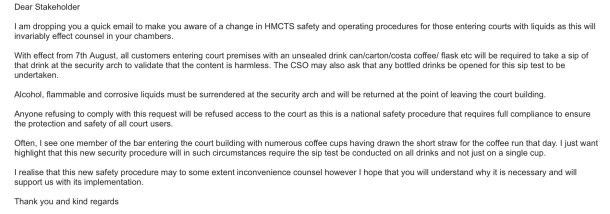
This is about the HMCS new security policy, on a national level, that anyone bringing liquid into Court has to take a sip of it, to demonstrate to security staff that it isn’t acid or some sort of hazardous liquid. That’s been going on for a while with bottled liquid, but it is now being extended.

I’m not sure why the product placement for Costa

(I didn’t write this and I already know that the author has misused ‘effect’)

Obviously, there are times when tempers run high in Courts, and of course sometimes people are attending Court where there’s a history of domestic violence and such, and one would never ever want a cup of acid to be thrown in such circumstances. And of course, one can only imagine the Daily Mail take if such a thing were to happen in a Court building – handwringing and demanding that heads must roll for not having anticipated it.

So I see where it comes from, particularly in light of the recent lurid headlines about acid attacks (and our own Home Secretary having not the slightest clue about what the actual sentencing provisions are for such offences are whilst playing to the “something must be done” gallery)

On the other hand, a minute application of common sense says that the reason why I and my colleagues and opponents don’t go about disguising acid as coffee and throwing it around at Court is NOT for fear of it being confiscated by Security guards (because hitherto we’d have got away with it) but because we’re not maniacs.

As an individual carrying a cup of coffee, the new scheme just causes a mild inconvenience – just taking a sip a little earlier than you anticipated. Not the end of the world.

This, however, does effectively put paid to the practice of coffee runs – where one person kindly goes to fetch coffees for a few other people. (Whilst the author of the email, who is not me, thinks that only counsel ever do this, of course others do it too. Doing a coffee-run, whilst you wait for the hearing to start, or wait for the windbags who went in first to finish, or for facts and reasons, is actually one of the few nice and civilised parts of attending Court. It seems a shame to lose it. )

If you have fetched four coffees and have to take a sip of each to demonstrate their safety, that’s going to rule out people like me who are happy to buy and fetch coffees for others but can’t drink them (because coffee is disgusting), or indeed anyone who prefers to drink their coffee untouched by the lips of others. It also avoids the prospect of someone saying “Does anyone fancy a coffee?” and you saying “ooh, me please” and then changing your mind as you realise that it is Malcolm Halitosis or Tina Moustache offering to fetch them…

(I would also point out that as a way of preventing “Alcohol” being brought in clandestinely, that asking the person bringing it in to sip it contains something of an exploitable loophole. Rather akin to asking the suspected heroin smuggler at an airport to go into a cubicle and do their own cavity searches)

Also, I’m not convinced that cardboard cups are a dream vehicle for transporting corrosive acid.

Cardboard goods are extremely sensitive to contamination. They must in particular be stowed away from colorants, acids, chemicals and fats/oils and be protected from dust and dirt.

How about polystyrene cups?

In the lab,polystyrene is melted and damaged by nearly every solvent.

Click to access MaterialsCompatability.pdf

I’m going to go out on a limb and say that anyone trying to transport corrosive liquid strong enough to injure a person is going to indeed injure a person with it if they try to do so in a coffee cup. That person will be themselves.

Glass bottles, and plastic bottles, possibly. And most Courts have been doing that at security for a long time, and it makes sense. Nobody is really going to object to that.

So if the coffee-cup sip test isn’t going to prevent alcohol (because the person bringing it is the person sipping it, and they will just stay silent) or corrosive liquids (because you’d detect that by the fact that the person’s shoes will be disintegrating) that only really leaves flammable liquids.

I think a sniff test would probably do the job there.

In the meantime, my loophole suggestion :- use a pen to write a message to the recipient under the lid, and assert your article 8 right to respect for private correspondence. (Suesspicious Mind note – this will not actually work, and will almost certainly make you late for Court whilst you argue Human Rights law with security guards, who will do their best to accidentally bang your shins with the metal detector wand and break the zips on your bag/suitcase every time they see you thereafter. So don’t do that)

“Oh my God, he’s got a pumpkin macchiato! Save yourselves! Get to cover” *(Not a coffee drinker, so is that even a thing?)

Benjamin Franklin, what do you want to tell us about whether the minute risk to our safety is worth sacrificing our freedoms?

If anyone wants to tell me in the comments section what the daftest thing they know has been confiscated by Court security, I’d love to hear it. I’ve been told this morning of peanut confiscation in case of nut allergy attack, and bike lights in case… you shine at the Judge??? Has anyone been asked to squirt perfume, or to apply spare lippy to make sure that’s really what it is?

You can’t have your kayak and eat it

(And yes, I did decide to write this one up because I couldn’t resist that joke)

Green v Adams 2017

This was a hearing following Mostyn J’s decision on mother’s application for financial provision for her child under Schedule 1 of the Children Act 1989. Mostyn J had made an order for such provision. The father appealed, unsuccessfully.

Subsequently, the father made an application to Court, aided by Dr Pelling (a name familiar to a lot of family practitioners he has actually had a lot of success as a MacKenzie Friend, including this somewhat pyrrhic victory but victory nonetheless of establishing that an assistant tipstaff assaulted him http://www.bailii.org/ew/cases/EWHC/QB/2004/492.html . I always enjoy a case with Dr Pelling in it – he really knows his way around the more obscure corridors of the law and when I refreshed my mind about the 57 cases that Bailli name-checks him in, he actually succeeds and is complimented for his manner and ability quite a lot of the time, and similarly, Mostyn J enjoys a good legal conundrum, so this had potential to be a fascinating judgment. Sadly, it disappoints, save for the kayak)

The father made an application that the Judge had in effect added things into the ‘pot’ that mother had not explicitly claimed for, that is the costs of a trip to China and the cost of a kayak. And that further, the figures that the Judge had calculated for these were too much, and that the lump sum father was ordered to pay was therefore too much.

http://www.bailii.org/ew/cases/EWFC/HCJ/2017/52.html

These two further points were, first, that the true cost of the trip to China referred to in my judgment of paragraph 1(iii) was £2,300 (which he had established by an email from the school) and, second, that the true cost of a kayak was no more than £500 (which he had established by Internet research). Therefore, he argued that in respect of these two items my assessment had been overstated by £350 and £300 respectively, a total of £650.

16.Accordingly, Dr Pelling argued that my lump sum of £20,600 was overstated by a total of £2,450 (i.e. £1,800 plus £650).

The Judge reminded himself that he did have the power to make awards for more than a person had actually sought.

However, I agree with Dr Pelling that if I was minded to go outside the field of battle as defined by the parties then the father should certainly have been given notice of my intention to do so. In any event, after having examined my memory, and even allowing for the considerable passage of time, I am satisfied that I did not intend to award the mother the full amounts and that I made a minor mistake. It is right that my judgment should be amended to reflect what I intended. Therefore paragraphs 1(ii) and (v) will be corrected to provide that the mother’s claim was for half the sums mentioned, namely £1,500 and £300.

19.However, on 13 July 2017, after the hearing and at a time when this judgment was largely completed, I received an email from Mr Holden which stated that the parties’ son had changed his mind about going on the educational trip to Israel this summer. Therefore, the mother would no longer pursue this head of claim and will repay the sum awarded.

20.The position is very different in relation to the claims concerning the China trip and the kayak. Here, the mother gave her best estimate of the historic costs. It was open to the father to challenge those figures and to adduce competing evidence. He did not do so and now is arguing that the court made its award on a mistaken basis. In my decision of DB v DLJ [2016] EWHC 324 (Fam) at paragraph 57 I stated at (ii) and (iii) that the claimant (that is to say the father in this case) must show that the true facts would have led the court to have made a materially different order from the one it in fact made, and that the absence of the true facts must not have been his fault. In my judgment, a correction in respect of these two items of £650 does not satisfy the criterion of a material difference and in any event I am not satisfied that the true facts could not have been placed before me by the father. I do not allow these corrections.

21.My conclusion is that the mother must repay to the father £3,300 (i.e. the full amount of the Israel trip – £3,000, and half the cost of the computer – £300) against which I offset her award of costs made above of £857, leaving the sum of £2,443 to be repaid.

There was also an application that the judgment should be anonymised, but we can all deduce what the conclusion of that was from the name of the case.

22.I now turn to the father’s application for further anonymisation of the main judgment. He says that the extent of anonymity given by me to the properties in paragraph 14 of my judgment is not enough, and that fictitious numbers and initials should be given. He says that there is a risk of jigsaw identification and a real danger of the people who live at those addresses been targeted by criminals. I am slightly surprised that this submission should be made by the father through Dr Pelling having regard to their trenchant resistance to any form of anonymisation in the proceedings in the Upper Tribunal heard by Mr Justice Charles and reported publicly as Adams v SSWP and Green [2017] UKUT 0009 (AAC). However, I am not satisfied that any further anonymisation is necessary, and this request is rejected.

(Seriously, I really did select this case on the basis of the kayak pun. I’m here all week, try the chicken)

Will you sign my petition ?

Don’t panic, I am not asking you to sign a petition. Although if I was, it would be for someone to make me some artwork of Sweep as a Transformer. Fighting MeGrimlock. And He-Man. That would be epic. Sweep would kick He-Man to bits. Despite not having legs. That’s how rock Sweep is.

Snap back to reality, oh there goes gravity….

This one covers something that comes up from time to time. Can a parent put a petition about their case online (notably on Change.org) and what can they / can’t they say in it?

Mr Justice MacDonald explains it all

“Ferguson!” (google it, or ask someone older)

Southend Borough Council v CO 2017

http://www.bailii.org/ew/cases/EWHC/Fam/2017/1949.html

10.The mother’s petition on the Change.org website is entitled “Please help stop the adoption of my 2 beautiful children”. It is directed to the United Kingdom Parliament and to the Prime Minister. In its original form, the explanatory narrative for the petition set out details of the final hearing before the District Judge, details of the orders granted by the court, the names, ages and disabilities of the children. The explanatory narrative also alleged that the social worker “lied under oath” and that the case was heard “without evidence” of emotional harm or neglect. Whilst, as I have already noted, there is no indication in the papers before me that the decision of the District Judge has been the subject of an appeal, but that certain information provided by the mother since the hearing suggests an appeal is at least contemplated, the explanatory narrative on the petition states that the mother is “applying to appeal to a higher court” to “put evidence before a judge to prove the social worker has lied under oath”. In its original form, the petition also exhibited a photograph of N and T, T being dressed in her school uniform.

If you’re not familiar with Change.org, it is one of those government initiatives like the Cones Hotline, aimed at empowering the public. In effect, anyone can set up a petition online at Change.org asking for others to sign it. If you get enough signatures (100,000 I believe), Parliament will debate your question.

(My prior experience with Change.org, other than it hosting petitions on behalf of parents who have lost their children in Court hearings, was Dave Gorman’s piece on it. http://voxpoliticalonline.com/2014/10/09/dave-gorman-on-government-e-petitions-hilarious-and-perceptive/ )

The Council issued Court proceedings, and the parents agreed at an interim stage to take down the portions of the petitions that would identify the children (their names, surnames, the photographs) but wanted the petition itself to stay up.

The Council considered that the petition, given that the signatories were all members of the extended family, still identified the family and hence the children, and sought removal of it in its entireity. Some of the responders also used the children’s names in comments when adding their signatures.

It is very clear that a parent can’t name the children or put photographs of them on the petition (and if for some reason you doubted that before, MacDonald J makes it very plain in this judgment) but the more difficult area is whether the petition is legitimate once those readily identifying features have been removed.

Here’s what the petition looked like at the start of the final hearing on this issue

11.Following the consent order of 25 May 2017, it took a little time for the parents to comply fully with the terms of that order. On 30 May 2017, the children’s names had been removed from the main page of the petition but the photographs of N and T remained visible and the other details were unaltered. On 8 June 2017, the photographs of N and T had been replaced with a photograph of all four children with their faces partially obscured. Ms Duxbury has confirmed that the parents have now complied fully with the consent order of 25 May 2017 with respect to the pictures, names and ages of the children that had been published on the main page of the petition on the Change.org website. As I have noted, friends and acquaintances of the parents have, on a limited number of occasions, identified the children by their forenames when responding to the petition and those posts remain. The current front page of the Change.org petition, which names the mother, reads as follows:

“In May 2017 family court granted, a full care order and placement order on all 4 of my beautiful children, despite me having solid evidence and this case was heard without evidence of emotional harm, neglect so I am applying to appeal to higher court so I can put evidence before a judge to prove to them i have never neglected my children , nor would i ever put them at risk of any sort of harm (i love my children with all my heart ❤ my focus on life is them) Having my children is my greatest achievement, they are my saviour they switched my focus from the outside to the inside. My children are gifts, they remind me of what's important. please help by signing this petition to reunite my family.<3"

That’s made me all nostalgic for 1337, I haven’t seen a “less than three” for ages and ages. I thought emojis had seen off 1337-speak. Aw, readers, I less than three all of you.

(And she managed to get a heart emoji in, so the less than three at the end is deliberate. Perhaps this mother is an uber haxxor who is keen to bring leet-speak back ?)

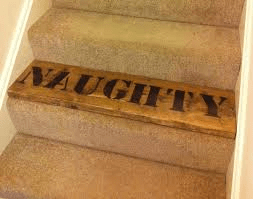
However, first, MacDonald J invites the usher to bring out the Naughty Step for the Local Authority and the legal department specifically.

before turning to the substantive issue, I must make some observations about an unfortunate course of conduct by the local authority following the granting of the order by consent on 25 May 2017.

7.Following the hearing on 25 May 2017, the mother contacted the court to alert it to the fact that the local authority was writing to members of her family in a manner that suggested that those family members were bound by the order of 25 May 2017 and prohibited from adding their names and comments to the Change.org petition. Having seen a copy of the letter being circulated by the local authority, I was satisfied that it does indeed read in that way and I notified the local authority through my Clerk that I would require an explanation.

8.The local authority now accepts that the letter it sent to family members does, wrongly, intimate that the order of 25 May 2017 prohibited family members from responding to the petition. Whilst the letter in question was written and sent by the allocated social worker, it would be wrong to criticise her. The social worker, as one would expect, sent the letter to the legal department of the local authority for checking before sending it out and the legal department returned the letter to the social worker un-amended for dissemination. The actions of this local authority legal department in permitting a letter in the terms drafted by the social worker to be sent are strongly to be deprecated. It is a matter of very grave concern that a local authority would seek to pass off an order of this court as something that it is not. There must be no repeat of this.

“All your naughty step are belong to us <3"

The legal framework (if petition is anonymised) boils down to article 10 (right to free expression) versus article 8 (child’s right to privacy)

20.The nature and ambit of the balancing exercise is well established. In considering whether to grant an order with respect to the publication of information the judge must balance the competing rights engaged. In many cases these will be the rights under Art 8 (respect for private and family life) and Art 10 (freedom of expression), although other rights may also have to be placed in the balance when reaching a decision regarding the publication of information. When conducting a balancing exercise between Art 8 and Art 10 (and any other rights engaged), the court applies the four propositions identified by Lord Steyn in Re S (A Child) (Identification: Restrictions on Publication) at [17], namely:

i) First, no article has, as such, precedence over the other;

ii) Secondly, where the values under the articles are in conflict, an intense focus on the comparative importance of the specific rights being claimed in the individual case is necessary;

iii) Thirdly, the justifications for interfering with or restricting each right must be taken into account;

iv) Finally, the proportionality test must be applied to each, referred to by Lord Steyn as “the ultimate balancing test”.
21.In applying what Lord Steyn described as the “ultimate balancing test” of proportionality the court must consider carefully whether the order that is being sought is proportionate having regard to the end that the order seeks to achieve (JXMX v Dartford and Gravesham NHS Trust [2015] EWCA Civ 96). This will involve an exacting analysis of the factual case advanced in defence of the measure in question (in this case the removal of the petition) to determine (a) whether the objective of the measure is sufficiently important to justify the limitation of a fundamental right, (b) whether the measure is rationally connected to the objective, (c) whether a less intrusive measure could be used and (d) whether having regard to these matters and to the severity of the consequences a fair balance has been struck between the rights of the individual and the needs of the community (Bank Mellat v HM Treasury (No 2) [2014] 2 AC 700 at [20]).

22.In A Local Authority v W, L, W, T and R (by the Children’s Guardian) [2006] 1 FLR 1 at [53], Sir Mark Potter P summarised the approach to the requisite balancing exercise as follows:

“The exercise to be performed is one of parallel analysis in which the starting point is presumptive parity in that neither article has precedence over or ‘trumps’ the other. The exercise of parallel analysis requires the courts to examine the justification of interfering with each right and the issue of proportionality is to be considered in respect of each. It is not a mechanical exercise to be decided upon the basis of rival generalities. An intense focus on the comparative importance of the specific rights being claimed in the individual case is necessary before the ultimate balancing test in terms of proportionality is carried out. Having so stated, Lord Steyn strongly emphasised the interest in open justice as a factor to be accorded great weight in both the parallel analysis and the ultimate balancing test …”
23.Within the balancing exercise, the child’s best interests are not paramount but rather are a primary consideration. Those best interests must accordingly be considered first, although they can be outweighed by the cumulative effect of other considerations (Re J (Reporting Restriction) [2014] 1 FLR 531 at [22]).

24.In undertaking the requisite balancing exercises, the impact of publication on the child must be weighed by the court (Re S (A Child) (Identification: Restrictions on Publication) at [25]). Whilst in many cases it will be demonstrated that publication will have an adverse impact on the child, this will not be the position inevitably. In Clayton v Clayton at [51] Sir Mark Potter P said:

“…given the existence of section 12 of the Administration of Justice Act 1960 which is apt to prevent publication or reporting of the substance of, or the evidence or issues in, the proceedings (save in so far as permitted by the court or as revealed in any judgment delivered in open court), I do not think that, as a generality, it is right to assume that identification of a child as having been involved in proceedings will involve harm to his or her welfare interests or failure to respect the child’s family or private life.”
25.In the circumstances, in each case the impact on the child of publication must be assessed by reference to the evidence before the court rather than by reference to a presumption that publication will be inevitably harmful to the child (see also R v Robert Jolleys, Ex Parte Press Association [2013] EWCA Crim 1135 at [16] and PGS (Appellant) v News Group Newspapers Ltd (Respondent) [2016] UKSC 26 at [73]).

26.Within this context, the court will require clear and cogent evidence on which to base its decision. Some of the evidence on which the requisite balancing exercise is undertaken will necessarily involve a degree of speculation (Re W (Children)(Identification: Restrictions on Publication) [2006] 1 FLR 1) although there comes a point where evidence is not merely speculative but pure speculation (Birmingham City Council v Riaz and others [2014] EWHC 4247 (Fam)).

MacDonald J also raised (but sensibly ruled that he didn’t need to decide the point) an argument about the Bill of Rights 1689. This seems a tricky point for a later Court to resolve. Brrrr.


32.The right of the subject to petition the Crown for redress for personal grievances was recognised in Magna Carta (although it probably dates to the Anglo-Saxon monarchs of England) and, more explicitly, in an Act of 1406 (Rotuli Paliamentorium 7 & 8 Hen. IV, No 63). The Bill of Rights of 1689 (1 William & Mary, session 2, cap 2) restated the right to petition the Crown, and the protection afforded to that right, in clear and unambiguous terms, stipulating that “…it is the right of the subjects to petition the King, and all commitments and prosecutions for such petitioning are illegal.” The Bill of Rights continues to apply in England and Wales. The right of the citizen to petition Parliament or the Government in respect of a personal grievance has thus been, and remains a fundamental constitutional principle (within the context of the right to Petition the European Parliament under Art 44 of the European Charter of Fundamental rights, the right to petition has been described as a fundamental right (see C-261/13 P Schönberger v Parliament)). Within this context, the House of Commons has a comprehensive body of rules that make provision for the submission of public petitions (see HC Standing Orders (Public Business) (2009)).

33.I did not hear detailed submissions on the operation of the Bill of Rights in this case and, specifically, on the effect (if any) of the prohibition it contains on “commitments and prosecutions” with respect to petitions seeking redress. Given the answer produced by the balancing exercise in respect of the ECHR rights engaged in this case, it has not been necessary to consider the point further. However, in a case where the balancing exercise were to come down in favour of injuncting a parent from circulating online a petition aimed at seeking redress from Parliament, it may well be necessary to go on to consider whether the fact that “all commitments and prosecutions for such petitioning are illegal” under the Bill of Rights of 1689 renders such a course unlawful.

(i.e is a petition to Parliament the same as petitioning the King, and prosecution for such petitioning is illegal, or is it only petitions to the King/Queen? In which case, Her Majesty is going to get an increased post-bag. )

In this case, the LA raised several arguments to say that publication of the anonymised petition would cause harm to the children, MacDonald J recognised each of these as having POTENTIAL to cause harm generally, but held that the LA had not produced evidence about the harm to these particular children

44.Turning in detail to the contended for justifications for interfering with the Art 10 rights of the parents relied on by the local authority, Ms Duxbury essentially submits that it is a matter of common sense that if C and W see online that their mother does not accept the outcome of the proceedings nor the validity of the care orders, this will act to upset the two children and undermine the stability and security of their respective foster placements. However, aside from this assumption, the local authority provides no specific evidence to support its contention that the presence of the petition, and its contents will cause emotional harm to C and W by means of causing them upset and potentially de-stabilising their respective foster placements.

45.Whilst it is the case that W’s foster placement has recently broken down, and Ms Duxbury informs the court that the foster carers feel that the precipitating issue was a level of anger and frustration being generated in W resulting from conflicting information being received from his birth family, there is no evidence before the court demonstrating that the breakdown resulted from the petition on the Change.org website (as opposed to, for example, exchanges during contact). Further, the assumption inherent in Ms Duxbury’s submission itself must be interrogated by reference to the nature of the information contained in the petition. W is 15 years old and C is 14 years old. Both children are fully aware that they were the subject of care and placement proceedings, that their parents do not agree with the decision of the court and that the parents wish the boys to be returned to their care. Within this context, the information set out in the petition will not result in the children becoming aware of views held by their parents’ regarding their placements of which they were previously oblivious. Whilst it may be said that, if it is permitted to remain online, the fact of, and the information contained in the petition acts to reinforce in the children’s minds their parents lack of acceptance of their placements following the outcome of proceedings, once again there is no evidence before the court that this is in fact the case.

46.Likewise, the local authority provides no specific evidence to support its contention that the presence of the petition, and its contents will disrupt efforts to find adoptive placements for T and N, or make an already challenging home-finding task more difficult, by discouraging prospective adopters from putting themselves forward. The highest that Ms Duxbury can put that submission is to assert that the online petition “could create anxiety with potential adopters”. Once again, whilst it may be said that it is a common-sense proposition that prospective adopters will be more reluctant to consider children who are the subject of an active online campaign, each case turns on its own facts and the assumption must be interrogated by reference to the evidence before the court. Within this context it is again important to look at the nature of the information contained in the petition. The petition makes clear that the children were the subject of proceedings, that the parents opposed to the plan of adoption and that the parents do not accept, and continue to oppose the outcome of the proceedings. All this is information that will be known to any prospective adopters. Within this context, the information set out in the petition will not result in prospective adopters becoming aware of information they would not otherwise be privy to. Whilst it may be argued that the presence of a petition indicating continued, active opposition by a parent following the conclusion of proceedings may act in more subtle ways on an adopter’s willingness to consider the children, once again this is an assumption rather than an evidenced fact. Indeed, information communicated to the court by the mother following the hearing tends to suggest that the local authority has now located adopters for T notwithstanding the existence of the online petition.

47.Finally, the local authority offers no evidence at all to support the alleged risk that the material already in the public domain will cause ongoing embarrassment and, potentially, emotional harm to the children as they get older in circumstances where it will remain on the Internet indefinitely in an easily and repeatedly accessible form. I accept that the fact that information is already in the public domain does not prevent injunctive relief where it can be shown that the repetition of known facts about an individual amounts to an unjustified interference with the private life of that person (see JIH v News Group Newspapers Ltd [2010] EWHC 2818 (QB) at [59]). However, once again, in this case the nature of the information is important.

48.The information contained in the petition setting out the mother’s objections and assertions regarding the fairness of the proceedings is, as I have outlined, relatively innocuous (once again, it does not contain details of the evidence before the court or details of the harm the court was satisfied that the children have suffered and does not seek to discuss the children’s individual needs), particularly when compared to other information that the courts have permitted to remain online (see for example Re J (Reporting Restriction), where the information in question was a video of the execution of an emergency protection order showing the child being removed in circumstances that were distressing, which video the court permitted to remain online subject to an order requiring the anonymisation of the name of the child). Further, the local authority offers no evidence to suggest that a petition placed online in response to a judicial decision in 2016, to which 160 people signed up and which received its last signature two months ago, is likely to be accessed in future years by others to the extent that it will result in embarrassment to the children, much less emotional harm. Again, whilst it is possible to speculate that this might be the case, given the nature of the information and the relatively small number of people who have accessed it at a time when it is relatively current, the court needs more than mere speculation before such a conclusion can be drawn. I also again bear in mind that the Administration of Justice Act 1960 does not act to prevent child being identified as having been the subject of proceedings.

49.In the circumstances, I am satisfied that there is very little cogent evidence before the court that each of the children or any of them will suffer embarrassment, much less emotional harm if the petition on the Change.org website remains in place online. Within this context, once again, it must be remembered that what the court is examining is whether there is evidence which amounts to a justification for interfering with the cardinal right of freedom of expression for the purposes of Art 10(2). Whilst it is, of course, possible to formulate a number of common-sense assumptions with respect to the potential impact on each of the children of persons accessing the online petition, the reality is that the justifications on which the local authority seeks to rely for interfering with the parents’ right to freedom of expression under Art 8 are poorly evidenced and largely speculative in nature.

The Judge’s conclusions are very plain that his decision (to allow the anonymised petition to stay up) is not one about the merits or otherwise of petitions and not a template to be followed in all future cases, but about the merits of THIS case and that the LA needed to show evidence about the impact or potential impact on these particular children which would have justified an interference with article 10 and that they, in THIS case, had not done so. It doesn’t mean that a Local Authority in another case would not be able to produce such evidence that would justify the petition being removed.

60.Finally, in respect of the contended for justifications for interfering in the Art 8 right of the children for respect for private life, in this case one of the main factors driving the interference in the children’s Art 8 right is the fact that the mother’s name appears on the front page of the petition and the children are referred to by their forenames in a limited number of the responses to that petition. Against this, the ability of a parent to make clear who is speaking out or seeking to petition for redress is self-evidently very important, it being very difficult, if not impossible, to effectively protest a contended for injustice or petition for redress of a personal grievance if the protester or the petitioner must remain anonymous and prevented from providing any salient details of their grievance that may breach that anonymity.

61.Having regard to the foregoing parallel analysis of the importance of the rights engaged in this case and the respective justifications for interfering with the same set out above, in which I have considered each of the children’s best interests as a primary consideration, and applying the ultimate balancing test of proportionality, I am satisfied that the local authority’s application for an injunction compelling the parents to take down their online petition must be dismissed.

62.Balancing the Art 10 right to freedom of expression of the parents (in the context of the importance of that right, the importance of parents who are the subject of state intervention being able to express their views about, the constitutional importance of the right to petition Parliament and the Government for redress with respect to a personal grievance and the importance of the ability of a parent to make clear who is speaking out or seeking to petition for redress) against the Art 8 right of the children to respect for their private and family life (in the context of the importance of that the right for the psychological integrity, personal development, development of social relationships and physical and social identity of the children and the court not being satisfied, having regard to the nature of the information and the children’s prior knowledge of it, that the evidence establishes that publication will cause emotional harm to C and W and potentially de-stabilising their respective foster placements, disrupt efforts to find adoptive placements for T and N or cause ongoing embarrassment to the children as they get older) leads me to conclude in this case the Art 10 right to freedom of expression outweighs the Art 8 right to respect for private and family life when it comes to the question of the online petition being taken down. Applying the ultimate balancing test of proportionality, in my judgment it cannot be said in this case that compelling the parents to take down their online petition directed at Parliament and Government, or compelling them to remove from the petition the mother’s name and the responses which utilise the forenames of the children, represents a proportionate response to the risk to the psychological integrity, personal development, development of social relationships and physical and social identity of the children presented by the limited amount of information concerning the children that the petition now contains.

63.For all the reasons I have given, the application of the local authority for an order compelling the parents to take down their petition on the Change.org website is accordingly dismissed. The order made by agreement on 25 May 2016 will continue in force.

CONCLUSION
64.I recognise that my decision will leave online a limited amount of information concerning the children in a format that has the potential to identify them as having been the subject of proceedings. However, cases dealing with the publication of information concerning children must be decided by the careful and rigorous application of the well-established legal principles articulated earlier in this judgment. As the President observed in Re J (Reporting Restriction), in the face of the challenges presented by the Internet we cannot simply abandon basic legal principles, as Lord Sumption observed in Prest v Petrodel Resources Ltd [2013] 2 AC 415, courts exercising family jurisdiction do not occupy a desert island in which general legal concepts are suspended or mean something different and as Hayden J observed in Re J (A Minor) [2016] EWHC 2595 (Fam), with respect to the balancing exercise required in cases of this nature, in a mature family justice system the weight afforded to the right to freedom of expression must be recognised and engaged with.

65.Within this context, cases dealing with the publication of information concerning children who are, or who have been the subject of family proceedings will necessarily involve competing interests. The court is required to balance a right that is important to the individual subject children, children who will often have been exposed to significant personal trauma, against a cardinal right that is important to parents, to children and to society as a whole. Where the court is required to strike this balance, a solution that comprehensively satisfies all interests is not possible.

66.Finally, I emphasise that this is a decision that turns on its own facts. It is not a judgment on the merits or demerits of online petitions generally, whether in the context of family proceedings or otherwise. Rather, it represents only the product of applying the required balancing exercise to the very particular circumstances of this case.

67.That is my judgment.

My cousin Vinny – or a model for how, in a better world, we could do things


I’m going to take the unusual step of publishing a judgment in full, because, well, you will see why.  It is written by Mr Justice Peter Jackson, who I think is as absolutely good as it gets.   (there’s a short preamble that explains that this was a private law hearing, both parents representing themselves, and that the young person met with the Judge before the decision was made)


There’s a lot that is wrong with family law, and I write about that all of the time. And people write comments telling me other things that are wrong with family law, and sometimes they are right.  Family law hurts. If you have a decision in family law that doesn’t go your way, it hurts you, for a long long time – maybe even forever, and that’s genuinely an awful thing.  We forget that, sometimes. Or perhaps we have got good at pretending that all that matters is that the Judge makes the right decision (forgetting that there are real people on the wrong side of those decisions, even when we think they are right)

Every family law case involves people who are hurting and being hurt, and this one is no exception. But this is one of those better times when I get to say that this, right here,  is something right about family law, and it is how it could be.


Re A (Letter to a Young Person) 2017

13 July 2017

Dear Sam,

It was a pleasure to meet you on Monday and I hope your camp this week went well.

This case is about you and your future, so I writing this letter as a way of giving my decision to you and to your parents.

When a case like this comes before the court, the judge has to apply the law as found in the Children Act 1989, and particularly in Section 1. You may have looked at this already, but if you Google it, you will see that when making my decision, your welfare is my paramount consideration – more important than anything else. If you look at s.1(3), there is also a list of factors I have to consider, to make sure that everything is taken into account.

The information I have comes from a variety of sources. There are the papers from the old proceedings years ago. There are more papers from the proceedings this year, especially your own statements, your mum and Paul’s statements, your dad’s statements, and the report of Gemma, the Cafcass officer. Then there is the evidence each of you gave at court. I have taken all this into account.

When I was appointed as a judge, I took the oath that every judge takes to apply the law in a way that is fair to everybody. Some people will say that this or that decision isn’t fair, but that’s usually their way of saying that they don’t like the decision. People who like decisions don’t usually say they are unfair. Here, your father loudly says that Cafcass is biased against fathers and during the hearing it became clear that he doesn’t have much confidence in me either. He is entitled to his view, but I can tell you that I found no sign of bias on Gemma’s part; on the contrary, I found her someone who had thought very carefully about you and your situation and used her professional experience of many, many family cases to reach an honest view of what would be for the best.

The decisions that I have to take are these: (1) should you go and live in Scandinavia? (2) should you become a citizen there? (3) if all your parents are living in England, should you spend more time with your dad? (4) if your dad goes to Scandinavia, and you stay here, how often should you see him?

Here are the main matters that I take into account:


  • Your stated views. You told me that you have long wanted to live in Scandinavia and that you could see yourself living there with your dad. If that doesn’t happen, you want to go back to having week on/week off. It worked in the past and you enjoyed it. You feel that your father helps you more with your education. If your dad goes to Scandinavia without you, you would be extremely unhappy. Your mum and Paul are very against you seeing more of your dad.
  • I believe that your feelings are that you love everyone in your family very much, just as they love you. The fact that your parents don’t agree is naturally very stressful for you, and indeed for them. Gemma could see that when she met you, and so could I when you briefly gave evidence. Normally, even when parents are separated, they manage to agree on the best arrangements for their children. If they can’t, the court is there as a last resort. Unfortunately, in your case, there have been court orders since you were one year old: 2004, 2005, 2006, 2009, 2010 – and now again in 2017. What this shows is how very difficult your parents have found it to reach agreements. This is unusual, but it how you have grown up. The danger is you get used to it.
  • I was impressed with the way you gave evidence. You are of an age where your views carry a lot of weight with me, and I consider them in the light of your understanding of what has made things as they are. As to that, I don’t think anyone of your age in your situation could understand it better than you do, but nor could they fully understand the influences that you are under and the effect that has on you.
  • Your parents have very different personalities. There is nothing wrong with that, it’s one of the joys of life that people are different. One of your homes is quite conventional, the other very unconventional. There’s nothing wrong with that either. What is of concern to me is this. I see your mother and Paul as being content with the life they lead, but I don’t see that in your father. He is a man with some great qualities. When he is relaxed, he has charm and intelligence. But underneath that, I see someone who is troubled, not happy. He has not achieved his goals in life – apart of course from having you. Because of his personality style, and the love you feel for him, he has a lot of influence over you. All fathers influence their sons, but your father goes a lot further than that. I’m quite clear that if he was happy with the present arrangements, you probably would be too. Because he isn’t, you aren’t.
  • So I have a view on the question of whether the idea of these proceedings comes from you or from your dad. My view is that you brought the proceedings mainly as a way of showing your dad how much you love him. It was mainly to meet his needs, and not yours. I have seen the self-centred way that he behaves, even in the courtroom, and how he makes sure everybody knows how little respect he has for anybody who disagrees with him. Even as a judge, I found it hard work stopping him from insulting the other witnesses. Your mother certainly finds his behaviour difficult, so difficult that she avoids contact with him whenever possible. I don’t think you yet realise the influence that your father has over you. It leads you to side with him and praise him whenever you can. You don’t do the same for your mother. Why is that? Is it because you sense that he needs it and she doesn’t? Also, I may be wrong, but when you gave your evidence I didn’t get the feeling that you actually see your future in Scandinavia at all. Instead, what I saw was you doing your duty by your dad while trying not to be too unfair to your mum. But you still felt you had to boost your dad wherever you could. That’s how subtle and not-so-subtle pressure works. So I respect your views, but I don’t take them at face value because I think they are significantly formed by your loyalty to your father.
  • And it is not just that. I believe your father has in some ways lost sight of what is best for you. He told me that he felt absolutely no responsibility for the state of the relationship between him and your mother. Nor did he satisfy me about his decision to emigrate without you (something he first mentioned in May), and why he would want do something that would so obviously cause you such unhappiness. On Monday, he told me it was 95% likely that he would go alone. On Wednesday, he told me it was 100% certain. Today, Thursday, he said it was 99.9997% certain but in his closing remarks a short while ago he said “If I go to Scandinavia…” before correcting “if” to “when”. My conclusion about all this, I’m afraid, is that, whether he knows it or not, your father has a manipulative side. I don’t believe he has any real idea whether he will go to Scandinavia or not, so nor do I. I can see that for him personally, Scandinavia may have some attractions, but I don’t believe he will find it at all easy to stop seeing you. I very much hope he will stay for your sake, even if it is at a cost to himself.
  • Sam, the evidence shows that you are doing well in life at the moment. You have your school, your friends, your music, and two homes. You’ve lived in England all your life. All your friends and most of your family are here. I have to consider the effect of any change in the arrangements and any harm that might come from it. In any case where parents don’t agree about a move overseas, the parent wanting to move has at least to show that they have a realistic plan. That plan can then be compared with other plans to see which is best. That has not been possible here. You will remember that at the earlier hearing in May, I made very clear to your father that if he was going to seriously put forward a move to Scandinavia, he had to give the court proper information about where you would be living and going to school, where the money would be coming from, and what the arrangements would be for you to keep in touch with family and friends in England. At this hearing, no information at all has been given. Your father described the move to Scandinavia as an adventure and said that once the court had given the green light, he would arrange everything. That is not good enough. In over 30 years of doing family law cases, I have never come across a parent who thought it might be, and no court could possibly accept it. What it means is that I have no confidence at all that a move to Scandinavia would work. Your dad thinks he would find a good life and good work there, but I have seen nothing to back that up – he hasn’t made a single enquiry about houses, schools or jobs. You don’t speak the language and you haven’t been there since before you were 5. Even your dad hasn’t been there for over 10 years. I also doubt his ability to provide you with a secure home and a reasonable standard of living if you lived with him full-time. I would worry about how it would be for you if things started to go wrong. I think you would find it exciting at first, but when reality set in, you might become sad and isolated. I also don’t think it is good for you to be with your father 24/7. In some ways, he would expand your vision of the world, but in many more ways he would narrow it, because he holds such very strong views himself, and because I believe that (maybe sincerely and without realising it) he needs you to fall in with his way of thinking. I also think it would be very harmful to be living so far away from your mum, from young Edward (who needs you too), and from Paul.
  • So I very much see you completing your schooling here. If, when you finish your A levels, you want to move to Scandinavia, you will be 18 and an adult – it will be up to you. Until then, I agree with Gemma, and with your mum and Paul, that you should make the most of the many opportunities that life here has to offer you. Although your dad is not that impressed with your school, most kids across the country would give a lot to have the life chances you already have. You don’t need more chances, or changes, but rather to make to most of what you have already.
  • As you will not be living in Scandinavia, I also don’t think that it would be in your interests to apply for citizenship there at this stage. I agree with Gemma that it would be a distraction. If you decide to do that when you’re 18, all well and good.
  • I have thought carefully about your request to spend more time with your father. I’m afraid that I think that the idea of spending week on/week off would be disastrous. It may have worked, with some difficulty, when you were a primary school, but it will not help your development to share your time between two homes with such different philosophies. In the end, not without some hesitation, and only if your father decides to remain living in England, I’m going to follow something like the arrangement that Gemma recommends. It will give you some more time with your dad, and more independence in getting to and from school. It won’t surprise you to hear that your dad told me that any outcome like this would be totally unacceptable to him and to you: can I suggest that you do your own thinking and don’t let his views drown out yours?
  • There needs to be an end to proceedings of this sort. They have been extremely stressful for everyone. This is the fifth case there has been about you and, unless something pretty extraordinary happens, it should be the last.


So, coming to the orders I am going to make:

A. I dismiss your dad’s applications to take you to live in Scandinavia and for you to apply for citizenship there.

B. You will have a holiday of a week in the second half of August this year with your dad, to be spent at his home unless he and your mother agree that it is going to be spent somewhere else.

C. I shall direct your father to write to your mother no later than 1 September to inform her whether or not he will be moving to Scandinavia and, if so, when.

D. If he writes that he is going to be moving (or does not write at all), contact will remain as it is: i.e. alternate weekends from Friday evening to Sunday evening. After he goes, contact (face-to-face and by phone/Skype etc) will be as agreed between your parents.

E. If your father writes to your mother that he is not going to be moving, contact will take place as follows: From the beginning of September, alternate weekends from Friday direct from school to Monday direct to school, until the end of the year. From the beginning of 2018, it will be alternate weekends from Thursday direct from school to Monday direct to school. I have not followed Gemma’s suggestion exactly because I think it is harder on you going backwards and forwards between the two homes every week. I think it would be better if you did that once a fortnight and that the increase is phased in.

F. I will make an order under s.91(14) of the Children Act that no further applications concerning you can be brought before the court by anyone, including yourself, without the Designated Family Judge giving permission. This order will run until 1 September 2019, so after your GCSEs. I do not think it need run for longer than that. The court will always give permission if someone wants to bring a reasonable application, but it gives the court control before any fresh proceedings are started.

Sam, I realise that this order is not the one that you said you wanted me to make, but I am confident that it is the right order for you in the long run. Whatever each of your parents might think about it, I hope they have the dignity not to impose their views on you, so that you can work things out for yourself. I know that as you get older, you will do this increasingly and I hope that you will come to see why I have made these decisions. I wish you every success with your future and if you want to reply to this letter, I know that your solicitor will make sure that your reply reaches me.

Lastly, I wanted to tell you that your dad and I enjoyed finding out that we both love the film My Cousin Vinny, even if it might be for different reasons. He mentioned it as an example of a miscarriage of justice, while I remember it for the best courtroom scenes in any film, and the fact that justice was done in the end.

Kind regards

Picture 1

Mr Justice Peter Jackson


Eleven plus and Spycatcher


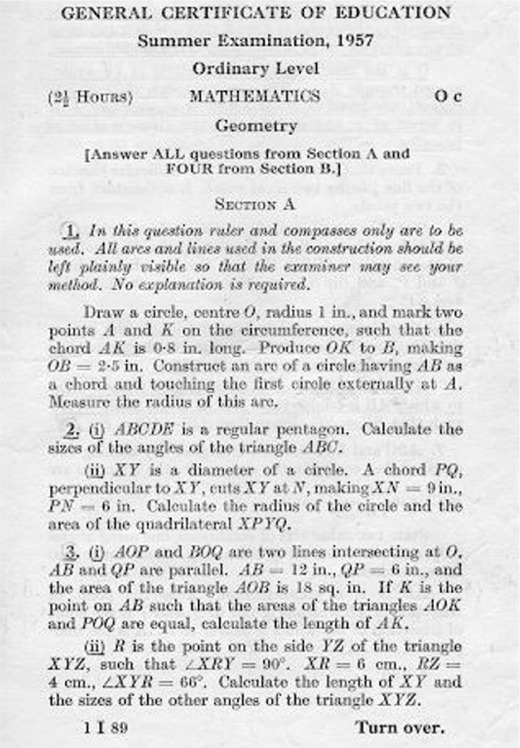
This one is a little outside our normal remit, but it covers Education, and hence children, and it is a bit unusual. In fact, even though it is a question about the legal implications of leaking exam questions it would actually make a perfect legal exam question – which I’m sort of leaking in advance of anyone actually doing it.


Matalia v Warwickshire County Council 2017

http://www.bailii.org/ew/cases/EWCA/Civ/2017/991.html


Mr Matalia owned a website. I’m not sure what else he was doing on the website, but one of the things that he did in 2013 was post some information about the contents of the 11 plus exam being used in Warwickshire after it had taken place.

He was able to learn what the contents were by making some enquiries of children who had sat the exam (I believe his nephew was one of said children)

So what? What earthly use is knowing the contents of an exam AFTER the event? That’s like someone running up to you with a hot tip for the Grand National and telling you that Red Rum won it three times in the Seventies. It’s not inaccurate, but it isn’t useful.

Well, except that not everyone who sits the 11 plus exam in Warwickshire does so at the same time  (which I personally think is something of a flaw in the security of their system, which Mr Matalia has exposed). There are three separate examination sitting dates, all using the same paper. So if you are taking the test on the third of those sitting dates and you know what is in the test because someone who was in sitting date one tells you, you have an advantage.

(Assuming there’s a grade curve, rather than a hard pass mark, it is utterly disdvantageous to people who sat the exam on the first date to help out people sitting later on, and actually if it were me, I’d tell them the questions were largely about the role of crocodiles in Egyptian mythology so they’d crash and burn, but that’s by the by)


Here’s what went onto Mr Matalia’s website


“A. Comprehension regarding Lemurs in Madagascar. Around 2 pages of text and perhaps 20 questions. Easy enough to finish.

A. Longer maths. 4 long questions with subsections (perhaps 15 minutes).

i) A question relating to luggage dimensions and time differences: London and Hong Kong.

ii) Cinema tickets, time calculations and prices.

iii) Prices of items in a sale, including original prices. E.g price was £4.85 after a 75% discount. What was the original price?

iv) Swimming suggestions – swimming lengths in a certain time. Required conversions and ratio/proportion knowledge.

Some questions were difficult and many may not complete the questions.

B. Synonyms (words included thrifty, frugal, insolent). Enough time to complete the questions.”


  • The relevant test included a comprehension question on a passage concerning lemurs in Madagascar with a total of 23 questions. The “Matching Words” section required candidates to give “thrifty” as a synonym for “frugal”. The judge found that the section on the website headed “Longer maths” also “contained truth”. He referred to an email dated 10 September 2013 in which the University told the Council that there were “4 maths Qs (6 marks) where day 2 candidates may be at an advantage – although the exact Qs are not revealed”.


It doesn’t sound as though Mr Matalia’s nephew was some sort of super-spy, taking detailed notes of the exam questions as part of a well designed scheme, but rather that those were just the bits he happened to remember when asked about them.  I mean, knowing that the Comprehension question was based on an article about lemurs doesn’t help you in the slightest. It isn’t going to be beneficial to cram the Wikipedia entry on lemurs to give you an edge. Also ‘cinema tickets, time calculations and prices’  is, when you boil it down ‘some questions involving maths’ – which I think most children sitting an Eleven Plus exam would probably anticipate.

But a visitor to the site who would be sitting the exam on one of the two later sitting dates would gain a slight edge (and on at least the thrifty/frugal question would pick up a free mark)

The Council asked Mr Matalia to take the exam spoilers down.  He refused and the Council applied for an injunction. They asked him to take the spoilers down before the trial. He refused.


Before the trial, Mr Matalia refused to give any undertakings, saying in an email to the Council that, quite apart from expecting to win, “it is financially advantageous for me to go to trial and the publicity and media details will be invaluable for my sites.” He also stated that he understood that “there is a surprise waiting for [the Council] for this year’s 11+ exams. I won’t spoil the fun….I did not ask for help, have no involvement, direct or indirect and no contact numbers. I understand the content on my site last year will be insignificant in comparison.”


Without trying to be unkind, and avoiding any feelings about whether eleven plus exams are a good thing, bad thing, indifferent thing, it does feel from the outside something of an unusual thing for a grown man to do, to post spoilers about an exam to be undertaken by eleven year olds.  I really don’t know what else was going on his website, or how that content fitted into the general scope of the site…  (It would make more sense to me if he were publishing the full questions and answers and charging for access. I don’t really understand the motivation here. It doesn’t seem like a political protest against grammar schools or trying to subvert the system, nor does it actually seem like a monetarised plan. I guess it was simply for the lulz)


Anyway, the Council got their injunction, banning Mr Matalia from posting on his website any information about Eleven Plus examinations in 2013, 2014 or 2015.  This was Mr Matalia’s appeal.


The case was decided on the principle of ‘breach of confidence’  – this has three limbs


  • three limbs of the test to establish a breach of confidence set out by Megarry J in Coco v A.N. Clark (Engineers) Ltd [1969] RPC 41 was satisfied. It is Mr Matalia’s case that none was satisfied.
  • The test formulated by Megarry J at p.47 of the report, and subsequently approved and applied many times, is:


“In my judgment, three elements are normally required, if, apart from contract, a case of breach of confidence is to succeed. First, the information itself, in the words of Lord Greene, M.R. in the Saltman case on page 215, must “have the necessary quality of confidence about it”. Secondly, that information must have been imparted in circumstances importing an obligation of confidence. Thirdly, there must be an unauthorised use of that information to the detriment of the party communicating it.”


Mr Matalia argued at his appeal (and I think it is a decent lawyer argument, though I suspect any normal human being would reject it immediately) – how can the information in an exam paper handed out to 1,600 children have a ‘quality of confidence’ about it? And when the paper was handed out to his nephew, how was there an obligation of confidence imported to him? Of course children talk about exams after they’ve taken them. And these days, they probably do so on social media, thus publishing their conversations.  With that in mind, how can the exam papers have that ‘necessary quality of confidence’?

He doesn’t argue, though it seems blindingly obvious to me – why don’t Warwickshire do their 11 plus exams all on the same day, then they don’t have to worry about this?


  • Ground 2 is as follows:


“2. The judge erred in concluding that the Appellant had committed a breach of confidence, given that

2.1 the relevant information which the Appellant had published on his website (“the Information”) was (as was accepted by the Judge, in paragraph 35 of his judgment (“the judgment”)) communicated to him by one or more pupils who themselves were under no duty of confidence in relation to the Information;

2.2 the Information was, in the context (see paragraph 34 of the Judgment, and paragraph 2.4 below), trivial;

2.3 the Information concerned a test about which the deviser of the test (Durham University) said to the Respondent (only 3 days after the 11+ examination from which the Information was believed by the Appellant to be drawn)

2.3.1 “the testing process as a whole would not seem to have been compromised” and

2.3.2 “If there are issues [i.e there was a possibility of late sitters having any “particular advantage” where the Respondent “had concerns”, the Respondent had] the option of excluding these questions from the results”;

2.4 the Respondent had written to the Appellant in April 2011 that

“it would be very very difficult for a child to remember any of the questions in enough detail to pass on to children who are yet to take the test in order for that child to be at any significant advantage” (see paragraph 34 of the judgment);

2.5 websites other than that of the Appellant had revealed and continued to reveal similar information about the content of the 11+ examinations set by the Respondent;

2.6 there was evidence before the Court that persons who acted (for financial reward) as tutors for the 11+ examinations set by the Respondent appeared surreptitiously to use information comparable to the Information in preparing their tutees to take the 11+ examinations administered by the Respondent (see paragraph 6 of the Appellant’s witness statement of 8 December 2014); and

2.7 there was evidence before the Court that children who had taken the 11+ examinations were giving to their friends and relatives who were about to sit the same examination at a later date information which was at least comparable to the Information (see also paragraph 6 of the Appellant’s witness statement of 8 December 2014).”


  • Apart from sub-paragraph 2.1 of Ground 2, which clearly relates to the second limb of Megarry J’s test, the other sub-paragraphs appear to relate both to whether the information disclosed by Mr Matalia on his website had the necessary quality of confidentiality about it (limb 1) and to whether its disclosure was to the detriment of the Council (limb 3). As to the other part of limb 3, that the disclosure was unauthorised, it is clear that neither the Council nor any other person authorised the disclosure.


Ground 2.1: chain of confidentiality


  • Mr Matalia submits that because he received the information from one or more pupils who were themselves under no duty of confidence in relation to it, he was not himself under any obligation of confidence and was free to publish it as he saw fit. He submits that the candidates were free to disclose the contents of the test and could therefore transmit the contents to others without any duty of confidentiality being imposed on the recipients.
  • Although Lewison LJ subsequently clarified that he gave permission to appeal on the entirety of Ground 2, he focussed on this issue in his reasons:


“1. Although the evidence is not entirely clear, it seems to be the case that the pupils taking the test were not told that it was confidential or that they should not discuss the contents of the test with others.

2. If that factual premise is correct then it is arguable that the judge was wrong to find that all three limbs of the test in Coco v Clark were satisfied.”


  • Despite this, Mr Bragiel’s skeleton argument made very little of Ground 2.1. He made even less of it in his oral submissions and, in answer to a question from Lindblom LJ, accepted that the issue was whether the information was confidential in nature and whether Mr Matalia realised or should have realised that it was confidential. However, in a note sent to the court after the hearing, Mr Bragiel stated that he had not abandoned reliance on the fact that the children taking the test were not told that the test was confidential or that they should not discuss it with others. He said this was the fundamental factor relied on and was relevant to each of the three limbs of Megarry L’s test.


This is the nub of it – if the nephew wasn’t told, or it wasn’t written on the exam papers ‘this is confidential’ or ‘you must not talk to other people about what is in this test’ or words to that effect, was the test in Coco v Clark satisfied?


This is, however, where we get into law exam territory – literally.  The reference that the Court of Appeal give here is in relation to the Spycatcher trial (a case where a former employee of UK Security Services wrote a book about his experiences, published it in Australia and it was serialised by the Sunday Times with excerpts appearing in other newspapers) and the SPECIFIC reference is

. But it is well settled that a duty of confidence may arise in equity independently of such cases; and I have expressed the circumstances in which the duty arises in broad terms, not merely to embrace those cases where a third party receives information from a person who is under a duty of confidence in respect of it, knowing that it has been disclosed by that person to him in breach of his duty of confidence, but also to include certain situations, beloved of law teachers – where an obviously confidential document is wafted by an electric fan out of a window into a crowded street, or where an obviously confidential document, such as a private diary, is dropped in a public place, and is then picked up by a passer-by.”


Come on, how meta is that? A law case about exam papers is decided by reference to a law case that was giving a hypothetical scenario beloved of law teachers.


The Court of Appeal liked this so much that they went back to it


It seems highly improbable that a 10 or 11-year old child would be prohibited from discussing the test with their parents, but that gets Mr Matalia nowhere. First, it does not follow that candidates owe no duty of confidentiality. If the Council became aware that a candidate was proposing to publish questions on social media, I do not see why it could not take steps to restrain it, assuming that the candidate knew that there were to be further sittings of the test. If, by virtue of their age, the candidates were not susceptible to injunctive relief, communication by them would be analogous to the example given by Lord Goff in Attorney General v Guardian Newspapers Ltd (No 2) of the confidential document being wafted into the street by an electric fan and picked up by a passer-by.


Secondly, and in any event, it does not follow that because a child can tell his or her parents about questions in the test they have taken, the parents are free to publish that information, knowing that other candidates are yet to take the test. The communication is made by the child in very particular circumstances, as part of the child-parent relationship. Given the confidential character of the information, as will or should be apparent to the parents, it would in my judgment be entirely consistent with principle to impose the duty of confidentiality on the parents, and quite contrary to principle to treat the parents as free to publish the information as they saw fit.


The appeal was refused and the onward secrecy of Warwickshire’s Eleven Plus exams is secured. Hooray. (or Boo, depending on how you feel politically about grammar schools)


(Dragging us back to family law, I’ve written before about how just like Rorschach tests, many of the psychometric tests applied by psychologists in assessment of parents aren’t available online – to stop people deciding in advance how to answer them, or being coached. So I guess this would apply to an enterprising parent who photographed the test paper and tried to publish it. Don’t do that, obviously. That would be a breach of confidence, and you would be made to take it down.)


And just to make us all feel super thick, here’s an O Level Geometry paper from 1957.


Belinda blinked. How on earth was she supposed to answer these questions?


What you hear’s a lethal style of conversation – can you sue or be sued for defamation during a child protection investigation

Or as MC Tunes famously sang, whilst mispronouncing the key word – “Don’t like what I say ? Then sue me for liable”

(He meant libel… Whilst he couldn’t pronounce libel, to be fair, he could pack jams like a party in a tin can. Is this alleged feat more or less impressive than cooking MCs like a pound of bacon? Discuss. )

We have established before that nothing that is said within a Court room can be used in an action for libel, slander or defamation – and that protection covers not only what a lawyer or witness says aloud, but to written documents and to conversations that were for the purpose of creating such documents.

(i.e Mr X can’t sue a social worker for saying in the witness box that “Mr X broke his son’s arm” even if that allegation is later found to be untrue. Nor can he sue the lawyer for saying “The threshold is met because Mr X broke his son’s arm” and nor can he sue the social worker for putting that in her Court statement or for saying such a thing to her lawyer outside the Court room in the preparation of the case. )

That’s all in Cutler v Dixon 1585
As the Courts have said in other cases

“The reasons why immunity is traditionally conferred upon witnesses in respect of evidence given in court, are in order that they may give their evidence fearlessly and to avoid a multiplicity of actions in which the value or truth of their evidence would be tried over again. Moreover, the trial process contains in itself, in the subjection to cross-examination and confrontation with other evidence, some safeguard against careless, malicious or untruthful evidence”

But what about defamation during the INVESTIGATION process? This case deals with that very issue, and may be of interest

ABC (A Mother) v The Chief Constable of West Yorkshire Police [2017]

http://www.bailii.org/ew/cases/EWHC/QB/2017/1650.html

I will try to capture the basic facts as quickly as possible. A mother, ABC, became concerned that her son who was 4 was being sexually abused whilst in the care of his grandparents. This is largely because he told her that they had put talcum powder on his willy and she believed that they were also taking indecent photographs of the boy. She made this complaint to the police, and a DC Green investigated it. As part of the investigation, the police officer asked her what their motivation might be and in answer to this she explained that they were bankrupt and might have a financial motive. In a later written statement, she said that she had not said this.
As part of the investigation, DC Green spoke with a social worker, and mentioned this aspect, saying that ABC had ‘lied’ to him during the investigation and that he did not consider the allegations to have any substance. The social worker, during her investigation, spoke with the GP and a GP record was later made of that discussion.

This is the record that was complained of, and when ABC learned of it, she sued the police officer for defamation

60.It was on 24 April that Victoria Stennett wrote up the GP Record on which the slander claim is based. I shall set out the full entry below, putting the words complained of in bold for clarity and ease of reference. I shall interpose some numbering, to help explain the argument and my findings on the issue of meaning. These points aside, I set out the entry exactly as it appears in the records, with all typographical errors.

“24 Apr 2015 12:30 Mobile Working: Victoria Stennett (Admin/Clinical Sup Access Role) @Supporting Families Unit

Reason for encounter – telephone call from Elsa Newell

Verbal communication interventions

discussion with Elsa newell social care. She has seen [BCD] and mum regarding the concerns that mum has voiced regarding grandparents and dad and sexual abuse towards [BCD]. She has attended court 3 times to stop all contact with the family and has been granted an order to stop grandparents from having over night care however the judge has stated that there is no evidence of abuse at all. Grandparents have admitted that there have been photos taken of him in the bath but police have checked these and they are not abusive mum also states that as grandparents are drying him them put talc on his penis and rubs it. She has stated that this is abusive and she does not even bath him therefore this is not right. There again is no evidence that this is abnormal behaviour other than general bathing of a child of 4. [BCD] has reported that he woke up one night at grandparents house in bed with step sibling Theo and there was a man in his room the man jumped on his bed and then ran out [BCD] did not tell anyone a she is not allowed out of bed when in bed. Mum stated that that [BCD] is drawing pictures of this man and has senn him since however grandparents and dad deny that therehas been an unknown man in the property overnight, [BCD] has also stated to social care that he has never seen this man before or since. Mum has put in a complaint regarding 3 police officers asthey are not taking thisseriously a complaint to the judge for not stopping dads contact and as the gp will not state that dad should have no access she is complaining regarding them [1] the judge has also ordered her not to discuss this matter with [BCD] as there have been witnesses stating that they have heard her putting words into [BCD’s]mouth. [2] She has also lied about the statement she has provided to the police and who was present when the police interviewed [BCD]. she states that her mother overheard the conversation between [BCD] and the police however this happened at nursery.

Elsa has seen [BCD] who likes spending time with his dad and he has not reported any concerns regarding his care from anybody. Nursery have no concerns and he is developing well.

Elsa wanted to know if mum had a history of mental health issues however all her records are private. [3] Elsa intends to close the case as there is nothing to suggest that there issexual abuse however there are reservations regarding mums role in this.

Activity: Patient related activity (20 minutes) Administration with Patient Record

Activity: Patient related activity (20 minutes) Telephone with other Professional

Patient Contact: 0 minutes Total Contact 40 minutes.”

A lot of the judgment deals with whether the mother had established that DC Green had said any of this, because it was a non-verbatim note of a conversation between a GP and a social worker drawing on things that the social worker had been told by other professionals. That’s not terribly interesting for our purposes, so skipping to the conclusion


69.The claimant goes on to set out the specific words of which she complains, and she has produced a written record of them in the form of the GP Record. There is no dispute that those words referred to her. It is not unreasonable to rely on a case that DC Green and/or DC Ridge made slanderous statements about the claimant to social services. The evidence establishes that each of them did speak to social services on the dates alleged. The Chief Constable is responsible for what her officers do.

70.But the GP Record is not a record of any slanderous statement made by a detective constable to Elsa Newell on or about 22 April 2015. It is a record of what Elsa Newell said to health worker Victoria Stennett in a telephone conversation on 24 April 2015. The GP Record does not purport to be or to contain an account of what any police officer said to Elsa Newell. Both the officers concerned have given evidence in which they deny making the statements complained of. The person to whom they are alleged to have made those statements, Ms Newell, has not given any evidence at this trial. The evidence is that she has no independent recollection of what she said. For that among other reasons a witness summons that had been served on her was set aside. The person to whom Ms Newell spoke has not given evidence either. An email that is before me contains some evidence that Ms Stennett thinks she wrote down accurately what Ms Newell said to her. But the email is not from Ms Stennett, and it is dated nearly two years after the initial record was made. It would be unsafe to attach any great weight to it.

71.I therefore have to decide whether I should reject the officers’ evidence and accept the claimant’s case, that it can and should be inferred from the GP Record and the other evidence before me, that the words that the claimant complains of were spoken to Elsa Newell by one or other or both of DC Green and DC Ridge.

72.There is nothing wrong in principle with an inferential case of slander. But it is often going to be hard to prove such a case, and there are real difficulties with the inferences invited in this instance. Some of the more obvious problems are these:

(1) The GP Record does not set out any direct quotation from any police officer. Nor does it contain anything that appears to be an indirect quotation from anything an officer said.

(2) The most recent written accounts of what the detective constables involved had said to social services are dated 15 and 22 April 2015, that is to say 9 and 2 days respectively before the conversation recorded in the GP Record.

(3) The Social Services records of what was said by DC Green on 15 April and by DC Ridge on 22 April 2015 are not helpful to the claimant. None of the language in either those records corresponds with any part of the words complained of.

(4) The first of the three elements of the words complained of (the passage about witness stating they have heard her putting words into her son’s mouth) is in a sentence, which I have labelled [1] above, that appears on its face to be a report of something said by a judge, not a police officer.

(5) The second element of the words complained of (“She has also lied …”) appears rather garbled, which is not what one would expect from a detective constable. There is ample evidence that DC Green writes clearly. DC Ridge seems to do likewise. More significantly, perhaps, this part of the words complained of is not easy to reconcile with the facts that were known to DC Green. It seems to suggest that the only conversation between BCD and the police was at nursery, so that the mother could not have overheard it. DC Green was well aware that was not so. He knew at the relevant time what ABC and her mother was saying about the matter. It is hard to see why he might lie about this. It is hard to see why DC Ridge would say anything on this topic. Her only role in the matter was to interview the claimant. Moreover, Elsa Newell knew that there had been two conversations between the police and BCD, or at least the social services records made that clear.

(6) The third element of the words complained of appears on its face to be a report of Elsa Newell’s intentions, and her reasons for them. It is clear that DC Green did have reservations about ABC’s role in the investigation, but it does not follow that these words reflect or embody a statement he made to Elsa Newell.

(7) The overall impression gained from a reading of Ms Stennett’s record is that it reflects a 20 minute conversation in which, whoever initiated the conversation, Ms Newell was conveying to the health visitor her overall assessment of the case, drawing on a number of sources of information.
73.For the reasons that follow I find that the claimant has failed to prove publication of all but one of the words complained of. That word is “lied”.

The Judge decided that “She has also lied” was a statement that had come from DC Green, and that he had said it to the social worker. That was potentially slander, and had then gone on to be published in the records.

Why might the word ‘lied’ be potentially slanderous?

Here are the ingredients that someone bringing a slander claim has to prove to the Court

82.The requirements that are relevant in this case are these. A claimant in slander must, unless it is admitted, prove that the publication of which they complain (1) conveyed a meaning or imputation which is defamatory at common law (2) has caused special damage, or is actionable without proof of special damage and (3) has caused or is likely to cause serious harm to the reputation of the claimant

86.The word “lie” in the context of the conversation between DC Green and Elsa Newell bears the natural and ordinary meaning that in the course of a police investigation into possible child sex abuse the claimant told a deliberate falsehood to a police officer. That is a defamatory meaning. It is unnecessary to rule on what meaning would have been attached to words which the claimant has not proved were published by any officer of the defendant.

(2) Actionable in slander?
87.It is a general rule of the common law that spoken words are not actionable as slander unless it is proved that their publication has caused special damage. None is alleged in this case, so the statements complained of are only actionable if they fall within one or more of the recognised common law or statutory exceptions to the general rule. Only one such exception is relied on here. A slander which imputes that the claimant committed an imprisonable crime is actionable without proof of special damage: see Lachaux v Independent Print Ltd [2015] EWHC 2242 (QB) [2016] QB 402 [8].

88.For the defendant it has been submitted that those who tell lies to police officers are not always prosecuted. That is no doubt true, but the question of law as to whether a statement is actionable as a slander does not depend on current charging standards or CPS policy. The question is not whether what was imputed would have led to a prosecution, but whether it amounted to a crime for which a sentence of imprisonment could (not would) be imposed.

89.For reasons that will appear, it is not necessary to decide this point, but I would be inclined to accept the claimant’s case on this issue. It may be that not all lies told to the police amount to a criminal offence. Here, though, the imputation of lying to the police that was published in this case might have amounted to the common law offence of perverting the course of public justice, but in any event would at least amount to wasting police time contrary to s 5 of the Criminal Law Act 1967. Both offences are punishable by imprisonment.

This is important – whilst a claimant normally needs to PROVE that the publication of the slander caused them special damage, that isn’t the case if the slanderous words suggest or imply that the claimant committed a crime for which they could be imprisoned.
(That’s probably going to be the case for any allegation of child abuse – it is difficult to think of an allegation that Mr X abused a child by doing Y, where Y would not be a crime for which Mr X might be imprisoned if he were prosecuted and convicted)

However, the claimant failed on the third ingredient, which was that she had to prove that the publication has caused or is likely to cause serious harm to her reputation


(3) Serious harm to reputation?
90.Here, the claimant’s case runs into difficulties. In my judgment she has failed to show that her case satisfies what I have called the “serious harm requirement.” This is contained in s 1(1) of the Defamation Act 2013 which provides that “A statement is not defamatory unless its publication has caused or is likely to cause serious harm to the reputation of the claimant.”

91.The meaning and effect of this provision were explored in Lachaux (above) but the principles have also been looked at in later cases. It is convenient to adopt the relevant parts of the summary which Dingemans J drew from the authorities in Sobrinho v Impresa Publishing SA [2016] EWHC 66 (QB), [2016] EMLR 12 at [46]-[50]:

“46. … first, a claimant must now establish in addition to the requirements of the common law relating to defamatory statements, that the statement complained of has in fact caused or is likely to cause serious harm to his reputation. Serious” is an ordinary word in common usage. Section 1 requires the claimant to prove as a fact, on the balance of probabilities, that the statement complained of has caused or will probably cause serious harm to the claimant’s reputation. It should be noted that unless serious harm to reputation can be established injury to feelings alone, however grave, is not sufficient to establish serious harm.

47. Secondly it is open to the claimant to call evidence in support of his case on serious harm and it is open to the defendant to call evidence to demonstrate that no serious harm has occurred or is likely to do so. However a court determining the issue of serious harm is, as in all cases, entitled to draw inferences based on the admitted evidence. Mass media publications of very serious defamatory allegations are likely to render the need for evidence of serious harm unnecessary. This does not mean that the issue of serious harm is a “numbers game”. Reported cases have shown that very serious harm to a reputation can be caused by the publication of a defamatory statement to one person.

48. Thirdly, there are obvious difficulties in getting witnesses to say that they read the words and thought badly of the claimant… This is because the claimant will have an understandable desire not to spread the contents of the article complained of by asking persons if they have read it and what they think of the claimant, and because persons who think badly of the claimant are not likely to co-operate in providing evidence.

50. … as Bingham LJ stated in Slipper v BBC [1991] QB 283 at 300, the law would part company with the realities of life if it held that the damage caused by publication of a libel began and ended with publication to the original publishee. Defamatory statements are objectionable not least because of their propensity “to percolate through underground channels and contaminate hidden springs” through what has sometimes been called “the grapevine effect”. However, it must also be noted that Bingham LJ continued and said: “Usually, in fairness to a defendant, such effects must be discounted or ignored for lack of proof”, before going on to deal with further publications which had been proved to be natural, provable and perhaps even intentional results of the publication sued upon.”

[As Suesspicious Minds side-note – “Percolate through underground channels and contaminate hidden springs” is some dope imagery and one can only surmise at how much Bingham LJ would have wrecked the mic had he chosen to abandon the law and get into spitting dope rhymes with MC Tunes and Vanilla Ice instead…]

97.The allegation is not a trivial one. But allegations of a serious nature do not always or necessarily cause reputational harm that is serious. This is not a case in which inference can provide a satisfactory basis for a finding that serious harm to reputation has been caused. Nor do I accept the claimant’s case that it is proved that serious harm is likely in the future. I can see that a record has been made in the electronic database of GP information. Beyond that, I know and can infer little. The claimant has put forward a series of suggestions as to how the words complained of might affect her prospects of working with children, or adopting, fostering or having more children of her own in future. But that could only be the case if and to the extent that relevant part of the GP Record would be disseminated or made accessible to people making decisions of that kind, and taken seriously in that context. I cannot make assumptions about such matters. On the evidence before the Court this cannot be said to be likely, or anything more than speculative. That is true, whatever the point in time by reference to which the likelihood of future harm needs to be addressed.

So the defamation claim fails.

Of broader importance is that the Judge then went on to consider the defences and to rule on them. These are very important for everyone reading this who is busy sharpening pencils in readiness to issue a defamation claim against social workers and police officers and teachers for saying things at a case conference or for writing things in their records.

Qualified privilege

Qualified privilege is a category of defamation that means in effect that the law accepts that person A is able to say stuff to person B because of the job they are both doing, even if that ends up being slanderous of person C – AS LONG as it is not malicious.

If qualified privilege applies to child protection investigations, then a parent can only sue a professional for defamation if they are able to prove that the professional acted MALICIOUSLY
(which is as football commentator say “A big ask”)

Qualified privilege
116.The general principle of law is that there are circumstances in which, on grounds of public policy and convenience, a person may without incurring liability for defamation make statements of fact about another which are defamatory and untrue. The defence available where such circumstances exist is known as qualified privilege.

117.One well-established category of circumstance giving rise to such a privilege is where the person who makes the communication is under a legal, social or mora duty to communicate on the topic in question and the recipient has a duty to receive or a legitimate interest in receiving information on that topic. One classic formulation of this principle is that of Lord Atkinson in Adam v Ward [1917] QC 309, 334:

“A privileged occasion is … an occasion where the person who makes a communication has an interest, or a duty, legal social or moral, to make it to the person to whom it is made, and the person to whom it is so made has a corresponding interest or duty to receive it. This reciprocity is essential.”
118.Ms Hayward relies on this principle. She submits, and I agree, that this is a case in which (i) the police had a duty to communicate with social services about the investigation into the allegations that BCD had been abused, and (ii) social services had a corresponding duty to receive such information. The claimant had alleged that BCD’s grandmother’s partner had sexually touched him and taken indecent photographs of him. BCD stayed frequently at his grandmother’s house, sometimes without his father there, as did BCD’s stepbrother. If true, as Ms Hayward argues, these allegations plainly posed a risk of serious harm to the children concerned. It was clearly appropriate to take a multi-agency approach to such matters. As Ms Hayward points out, when the allegations were first passed to the police they made a safeguarding report to social services almost immediately, and thereafter, as set out in the social services log, ensured that social services were kept apprised of the investigation.

119.It was necessary, submits Ms Hayward, for social services to understand the nature of the allegations, the progress of the investigation and, pending a final decision on the outcome of the investigation, the views of the police (and in particular the investigating officer), as to the substance of the allegations and the reliability of the person making them. It was entirely appropriate for such information to be relayed to social services as it would help them better understand and assess whether there was any risk to BCD and, if so, to manage it.

120.Where a public authority such as this defendant seeks to rely on the defence of qualified privilege the Court must take account of human rights law. A public authority can have no duty to make a communication if it represents an unnecessary or disproportionate interference with the Article 8 rights of an individual: Clift v Slough Borough Council [2010] EWCA Civ 1171 [2011] 1 WLR 1774. Ms Hayward recognizes this. She argues that to the extent that the communication complained of engaged the claimant’s Article 8 rights, it was not more than necessary and proportionate, having regard to shared safeguarding functions of the police and social services. I agree.

121.These activities were taking place within a context governed by statute and well-known statutory guidance. The Children Act 2004 imposes duties on local authorities and the police with regard to the safeguarding and welfare of children. By s 11(2) of the 2004 Act, a local authority and a chief officer of police for a policing area “must make arrangements for ensuring that (a) their functions are discharged having regard to the need to safeguard and promote the welfare of children.” By s 11(4), such bodies and persons must have regard to any guidance given to them by the Secretary of State. The guidance in force at the relevant times was “Working together to safeguard children – A guide to inter-agency working to safeguard and promote the welfare of children” dated March 2015. Relevant passages are to be found in paragraphs 12, 15, 18, 22 and 23. Paragraphs 22 and 23 appear under the heading “Information sharing”. Paragraph 22 makes the obvious point that “Effective sharing of information between professionals and local agencies is essential for effective identification, assessment and service provision.” It is unnecessary to cite these paragraphs more extensively. It is clear that the guidance encourages professionals involved with children to share information with a view to enhancing the prospects for effective safeguarding, or promoting welfare.

122.Of course, it is necessary to consider the particular information provided in the individual case, and whether there was a real need to provide that information to the particular individual(s) with whom it was shared. The statement that “she lied” was not made in order to save a child from abuse. But it was clearly highly relevant to the duties which social services had to perform. In contrast to the factual position in Clift, the statement was communicated to a single individual, Ms Newell, who was personally under a duty to acquire and assess information relating to the welfare of BCD. This was information of that nature. In my judgment it is plain that DC Green had a duty to provide Ms Newell with his assessment of the reliability of the claimant, who had made allegations that her son was the victim of abuse by adults within his family. As Ward LJ observed in Clift at [35] “it cannot be held to be disproportionate for a [public] authority to do what it is bound to do anyway”.

So it falls within qualified privilege for a police officer to share details of his investigation with a social worker AND to give his professional opinion as to whether he believed the allegations and his view of whether the individuals in the case were reliable witnesses.

The same would be true of things said in a case conference or core group. (Whilst it MIGHT be arguable that a father who makes a defamatory allegation about a mother in a Case Conference is not covered by qualified privilege – he has no legal duty to share such information – and it might be arguable that he doesn’t have a social or moral duty unless he genuinely believes it to be true, it is rather academic, because he won’t have any money to make him worth suing…)

The mother was not able to prove that when DC Green told the social worker that “she also lied” that he did so maliciously, rather than acting within his statutory duties.

That means that there is still a very high bar for a claimant to surmount if they do want to successfully sue a professional for defamation.

1. They must prove what was said (the records probably do that) and that it was published and that the words were defamatory
2. They must prove special damages (that they suffered loss as a result) OR that the case is actionable without proof of special damages (though if the words complained of imply that the claimant did something which they could be imprisoned for, that would tick that particular box)
3. They must prove that the words complained of caused serious harm to their reputation or are likely to do so
4. And if the words complained of happened within an investigation process qualified privilege will attach, so the claimant must prove MALICE – i.e not just sharing information but saying those things with malicious intention to cause the claimant harm, distress or embarrassment.

I can imagine a scenario in which a parent is exonerated of an allegation in care proceedings but a professional in the case doesn’t accept that, and subsequently goes on to record on a file or share with another professional “Mr X broke his son’s arm” – if that happens after a family Court has ruled that Mr X didn’t do that, then that is potentially malicious in nature. Saying it before the Court has dealt with it wouldn’t be. And “ Mr X was accused of breaking his son’s arm but the family Court decided he didn’t do it” is not defamatory, because it is true.

The golden rule with any email or letter or record is “Imagine that I am sitting in Court with everyone involved and listening to a Judge read this out loud” – if it says something that would make you squirm or that you cannot defend, don’t say it.

Committal to prison – making false accusations

Gibbs v Gibbs 2017

http://www.bailii.org/ew/cases/EWHC/Fam/2017/1700.html

This was an application by the father of a child (who by 2017 had turned 18) to commit the mother to prison for breaching court orders, notably about publishing allegations that mother had made within the private law proceedings but had never been found to be proven.

The private law proceedings have a dreadful history, set out by Hayden J, going back to 2001 and only ending in 2004.

A Consent Order was placed before the Court which was scrutinised by the Judge in a short judgment which has been transcribed and filed in this application. The preface to the order records that it was acknowledged specifically by the mother ‘that she was afforded the opportunity to pursue the allegations but did not seek to do so’. Secondly, it was recorded that the mother:

“accepts that by not raising any allegations of emotional, physical or sexual abuse against Mr Gibbs the contact between [B] and her father should proceed on the basis that all the allegations are unfounded”

6.Thirdly, the Order recorded that the mother ‘should not seek to raise any allegations of emotional, physical or sexual abuse against the Reverend Gibbs in any other forum with any other person or body and specifically including Mr Gibb’s employers’, the Methodist Church. Finally, it was expressly acknowledged that ‘contact between the younger child B and her father should proceed on the basis of the concessions made by the mother that day’.

7.Though the case had in effect settled, by the agreement of the parties, Mr Justice Munby nonetheless delivered a short judgment. Aspects of that judgment require to be highlighted:

“The advice which mother has received and the decision which the mother has taken seem to me to be entirely appropriate in the circumstances. These matters must now once and for all finally be laid to rest. That, as I understand it, is the basis on which I am being invited to approve this order. I am sure that I do not have to say this, but it is important for the parties to appreciate that this is intended to be a final order which maps out into the foreseeable future the pattern of father’s contact with B and, equally importantly, B’s contact with her father.”
8.Later the Judge recorded that both the mother and father:

“have taken a brave decision, and a decision which in many respects and for different reasons must have been difficult for each of them, [they] are to be congratulated and thanked for agreeing to this order. I hope that each of them will join with me in thanking the lawyers collectively, and indeed the other professionals involved, whose input and assistance I have little doubt has done much to bring this about. ”
9.There was therefore no doubt that the mother had received clear advice, that it was identifiably, on the available evidence, correct, and that the understanding of the parties as to the significance of the order was investigated and established to the satisfaction of the Judge.

At the end of the proceedings in 2004, Ryder J (as he then was) made a Prohibited Steps Order that prevented the mother publishing her allegations about the father (she having had ample opportunity to present those allegations before the Court and seek findings and having always declined to do so – almost certainly because they had no substance or merit and were utterly incapable of being proved) and attached a penal notice to them.

It appears that in 2017, the mother realised that the Prohibited Steps Order and penal notice were no longer in force, as the child was now 18, and thus sent out thousands of emails making allegations about the father.

17.From early in 2017 and perhaps for a little time before that, the mother had begun to step up her campaign of vilification against the father. She issued a raft of emails to thousands of individuals all of which either accused the father directly of physical, sexual and emotional abuse or inferred in the most unsubtle of ways that he was an abuser. The father had undoubtedly become used to his character being traduced by the mother in this way but this bombardment against his reputation was, as the mother herself frankly acknowledges, beyond anything that she had undertaken before. She had, she told me, visited her lawyer ‘some time in approximately 2014’. She discovered that the prohibited steps order made in the Children Act proceedings was not life long, as she had understood it to be but in fact expired when B turned 18 years of age. This in part explains, in my view, the liberation she felt in being able to pursue her campaign more vigorously.

18.In contemporary society it is difficult to think of any allegation against a man or a woman which attracts greater public opprobrium than one of sexual abuse against a child. Where these allegations are proved that public censure is entirely understandable. Here allegations are not proved. The responsibility of mature adults is to take such complaints seriously, but to avoid rushing prematurely to judgement. The Reverend Gibbs believes that, faced with the onslaught of his ex wife’s allegations, his Church, his friends and his colleagues have done precisely that, moved ultimately to judgement against him. They have, he believes, succumbed to the openly malevolent objectives of his ex wife to discredit him publicly and to attack his position in the Church.

19.Mrs Gibbs does not deny any of this. She accepts that she sent the emails, she asserts, unequivocally that she does not think her husband should be part of the Church. She believes that there has been ‘perjury’ and ‘sexual abuse’ and she believe it is her bounden duty to expose that, notwithstanding the history of the litigation that I have taken time to set out.

20.Like DJ Hayes, now 16 years ago, I have no doubt that the mother has come to believe that what she asserts is true. Again, it requires to be said: neither of the party’s children, both well into adulthood, has ever made a complaint to the police or been subject to investigative ABE interview; neither has appeared before, or presented written evidence to a Court alleging abuse. There is no extraneous medical evidence pointing to abuse. Mrs Gibbs, when represented, as I have said, by experienced counsel before a judge of this division, readily accepted that the evidence before the court could not, even on the civil standard of proof, establish a finding. At risk of repeating myself: there has been no finding of sexual abuse; no finding of perjury against the father; no evidence produced either in 2003 or in the years that followed that would be likely to establish such findings.

The father made an application to the Family Court, both for permission for he himself to be able to produce material from the family Court proceedings to show that there had been no suspicion or findings that he had abused his children, and also to obtain an order to make the mother stop doing this.

Up to that point, the mother had cleverly exploited a loophole and could not be punished for her behaviour. But once the order was made, she had to then comply with it because the loophole had been closed. This is where mother made a dreadful error, because within 24 hours of Roberts J making an order to stop mother’s behaviour

On 19th June Mrs Gibbs appeared (in person) before Roberts J in response to the father’s application for permission to disclose material from the Children Act Proceeding into the public domain and to prohibit the mother from further defamatory publication. Paragraphs 10 and 11 of the Orders made that day, which were reinforced by penal notices, state:


10: Until further order, the Respondent must not disclose, disseminate, or publish any information about these proceedings concerning the Applicant, or any proceedings in the Family Court that have involved the parties, and any allegations made within the context of proceedings in the Family Court, whether by print, electronic form, or on the world wide web and should not instruct, encourage or in any way suggest that another person should do so.

11: Until further order, the Respondent shall not copy any third party into her correspondence with the Applicant’s solicitor, save her own legal advisor.

She had breached that order

22.These provisions make it clear that the respondent (mother) must not disclose or publish any information generated from any Family Court proceedings. The objective of the order was to disable Mrs Gibbs from further denigrating the father’s reputation. She is unapologetic about what happened thereafter. Within 24 hours of Roberts J’s order Mrs Gibbs was barraging rafts of individuals with her unsubstantiated allegations. There were, by 6.45am on 20th June, a hundred further recipients to her allegations. The schedule below sets out the breaches of the order, each of which is admitted by Mrs Gibbs.

In respect of paragraph 10

i) Email at 06:45 on 20.06.17 to circa 100 recipients (at C309-C310);

ii) Email at 07:08 on 20.06.17 to Rev Horton and copied to circa 100 others (at C311);

iii) Email at 20:11 on 20.06.17 to Mrs Poxon and copied to circa 100 others (at C332-C333);

iv) Email at 20:16 on 20.06.17 to President of Methodist Conference and copied to circa 100 others (at C334-C335);

v) Email at 06:56 on 21.06.17 to Prof Jay and copied to circa 100 others (at C324-C325);

vi) Email at 07:05 on 21.06.17 to George Freeman MP and copied to circa 100 others (at C326-C327);

vii) Email at 22:58 on 21.06.17 to President of the Methodist Conference and copied to circa 100 others (at C336-C337);

viii) Email at 08:43 on 22.06.17 to circa 100 recipients (at C338-C339);

ix) Email at 02:39 on 23.06.17to circa 100 recipients (at C340-C341);

x) Email at 03:00 on 23.06.17 to Mrs Poxon and copied to circa 100 others (at C342-C344);

xi) Email at 06:47 on 23.06.17 to Mrs Poxon and copied to circa 100 others (at C344-C345);

xii) Email at 11.23 on 24.06.17 to Rev Horton and copied to 100 others (at C346-C347);

xiii) Email at 16:45 on 24.06.17 to Mrs Poxon and copied to 100 others (at C348-C349);

xiv) Email at 05:57 PM on 24:06.17 to circa 100 recipients (at C329-C330);

xv) Email at 17:36 on 25.06.17 to circa 100 recipients (C355-C356);

xvi) Email at 17:43 on 25.06.17 to Mrs Poxon and circulated to circa 100 others (C357-C358);

xvii) Email at 18:42 on 25.06.17 to circa 100 recipients (C359-C360);

xviii) Email at 06:14 on 26.06.17 to circa 100 recipients (C352-C354).

In respect of paragraph 11

xix) Email at 20:00 on 20.06.17 to Applicant’s Solicitor and copied to circa 100 others (at C321);

xx) Email at 06:41 on 21.06.17 to Applicant’s Solicitor and copied to circa 100 others (at C322-C323);

xxi) Email at 07:36 on 22.06.17 to Applicant’s Solicitor and copied to circa 100 others (at C328);

xxii) Email at 17:57 on 25.06.17 to Applicant’s solicitor and copied to 105 others (at C350-C351).

That put her at risk of a custodial sentence. Hayden J told her that she was entitled to free legal representation, and she declined it. He told her that he did not want to send her to prison and that an alternative would be for her to genuinely promise not to do this in the future and stick to it, she refused.

23.Mrs Gibbs appears before me today unrepresented. I have advised her at least twice that I have it within my power to order that criminal legal aid be provided so that she can be represented by counsel. She does not, she tells me, wish to be represented by counsel. She only wants to explain to me that it is her duty to stand up to what she perceives to be perjury. She has looked at the core material with me, she has been sent the bundle of documentation in advance, though she has not brought it with her to court. She tells me, she hardly needs it for she ‘has lived it’ and most of the documents relate to material drafted and sent by her.

24.This is an application to commit her to prison for breach of those orders. The breaches are not contested. Instinctively, the last thing I would want to do would be to send Mrs Gibbs to prison. I advised her of the options available to this court, one of which was to suspend a sentence of imprisonment on her undertaking that she would comply with Roberts J’s order. She declined to do so unless, as she put it, and I repeat verbatim, “This court could give assurance that it can require a judicial review of the background facts of the case.”

25.This case has been exhaustively litigated. Three senior judges have reviewed the scope of the protective framework, and Mrs Gibbs has flagrantly undermined or actively disobeyed Court Orders. She tells me that she has come to Court expecting to go to prison and is ‘happy, proud, and completely at peace to be in contempt of court’. In an email directed to the President of the Family Division she states ‘short of killing me or having me killed, you will not silence me…’

Even after sentencing her to prison for 9 months, Hayden J explained to her that she could apply to purge her contempt (i.e say sorry, promise not to do it again and go free) and she declined
this. Hayden J says “I do not find it necessary to repeat her defiant response”


[I know that I’m going to get comments about ‘gagging’ and ‘free speech’ and that she was sent to prison for speaking ‘the truth’ and for trying to protect her children. I would have no love for father if he had done what mother accused him of. But he obviously hasn’t. IF HE HAD, there’s no way that the mother would have agreed over and over again to drop the allegations against him. Please read the portions of the judgment that make it really clear that this mother had had many opportunities to place evidence of abuse before the Court and failed to do so time after time. And imagine for a moment being in the shoes of a father who has done nothing wrong, but is finding thousands of poison pen letters circulating to almost everyone he has ever met accusing him of the most dreadful things you can contemplate. You can accuse anyone of anything in a Court hearing and be free of libel – make your allegations and have the evidence for them tested. But don’t pass up that opportunity and write poison pen letters]

Here come the Hofstetter

Extraordinary, juice like a strawberry

The Court of Appeal in Re S-F (A child) 2017

http://www.bailii.org/ew/cases/EWCA/Civ/2017/964.html

Manage to go through the gears from – it might be helpful to see the Agency Decision Maker’s Hofstetter decision record as to how the decision as to adoption was reached to ‘it is good practice for the LA to provide that’ to ‘it is bad practice if they don’t provide it’ in the space of a single paragraph.

So from here on out, it is bad practice for a Local Authority not to file and serve the Hofstetter record when they lodge a placement order application.

Also, I’ve got this gold ring with writing on it that I need you to get rid of if you have a moment, the one that says “One ring to rule them all” – so if you could just dispose of that for me, that’d be just peachy. Thanks!

One does not simply walk into Mordor Family Proceedings Court…

(The Hofstetter document case http://www.bailii.org/ew/cases/EWHC/Admin/2009/3282.html Hofstetter and Another v London Borough of Barnet 2009

132.I appreciate that the Agency Decision Makers are very busy and the potential advantages both in saving time and resources, and in avoiding arguments based on differences of expression, that flow from them adopting the reasons for a recommendation. But in my view before that course is taken the Agency Decision Maker must consider with care, in the light if his or her role and the wider information he or she has, which of the reasons underlying the recommendations he or she is adopting and why this is the case.

133.Perhaps particularly when, as here, the recommendation for the qualifying determination and the decision in the case are the same, I suggest that, with a view to ensuring that the Agency Decision Masker approaches the making of the decision in the case, and thus a reconsideration of the case, with an open mind, and as the decision maker, it would be a good discipline and appropriate for him or her to:

i) list the material taken into account,

ii) identify the key arguments on both sides,

iii) ask whether he or she agrees with the process and approach of each of the relevant panels and is satisfied as to its fairness, and that both panels have properly addressed the arguments,

iv) consider whether any information he or she has that was not before a relevant panel has an impact on its reasons or recommendation,

v) identify the reasons given for the relevant recommendations that he or she does, or does not, wish to adopt, and

vi) state (a) the adopted reasons by cross reference, repetition or otherwise and (b) any further reasons for his or her decision, when informing the prospective adopters of that decision.

This is a fact and issue sensitive exercise. But in my view it, or a similar approach, should assist the Agency Decision Maker to identify the issues, the factors that have to be weighed and importantly his or her reasons (rather than those of others) for the decision that he or she is charged with making as the Agency Decision Maker )

Here is what the Court of Appeal say (in Re S-F) about it now being bad practice if the ADM minutes of the decision making process are not filed and served. Note the line about the record being ‘susceptible of cross-examination’


11. The permanence report and the agency decision maker’s record of decision contain the required analysis and reasoning which is necessary to support an application for a placement order. They are disclosable documents that should be scrutinised by the children’s guardian and are susceptible of cross examination. It is good practice to file them with the court in support of a placement order application. Given their importance, I would go further and say that it is poor practice not to file them with the court because this is the documentation that records in original form the pros and cons of each of the realistic care options and the social work reasoning behind the local authority’s decision to apply for a placement order.

Ryder LJ also reminded practitioners about Re B-S (in case anyone has forgotten it) but does so with punchy language

The proportionality of interference in family life that an adoption represents must be justified by evidence not assumptions that read as stereotypical slogans. A conclusion that adoption is better for a child than long term fostering may well be correct but an assumption as to that conclusion is not evidence even if described by the legend as something that concerns identity, permanence, security and stability.

And stresses that the evidence and analysis has to be centred around the particular child, not merely relying on general thinking for children of similar ages and characteristics. What is right for THIS child, and why is that said to be right?

In order to have weight, the proposition that adoption is in the best interests of the child concerned throughout his life and is preferable to long term fostering should be supported by a social work opinion derived from a welfare analysis relating to the child. If appropriate, the conclusions of empirically validated research material can be relied upon in support of the welfare analysis, for example: research into the feasibility and success of different types of long term placements by reference to the age, background, social or medical characteristics. As this court has repeatedly remarked, the citation of other cases to identify the benefits of adoption as against long term fostering is no substitute for evidence and advice to the court on the facts of the particular case.

The Court of Appeal also criticised the LA for stopping their family finding once they were aware that an appeal was pending – the appeal took ages to be heard, and therefore the Court didn’t have up to date evidence about the family finding process. (Candidly, I’d have done the same as this LA – you’re not going to find any matches for a child whilst there’s an appeal pending, and you can’t do anything with a potential match even if you find one. But don’t do that in the future – keep up the fruitless and time-consuming search for a match, just so you can tell the Court of Appeal that no prospective adopters want to be matched with a child whilst they know there is an appeal pending and that nobody knows how long the appeal process will take)

5. It is a matter of regret that in the six months that has intervened between the order complained of and the appeal hearing the local authority did not see fit to undertake concurrent planning in order that they might know about the success or likelihood of success of a search for an adoptive placement. The appeal after all is being heard at a time when the local authority would have abandoned its search for adoptive carers, the child having been with his foster carer for six months. The irony of that circumstance appeared to be lost on the local authority until it was pointed out. It is no good saying that appeals should not take so long. I am sure everyone would agree but local authorities have statutory care planning and review obligations and that includes consideration of the adverse impact on a child of delay. If it is the case that a welfare analysis necessitated a time limited search for adoption, the same analysis should inform the local authority’s planning process over the same time period

Watching the detectives

This is a quirky little case. I should tell you at the outset that we don’t get a conclusion and all of the answers. Half of the answer, with perhaps another half to come at a later stage.

The question arose in care proceedings. One of the issues in the case was whether the mother had genuinely separated from the father, or whether they were simply pretending to have done so and carrying on the relationship in secret. This happens from time to time in care proceedings.

The Local Authority paid a private investigator to watch the father, and the private investigator produced evidence that the father was staying overnight at the mother’s home, for about a week. (However, the evidence did not show whether or not the mother was also there, allowing the parents to run a defence that the father had been staying at that property but that mother and the children had not been)

Two legal issues arose in the case.

1. Whether the LA had obtained the proper consents under the Regulation of Investigatory Powers Act (RIPA) to conduct covert surveillance of a person, whether this was a breach of article 8 of the Human Rights Act and thus whether damages should flow from it. (which is the really interesting bit of the case and which SPOILERS doesn’t get answered)

and

2. If there was a failure to obtain the proper RIPA consents, is the evidence inadmissible?

The latter is of interest, because it may impact on other scenarios where evidence is improperly obtained (and of course, we are thinking here of clandestine recordings whether audio or video, done without the knowledge of those being filmed)

We DO get an answer to that.

This is a decision of a circuit Judge, so it is not binding case law, but it is an interesting overview of the law (and I agree with the conclusions)

Re E and N (no2) 2017

http://www.bailii.org/ew/cases/EWFC/OJ/2017/B27.html

2. In the course of the hearing before me the applicant local authority sought to rely on surveillance evidence which covered the period of 28 and 29 April 2017. The evidence showed that the father had stayed at the mother’s address in circumstances where the parents had maintained that they have been separated since November 2016. The local authority accepted that the evidence did not show that the mother was present during the aforementioned period. The local authority relied on this evidence as part of a wider canvas to prove an allegation that the parents have remained in a relationship despite their maintained assertion that they have separated.

3. Both parents agreed that due to the father’s difficult personal circumstances at that time, with the mother’s permission, he stayed at the mother’s address. The mother was staying at her own mother’s property and she was not present when the father stayed at her address.

4. At the conclusion of the hearing the parties made detailed submissions. This included submissions about the surveillance evidence and the local authority’s asserted overzealous approach to the parents in attempting to prove its case. The parents invited me to make a number of findings in this regard. I decided to give a separate judgment on these issues so as not to jeopardise an expeditious resolution to the last hearing before me.

5. The local authority in its written submissions dated 7 June 2017 and refined in its written replies to the parents’ submissions dated the same, invites me to;

a. Endorse the decision to conduct such surveillance as reasonable, or to make no findings in circumstances where the court has not received any evidence on this issue, or

b. Make no comment about it (given that it does not go to the central issue of the disputed findings), or

c. Find that it would be inappropriate to make any findings on the mother’s submissions that go to or are capable of going to the issues of alleged breaches of her Article 8 rights, or

d. Transfer the decision on this issue to a different tier of the judiciary, and

e. Confine my judgment to the issues arising out of the hearing.
6. The mother having taken the lead on these submissions and supported by the father, invites me to find that;

a. The actions of the local authority were misjudged and deeply unfortunate given the duty on the local authority to act in a fair way within litigation against individuals,

b. The authorisation for the surveillance (if any) and the surveillance itself were not fair, reasonable or proportionate,

c. The local authority has not complied with the terms of the Act (below),

d. The mother has been unlawfully subjected to surveillance;

e. This is an example of an over-zealous prosecution of the local authority’s case against her,

f. The directed surveillance is a breach of her rights under Article 8 of the European Convention for the Protection of Human Rights and Fundamental Freedoms (1950).

The father further submitted that there is no justifiable reason or purpose for the surveillance to have extended to following the father to the reception area at the contact centre and at the father’s solicitors’ offices.

The Judge looked at the safeguards about agencies of the State carrying out covert surveillance of members of the public, that are set out within RIPA – the surveillance needs to be properly authorised under s28, and the officer authorising it must be approved under s30 to do so. (Here, what seems to have happened is that a senior manager of Children’s Services authorised it, which is not RIPA compliant)

28 Authorisation of directed surveillance.

(1)Subject to the following provisions of this Part, the persons designated for the purposes of this section shall each have power to grant authorisations for the carrying out of directed surveillance.

(2)A person shall not grant an authorisation for the carrying out of directed surveillance unless he believes—

(a)that the authorisation is necessary on grounds falling within subsection (3); and

(b)that the authorised surveillance is proportionate to what is sought to be achieved by carrying it out.

(3)An authorisation is necessary on grounds falling within this subsection if it is necessary—

(a)in the interests of national security;

(b)for the purpose of preventing or detecting crime or of preventing disorder;

(c)in the interests of the economic well-being of the United Kingdom;

(d)in the interests of public safety;

(e)for the purpose of protecting public health;…

(4)The conduct that is authorised by an authorisation for the carrying out of directed surveillance is any conduct that—

(a)consists in the carrying out of directed surveillance of any such description as is specified in the authorisation; and

(b)is carried out in the circumstances described in the authorisation and for the purposes of the investigation or operation specified or described in the authorisation

The real point of this is that the authorisation of covert surveillance is firstly not a rubber stamp, and secondly, the decision about whether or not to authorise is taken by a RIPA officer someone who is trained in the application of the Act and the principles within it and not have a stake in the outcome of the investigation – i.e to scrutinise whether cover surveillance is really appropriate and proportionate.

The Judge did not reach a conclusion on whether the LA had failed to comply with RIPA or whether the parents article 8 rights had been breached – they would have to issue a claim and have proper evidence about this issue before a Court could rule on it. However, from what is said, I don’t think that what the LA did complied with RIPA (That doesn’t mean that they DIDN’T – they may have got a RIPA authorisation and not put that before the Court – though that seems a strange decision if so…)

In addition to the surveillance report, the only direct evidence in this connection is a document entitled “REQUEST FOR AUTHORISATION TO COMMISSION A PRIVATE INVESTIGATOR”. This documents was signed on 26 April 2017 by the “Director of Children and Learning Skills”. It is far from clear if the signature is that of the person making the application or the person authorising the request. On the face of it, the form does not appear to be a form authorising surveillance. This illustrates the evidential difficulties in the relief that the parents are seeking. These are exacerbated by further fundamental difficulties which include the lack of any formal application and the consequential lack of any formal reply. Therefore, having regard to the guidance that I have detailed above and the evidential difficulties that I have identified, in my judgment it would be entirely inappropriate for me to make any findings in respect of the local authority’s conduct, decision making processes and any alleged breaches of the parents’ Article 8 rights. Similarly, in my judgment it would also be entirely inappropriate for me to endorse the local authority’s actions. If there is to be such an enquiry into these issues, it must be undertaken in accordance with the guidance that I have set out above and by way of a formal application following which the court will give the necessary directions. Inevitably this will include the filing and service of appropriate evidence.

Anyhow, that whole issue will have to wait for part 3, if there is to be a part 3.

What we are left with is whether evidence that may have been obtained improperly is capable of being admissible, or whether it should not even get before the Court if it was obtained improperly.

15. However it is clear that the surveillance evidence is relevant to the issues in the case. Goddard LJ in the Court of Appeal decision in Hollington v. F. Hewthorn and Company Limited, and Another [1943] KB 587, at 593 and 594 explained the test in the following terms;

“Before dealing with the authorities, let us consider the question in the light of modern law relating to evidence … We say “modern law” because in former days, it is fair to say, the law paid more attention to competency of the witnesses that to the relevance of testimony …

It was not till the Evidence Act. 1843, that interested witnesses, other than the parties, their husbands and wives were rendered competent, and by the Evidence Act, 1851, the parties, and by the Evidence Act, 1853, their spouses, were at last enabled to give evidence …

But, nowadays, it is relevance and not competency that is the main consideration, and, generally speaking, all evidence that is relevant to an issue is admissible, while all that is irrelevant is excluded”.

Furthermore, the test for deciding “relevance” was succinctly expressed in the House of Lords decision by Simon LJ Director of Public Prosecution v Kilbourne [1973] 1 All ER 440, at 460 J in the following terms;

“Your Lordships have been concerned with four concept in the law of evidence: (i) relevance; (ii) admissibility; (iii) corroboration; (iv) weight. The first two terms are frequently, and in many circumstances legitimately, used interchangeably; but I think it makes for clarity if they are kept separate, since some relevant evidence is inadmissible and some admissible evidence is irrelevant in the sense that I shall shortly submit). Evidence is relevant if it is logically probative or disprobative of some matter which requires proof.”
16. Keeping the concepts of “relevance” and “admissibility” separate, I will first deal with the issue of relevance before turning to consider the issue of admissibility. The factual matters that the local authority sought to prove included an allegation that the parents remain in a relationship. Therefore on a cursory analysis of the facts that remained in issue and required the court’s determination, it is clear that the surveillance evidence was relevant to this allegation. Indeed no party has sought to submit that it was not.

17. As to the question of admissibility, I have made it clear earlier in this judgment I am not making any findings in respect of the local authority’s conduct or whether the surveillance is compliant with the provisions of the Act. However the questions of compliance and legality have a close connection to the question of admissibility. There is no automatic bar to admissibility of evidence that has been improperly or illegally obtained. In the context of family law, this was considered and illustrated in the Court of Appeal decision in Imerman v Tchenguiz and others [2011] 1 All ER 555where at paragraph 177 Lord Neuberger MR concluded that;

“Accordingly, we consider that, in ancillary relief proceedings, while the court can admit such evidence, it has power to exclude it if unlawfully obtained, including power to exclude documents whose existence has only been established by unlawful means. In exercising that power, the court will be guided by what is “necessary for disposing fairly of the application for ancillary relief or for saving costs”, and will take into account the importance of the evidence, “the conduct of the parties”, and any other relevant factors, including the normal case management aspects. Ultimately, this requires the court to carry out a balancing exercise, something which, we are well aware, is easy to say in general terms but is often very difficult to effect in individual cases in practice.”

A Local Authority v J [2008] EWHC 1484 (Fam) is an example where surveillance evidence was admitted by the court, although Hogg J in this case was not asked to consider the provisions of the Act.

Furthermore, Re DH (A MINOR) (CHILD ABUSE) [1994] 1 FLR 679 whilst predating the Act and concerning an individual, Wall J admitted the covert recording of a child by the child’s father.
18. In these circumstances I have assessed the surveillance evidence to be relevant and admissible. Accordingly I have admitted the same as evidence in the case. I made the relevant findings in my first judgment after considering the surveillance evidence together with a number of other pieces of evidence and have considered it in the context of the totality of the evidence that was before me. However the issue of admissibility of evidence is entirely separate to the requirements of public authorities and public bodies to comply with statutory provisions that regulate their conduct and their duties to the public. In circumstances where a public authority or public body has acted in breach of statutory provisions and where any evidence that is adduced as a consequences of those actions is admitted by the court, this will not absolve the public authority or body from its duties under any relevant enactment

Evidence, if it is relevant, can still be admissible even if it was obtained unlawfully. I have wondered for a long time whether Re DH’s principle survived the HRA. As this is not precedent, and of course, a Circuit Judge can’t overrule the principle that Wall J set down in a superior Court, but it is an interesting debate that might be had at a later stage.

The Judge draws the interesting distinction that whilst the evidence itself might be admissible, that doesn’t stop a Court taking action about the improper or unlawful conduct – just because they got to use the evidence, doesn’t mean that they get away scot-free if they behaved badly in obtaining it.

Morocco Mole too…. inspired by my trip to Marrakech