Monthly Archives: August 2017

Carbonara conundrums – what we do or don’t know about the “Muslim foster carer” case


Unless you’ve been living under a rock, or you’ve taken a year off from the news in the hope that when you come back everything will be okay (good luck with that), you’ll have heard about the child in foster care said to have been mistreated by Muslim foster carers.

The Times (paywall paywall paywall) and Mail have reported on it extensively this week, and most other papers have followed them.

This is the gist of the story – a white English child whose mother is a Christian, has been placed against mother’s wishes with Muslim carers. The child told the mother that they had not spoken English (the press reports were that the carers couldn’t speak English, we know now that this is not correct), that they had told her she couldn’t or shouldn’t celebrate Easter or Christmas, was forbidden from having her favourite meal spaghetti carbonara because it contains ham, had her crucifix taken/ripped off her, and was told that all English women are alcoholics. The child was reported to be distraught by this.


The Press reported that, and had the additional angle that it was wrong for white Christian children to be placed with Muslim carers.  The Times published a genuine (but pixelated) photograph of the female foster carer and the child, the Mail used a stock photograph and badly photoshopped in a veil for some reason on the adult female.

 

Han Solo was all, like “they’re going to put me in the Carbonara chamber? Bring it”



Imagine that I am more tech savvy and that this niqab is over the plate of carbonara. That would be much better.


Let’s very quickly deal with the first issue – the systemic one.  Should ethnic and cultural matches be the priority when placing children – well, sort of. Local Authorities do have duties to take into account the child’s cultural and religious heritage and make sure that those needs are met in foster care.  At the same time, the Government brought about law  (cough, at the behest of the same Press outlets who are screeching about this) to stop those factors being considered in adoptive placements  (that came about because the Press were appalled that white carers were being told they couldn’t adopt non-white children, of whom there was a surfeit – the system had more white carers than white children who needed carers, and more BAME children who needed carers than BAME carers. That’s true of foster carers too).

So whilst a Local Authority will try to match children to foster carers, it isn’t always possible to have an exact match – the amount of carers of particular types doesn’t equate to the amount of children who need such carers.  In general, it is more common to find BAME children placed with white carers than the reverse – which is what happened here, but it depends where you are in the country.  When I worked in the West Midlands, we did sometimes have to place white children with BAME carers, so it depends on local demographics as well as national ones.


So there is a systemic problem, but it is interesting that the Press have complained about it in two different directions, that white carers should be allowed to have BAME children and that white children shouldn’t be with BAME carers.  I think the Press might want to have a bit of a think about that.


Anyway, I’m more interested in the INDIVIDUAL issues.

Easiest question first.


  1. If the foster carer did this, is that okay?


Absolutely not. Local Authorities and foster carers have a duty to look after children in their care and treat them well. They have a duty to respect a child’s cultural and religious heritage and what is complained of here IF TRUE is appalling.  IF TRUE, that person would be unsuitable to foster and would probably be deregistered as a foster carer.


2. Are all foster carers perfect?


No. Foster carers are human beings, and all human beings have flaws and are capable of showing those flaws. Some foster carers have abused children in their care – some much more seriously than these allegations and have gone to prison for it. The Press don’t seem to give those convictions front page stories very often (though cases where foster carers murder children in their care do make the front page).  It’s a bit like a plane crash – plane crashes happen, and when they happen it is awful and dreadful and important that people try to learn from how it happened and stop it happening in the future, but you can’t assess whether plane travel is generally safe or generally dangerous by only thinking about the ones that crash. You have to have the context of there being a lot of planes flying every day with no problems.  (That doesn’t mean that abuse in foster homes is okay, any more than a plane crash is okay. Just that context is important)

3. So is this a story?


IF TRUE, yes, it is a story.  If it isn’t true and mother’s allegations are false, it’s not really a story at all.  Person lies in Court is not a news story. People do it all the time. That’s why we need Judges. If everyone who went to Court just told the truth always, we wouldn’t need a Judge and thousands of pieces of paper to work things out.


4. So is it TRUE ?


We don’t know.  There’s some stuff that we DO know.


The Court have published the order

https://www.judiciary.gov.uk/judgments/the-child-ab-case-management-order-no-7-anonymised/


From that, we do know some stuff. I’d suggest you read it at the end rather than now, because whilst it might make readers lean one way or the other on whether the story is true or not, the ultimate fact is that we don’t know.  We know that mother alleges this stuff, and that the Local Authority say it isn’t true.  The Court is gathering the evidence, but nobody has yet got into the witness box and answered questions and the Judge hasn’t decided anything.

If this child has given that account, it MUST have been in a supervised contact setting. So perhaps there is evidence that supports the mother’s allegations – of contact recordings showing that the child said that. Perhaps the contact recordings don’t show any such conversations. We don’t know.  The Times certainly didn’t apply to Court for permission to publish an anonymised version of the contact recordings that would support their story – that doesn’t necessarily mean they don’t exist, maybe the reporter didn’t know that they could ask. Maybe if they had asked, the Court would have said no. We don’t know.

Anyone who says now that they are SURE the foster carer has done this, is coming to that conclusion when we don’t know any of the facts or evidence. Equally, anyone who says this mother must be lying (because she is this, that and the other) is also jumping to a conclusion when we don’t know any of the facts or evidence.  Imagine for a moment this Press report being that a mother claimed the foster carer racially abused her, or that a psychologist made up quotes from her – we might speculate that the mother is bound to be making this up (but in two cases where those things were claimed, the mother was right and tape recording evidence proved it).   So don’t assume that either of them MUST be telling the truth. We don’t know.

5. Will we EVER know?


Tricky. The way that we will know whether the evidence, as tested in Court, by witnesses being asked evidence and the documents being considered, is when a judgment is published. That judgment would clearly be in the public interest and I’m sure it will be published. I would then write about it.  The Press may, if the Judge decides that the mother’s account was right. They may, if the Judge decides they were all fooled by a single source, publish that with an apology. They may publish a Christoper Booker-esque piece about how the secret family Courts have got this wrong and that they know best. We don’t know.


6. But will there be a judgment?


This is really my reason for contributing on this.  The family Courts are paid for by taxpayers. They are spending taxpayers money. They have a job to do in relation to each set of care proceedings they hear. The Court of Appeal has made it clear that they have to answer two questions.


(a) Has this child been significantly harmed or is the child at risk of significant harm with that harm being a result of the parents behaviour being unreasonable (and if not, that’s the end of it)

and

(b) What orders, if any, should the Court make?


(Many people wrongly conflate b with – decide where the child should live. Although there’s often quite a bit of overlap, the Court is not deciding where the child should live, but what order if any to make)


Now, from reading the order, this mother is undertaking drug tests and alcohol tests, and is also facing criminal charges for something (some of the Press reports specify it, but it isn’t in the order) and the criminal proceedings papers are being produced.  I think those things are probably relevant to (a) – it may be proved, or it may not. But whether or not  the foster carer did or didn’t do these things doesn’t come into it.

The foster carer isn’t being considered as a permanent carer for the child, so there’s no need to assess her for (b). It is a straight shoot-out between Special Guardianship Order to grandmother (with possibly a string of other orders about placing the child in a foreign country, as that’s her intention) or no order/Supervision Order with the child being with mother.  That’s going to hinge on whether the Court considers that mother can provide good enough care for the child. These allegations don’t come into it.

But, surely if the Court decides that mother was wronged about the foster placement, they’d have to put that right by returning the child to her care? No, the Court’s paramount consideration is the child, not mother.   But surely, if the Court decides mum lied about these allegations, they couldn’t return the child to her care? No, because the Court’s paramount consideration is the child, not whether mother lied.  But surely if mother lied about this, the Court could take that into account as to whether she’s lying about other stuff?  Well, not really. The Court have to follow a principle from a case called Lucas  – the Court must remind itself that just because a person told lies about A that doesn’t mean that they are lying about B, C or D too – people can tell lies for a number of reasons and lying about one thing, even if you are caught out doesn’t mean you are lying about everything.


SO – I think there is a considerable prospect of the Court not actually litigating this argument at all.  If the assessments of mother are that she can provide good enough care, there won’t be a contested final hearing at all. If there is a final hearing about SGO with grandmother versus no order/ Supervision Order with mum, then this aspect doesn’t help the Court make that decision in any way.


It is possible that the Court will deal with it and make findings one way or the other, as a result of the public interest – but it is worth remembering that the Court isn’t a public inquiry – it isn’t there to give me, or you or the Daily Mail answers – it is there to decide what orders to make for the child.  If the Court hears evidence about these allegations, they would need to hear from the foster carer (s), the contact supervisor(s) and mother – that probably amounts to adding an extra day to the hearing to satisfy my curiousity. And if the Judge spends an extra day doing this case than another case, another child, has to wait for their decisions.


It’s a bit of a downbeat answer – we may never know from the family Court what really happened.


BUT BUT BUT


What about other Court hearings?

Well, it is theoretically possible that mother might make a claim under the Human Rights Act for damages for these allegations, and then the Court would have to hear evidence and make the decision.  Or for damages as a result of the Local Authority failing to comply with their statutory duty to promote and respect the child’s cultural and religious heritage. That sounds a bit thin.  Firstly, the claim even if everything is proved is a bit thin for a HRA claim and secondly mother would have to get that litigation funded somehow – which means persuading either the Legal Aid Agency that this is an exceptional case which justifies it or persuading a lawyer to do it for free.

And there isn’t an automatic guidance that all judgments like that are published (I think it would be in this case due to the public interest).


What else?

Well, an investigative route would be Fostering Panel. Foster carers do have their registration reviewed, and Fostering Panel can consider revoking registration. They aren’t massively set up for hearing evidence on contentious issues and making determinations as to disputed facts – I also don’t think they’d do a long ‘judgment’  – it would be more likely to be a short decision. And they don’t have to publish that. And even a cunningly-worded FOI request to Tower Hamlets would probably be knocked out on the basis that the foster carer has rights under the Data Protection Act about their sensitive and personal data.


A Serious Case Review? Don’t think it meets the criteria – the child hasn’t been seriously injured.


So either this Judge will go out on a limb to deal with the allegations as part of a contested final hearing and publish a judgment, or we will never know. At this point, I’d say it is 70-30 on us never knowing.


ANYONE CURRENTLY saying  “This is definitely what happened in this case” does not know what they are talking about.  It is a guess. It might turn out to be a good guess, but it is a guess.

Guardian and Child’s Solicitor get strong (and justified) bashing from High Court

This is a Keehan J decision in the High Court.

It is pretty rare for a Judge to criticise a Guardian, and I can’t recall a case before where a Child’s Solicitor was criticised in a judgment. This is full on judicial dissection. And in my humble opinion, utterly warranted.

The case involved a child who was 13 and had learning difficulties. There was also a sibling, Y. There were serious allegations of abuse made by the child against the father. Achieving Best Evidence interviews had been conducted.

Most of the case is very fact specific, so I won’t go into it, (and the hearing lasted 20 days, so there was a LOT of it) but the part that has wider application is what happened towards the end of the case.

The father, understandably, made an application for the child X to give evidence. The Court set down a Re W hearing to decide whether the child should or should not give evidence. The Court directed the Guardian to meet with the child and to provide a report to the Court as to her view as to whether the child should or should not give evidence.

What actually happened was that the Guardian allowed the child’s solicitor to take the lead during that visit and that rather than exploring the Re W issues, the child’s solicitor actually cross examined the child AT LENGTH about the detail of the disclosures, leading her, challenging her, contradicting her. (In fact it also appears that some of the disclosures made were fresh disclosures not previously made, so it was not only emotionally abusive to the child but contaminated the evidence, and neither the Guardian nor the solicitor made referrals to the social work team about the fresh allegations)
(I’ve used ‘disclosures’ here as a synonym for ‘allegations’ and have rightly been corrected. We should all use allegations for things that are yet to be proved, and disclosures afterwards. Fixxored in edit)

None of this should have happened. Reading the case it appears that the Guardian is the subject of internal disciplinary proceedings through CAFCASS and that there is to be a hearing to decide whether this case should be referred to the Solicitors Regulatory Authority. It will be a very difficult thing for either of them to come back from, professionally. Readers can make up their own mind how sympathetic they are about that.

Wolverhampton City Council v JA and another 2017

http://www.bailii.org/ew/cases/EWFC/HCJ/2017/62.html

The Former Children’s Guardian and the Former Solicitor for the Children
172.On 30 August 2016 the then children’s guardian, AB, and the children’s solicitor, Ms Noel, visited X in her foster placement for the purpose of speaking with her, ostensibly to gain her wishes and feelings about giving evidence at this hearing.

173.During the course of this interview X is recorded as having made a number of disclosures relating to her having been sexually abused.

174.On 6 September 2016 AB and Ms Noel paid a similar visit to Y.

175.At an advocates’ meeting the disclosures made by X in her interview on 30 August were revealed. It became apparent that no referral in respect of those disclosures had been made to the local authority nor to the police. The advocates’ meeting was immediately terminated and an urgent directions hearing was sought before the then allocated judge.

I’ve done at least a thousand advocates meetings and they are universally very dull. This one, however, wasn’t. There must have been an utterly deathly silence as this information came to light.

176.The children’s guardian and the children’s solicitor were ordered to disclose their notes on both interviews with the children and to file and serve witness statements.


177.On 30 September 2016 the appointment of the children’s guardian and the children’s solicitor were terminated and a new guardian and solicitor were appointed for the children. I am, understandably, asked to make clear in this judgment that the current children’s guardian, the current children’s solicitor and counsel instructed by him at this hearing had no part and no involvement, whatsoever, in the events of 30 August or 6 September 2016.

So a whole new team was appointed to represent the child, and that new team were untainted by these failures.

178.The guardian and solicitor’s interview of Y on 6 September 2016 could be the subject of considerable criticism, however, for the purposes of this judgment I focus on the interview with X on 30 August where the most egregious errors occurred.

179.X was subjected to an almost two hour cross examination conducted principally, if not exclusively, by Ms Noel: I stop short of categorising it as an interrogation. I have never seen the like of it before and I hope never to see a repetition of it again. X was asked leading questions on innumerable occasion, she was contradicted repeatedly by Ms Noel and when X denied a particular treatment or abuse by her father the question was put again and again, effectively denying the child the opportunity of being heard.

180.A particularly egregious question was asked by Ms Noel when she asked ‘Did your dad ever push the sponge or his fingers inside your private?’ X replied ‘no I don’t think so but it was painful’. The question was repeated and the answer was the same save hurt replaced painful. Ms Noel then asked ‘did dad ever get into bed with you’. Answer no. Prior to this interview and prior to these questions X had never asserted that the father had inserted his fingers into her vagina nor that he got into bed with her.

When you have a High Court Judge driven to say “I have never seen the like of it before and I hope never to see a repetition of it again” things are really bad. This is painful to read.

181.Prior to this ‘interview’ X had not said that she had told her mother of the father’s alleged sexual abuse of her.

182.At the time of both X’s and Y’s interviews the children’s guardian and the children’s solicitor knew that there was an ongoing police investigation into these allegations of sexual abuse and ongoing enquiries by the local authority.

183.Both AB and Ms Noel accepted their respective contemporaneous notes of the two interviews were not a verbatim transcript of the interviews. As the lead questioner Ms Noel’s notes were more comprehensive than AB’s but neither recorded all questions asked nor all the answers given.

The impact on the Guardian of these failings was so pronounced that the Judge was actually very concerned about her well-being when giving evidence.

184.AB is a very experienced children’s guardian of longstanding. I was very concerned about her welfare and well being when she came to give evidence.

185.My order of 6 December 2016 was received by Cafcass. She was the subject of internal disciplinary procedures of which it is not necessary for the purposes of this judgment to say any more. She has since been reinstated.

186.The guardian had just returned from holiday. She knew the purpose of the visit was at my request to establish X’s views about giving evidence. She met Ms Noel outside the foster carer’s home and there was a limited discussion about how the interview should proceed. She told me, and I accept, she agreed Ms Noel should take the lead in asking questions as she had not been present at the last court hearing. It was she said, and I accept, the one and only time she had allowed a children’s solicitor to take the lead in asking questions of a child. She had not, at that time, viewed the children’s ABE interviews nor had Ms Noel.

187.When asked why she had not referred the disclosures made by X to the police, she said Ms Noel advised her that she needed to consult with counsel then instructed on behalf of the children.

188.AB conceded her note taking of the interview was not as thorough as it should have been. She readily acknowledged that she should have stopped the questioning as soon as disclosures had been made. She candidly told me that X wanted to talk and because AB believed the children had not been listened to she was open to let X, and then Y on 6 September, talk. She said she was uneasy at some of the questions the girls were asked by Ms Noel and now realised she should have stopped it.

189.It was immediately obvious from the moment AB stepped into the witness box that she was racked with guilt and remorse. Only a few minutes into her evidence she became distressed and I adjourned for a short period to enable her to compose herself. She readily acknowledged the grave and serious professional errors she had committed in allowing these interviews to progress as they did – most especially in respect of X – and for not terminating them at an early stage.

190.I accept the guardian’s errors and professional misjudgement in this case were grave and serious. Nevertheless I accept her regret and remorse at her actions and omission are entirely genuine and sincere.

It is obviously very dreadful that a children’s solicitor would cross-examine a child with learning difficulties about sexual abuse allegations for 2 hours – that’s made worse still when you realise that she had not even seen the ABE interviews – so effectively cross-examining without properly looking at the source material.

If you think things were bad for the Guardian, they are about to get very much worse

191.I only wish I could make the same observations in respect of Ms Noel: I regret I cannot.

192.Ms Noel has been a solicitor for 11 years. She has been on the Children’s Panel for 6 years but this was the first case of sexual abuse in which she had acted for the children. I do not understand why a solicitor so inexperienced in acting for children should have come to be appointed in as complex and serious case as this one.

193.I was moved to comment during the course of Ms Noel’s evidence that by her actions during the interview with X she had run a coach and horses through 20 years plus of child abuse inquiries and of the approach to interviewing children in cases of alleged sexual abuse. I see no reason, on reflection, to withdraw those comments.

194.At the conclusion of Ms Noel’s evidence, in very marked contrast to that of the former children’s guardian, I had no sense that Ms Noel had any real appreciation of what she had done or of the extremely serious professional errors she had committed. She appeared to be almost a naïve innocent who had little or no idea of what she had done.

That’s the stuff of anxiety nightmares, having that sort of thing said about you.

195.It is right that I set out with particularity her evidence, most especially to highlight those matters which cause me to make the foregoing observations.


196.Ms Noel told me that her visit to X was the first time she had met X.
She said that the language she used when asking questions of X and the length of the interview – some 2 hours – was “possibly” inappropriate for a child with learning difficulties. On repeated occasion Ms Noel had told X how brave she was being in answering the questions. On reflection, she said, such comments could have been seen by X as a clue as to what she was expected to say and to talk about. She said that ‘it may appear but was not my intention.’

197.Ms Noel had had no training in how to speak with children involved in court proceedings. She knew X had made disclosures to the police and to her foster carers. Why, therefore, she was asked did she embark on this lengthy questioning of X? She replied that at the time she wanted to clarify what X was saying. With the benefit of hindsight, she accepted she should not have done so and should have stopped asking questions. She said she did not know she had asked X directed or leading questions. When it was put to her that she was cross examining X, Ms Noel replied ‘I suppose so, yes’.

Now, perhaps it is an omission of Children Panel training that she did not have training in how to ask children questions, but as an ADVOCATE you really should know whether or not you are asking someone directed or leading questions – that’s a catastrophic failing to admit that you didn’t know whether you were or not. And note that this 2 hour cross-examination was the first time she had ever met the child.


198.She confirmed her notes were not a verbatim record and that she had not noted X’s demeanour during the course of the interview. She accepted she had probably got some questions and answers missing from her notes and in that sense her notes could be misleading.


199.Ms Noel asserted she had only seen the DVDs of the girls’ interviews after she had seen X on 30 August and Y on 6 September. She had not reported X’s disclosures to the local authority because counsel then instructed by her had advised her to wait until after counsel had met with her and the guardian in conference.

(The Judge doesn’t pass any comment as to whether counsel was right or wrong there. I might have my own view, but the Judge had all of the facts and was in a far better position to say so if there was fault)

200.Ms Noel accepted that in acting as she did she had badly let the children down. She accepted there was a risk of the children, especially X, being ‘set up’ to make fake allegations. She accepted there were not insignificant differences between her contemporaneous notes of her meetings with X and with Y and those set out in her statement which she had prepared and signed in December.


201.Ms Noel was specifically asked if she had approved and authorised the contents of a position statement provided to the court for hearing on 16 September 2016. She said she could not remember. When reminded that she had emailed the same to the court, she replied ‘I would have read it’. The position baldly states that in the interview with the guardian and the solicitor X had made disclosures of a sexual nature against her father and had made disclosures in relation to the state of knowledge of the mother and the maternal grandmother. At no point is any reference made to the circumstances in which X said these things, namely that she had been subjected to an intense and prolonged period of cross examination.


202.I am sorry to observe that Ms Noel’s many acknowledgments of error and of professional misjudgement were made, in my judgment, very begrudgingly.


203.In conclusion I find that in relation to interview undertaken with X on 30 August 2016:

a) she was inappropriately questioned by Ms Noel;

b) the interview lasted for a wholly excessive length of time;

c) the conduct of the interview took no account that X suffered from learning difficulties;

d) she was repeatedly asked leading questions;

e) frequently leading questions were repeated even after X had answered in the negative to the proposition implicit in the question;

f) there was absolutely no justification for embarking on this sustained questioning of X;

g) the exercise was wholly detrimental to X’s welfare and seriously imperilled a police investigation;

h) the conduct of the interview led to a real possibility that X would be led into making false allegations;

i) the conduct of the interview was wholly contrary to the intended purpose of the visit, namely to establish X’s wishes and feelings about giving evidence in this fact finding hearing; and

j) the record keeping of AB and Ms Noel was very poor. Not all questions and answers were recorded or accurately recorded. No reference is made to X’s demeanour during the interview or to any perceived change in her demeanour.

204.The breaches of good practice were so legion in the interview conducted with X that I have concluded that it would be unwise and unsafe for me to rely on any comments made by X
. I will have to consider later in this judgment the extent, if at all, to which this interview with X on 30 August tainted the subsequent ABE interview undertaken by the police with X on 30 September 2016.


205.One of the worst examples of these very poorly conducted interviews arose in Y’s interview on 6 September. She alleged for the very first time that she told her grandmother of the sexual abuse she had suffered. For the reasons I have given in relation to X’s interview, I pay no regard to this comment at all. To the extent that I find, if at all, that the grandmother knew about the sexual abuse of both girls, I shall rely on the other evidence before me.


206.The issues of whether I should name Ms Noel in this judgment and/or she should be referred to her professional disciplinary body is to be determined at separate hearing. None of the parties to these proceedings wish to be heard on these issues: the matter is left to the court. I will, however, hear submissions on behalf of Ms Noel at that hearing. At the hearing on 18 August I read and heard submissions from counsel on behalf of Ms Noel. I was asked to show compassion to Ms Noel and not name her in the judgment. A number of personal and professional reasons were advanced. I do not propose to set them out in this judgment. I took account of all those submissions but concluded that the public interest and the need for transparency overwhelmingly required me to name Ms Noel. Accordingly her name appears in the published version of this judgment.

Child refugees – section 20? Care proceedings? Either?

This is a case in which Mr Justice Peter Jackson was asked to decide whether to make a Care Order for two children aged 9 and 10 who had come to England as refugees from Afghanistan due to actions of the Taliban in their own country.
The Judge was also asked to give indications as to whether care proceedings or s20 were the right approach for other children and other Local Authorities.

Re J (child refugees) 2017
http://www.bailii.org/ew/cases/EWFC/HCJ/2017/44.html

On the critical issue of threshold (which has given me disquiet for a while, because the Act requires that the significant harm is as a result of the parents behaviour not being what it would be REASONABLE to expect a parent to provide, and if you are a parent in a war-torn country such as Syria and you can get your child to a place of safety can that really be said to be unreasonable?) the Judge decided this :-

15.The question first arises as to whether such children can properly be accommodated under section 20 of the Children Act, or whether the Local Authority is under an obligation to bring care proceedings. In this case, the threshold criteria have undoubtedly been crossed because the children have certainly faced the risk of significant harm and have, indeed, suffered significant harm at the time the proceedings were brought as a result of being sent across the world without any parental protection. Whether the children are to be described as abandoned or just sent out into the world makes no difference. It also seems to me that the fact that the children may have been sent out of Afghanistan for their own benefit does not prevent the threshold for care proceedings being met. That was a decision that was taken either by the parents or the parents were not in a position to exercise parental responsibility so that it was taken by others. The fact that the children might have suffered worse harm by staying does not mean they have not suffered significant harm and risked suffering significant harm by going.

(For my own part, I think that rather weakens the concept of a parent acting unreasonably from the statutory test, but we now have our pragmatic answer that sending a child overseas to become a child refugee is, in and of itself, sufficient to meet threshold. I can understand, however, why a Court would want to find threshold proven in this sort of situation, and why the formulation above was arrived at)

On the issue of whether or not care proceedings should always be preferred to s20 or vice versa, the Judge decided that it was a case specific decision rather than there being a universal preference. He helpfully outlined some of the factors to take into account when a Local Authority was making such a decision

18.Turning finally to the issue that faces many Local Authorities who are taking up responsibility for unaccompanied children, the submission made by Mr Jones is that the question of whether it is appropriate to apply for a care order will depend upon the facts of the individual case. I agree with that. This relatively short application is not the occasion to define when applications should be made to the court or not, to define the limits of accommodation under section 20, or to try to identify where the dividing line might fall. This is a case in which the Local Authority’s decision to take proceedings for the protection of children as young as ten and nine with no relatives whatever in this country so far as it was obviously correct. There may be many other cases, however, in which much older children fall into the hands of Local Authorities where accommodation under section 20 would be perfectly appropriate, because the arrangements in place for their support are relatively straightforward and need no oversight from the court or input from a litigation friend or children’s guardian.

19.I will, however, take advantage of the thought that has gone into the presentation of this case by referring to a schedule of the advantages and disadvantages of section 20 accommodation and care orders in so far as they might apply in cases of this sort. I do so in case, firstly, to carry forward the work and in case it should be useful to others.

20.Starting with accommodation under section 20, I the benefits that flow are: firstly, the provision of accommodation; secondly, the possibility of a child in need plan; thirdly, the availability of support under the leaving care legislation when the child reaches maturity; and fourthly the availability of looked after child reviews and an independent reviewing officer.

21.Turning then to the benefits that may arise under a care order, they are these: firstly, as above, the provision of accommodation; secondly, by distinction, support under a formal care plan that has been approved or at least considered by a children’s guardian and by a court; thirdly, again, the children would be entitled to leaving care legislation and support; fourthly, they would be entitled again to looked after reviews; fifthly, the children would have priority in relation to the obtaining of specialist therapy or medical care. They would undoubtedly be a first call on the Local Authority’s resources if subject to a care order and, depending upon the education legislation, quality for priority in the allegation of educational resources. Next, the Local Authority will have parental responsibility for the children, allowing it to make and carry through decisions about care, medical treatment, education and so forth. Next, if the children were to leave their placement, the Local Authority would be under a duty to find them with whatever measures were to hand. Next, the Local Authority holding a care order would be obliged to take an active role in relation to the asylum applications of such children, and finally, a care order would be most likely to provide the children with a plan for a permanent and established family life. Considering the benefits, it will easily be seen that the advantages of a care order may particularly apply to younger children or to children with unusual or particular needs.

22.The disadvantages of each option are to some degree the other sides of the coin of advantage, firstly as to section 20: (1) no one has parental responsibility or is able to exercise it; (2) there is a risk that the children will fall down the queue for such services as may be available; (3) although section 20 can be used in cases where children have been abandoned, that is not its core function; (4) living under section 20 throughout one’s middle and later childhood may lead to a lack of purpose in planning for the future and looser responsibilities should the children, for example, abscond. Without a care order or the presence of just section 20 accommodation, there may be more uncertainties than need be.

23.As against that, the disadvantages of a care order are few. It may potentially stigmatise the children to be accompanied by such an apparatus, and secondly, as a matter of principle it is a more interventionalist order that accordingly needs to be justified.

24.That is the balance sheet collected by Mr Jones, to whom I am grateful.

25.It will be apparent that cases of this kind, however, cannot be read alongside the very different class of case where Local Authorities harbour children under section 20 where they have, in effect, removed them from their parents for child protection purposes and where the parents are at hand and, in many cases, wanting the children back. In those cases, the instances of judicial and other guidance in favour of bringing care proceedings without delay are numerous, but they do not, I think, apply in circumstances of this kind. It is neither in the interests of individual children, nor, I think, in the wider public interest for Local Authorities to feel that they have to bring care proceedings to no good purpose, as would be the case if every unaccompanied asylum-seeking child was to be brought within care proceedings.

The last sentence is very significant, so I’ll repeat it

It is neither in the interests of individual children, nor, I think, in the wider public interest for Local Authorities to feel that they have to bring care proceedings to no good purpose, as would be the case if every unaccompanied asylum-seeking child was to be brought within care proceedings.

So a Local Authority, and the IRO, should be weighing up with such children which of the two options is the better option for the child, but the law is not that section 20 is always wrong or always right. There needs to be individual analysis of what’s best for that particular child.

Ostriching and adverse inferences

The law in relation to decisions not to engage with assessments and the consequences that may flow from this

I ended up scratching my head about this issue about a month ago – where a parent doesn’t engage with assessments and doesn’t provide samples for drug testing, what can the Court do about it? It seemed a very obvious answer that the Court would be invited to draw adverse inferences from the failure to cooperate, but I couldn’t easily lay my hands on the authority for that proposition. It turned out to be more elusive than I had imagined, so having done the research and written it up, it was rather vexing to receive an email minutes later to say that the parent was now willing to engage rendering all my hard work pointless.

So, waste not want not. At the very least it might save someone else having to do all the legwork.

1. The starting point is that under the Children Act 1989 and civil proceedings generally, the burden of proof in any allegation falls upon the party making it, and the standard of proof is the balance of probability. Thus, in care proceedings, it will be the task of the Applicant to establish that it is more likely than not that the parent’s behaviour, history or failings amount to behaviour that it is not reasonable to expect a parent to provide and that it amounted to either causing the child significant harm or establishes a likelihood of significant harm in the future.

2. In a case where the allegation is, say, mental health instability or substance misuse, it is not a burden on the parent to demonstrate that their mental health is now fine, or that they are no longer using heroin. (This misapprehension works its way quite regularly into language used outside Court – “This mother needs to show me that she’s changed” and so on, but it is not a legal burden on the mother at all.)

3. If the Local Authority satisfy the Court that an assessment under Part 25 is necessary to establish the history and prognosis of mother’s mental health, or the current status of abstinence from or usage of substances in order to make confident predictions about the future, what happens where a parent declines to participate?

4. The Court of Appeal in S (Children) [2006] EWCA Civ 981 http://www.familylawweek.co.uk/site.aspx?i=ed1435 addressed particularly where the limits are in the family Court of compelling parents to produce evidence.

5. 23. I move, therefore, from the clear need for the court to receive the disputed evidence to the manner by which it should do so. I have no doubt that the submission is correctly made on behalf of the father, and today correctly conceded on behalf of the local authority, that the court cannot compel a party, against his will, to procure the evidence of a person not already a witness in proceedings. A party can be permitted to file evidence which he wishes to file; and, in civil proceedings, he can be compelled to file evidence from himself. He cannot, however, be compelled to file evidence to be collected by him from a third party; for he has no power to compel the third party to co-operate in enabling him to comply with the order against him. So, yes, the father is right: he should not have been subject to purported compulsion to file a report by his psychiatrist. The judge seems to have recognised as much when, in judgment, he observed “although it does not seem to me that the father can be forced to, the evidence from [the father’s psychiatrist] can be obtained now.” Notwithstanding his doubts the judge for some reason proceeded in his actual order to direct the father to file a report from the psychiatrist.

6. A parent can be compelled to provide a statement from themselves within care proceedings (there is no “right to silence” as a result of s98(2) and failure to produce a statement as directed could be treated as contempt and breach of an order and punishable by committal Re LR (Children ) 2013 http://www.familylawweek.co.uk/site.aspx?i=ed117035 )

7. There is, however, a right to silence, when the application is for committal, and the parent must be informed by the Judge that he or she does not HAVE to go into the witness box and is entitled to decline the option of giving evidence. The Court of Appeal confirmed in Khawaja v Popat & Anor [2016] EWCA Civ 362 that the Court can draw adverse inferences from the parents decision to exercise that right to silence (this is NOT the case in criminal law, but is the case in civil law)

http://www.bailii.org/ew/cases/EWCA/Civ/2016/362.html

27.As the proceedings led potentially to a criminal penalty, the appellant could not be compelled to give evidence. He could have remained completely silent and could have addressed submissions as to the strength or weakness of the evidence adduced by the respondent. However, he took a half-way course. He provided two affidavits in explanation, but he declined (as was his right) to have that evidence put to the test in cross-examination.

28. It might have been unwise for the judge to say to the appellant so bluntly that “…the reality is that if you don’t go in the witness-box it is likely that I will infer that you won’t go in the witness-box because you know you are lying…”. However, it seems to me that his overall remarks to the appellant, at the end of Mr Roseman’s opening of the case for the respondents, were correctly in accord with the law and practice as reflected in paragraph 81.28.4 of Civil Procedure 2015 Vol. 1 (p.2460) as follows:

“A person accused of contempt, like the defendant in a criminal trial, has the right to remain silent (Comet Products UK Ltd. v Hawkex Plastics Ltd. [1971] 2 QB 67, CA). It is the duty of the court to ensure that the accused person is made aware of that right and also of the risk that adverse inferences may be drawn from his silence (Interplayer Ltd. v Thorogood [2014] EWCA Civ 1511, CA…)…”
29.It is entirely clear from the transcript of the judge’s exchanges with Mr Roseman that he recognised fully the burden of proof that was upon the respondents and the standard of proof required to discharge that burden. The judge pressed Mr Roseman closely upon the evidence adduced in support of the application. I do not accept Mr Hendron’s submission that the judge concluded that the appellant’s silence on its own proved his guilt (contrary to the principles emerging from R v Cowan [1996] 1 Cr App R 1 at 7). The judge was conspicuously aware of the burden resting upon the respondents throughout. In my judgment, it seems clear that the judge recognised that the respondents’ evidence produced a case for the appellant to answer; he found the explanations given in the appellant’s affidavit evidence unsatisfactory and in the absence of oral evidence he drew the inference open to him that the appellant’s explanations were untrue.

30.It seems to me further that the law and practice as briefly stated in Civil Procedure (Loc. Cit. supra), and applied by the judge, is entirely consistent with the jurisprudence of the European Court of Human Rights, as reflected (for example) by the following passage from the judgment in Murray v UK [1996] ECHR 18731/91 at paragraph 47:

“On the one hand, it is self-evident that it is incompatible with the immunities under consideration to base a conviction solely or mainly on the accused’s silence or on a refusal to answer questions or to give evidence himself. On the other hand, the Court deems it equally obvious that these immunities cannot and should not prevent that the accused’s silence, in situations which clearly call for an explanation from him, be taken into account in assessing the persuasiveness of the evidence adduced by the prosecution.”

“Wherever the line between these two extremes is to be drawn, it follows from this understanding of “the right to silence” that the question whether the right is absolute must be answered in the negative.”

“It cannot be said therefore that an accused’s decision to remain silent throughout criminal proceedings should necessarily have no implications when the trial court seeks to evaluate the evidence against him. In particular, as the Government have pointed out, established international standards in this area, while providing for the right to silence and the privilege against self-incrimination, are silent on this point.”

“Whether the drawing of adverse inferences from an accused’s silence infringes Article 6 is a matter to be determined in the light of all the circumstances of the case, having particular regard to the situations where inferences may be drawn, the weight attached to them by the national courts in their assessment of the evidence and the degree of compulsion inherent in the situation.”

8. If a parent has within their possession and control documents or evidence, this can also be ordered to be produced. But the thrust of the passage in Re S 2006 above is that a parent cannot be compelled to participate in a psychiatric assessment if they do not consent. The Court has no power to compel them to do so.

9. However, the Court of Appeal provided a recommendation for such a scenario :-


24. It must be remembered, however, that the request for an order that the father should file a report from the psychiatrist was only the fall-back application made on behalf of the local authority. Their primary application was for an order for the disclosure of the records held by the psychiatrist and the linked records held by the father’s GP. Granted the relevance of the father’s psychiatric condition, that application was in my view unanswerable. In the ordinary case, in which the medical records are held by the doctors, the appropriate direction would have been to grant leave to the local authority to issue what in the Division we still have to call subpoenas duces tecum and ad testificandum, returnable either at the outset of the substantive fact-finding hearing or, surely more conveniently, at a prior review hearing, at which the doctor or doctors can produce the records to the court and answer such questions as will enable the parties both to make sense of them and, more broadly, to collect from them the focussed information about the parent’s likely condition at the time of the event. In this case, however, we are given to understand that the medical records are already in the possession of the father; and so in my view there is no impediment to a straightforward order for his immediate disclosure of them to all other parties. To that order I would attach permission to the local authority and the guardian, if so minded, to show the records to a psychiatrist of their own choosing; and, having studied the records and perhaps having instructed a psychiatrist to educate them about their significance, the local authority and/or the guardian will be free at the next review hearing to ask for leave to issue a subpoena ad testificandum against the father’s psychiatrist. I have to say that, once the court in care proceedings has decided in principle that such information should be obtained and once the parent has had the benefit of legal advice, this cumbersome method of obtaining it is usually circumvented by his agreeing, as a recital to the order, to procure a report from the psychiatrist upon the matters ruled to be relevant. Perhaps, now that this appeal is reaching its end and now that he can be given further and clearer advice, the father will be amenable to that elementary level of co-operation. But we should not count on it. It follows that I propose that the local authority’s cross-appeal and, insofar as it relates to the direction that the father should file a psychiatric report, the father’s appeal should be allowed; and that the orders which I have indicated should be substituted for the direction made by the judge. In all other respects the father’s appeal should in my view be dismissed.

9. The Court does, therefore, have jurisdiction to compel production of the medical records and can, if a party has made an application under Part 25 for an expert, direct that the expert report on a paperwork basis, considering said records. (And the Court of Appeal express hope that given that scenario, a parent would reflect that a report might be more favourable and balanced and nuanced if the expert has the benefit of speaking to them about these issues and thus change their mind about participation)

10.However, such an option is not available with drug or alcohol testing. If the parent is not consenting to the production of samples, alternate methods of collecting the samples cannot be used.

11. The issue therefore is whether the Court is entitled to draw adverse inferences or conclusions (specifically – does the decision by a parent not to consent to providing a sample amount to evidence that the tests if undertaken would demonstrate something unfavourable to the parents case?)

12. The High Court in RE O (CARE PROCEEDINGS: EVIDENCE)
[2003] EWHC 2011 (Fam) considered the issue of adverse inferences where a parent declined to give evidence at all or refused to answer particular questions

13. As a general rule, and clearly every case will depend in its own
particular facts, where a parent declines to answer questions or, as here, give
evidence, the court ought usually to draw the inference that the allegations are
true.

13. A decision not to consent to provide samples for the purpose of alcohol or drug testing is not strictly a parent declining to give evidence, but rather a parent declining to provide additional evidence which might establish things one way or another.

14. It might be analogous to the refusal to submit to DNA testing in paternity cases. The Court in those cases are entitled to draw ‘such inferences, if any, from that fact as appear proper in the circumstances’ (s23(1) Family Law Reform Act 1969) – the Court of Appeal ruled in Re G (Parentage : Blood Sample) 1997 1 FLR 360 that where a putative father refused to submit to blood tests then a forensic inference should be drawn and since the forensic process was advanced by the truth being told in court, those who obstruct that process will have an adverse inference drawn against them.

15. Whilst this is a helpful illustration, as the statute in question specifically provides in s23(1) the Court’s power to draw inferences, and the Children Act 1989 does not, it does not provide a definitive answer.

16. The Supreme Court, dealing with an ancillary relief case, considered the issue more broadly, in Prest v Petrodel 2013 https://www.supremecourt.uk/cases/docs/uksc-2013-0004-judgment.pdf

44. In British Railways Board v Herrington [1972] AC 877, 930-931, Lord Diplock, dealing with the liability of a railway undertaking for injury suffered by trespassers on the line, said:
“The appellants, who are a public corporation, elected to call no witnesses, thus depriving the court of any positive evidence as to whether the condition of the fence and the adjacent terrain had been noticed by any particular servant of theirs or as to what he or any other of their servants either thought or did about it. This is a legitimate tactical move under our adversarial system of litigation. But a defendant who adopts it cannot complain if the court draws from the facts which have been disclosed all reasonable inferences as to what are the facts which the defendant has chosen to withhold. A court may take judicial notice that railway lines are regularly patrolled by linesmen and Bangers. In the absence of evidence to the contrary, it is entitled to infer that one or more of them in the course of several weeks noticed what was plain for all to see. Anyone of common sense would realise the danger that the state of the fence so close to the live rail created for little children coming to the meadow to play. As the appellants elected to call none of the persons who patrolled the line there is nothing to rebut the inference that they did not lack the common sense to realise the danger. A court is accordingly entitled to infer from the inaction of the appellants that one or more of their employees decided to allow the risk to continue of some child crossing the boundary and being injured or killed by the live rail rather than to incur the trivial trouble and expense of repairing the gap in the fence.”

The courts have tended to recoil from some of the fiercer parts of this statement, which appear to convert open-ended speculation into findings of fact. There must be a reasonable basis for some hypothesis in the evidence or the inherent probabilities, before a court can draw useful inferences from a party’s failure to rebut it. For my part I would adopt, with a modification which I shall come to, the more balanced view expressed by Lord Lowry with the support of the rest of the committee in R v Inland Revenue Commissioners, Ex p TC Coombs & Co [1991] 2 AC 283, 300:

In our legal system generally, the silence of one party in face of the other party’s evidence may convert that evidence into proof in relation to matters which are, or are likely to be, within the knowledge of the silent party and about which that party could be expected to give evidence. Thus, depending on the circumstances, a prima facie case may become a strong or even an overwhelming case. But, if the silent party’s failure to give evidence (or to give the necessary evidence) can be credibly explained, even if not entirely justified, the effect of his silence in favour of the other party may be either reduced or nullified.”
Cf. Wisniewski v Central Manchester Health Authority [1998] PIQR 324, 340

17. It is suggested, therefore, that following the guidance in Prest v Petrodel (The ‘modification which I shall come to’ being very specific to ancillary relief cases and we can thus ignore it) , where the Local Authority have provided evidence which provides a reasonable basis for coming to a conclusion about substance misuse or alcohol misuse, a parent who chooses to be silent and not provide evidence by way of scientific testing (unless credibly explained) may have the Court determine that their silence turns a prima facie case into a strong or overwhelming one.

18. A Local Authority could not simply ask for a drug test as a fishing expedition and ask the Court to draw adverse inferences if a parent refuses to give one – they need to establish an evidential basis for suspicion that a test is necessary. (Previous history, allegation by a credible witness, evidence of the parent acting in a way which is consistent with drug misuse or so on)

(Why Ostriching? It’s lawyer slang for when a client is burying their head in the sand and pretending that it will all just go away if they ignore it. Actually, ostriches don’t do this – though they do dig holes in the sand to bury their eggs, and occasionally put their heads in those holes to turn the eggs hence the myth.)

Octavia, looking for Hartley and Topov

And all through my coffee break time

This is trivial. And that’s coming from someone who wrote a whole piece this week just so he could use a play on words about “kayak”. So yes, I know it is trivial. I do have a piece planned on the President’s Blood on our hands case, but that needs time to percolate, so to speak.

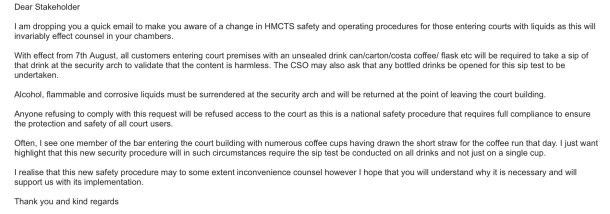
This is about the HMCS new security policy, on a national level, that anyone bringing liquid into Court has to take a sip of it, to demonstrate to security staff that it isn’t acid or some sort of hazardous liquid. That’s been going on for a while with bottled liquid, but it is now being extended.

I’m not sure why the product placement for Costa

(I didn’t write this and I already know that the author has misused ‘effect’)

Obviously, there are times when tempers run high in Courts, and of course sometimes people are attending Court where there’s a history of domestic violence and such, and one would never ever want a cup of acid to be thrown in such circumstances. And of course, one can only imagine the Daily Mail take if such a thing were to happen in a Court building – handwringing and demanding that heads must roll for not having anticipated it.

So I see where it comes from, particularly in light of the recent lurid headlines about acid attacks (and our own Home Secretary having not the slightest clue about what the actual sentencing provisions are for such offences are whilst playing to the “something must be done” gallery)

On the other hand, a minute application of common sense says that the reason why I and my colleagues and opponents don’t go about disguising acid as coffee and throwing it around at Court is NOT for fear of it being confiscated by Security guards (because hitherto we’d have got away with it) but because we’re not maniacs.

As an individual carrying a cup of coffee, the new scheme just causes a mild inconvenience – just taking a sip a little earlier than you anticipated. Not the end of the world.

This, however, does effectively put paid to the practice of coffee runs – where one person kindly goes to fetch coffees for a few other people. (Whilst the author of the email, who is not me, thinks that only counsel ever do this, of course others do it too. Doing a coffee-run, whilst you wait for the hearing to start, or wait for the windbags who went in first to finish, or for facts and reasons, is actually one of the few nice and civilised parts of attending Court. It seems a shame to lose it. )

If you have fetched four coffees and have to take a sip of each to demonstrate their safety, that’s going to rule out people like me who are happy to buy and fetch coffees for others but can’t drink them (because coffee is disgusting), or indeed anyone who prefers to drink their coffee untouched by the lips of others. It also avoids the prospect of someone saying “Does anyone fancy a coffee?” and you saying “ooh, me please” and then changing your mind as you realise that it is Malcolm Halitosis or Tina Moustache offering to fetch them…

(I would also point out that as a way of preventing “Alcohol” being brought in clandestinely, that asking the person bringing it in to sip it contains something of an exploitable loophole. Rather akin to asking the suspected heroin smuggler at an airport to go into a cubicle and do their own cavity searches)

Also, I’m not convinced that cardboard cups are a dream vehicle for transporting corrosive acid.

Cardboard goods are extremely sensitive to contamination. They must in particular be stowed away from colorants, acids, chemicals and fats/oils and be protected from dust and dirt.

How about polystyrene cups?

In the lab,polystyrene is melted and damaged by nearly every solvent.

Click to access MaterialsCompatability.pdf

I’m going to go out on a limb and say that anyone trying to transport corrosive liquid strong enough to injure a person is going to indeed injure a person with it if they try to do so in a coffee cup. That person will be themselves.

Glass bottles, and plastic bottles, possibly. And most Courts have been doing that at security for a long time, and it makes sense. Nobody is really going to object to that.

So if the coffee-cup sip test isn’t going to prevent alcohol (because the person bringing it is the person sipping it, and they will just stay silent) or corrosive liquids (because you’d detect that by the fact that the person’s shoes will be disintegrating) that only really leaves flammable liquids.

I think a sniff test would probably do the job there.

In the meantime, my loophole suggestion :- use a pen to write a message to the recipient under the lid, and assert your article 8 right to respect for private correspondence. (Suesspicious Mind note – this will not actually work, and will almost certainly make you late for Court whilst you argue Human Rights law with security guards, who will do their best to accidentally bang your shins with the metal detector wand and break the zips on your bag/suitcase every time they see you thereafter. So don’t do that)

“Oh my God, he’s got a pumpkin macchiato! Save yourselves! Get to cover” *(Not a coffee drinker, so is that even a thing?)

Benjamin Franklin, what do you want to tell us about whether the minute risk to our safety is worth sacrificing our freedoms?

If anyone wants to tell me in the comments section what the daftest thing they know has been confiscated by Court security, I’d love to hear it. I’ve been told this morning of peanut confiscation in case of nut allergy attack, and bike lights in case… you shine at the Judge??? Has anyone been asked to squirt perfume, or to apply spare lippy to make sure that’s really what it is?

You can’t have your kayak and eat it

(And yes, I did decide to write this one up because I couldn’t resist that joke)

Green v Adams 2017

This was a hearing following Mostyn J’s decision on mother’s application for financial provision for her child under Schedule 1 of the Children Act 1989. Mostyn J had made an order for such provision. The father appealed, unsuccessfully.

Subsequently, the father made an application to Court, aided by Dr Pelling (a name familiar to a lot of family practitioners he has actually had a lot of success as a MacKenzie Friend, including this somewhat pyrrhic victory but victory nonetheless of establishing that an assistant tipstaff assaulted him http://www.bailii.org/ew/cases/EWHC/QB/2004/492.html . I always enjoy a case with Dr Pelling in it – he really knows his way around the more obscure corridors of the law and when I refreshed my mind about the 57 cases that Bailli name-checks him in, he actually succeeds and is complimented for his manner and ability quite a lot of the time, and similarly, Mostyn J enjoys a good legal conundrum, so this had potential to be a fascinating judgment. Sadly, it disappoints, save for the kayak)

The father made an application that the Judge had in effect added things into the ‘pot’ that mother had not explicitly claimed for, that is the costs of a trip to China and the cost of a kayak. And that further, the figures that the Judge had calculated for these were too much, and that the lump sum father was ordered to pay was therefore too much.

http://www.bailii.org/ew/cases/EWFC/HCJ/2017/52.html

These two further points were, first, that the true cost of the trip to China referred to in my judgment of paragraph 1(iii) was £2,300 (which he had established by an email from the school) and, second, that the true cost of a kayak was no more than £500 (which he had established by Internet research). Therefore, he argued that in respect of these two items my assessment had been overstated by £350 and £300 respectively, a total of £650.

16.Accordingly, Dr Pelling argued that my lump sum of £20,600 was overstated by a total of £2,450 (i.e. £1,800 plus £650).

The Judge reminded himself that he did have the power to make awards for more than a person had actually sought.

However, I agree with Dr Pelling that if I was minded to go outside the field of battle as defined by the parties then the father should certainly have been given notice of my intention to do so. In any event, after having examined my memory, and even allowing for the considerable passage of time, I am satisfied that I did not intend to award the mother the full amounts and that I made a minor mistake. It is right that my judgment should be amended to reflect what I intended. Therefore paragraphs 1(ii) and (v) will be corrected to provide that the mother’s claim was for half the sums mentioned, namely £1,500 and £300.

19.However, on 13 July 2017, after the hearing and at a time when this judgment was largely completed, I received an email from Mr Holden which stated that the parties’ son had changed his mind about going on the educational trip to Israel this summer. Therefore, the mother would no longer pursue this head of claim and will repay the sum awarded.

20.The position is very different in relation to the claims concerning the China trip and the kayak. Here, the mother gave her best estimate of the historic costs. It was open to the father to challenge those figures and to adduce competing evidence. He did not do so and now is arguing that the court made its award on a mistaken basis. In my decision of DB v DLJ [2016] EWHC 324 (Fam) at paragraph 57 I stated at (ii) and (iii) that the claimant (that is to say the father in this case) must show that the true facts would have led the court to have made a materially different order from the one it in fact made, and that the absence of the true facts must not have been his fault. In my judgment, a correction in respect of these two items of £650 does not satisfy the criterion of a material difference and in any event I am not satisfied that the true facts could not have been placed before me by the father. I do not allow these corrections.

21.My conclusion is that the mother must repay to the father £3,300 (i.e. the full amount of the Israel trip – £3,000, and half the cost of the computer – £300) against which I offset her award of costs made above of £857, leaving the sum of £2,443 to be repaid.

There was also an application that the judgment should be anonymised, but we can all deduce what the conclusion of that was from the name of the case.

22.I now turn to the father’s application for further anonymisation of the main judgment. He says that the extent of anonymity given by me to the properties in paragraph 14 of my judgment is not enough, and that fictitious numbers and initials should be given. He says that there is a risk of jigsaw identification and a real danger of the people who live at those addresses been targeted by criminals. I am slightly surprised that this submission should be made by the father through Dr Pelling having regard to their trenchant resistance to any form of anonymisation in the proceedings in the Upper Tribunal heard by Mr Justice Charles and reported publicly as Adams v SSWP and Green [2017] UKUT 0009 (AAC). However, I am not satisfied that any further anonymisation is necessary, and this request is rejected.

(Seriously, I really did select this case on the basis of the kayak pun. I’m here all week, try the chicken)