Author Archives: suesspiciousminds

Low level falls and head injuries


This is a case decided by Recorder Howe QC, and it is not binding precedent, and also of course it turns on the individual facts of the case, but it does seem to me to have wider interest and implications on what the medical professionals said about whether a fall from a low level height could cause the sort of bleeding on the brain (subdural haematomas) which are often linked with non-accidental shaking injury.  There was also a skull fracture about a month later.

In this case, the parents account was that the only incident of note was the child, 11 months old, had been standing, holding onto the back of a chair for support and had fallen backwards and banged his head on a laminate floor. The skull fracture they say was caused when the child fell and hit his head on a kerb.

Could that have caused the serious injuries that he sustained?


Re N (A child: Low level falls) 2016

http://www.bailii.org/ew/cases/EWFC/OJ/2016/B29.html

Regulars may have picked up that there is a lot of controversy about subdural haematomas and how they might be caused and whether there can, in some cases, be a more benign explanation. The subject even made the national news when Dr Waney Squier was struck off by the GMC for having a view that they considered to be out of step with mainstream thinking.

Here is what the experts said on this case, and I think it is very candid about the limitations of medical science and that the field develops and moves on.  As indicated earlier, much of what is said relates to the very particular set of circumstances of this particular case, but some passages have potential wider interest. I’ve tried to underline these.


The Evidence Presented at the Hearing

The Expert Evidence

  1. I have had the advantage of written and oral evidence (by video link) from 3 very experienced experts who regularly provide reports for family and criminal court proceedings. Dr Patrick Cartlidge is a Consultant Paediatrician, a senior examiner for the Royal College of Paediatricians and Child Health and a senior examiner for Cardiff University. Dr Alan Sprigg is a Consultant Paediatric Radiologist based at Sheffield Children’s Hospital with a special interest in the imaging of suspected non-accidental injury involving cranial and skeletal injury. Mr Peter Richards is a Paediatric Neurosurgeon based at The John Radcliffe Hospital in Oxford hospital. All 3 experts maintain clinical NHS practices in addition to their medico-legal work and are very well placed due to their qualifications, years of experience and current clinical work to provide expert opinion concerning the likely causes of the injuries suffered by N.
  2. I have had the advantage of written and oral evidence (by video link) from 3 very experienced experts who regularly provide reports for family and criminal court proceedings. Dr Patrick Cartlidge is a Consultant Paediatrician, a senior examiner for the Royal College of Paediatricians and Child Health and a senior examiner for Cardiff University. Dr Alan Sprigg is a Consultant Paediatric Radiologist based at Sheffield Children’s Hospital with a special interest in the imaging of suspected non-accidental injury involving cranial and skeletal injury. Mr Peter Richards is a Paediatric Neurosurgeon based at The John Radcliffe Hospital in Oxford hospital. All 3 experts maintain clinical NHS practices in addition to their medico-legal work and are very well placed due to their qualifications, years of experience and current clinical work to provide expert opinion concerning the likely causes of the injuries suffered by N.
  3. The 3 experts participated in an experts’ meeting on 11 th February 2016 and the transcript of that meeting is found at E152 of the court bundle. The transcript records a very large measure of agreement between the experts that can be summarized in relatively short form. All 3 experts accepted that the fall described by the parents on 9 th August 2015 could cause the intracranial injuries discovered [the August injury], although such significant injury from a fall from standing would be very unusual. Mr Richards was of the opinion that the significant interference with the functioning of the brain was also very unusual from such a low fall. Despite the unusual features, the experts would accept the account given for the August injury to be a credible explanation.
  4. Concerning the September injury, the experts agreed that no convincing explanation had been given as to how N had suffered this fracture. They were all of the opinion that the explanations offered by the parents were very unlikely to cause a skull fracture and, in the absence of a credible explanation, this was likely to be an inflicted injury. They were all of the view that, as the September injury was more likely to have been non-accidental, when taken together with the unusual features of the August injury, this increased the likelihood of the August injury also being caused by an inflicted event.
  5. When giving their oral evidence, what had appeared to be a large measure of agreement between the experts did, due to the well targeted and effective questions put to them by all 4 advocates, fall away with respect to a number of important matters. This was not, in my judgment, wholly unsurprising given that each expert answered the questions from the perspective of their own particular specialisms and their own clinical and medico-legal experience. However, the divergence of views produced an additional element of complexity to the determination of the local authority’s allegations against the parents in this already complex case.


Head Injuries Caused by Low Level Fall

  1. For the local authority to succeed on the primary threshold findings it seeks, it has to prove on the balance of probabilities that the explanations provided by the parents are not how these injuries were caused. It is not for the parents to prove that the injuries were caused by the low level falls that they have described.
  2. When he gave his oral evidence, Mr Richards said the following [my note]: “This is a debate [whether low level falls can cause intracranial injury] that is lively at the moment. I was recently in a telephone conference involving a number of experts. Dr Cartlidge was involved and making a point about these cases and there were some rather heated exchanges about the possibility of low level falls causing serious injury. The vast majority of low level falls are not imaged. Of those that are, neuro-radiologists will say that low level falls, of the type N had, cannot cause multi-compartment bleeding and, therefore, the story given by the parents must be untrue. I, like Dr Cartlidge, say ‘can you say that on the data we have’? I say we don’t know.

A decade ago, apart from the babies that died, it was said that birth did not cause subdural haemorrhages. 3 research projects have now demonstrated that it does and it is now universally accepted that birth causes subdural haemorrhages in about 50% of babies. The medical profession were wrong before. Low-level falls may be similar. We can’t do routine MRI scans of children of this age as they have to be given anaesthetic to keep them still. The reason that these children are not imaged is because the majority just get up from a fall and have no injury. Very few have any disturbance for 1 or 2 days and even fewer for a longer period”.

  1. At paragraph 23 of his report dated 16 th December 2015, Mr Richards said “patients with such low level falls are rarely imaged on the grounds that there is no neurological disturbance from such falls, so we do not really know the number of low level falls which do cause fresh subdural bleeding. In those that are imaged it is extremely rare to identify fresh subdural bleeding.”
  2. In his report to the court, Dr Cartlidge said, at page 19, ” It is probably very unusual for such a short-distance fall to cause subdural bleeding, although I agree with Mr Richards that it could be more common than currently appreciated since neuro-imaging might not be undertaken in such cases. I have professional experience of a similar low-distance fall causing subdural bleeding in two infants (findings of Family Courts). Initial symptoms in my experience are often akin to those seen in reflex­ anoxic episodes.
  3. When he gave his oral evidence, Dr Cartlidge said that children would usually stand with soft knees and if he did have that typical stance, and he had some saving reflexes, he would not perform what Dr Cartlidge described as a ‘matchstick fall’ (a straight fall backwards with a stiff body). Dr Cartlidge was of the opinion that by far the most likely response from a child of this age would be a bending of the knees and a fall onto his bottom. However, Dr Cartlidge went onto describe the circumstances of 3 cases he has encountered in his medico-legal work where the family court accepted that an injury had been caused by an accident or had not found the allegation of non-accidental injury to be proved. The detail given by Dr Cartlidge in his oral evidence was supplemented by a later e-mail that all advocates agreed I should consider. The details of the low-level fall cases referred to by Dr Cartlidge included the following:

1 case involved a 42-week old who fell about 65 cm from a bed. There was a brief acute encephalopathy (interference with the functioning of the brain), subdural bleeding over a cerebral hemisphere and in the posterior fossa (the part of the brain at the top of the brain stem underneath the cerebral hemispheres) and acute traumatic effusion (an acute effusion appears similar to chronic subdural haemorrhage on the initial CT scan (as black fluid) but is due to an acute tear/rent in the arachnoid membrane allowing normal cerebrospinal fluid (seen as black on CT scans) from the subarachnoid space to cross into the potential subdural space. This causes a black fluid collection of cerebrospinal fluid (CSF) in the subdural space due to recent trauma that mimics the appearance of an old subdural haemorrhage from a prior injury). There was subdural blood in the thoracic, lumbar and sacral spine and bilateral retinal haemorrhages. The Family Court found the injuries to be accidental.

A second case involved a 35-week old who fell from standing (about 70 cm). There was acute encephalopathy after initial crying for some 2 minutes and a large subdural haematoma (space-occupying). There were also retinal haemorrhages. The Family Court found the injuries to be accidental.

In the 3 rd case a 52-week old fell from standing (about 70-75 cm). There was mild or possibly absent acute encephalopathy. Subdural bleeding was present over a cerebral hemisphere and in the posterior fossa. Acute traumatic effusion was present. There was subdural blood in the lumbar spine and bilateral retinal haemorrhages. The Family Court found the injuries to be accidental.

  1. I must decide the facts in this case on the evidence that I have heard about this child and not be swayed by comparisons to other cases involving different children and different facts. However, Dr Cartlidge’s purpose in highlighting these other cases was to provide clear examples to support his opinion that children can suffer what he described as ‘nasty intracranial injuries’ when falling from standing.
  2. At page 21 of his report, Dr Sprigg says “Subdural haemorrhages may occur following a known traumatic event involving a significant impact, e.g. being dropped forcibly onto the baby’s head from a significant height or hitting a hard object at speed. In older children they can occur during accidents -eg getting knocked over by a car. They are exceptionally rare from low-level domestic falls in infants. The site of bleed in accidental injury is usually physically related to the site of impact over the cerebral hemisphere. Subdural bleeds in non-accidental injury are more often over both hemispheres and may also be seen in the posterior fossa near the cerebellum near to the craniocervical junction. This is a rare site for accidental trauma”.
  3. At page 13 of his report, Dr Sprigg sets out “the finding of posterior fossa bleeding is more commonly seen in non-accidental head injury (NAHI) but it is recognised in significant accidental impact to the back of the head”.
  4. In his oral evidence, Dr Sprigg told me that the bleeding seen on the scans was consistent with a shake or an acceleration/deceleration event. He said that there was bleeding over both sides of brain and at the base of the brain. His evidence was that this is a pattern that is commonly seen in shaking cases but it can also occur if there is a significant bang to the back of the head.
  5. It was Dr Sprigg’s opinion that the bleeds found on 11 th August 2016 [the August injury] could have happened by a short fall but it would be uncommon. When cross-examined by Ms McFadyen, Dr Sprigg told me [my note]

“A fall to the floor as described is acknowledged as a mechanism that can cause this intracranial injury. Most children would not suffer any injury from such a fall. Some may suffer a skull fracture. It is uncommon to find bleeding over both hemispheres and at the cerebellum but it is possible. If the history had been that he fell on his forehead, I wouldn’t agree that the explanation was consistent but as he fell onto the back of his head, where all the veins gather and is an area vulnerable to injury, it is a credible account. Had this occurred at our hospital, it would have been said that this was feasible”.

  1. Having heard all 3 experts give their oral evidence, I formed the clear impression that they were each open to the real possibility of such low level falls, of the kind described by M and F as occurring on 9 th August 2015, causing the intracranial injuries seen on the 11 th August scans. Indeed, Mr Richards and Dr Cartlidge were more open to this kind of mechanism being an accurate account for the causation of such significant bleeding than they would have been in years past. There was no hint of dogmatism from any of the 3 experts; they were open to considering both the rare and the unusual.
  2. Mr Richards, Dr Cartlidge and Dr Sprigg carried this openness to considering the unusual and rare through to their consideration of the potential causes of the skull fracture discovered on 14 th September.
  3. In his report dated 24 th November 2015, Dr Sprigg provides a detailed account of the possible causes of skull fractures. He describes:

“A skull fracture is commonly due to a forceful impact. This may be due to the head hitting something hard, or a hard object hitting the head with significant force. An infant may have an accidental skull fracture but this depends on its level of mobility. For example, a two month old baby is not sufficiently mobile to self inflict a skull fracture, but a ten-month old that is crawling and falls downstairs might self inflict a skull fracture. An infant’s skull is flexible and tends to bend rather than fracture. It takes significant force to fracture an infant’s skull. As a generalisation under 1-2% of infants will sustain a skull fracture if they are dropped from below adult waist height. However, if the fall is from a greater height this is more likely to produce a fracture than a low level fall. When the fall is onto a hard surface (eg concrete or laminate flooring) versus a more compliant surface (eg carpet with under-felt over floorboards) then the harder surface increases the chance of fracture. A free fall (drop) involves less force of impact than if a baby is thrown down. Occasionally skull fractures occur related to birth. They are uncommon, but have a higher incidence in a difficult forceps delivery than ventouse or than in normal vaginal delivery of a normal sized baby”.

  1. When he gave his oral evidence, Dr Sprigg was of the opinion that either fall described by M (from sitting or from standing) [the September injury] would be unlikely to cause this skull fracture but could not be excluded as impossible. When answering questions from Ms McFadyen, he told me “If this was an isolated event and the history was that he had fallen over to the right and had come straight into casualty, it would be accepted as an accidental event. There is a skull fracture rate of below 1 to 2 % if a fall is from below adult waist height but had he been presented quickly with a consistent history, the explanation might have been accepted”.
  2. Mr Richards’ mind was similarly open to the possibility of the fall as described by M being a possible cause of the skull fracture. He told me that a low level fall would be unusual for causing a skull fracture and a drop of about 82 cm is usually required to cause a fracture from research undertaken with deceased infants. However, he would not rule it out as impossible but it would be a very rare event.
  3. Similarly, Dr Cartlidge would not rule-out any event as being impossible but was more sceptical that the simple fall, of either type described by the mother, would cause a skull fracture. It was put to him that it may have been that N fell and hit his head on the kerb. When considering this scenario, Dr Cartlidge said [my note] “the right side of the head is the site of the fracture. The shoulder is in the way and for the shoulder not to be in the way, I struggle to see how the right side of head would bear the full brunt of the force of the fall but if you get over that and the head pivots over his neck and hits the edge of the kerb, that could cause the fracture”. That was about as close as Dr Cartlidge would be drawn toward accepting that the fall described was, of itself, a possible mechanism.
  4. Having considered the fall proposed for the September injury in isolation, each expert relied on important contextual facts as indicating that the fall described on 6 th September 2015 would not have caused the fracture to N’s skull.
  5. Establishing a timeframe for the causation of the skull fracture and identifying whether the evidence reasonably excludes the 6 th September, a date some 8 days before the fracture was discovered on the scans as a day within that timescale, is a crucial matter for the court to consider when determining whether the local authority has proved that this alleged fall was not responsible for the skull fracture.
  6. When looking at the timing of skull fractures, there was no dispute between the experts as to limits of radiological evidence. Dr Sprigg described in his oral evidence that once a skull fracture is present, it can be seen for 3 to 6 months on the x ray, as there is no healing periosteal reaction. He said that the fracture can only be said to be recent if there is swelling present over it and that swelling is present for around 7 to a maximum of 10 days. The identification of scalp swelling, what type of scalp swelling was present and how long a swelling would be present became an issue between the experts upon which they did not agree.
  7. In addition to the identification of swelling, all 3 experts agreed that the clinical presentation and the clinical history was crucial in identifying a reliable timescale for the causation of a skull fracture. The immediate pain reaction of a child was a matter upon which the experts agreed however, the duration of a visible pain reaction when touching the site of injury, and its relevance to the timeframe for the injury, was not a matter upon which Mr Richards and Dr Cartlidge agreed.


In this case, the threshold was found to be satisfied in relation to the skull fracture in September 2015 (changed from previous inaccurate year on my part), the evidence of the parents being a relevant factor and the lies that they were found to have told about various matters.


There was not a finding that they had caused an injury in August by shaking the child and the Judge was satisfied by the parents explanation for this injury.

141.                      As already described, N was admitted to hospital on 9 th August 2015. M and F gave an account of him falling and hitting his head. The treating doctors at Birmingham Children’s Hospital accepted that the fall described was an acceptable explanation for N’s presentation.

  1. I have heard evidence from Mr Richards, Dr Cartlidge and Dr Sprigg and all 3 experts would accept that the fall described could account for the subdural bleeding found.
  2. Mr Richards says at §2.4 on E66 that there was no evidence of impact either clinically or on neurological imaging and he thought that unusual given that N’s behaviour was disturbed for so many days. He also thought it very unusual that such a low fall would, of itself, cause such significant symptoms. In his oral evidence he said subdural haemorrhages can have no symptoms at all and those seen on N’s scans were very thin and not compressing the brain. He said there was no other brain injury so, would not expect the haemorrhages to cause any symptoms at all, the symptoms have come from the way the brain was functioning and it was not functioning right with for 5 or 6 days. It was Mr Richard’s opinion that such a level of disturbance would require a harder bang on the head. He said that he would only expect to see disturbance of brain function of 24 to 48 hours so disturbance for longer would be consistent with a harder level of force. He said it was very very unusual if this was caused by this the low level fall.
  3. Dr Cartlidge and Dr Sprigg in the expert’s meeting on 11 th February and in their oral evidence acknowledged the unusual features of the case as outlined by Mr Richards but all 3 experts accepted the fall described as a possible mechanism for N’s presentation.


       I understand the approach taken by the experts that the unsatisfactory nature of the explanation given by the parents for September injury increases the likelihood of the August injury being an inflicted event. However, I have had the advantage of seeing MK give evidence. This was a witnessed fall and not, in my judgment, an event that has been invented. I find that there is no evidence of any other intervening event that has caused this injury and the local authority is simply speculating that M must have injured N at some point overnight or during the day on 10 th August. N’s presentation was consistent with a pattern recognised by Dr Cartlidge and although the experts could not exclude a 2 nd event, they were of opinion that one event was the most likely explanation. I accept their expert opinion and find that the one event that was witnessed by MK caused this August injury.


Something something oranges something part 2


You may recall the recent Holman J case in which a 16 year old subject of care proceedings had told the social worker and Guardian something personal which he did not want his parents to know, and the social worker and Guardian were divided as to whether this was something which could legitimately be kept from the parents


Something something oranges something

The application, this time with the parents represented, was decided by Mrs Justice Roberts.

Local Authority X v HI and Others 2016


http://www.bailii.org/ew/cases/EWHC/Fam/2016/1123.html

It raises some interesting questions.

The Court was aware of what the information was, as were the social worker and the Guardian. The mother and father did not know what it was. All of the barristers knew the information, having agreed (upon instructions from their clients) that they would know it but not share it with them.  It is almost impossible to fathom what the parents counsel were supposed to do if the parents were making guesses as to what it might be – save for just being plummy and saying “I can’t indulge in speculation”

The parents, who were the only people in the room who didn’t know what their son’s personal information was,  really then had to work on the basis of Holman J’s categorisation of the information

  1. As to the substance of the information which I has shared, it was described by Holman J in an earlier judgment[1] in this way:-
    1. “Relatively recently, the child concerned imparted some information to a social worker, which he has repeated also to the guardian. I stress that the information does not relate or pertain at all to either of his parents or his stepmother, but relates and pertains essentially to himself. Nothing in the information is in any way critical of anything done or not done, or said or not said, by either of his parents or his stepmother. The child himself has said very strongly that he does not wish either of his parents or his stepmother to know the information in question. The guardian considers that that confidentiality should be respected and that the information should not be disclosed or revealed to either of the parents or the stepmother. The local authority are very mindful and respectful of the confidentiality of a 15-year old child who is in their care, They do not consider that, realistically and objectively, the information could or should affect any issue at the forthcoming final hearing of the care proceedings. But they do consider that if one or other or both parents did know the information, one or other or both of them might wish to seek to deploy it in some way as part of their case in the care proceedings.” (The emphasis is mine.)

The argument came into these two camps

A) The Guardian arguing that just as a doctor has a duty of confidentiality to a young person who has capacity (see Gillick) so do a social worker and Guardian have a similar duty if a young capacitous person tells them something and says that they want it to go no further.  (also relying on the  PD v SD, JD and X County Council [2015] EWHC 4103 (Fam).  which was the young person who wanted to undergo gender reassignment and did not want his adoptive parents to have any detailed information)

Thus, on the Guardian’s case as advanced by Dr Bainham, the duty of confidentiality which was found to exist as between a Gillick competent child and a doctor or other medical professional advising on, or offering, medical treatment would necessarily be extended so as to cover social workers and other professionals engaged with the young person concerned.

B) The Local Authority and the parents arguing that that was correct IF the case was not in Court, but once there were Court proceedings, the Article 6 right to fair trail would outweigh such a right to confidentiality, unless there were compelling circumstances.

  1. Specific guidance in relation to the obligations on a local authority in care proceedings was provided by Lord Mustill in the leading case of Re D (Minors)(Adoption Reports: Confidentiality) [1996] AC 593. At page 615 D to H, his Lordship set out five principles with which the members of the full court were in agreement.
    1. “1. It is a fundamental principle of fairness that a party is entitled to the disclosure of all materials which may be taken into account by the court when reaching a decision adverse to that party. This principle applies with particular force to proceedings designed to lead to an order for adoption, since the consequences of such an order are so lasting and far-reaching.

2. When deciding whether to direct that notwithstanding rule 53(2) of the Adoption Rules 1984 a party referred to in a confidential report supplied by an adoption agency, a local authority, a reporting officer or a guardian ad litem shall not be entitled to inspect the part of the report which refers to him or her, the court should first consider whether disclosure of the material would involve a real possibility of significant harm to the child.

3. If it would, the court should next consider whether the overall interests of the child would benefit from non-disclosure, weighing on the one hand the interest of the child in having the material properly tested, and on the other both the magnitude of the risk that harm will occur and the gravity of the harm if it does occur.

4. If the court is satisfied that the interests of the child point towards non-disclosure, the next and final step is for the court to weigh that consideration, and its strength in the circumstances of the case, against the interest of the parent or other party in having an opportunity to see and respond to the material. In the latter regard the court should take into account the importance of the material to the issues in the case.

5. Non-disclosure should be the exception and not the rule. The court should be rigorous in its examination of the risk and gravity of the feared harm to the child, and should order non-disclosure only when the case for doing so is compelling.”


Obviously an important issue to resolve – young people do tell social workers and Guardians things, and sometimes they would prefer that their parents did not know. If the Guardian is right here that the approach should be in line with Gillick, then the decision would be made by the individual social worker and Guardian, and if not, the decision would be made by the Court, with non-disclosure being the exception and not the rule.


In the context of the present application, it is important to state that the information in respect of which I seeks to maintain privacy is not information which will have a bearing on any evaluation undertaken by the court in relation to the issue of whether or not the care which the second and fourth respondents have given, or may give in future, to I is likely to cause him to suffer significant harm such as to justify the making of a final care order. In my judgment, it will have no bearing whatsoever on any judicial investigation into the quality of the care they have provided in the past or the care they are likely to offer to I in the future in terms of the sort of care it would be reasonable to expect a parent to provide. Further, the local authority accepts that the information has not, and will not, affect or influence their decision-making for I in terms of the final care plan which is now before the court.


It would be very difficult to withhold from the parents information which went to whether a particular allegation in the case was true or false, or where the child was expressing a view about where his future home should be, but in this case, the Court was saying that the information was personal and not something that would have any bearing on the outcome of the case.

Father’s counsel disagreed,

  1. In his written skeleton (para 117), Mr Day on behalf of I’s father says that his client wishes to utilise the material at the forthcoming final hearing. He raises concerns that I “will become involved [in] gang culture and criminality and that corporate care will not be in his best interests. The sensitive information very much supports and grounds that contention and is required for there to be a fair trial.”
  2. With respect to Mr Day (who knows the nature of the confidential information), I can see no correlation at all between the information which I has imparted and the likelihood of his becoming involved in gang culture or the sort of criminality which is sometimes associated with such involvement or membership. The link between the two is not even tenuous in my judgment. Furthermore, the statement of intent to use the information at the forthcoming trial is made in an evidential vacuum. As matters stand, I’s father does not know anything about the information and he will not know unless and until the court authorises its disclosure. Mr Day seeks to widen the ambit of his assault on confidentiality by asserting that the material is relevant to that part of his client’s case which relates to an allegation that the local authority will not provide appropriate care for I if a final order is made. It seems to me that this is a matter for the trial judge who will be responsible for scrutinising with the utmost care the final plan advanced by the local authority.


What was the right test? And was the information relevant?  The Judge decided this


Analysis and Discussion

  1. The local authority was absolutely right to make this application. In my judgment, Holman J was also absolutely right to rule that the matter must come back to be dealt with on notice to the respondents.
  2. In terms of the correct approach to the issue of disclosure, I do not accept that I can consider issues flowing from I’s ‘personal autonomy’ in a vacuum. In my judgment, Mr Day is correct on this point. Gillick and Axon were both cases which did not involve any consideration of the engagement of Article 6 rights. In each, the applicant was seeking declaratory relief but no more. In this case, both Article 6 and Article 8 rights are engaged and accordingly the Re D test must form a part of the overall balancing exercise which I have to perform. However, it seems to me that the principles to emerge from Gillick and Axon become relevant at the stage of the balancing exercise where judicial focus is on the welfare of the child or young person. Respect for his or her views and the consequences of overriding those views where they are genuinely and strongly held must, in my judgment, form part of those welfare considerations.
  3. Dr Bainham makes the valid point on behalf of the Guardian that if Gillick principles are not accorded priority, any ‘looked after’ child in these circumstances would be at a disadvantage since his views would be accorded less respect because of the fact that he is at the centre of contested care proceedings. Whilst I can see the force of that submission, it does not in my judgment mean that I can disregard the equally important considerations which flow from the engagement of the respondents’ Article 6 rights. I’s views are important. They are entitled to considerable respect but they are one aspect of the overall balance which has to be achieved in this case. In my judgment, they are not determinative of outcome. Further, the fact that neither of his parents is currently exercising day to day parental care for I does not dilute the parental responsibility which they currently share with the local authority.
  4. The first question which must be addressed is that of relevance. Nothing which was said by I impinges upon, or affects in any way, the local authority’s case in relation to the respondents’ allegedly deficient parenting. On behalf of the local authority, Mr Krumins submits that it is important to distinguish in this context between the relevance of the information and the weight which can properly be attached to it. In relation to relevance, he contends that the threshold is low. Nevertheless, he concedes that the information is unlikely to assist the trial judge and will ultimately make no difference to outcome. I bear in mind the observation of Thorpe LJ in Re M (Disclosure) that if there is anything within the local authority’s care plan which gives rise to concerns, that may well be adverse to the respondents’ case should disclosure be withheld. However, where the principal challenge to, and defence of, the care proceedings amounts to a denial by the second and fourth respondents of the poor parenting which gives rise to the perceived risk of significant harm to I, it is difficult to see how a care plan which involves removal from that harmful environment can be said to raise independent concerns. That will be the central issue for the trial judge to determine.
  5. I have significant concerns about whether or not the information for which protection is sought is truly relevant to these proceedings. Whatever subjective views Mr Day may seek to advance on behalf of I’s father, it is difficult to see how any objective analysis of the information could lead to the conclusion that it has any relevance to the issues to be determined later this month. However, for the purposes of my judgment and on the basis that Mr Day is right and it has some tangential (or greater) relevance, I must go on to apply the balancing test set out in Re D.


Having decided to approach the matter on the Re D principles, the Judge went on to consider whether disclosure would present some risk of significant harm to the child


  1. Thus, the next question to be answered is whether disclosure of this information would involve a real possibility of significant harm to I.
  2. The Guardian and the local authority are not agreed on this aspect of the case. The local authority accepts that disclosure would be likely to expose I to an awkward and embarrassing situation, but no more. Within the material which has been put before the court is a statement prepared by a social worker on behalf of the local authority. It is dated 8 April 2016. In that statement, the social worker, AB, expresses the view that I may be embarrassed or ashamed as a result of disclosure. However, she acknowledges, too, that he may in future be reluctant to share information with professionals if the information is revealed to his parents against his wishes. Her statement also raises an issue as to whether what he said was true in any event.
  3. The concerns of the social worker find strong reflection in the Guardian’s evidence. She tells me that, knowing what she does about I’s father and step-mother, she believes neither ‘would … be able to respond to the information in a child-centred way at all, and that this could have emotionally devastating consequences for [I]’. She sets out in her evidence a report which she had received from a colleague who was present at a recent LAC review which was attended by I’s father and step-mother. One of the issues for discussion on that occasion was their willingness to engage in some work with an appropriate professional in order to assist their understanding of I’s needs. Their presentation on that occasion was said to be “extremely oppositional, even in [I’s] presence”. The report which emanated from that meeting is recorded in the body of the Guardian’s statement in this way.
    1. “It was appalling … [I’s father] totally took over, attempting to intimidate the professionals, leading to … [I] putting on the hood of his jacket and pressing his forehead onto the table in what appeared to be a combination of anxiety, frustration and sheer embarrassment. His wife [I’s step-mother] then started a wholly inappropriate and crass attack on the social worker – how can she do the job at her age, not having children. Basically, following father’s continued ranting and finger-pointing at me, I had no choice but to prematurely bring the review to an end. I’m far from convinced that the LA should be promoting contact for [I] with them. Before there can/should be any relationship work undertaken, perhaps father in particular should be advised to see his GP regarding having anger management and/or counselling. He certainly won’t be invited to the next review unless he makes some radical changes.”
  4. The Guardian expresses her very real concerns that the good relationship which I has managed to establish with his social worker and foster carer may be damaged by disclosure of the information which he wishes to keep private. Those relationships are important to him because they enable him to confide in these professional carers and, in turn, to receive appropriate support and guidance. To override his express wishes may undermine his trust in professionals making it difficult for them to offer the level of help and support from which he has so clearly benefitted to date. This would be entirely counter-productive and inimical to his best interests. She has no confidence in either the father’s or step-mother’s ability to respond appropriately or sensitively to something which I regards as a personal and embarrassing episode and she regards the prospects of disclosure as being ‘highly detrimental’ to his welfare.
  5. Thus, it seems to be common ground that disclosure to the parents will cause I emotional upset and some distress. The disagreement centres on the level of emotional harm and whether or not this is likely to be “significant”.
  6. On behalf of the father, Mr Day submits that “the worst reaction could be that the father is dismayed, disappointed and at worst may remonstrate with his son”. On behalf of I’s step-mother, Mr Fletcher reminds me that I has been told by his social worker that it is not possible for her to provide him with a guarantee that anything he tells her will remain private as between them. He points to the absence of any direct statements by I himself as to his fear of his parents’ reaction. He invites me to consider whether any perceived harm could be mitigated by putting in place safeguards so as to ensure that I was protected from any such reaction from his father and step-mother as that anticipated by the Guardian.
  7. I have to bear in mind that I is a very vulnerable young man. He is not yet 16 years old and has already been the subject of two separate sets of care proceedings. He has been found to have suffered neglectful and abusive parenting at the hands of his mother. His experience of life was fractured when he left his home with her to live in a completely different part of the country with his father and step-mother. His unhappiness and distress in that placement is reflected in his attempts to abscond and his absolute resistance to any return to that household and any form of continuing relationship with his father and/or his present wife. Whilst I accept that it is an untested account, I regard the record of what transpired at the recent LAC review as providing a valuable insight into what I is likely to be experiencing at the present time in terms of the conflict which appears to exist between his family and the professionals who are currently caring for him. The picture of I which emerges from the record of that meeting is one of a young man who has few, if any, coping strategies for dealing with that conflict. I do not accept that the absence of a specific reference by I to fear of his father’s reaction should lead me to a conclusion that he has no such fear. On behalf of the mother, Miss Bartholomew supports the Guardian’s position that there is a real risk of further significant harm to I in the event of disclosure. She records in her written submissions the mother’s historic and ongoing concerns about the aggressive and inflexible behaviour demonstrated by his father. She is concerned that his reaction to the information may well place I at risk of significant harm.
  8. In my judgment, whether one applies the label of “significant” or “real” harm to the question, there is indeed a real possibility of significant and detrimental harm to I if this information is disclosed. In his evidence in response to the local authority’s case, I’s father has denied entirely that his son is suffering, or has suffered, from any significant emotional harm. He accepts that he has shouted at I but justifies this on the basis that, “If you don’t stand up as a parent, the children are going to walk on you”. It is said that he referred to I in highly derogatory terms because of his educational difficulties. He does not admit using any such inflammatory terms but still refers to I in his statement as “this little boy”. I am satisfied that there is a clear risk that the consequences of disclosure of this material may well result in I’s disengagement from the professionals who have provided him with guidance and support since his reception into care. He has been damaged by his experience of family life in recent years and findings in relation to threshold have already been made in the context of the interim care order which sanctioned his removal from his father’s home. If his current support structure were to be put at risk for any reason, he may well withdraw and internalise issues thereby putting his happiness and future wellbeing at significant risk.
  9. I bear in mind, too, that whether or not the trial judge makes a final care order at the conclusion of these proceedings later this month, any prospect of repairing the relationship between I and his father will inevitably have to involve some form of therapeutic input from an appropriate professional or professionals. In this respect, it is essential that I believes that he can repose trust and confidence in those professionals and the care and support they will be providing. It would be harmful to him, and significantly so, if the chance to restore some form of relationship between parent and son in future were jeopardised because of a disclosure now of information which he regards as confidential.


The next step was to balance the article 6 rights and article 8 rights.


  1. In these circumstances, the final step is to weigh the interests of the respondents in having the opportunity to see and respond to the material. This involves a rigorous consideration of the engagement of their Article 6 and Article 8 rights.
  2. Given what I have already said in my judgment, I can dispose of the issue in relation to their Article 8 rights in fairly short order. These rights, whilst engaged, cannot take precedence over I’s Article 8 rights and he is clearly expressing a wish for no communication with his father or step-mother at the present time. As Yousef makes clear, the child’s rights are the paramount consideration in any balancing of competing Article 8 rights.
  3. As to the respondents’ Article 6 rights, the relevance of the information to outcome has already been addressed. In my judgment, it is of tangential or minimally indirect relevance at its highest and is completely irrelevant at its lowest. The local authority accepts that it will not impact upon outcome or future planning for I. The respondents’ rights to a fair trial are, of course, absolute but, as Lady Justice Hale acknowledged in Re X, in deciding how to conduct a fair trial, it is perfectly reasonable to take account of the facts and circumstances of the particular case with which the court is dealing. The concept of a fair trial is inviolable but the content (including the evidence) which is placed before the court is flexible and depends upon context and the issues with which the court is dealing. Whilst I accept that any departure from the usual requirements in relation to the disclosure of evidence in an adversarial trial must be for a legitimate aim and proportionate to that aim, the Court of Appeal has held that protecting the welfare of vulnerable young persons is a specific and undoubtedly a legitimate aim.
  4. In my judgment, the harm which would be caused by disclosure of information which has very little, if any, relevance to the issues which need to be determined by the court would be wholly disproportionate to any legitimate forensic purposes served. I am entirely satisfied that depriving the respondents of the opportunity to have this information will not deny to any of them a fair trial. Disclosure would, however, be a breach of I’s Article 8 rights.
  5. Considering all these matters in the round, I have reached the clear conclusion that the case for non-disclosure of the information which is the subject of the Guardian’s current application is compelling. The circumstances of this case, looked at in the round, do make it exceptional and I regard it as entirely necessary that I’s confidence and privacy in this information is maintained. I cannot overlook the fact that, as a Gillick competent young person, he has expressed in the clearest terms his wish that the family should not have access to the information. Those wishes deserve the court’s respect, albeit in the context of the overall balancing exercise which I have conducted


This particular passage has some broader significance – the right to a fair trial does not mean that a person gets to run the case exactly as they please, the Court controls the content and nature of the hearing whilst still having the duty to secure that the trial is FAIR


The concept of a fair trial is inviolable but the content (including the evidence) which is placed before the court is flexible and depends upon context and the issues with which the court is dealing


Finally, the Judge recognised that the parents knowing that something was being kept from them (even if most of us can guess what it might be) was difficult


Finally, I would conclude by echoing the words of Holman J which are exquisitely apt in this case. I, too, am deeply conscious that whenever disclosure issues of this kind arise, there is inevitably a problem once parents or other interested respondents are put on notice that there exists some information in respect of which the court has supported an application for non-disclosure. As Holman J observed, ‘”conspiracy theory” and imaginings may inevitably take over’. The parents and step-mother may well be concerned that the information is graver than it actually is. I would hope to reassure them by my finding in relation to the likely relevance of the information to the issues which are at stake.

Megalomania and physics

I did a sort of interview thing for This Lawyer’s Life last week, and it occurred to me that some of my readers might not have seen it, so here is the link.

Monday Man : This Lawyer’s Life: Andrew Pack aka Suesspicious minds

There was originally a photograph of me on the piece, but I soon got rid of that. I could not be responsible for bills for cracked laptop and ipad screens.


This Lawyer’s Life is a great site anyway – it’s like Grazia for lawyers, but with less Jennifer Anniston (and probably about the same amount of Amal Clooney)


Woman who sparked versus Magical Sparkle Powers

You might remember this Court of Protection case

A life that sparkles

where a woman was found by the Court of Protection to have capacity to refuse medical treatment, even though doing so would be likely to bring about her death. The woman had some unusual (though capacitous) ideas about how she wanted to live, and she preferred to leave life whilst she still felt glamourous and sparkling, rather than to limp on in life and eventually fade away. It was an interesting case, with a lot to debate. As a result of this decision, she did die, leaving three children, one of whom was still a minor. Very sad case.

Sadly, some of the mainstream Press, having spent years sobbing outside the doors of the Court of Protection wanting to be let in to report responsibly, rather let themselves down, with the reporting they carried out


  • The application came before me on 9 December 2015. In summary, the statements filed in support of it show that:


i) V and G have been distressed by having to be involved in the COP proceedings, and by the extensive media interest in the information about C and their family that was provided to the COP, which appears to them to have been precipitated not only by a wish to report and comment on the bases on which the COP reached its decision but also to attract prurient interest in their mother’s sexual and relationship history (including her relationship with her children V, G and A).ii) At the time of the hearing before MacDonald J, neither V nor G anticipated the possibility that C and her family would be named in the press and that photographs of them would be published. Their attention was entirely taken up with the decision the COP was required to make and its implications.

iii) C’s youngest daughter, A, is a teenager who was already suffering from fragile mental health which has manifested itself in her physical conduct. The suicide attempt of her mother and her subsequent refusal of life-sustaining treatment despite A’s request to her to accept treatment, with which A had a direct and stressful involvement, have understandably had an appalling impact on A’s emotional and psychological wellbeing.

iv) A has already been negatively affected by the media coverage of the family, despite attempts by her father to shield her from it. Inevitably, A has now been told about certain very limited aspects of the COP’s reasoning, including negative descriptions of her mother’s character, which have upset her further. A’s father and one of her teachers are sure that if her mother is named, this will have an even more serious effect on A’s mental wellbeing and her ability to cope at school. V also asks the court to have regard to the serious risks of harassment of A not only directly from people around her, e.g. at school, but also on the internet including and in particular through social media.

v) There have been numerous attempts by journalists to contact the family and people with a previous relationship with C and her children.

vi) Family photographs have been obtained and published in a pixelated form.


  • Before the reporting restrictions order was extended:


i) At around 5.30 pm on Wednesday 2 December 2015 a reporter from the Daily Mail went to the home of A’s father (an ex-husband of C) where A lives. A answered the door and without saying who she was the reporter asked to speak to her father using his name, V asked who she was and was told that she was a journalist from the Daily Mail, A’s father came downstairs and the journalist asked if he would talk to her about his ex-wife. He refused and the journalist left.ii) On the evening of 2 December 2015 a reporter from the Mail on Sunday was asking questions about C in one of the pubs in the village where A and her father live. This was reported to V by friends in the village.


  • More generally, the evidence indicates that on unspecified dates (a) the Daily Mail and the Sun contacted C’s third ex-husband in America, and (b) a journalist went to see the husband of the housekeeper of flats where G had once lived seeking G’s current details on the basis that he was writing a memorial piece about G’s mother and was sure that G would want to speak to him. During his visit he opened C’s Facebook page.
  • Some of the coverage contains pixelated photographs of C, V and G. It is plain that some of these photographs have been chosen as photographs that emphasise the aspects of the published accounts that are of prurient interest and there is at least a risk, particularly in respect to C, that she would be recognised by some people.
  • Examples of reporting in the Times (4 December), the Daily Mail (6 December) and the Sun Online (6 December), are highlighted by V:


i) the Times ran a pixelated photograph of C on its front page with a caption “Voluntary death. The socialite allowed to die at 50 rather than grow old had a narcissistic disorder, doctors said. A court ruling blocked her identification. Page 7”. The article at page 7 was under the headline: “I won’t become an old banger” there was a further pixelated photograph of C standing by a car and a pixelated photograph of one of C’s adult daughters,ii) the Daily Mail at pages 26 and 27 published the same pixelated photograph as that on the front page of the Times and the article had the headline: “Revealed: Truth about the socialite who chose death over growing old and ugly —- and the troubling questions over a judge’s decision to let her do it”. Near the end of the article it is stated: “For the husband and daughters she leaves behind, the manner of her death is heartbreaking”, and

iii) the Sun Online has two headlines: “Mum who fought to die was “man eater obsessed with sex, cars and cash” and “A Socialite who chose to die at 50 rather than grow old was a “man eater obsessed with sex, money and cars”, a pal claimed yesterday” and published two pixelated photographs of C at a younger age each showing her with a drink in hand. In one in which she is wearing a low-cut party dress and in the other she is raising her skirt, standing by a vintage motor car and wearing what appears to be the same outfit as she is wearing in the photograph on the front page of the Times and in the Daily Mail.


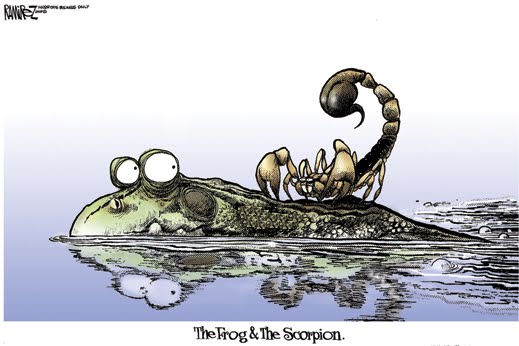
There’s an old Aesop fable about a frog and a scorpion. The scorpion wants to cross a river and asks the frog if he can ride across on the frog’s back. No, the frog responds, you’ll sting me and I’ll die. Wait, says the scorpion, if I was foolish enough to sting you whilst we were crossing, we’d both die – you from the sting, but I would drown, so it won’t be in my interests to sting you. The frog agrees. Midway across the river, the scorpion begins stinging the frog. The frog shouts, if you keep doing that, we’ll both die. The scorpion says, I know, but it’s in my nature.


frog-scorpion

It really isn’t in the longer term interests of the Press to sting the frog of transparency by using that additional access to behave so irresponsibly and despicably, but it’s in their nature.

Anyhow, this is Charles J’s decision on the Reporting Restriction Order.

V v Associated Newspapers Ltd 2016

http://www.bailii.org/ew/cases/EWCOP/2016/21.html


The first law Geeky point, hence the title, is what jurisdiction the Court of Protection have to make a Reporting Restriction Order. The argument goes like this :- (a) The Court of Protection exists to determine whether a person has capacity, and if not, what is in their best interests and you have already ruled that this woman HAD capacity, so your involvement stops and (b) as she is now dead, whatever jurisdiction you had over her affairs is now gone. Decent points.

Charles J concluded that the CoP did still have jurisdiction, and in any event, if they don’t, then the High Court will just use Magical Sparkle Powers (TM)


  • I have concluded:


(1) The COP has jurisdiction after the finding that C had capacity and her death to make the reporting restrictions order sought by the Applicant but insofar as it may be necessary or appropriate I will also make it as a High Court judge.

There is a longer answer here:-

Jurisdiction of the COP to make a reporting restrictions / anonymity order after it has determined that C had capacity and/ or after C’s death

  • As I have already mentioned this jurisdictional point is raised by the media Respondents but they do not resist me making an injunction as a High Court judge. They base the argument on the finding of capacity made by MacDonald J. The Applicant addresses the relevant jurisdictional effect of this finding and of C’s death.
  • The media Respondents rely by analogy on In re Trinity Mirror Plc and others [2008] QB 770 concerning s.45(4) of the Supreme Court Act 1981 which provided that in “all other matters incidental to its jurisdiction” the Crown Court was to have the like powers, rights, privileges and authority as the High Court. The Court of Appeal held that the Crown Court has no inherent jurisdiction to grant injunctions and that unless “the proposed injunction is directly linked to the exercise of the Crown Court’s jurisdiction and the exercise of its statutory functions, the appropriate jurisdiction is lacking”.
  • Section 47 of the MCA is worded slightly differently and provides that: “the court has in connection with its jurisdiction the same powers, rights, privileges and authority as the High Court”. It is generally accepted that the COP does not have an inherent jurisdiction so the issue is whether it can grant an injunction because it is exercising that power “in connection with its jurisdiction“.
  • At the time that the reporting restrictions order was made in this case by Moor J, sitting as a judge of the COP, I consider that it is clear that he was making that order in connection with the jurisdiction of the COP to determine initially whether or not C had capacity. In my view, it follows that he could in reliance on s. 47 have made that order for a period extending beyond any finding made that C had capacity, or the death of C (as to which see further below), if he had thought that that was appropriate. He did not do so.
  • The effect of the argument of the media Respondents is that if the hearing on 13 November 2015 had been before a judge, other than a High Court judge (which is not the practice in serious medical treatment cases but could occur in other cases) that judge having determined and announced his decision that C had capacity as a judge of the COP had no jurisdiction to continue, vary or discharge the injunction granted by Moor J. To my mind, that would be an unfortunate and odd result particularly, for example, if C had asked for it to be discharged. However, in my view, it does not arise because I consider that the termination, continuation or variation of an injunction made by the COP in the exercise of its jurisdiction conferred by s. 47 would also be within the jurisdiction so conferred as being “in connection with its jurisdiction”.
  • However, by its terms the injunction that was granted by Moor J expired on the death of C and so the present application is for a new injunction that was made at a time when for two reasons the COP no longer had jurisdiction over C and was therefore functus officio.
  • The Applicant points to a number of sections in the MCA which give the COP jurisdiction to make orders in respect of persons whether they have or lack capacity (see ss 15 (1)(c), 21A, 23 and 26(3)) but, in my view, this does not provide an answer because in this case the COP was not exercising jurisdiction under any of those sections.
  • To my mind the question on this application is whether the COP has power to grant a new injunction because it relates to proceedings that were before it although by reason of its decision and/or the death of P it no longer has any jurisdiction to make the welfare order sought. The answer is determined by considering whether in those circumstances it is exercising a power “in connection with its jurisdiction“. In my view the answer is that it is. This is because, in my view, the nature and extent of the relevant Article 8 rights relied on flows from the existence of the earlier proceedings before the COP, in which it exercised its jurisdiction and I see no reason to construe s. 47 to limit the power it confers to the period during which that jurisdiction continues to exist over the subject of the proceedings.
  • Indeed, I agree with the Applicant that the principle that legislation should be interpreted so far as possible to be compatible with Convention rights supports this conclusion because:

i) it promotes the grain of the legislation (the MCA), andii) it enables the court best placed to carry out the balancing exercise between competing Convention rights to perform that exercise.

  • That grain links back to the points I have already made that the jurisdiction of the COP invades not only the life of its subject P but also on many occasions the lives of others and in particular P’s family members.
  • Conclusion. I can make the injunction sought as a judge of the COP and I do so. However to avoid any jurisdictional argument in the future, and if and so far as this is necessary, I also make it as a High Court judge exercising the jurisdiction of that court.


The central issue here was whether the Press could report the story, and deal with both the human interest angle and the issue for public debate (the case being categorised – incorrectly, as a ‘right to die’ case, which is always interesting to the public – in fact, it is not a development of law at all, because people with capacity have always been able to refuse medical treatment, which is all that happened here) WITHOUT identifying the woman at the heart of the story. Clearly, the Press knew who she was, because they were able to doorstep people who knew her, look at her Facebook page and print pixelated images of her.


  • The naming propositions are reflected in the following points made by Mr Steafel:


The Daily Mail considers it has a duty to the public to report fairly and accurately on what happens in the courts. In order to engage the interest of members of the public in the kinds of issues the court decides, it is however necessary to publish articles and reports that people actually want to read. That means telling our readers about the facts of the cases, including the real people and places involved, and sometimes publishing pictures that relate to these people and places.

Where proceedings are anonymised, it is more difficult to engage our readers as the real people involved in the cases are necessarily invisible and the stories therefore lack a vital human dimension. It is human nature to find it more difficult to take an interest in a story about problems arising from, say, dementia or the right to die if the story does not feature identifiable individuals. If we cannot publish stories about important issues that people are drawn to read, this will inevitably limit and reduce the quality of public debate around these issues. It is in my view important in a democratic society that we should encourage informed debate I believe that the media, including the popular press, fulfils a vital function in this regard. By reading about the experiences of others, readers are likely to be able to identify with those people and understand what they are going through. But they are much less engaged – and correspondingly less focused on the surrounding public debate – where they cannot identify with real people, places and events. Pictures are a hugely potent way of engaging readers and one of the problems with covering anonymised cases is that it is impossible to include pictures in our stories which identify those involved.


  • I agree that fair and accurate reporting is vital if the public interest is to be promoted and I acknowledge that whether something is fair involves a value judgment and does not equate to it being balanced.
  • On the intense scrutiny that is required of the rival propositions relating to anonymisation I consider that a distinction can be made between (a) cases where pursuant to the default or general position under the relevant Rules or Practice Directions the court is allowing access (or unrestricted access) to the media and the public, and (b) cases in which it is imposing restrictions and so where the court is turning the tap on rather than off. But, I hasten to accept that this distinction:


i) simply reflects the strength of the reasoning that underlies the relevant COP Rules and Practice Directions, the established Scott v Scott exceptions and the positon referred to by Lady Hale that in many, perhaps most cases, the important safeguards secured by a public hearing can be secured without the press publishing or the public knowing the identities of the people involved, and soii) provides weight to the general arguments for anonymity to promote the administration of justice by the COP generally and in the given case, and does not

iii) undermine the force of the naming propositions as general propositions, with the consequence that the COP needs to remember that it is not an editor.


  • As I have already said (see paragraphs 94 and 95 above) the weight to be given to (a) the naming propositions, and (b) the conclusion on what generally best promotes the administration of justice will vary from case to case and on a staged approach to a particular case the weight of the naming propositions, and so this aspect of the factors that underlie and promote Article 10, will often fall to be taken into account in the context of (i) the validity of the reasons for their application in that case, and (ii) the impact of a departure in that case from the general conclusion on what generally promotes the administration of justice in cases of that type. This means that those reasons and that impact will need to be identified in a number of cases.
  • As I have already mentioned, although he refers to and relies on the naming propositions Mr Steafel does not say why in this case the relevant public interests, rather than the gratification of a prurient curiosity or interest of the public:


i) would be or would have been advanced by the identification of C and members of her family in the publicity that took place,ii) was advanced by the reporting that contained pixelated photographs and focused on C’s lifestyle, or

iii) why he says the balance will change on A’s 18th birthday between reporting that does not name C and her family and reporting that does.

Accordingly he does not say, as an editor, why in this case the view expressed by Theis J that “there is no public interest in C or her family being identified” either is wrong or will become wrong when A is 18.


The Press had the chance to set out arguments and provide evidence as to why naming the woman was necessary for the proper and accurate reporting, rather than to gratify prurient curiousity, and they did not do so. Nor did they take up the Court’s offer of the ability to file evidence setting out why they felt the previous reporting and methodology were appropriate…


  • S0, to my mind, in this exercise the COP needs to consider why and how the naming propositions, and so the proposed naming or photographs of C and her family members that links them to the COP proceedings, would or would be likely to engage or enhance the engagement of the interest of the public in matters of public interest rather than in those of prurient or sensational interest.
  • This has not been done in this case. But in contrast evidence has been put in on the likely harm to the relevant individuals that such reporting would cause.
  • The ultimate balance in this case on the dispute relating to duration. On one side are:


i) the Article 8 rights of all of C’s children,ii) the weight of the arguments for a reporting restrictions order in this case, and so of the general practice in the COP of making such orders in analogous COP cases where the family do not want any publicity and have given evidence of matters that affect their private and family life and that of P of a clearly personal and private nature,

iii) the acceptance by the media Respondents that until A is 18 the balance between the Article 8 rights and Article 10 rights in this case justifies the grant of a reporting restrictions order,

iv) the compelling evidence of the extent and nature of the harm and distress that reporting that identifies C and any member of her family as respectively the subject of (or members of the family of the subject of) the COP proceedings and so of MacDonald J ‘s judgment would cause, and

v) the ability of the court to make a further order if and when circumstances change.


  • On the other side are the general propositions relating to the benefits of naming the individuals involved.
  • I accept that Thiess J’s statement that “there is no public interest in C and her family being identified” and my indications of agreement with it at the hearing go too far because of the well-known and important naming propositions and the public interests that underlie them. But, in my view, the absence of an explanation of why:


i) the accepted balance changes on A’s 18th birthday and so of why identifying C and her family and linking them to the COP proceedings and the publicity at the end of last year would then promote the public interests that underlie Article 10, or why those public interests could not in this case then still be properly and proportionately served by reporting that observes the reporting restrictions order, orii) more generally why any such identification would at any other time promote (or have promoted) or its absence would harm (or would have harmed) the public interests that underlie and promote Article 10

means that the naming propositions have no real weight in this case and balance of the competing factors comes down firmly in favour of the grant of a reporting restrictions order until further order.


As there was to be an Inquest, and Inquests are open to the press and public, the Court did need to consider whether the Reporting Restriction Order should cover the naming of this woman or her family emerging from the Inquest.

The extension of the order to cover C’s inquest.


  • The earlier orders provide that the injunction does not restrict publishing information relating to any part of a hearing in a court in England and Wales (including a coroner’s court) in which the court was sitting in public. It seems to me therefore that the result the Applicant seeks would be achieved by changing the word “including” to “excluding”.
  • This is much closer to the position in Re S and Potter P addressed such an application in Re LM [2007] EWHC 1902 (Fam) where he said:


The Overall Approach

53. In approaching this difficult case, I consider that I should apply the principles laid down in Re S, ————-

54. There are obvious differences between proceedings at an inquest and the criminal process, most notably that the task of the Coroner and jury is to determine the manner of the death of the deceased and does not extend to determining questions of criminal guilt. In various cases that has been held to be a matter of weight in respect of witnesses seeking to protect their own personal safety. However, in this case, the inquest to be held is into the killing of a child, L, in the situation where a High Court Judge has already found as a matter of fact that the mother was responsible for L’s death and the application is made because harm is indirectly apprehended to a child who is a stranger to the investigative process. It is presently uncertain whether criminal proceedings will in fact be taken against the mother. If so, and the Coroner is so informed, then no doubt he will further adjourn the matter pursuant to s.16. of the Coroners Act 1988. If that is done, then the question of publicity and reporting restrictions in those proceedings will fall four square within the principles propounded in Re S. If not, and if, as seems likely, the mother continues to pose a danger to any child in her care, then, if continued, the reporting restrictions in the care proceedings would prevent that fact from reaching the public domain, despite its clear public interest and importance.


  • He carried out a detailed balance between the competing rights emphasising the strength and importance of a public hearing of the inquest and so the general conclusion on what promotes the administration of justice in such proceedings. Having done so he refused the injunction sought that the parents should not be identified.
  • Here the important issue of child protection is absent.
  • In the note of counsel for some of the media Respondents dated 28 January 2016 points are made about the importance of a proviso permitting the reporting of other proceedings conducted in open court, including a coroner’s court. But after the Applicant sought this extension junior counsel responded (as mentioned in paragraph 49 above) that his clients are neutral on this point.
  • As the approach of Potter P confirms an application for restrictions on the reporting of other proceedings conducted in open court engages important and powerful interests against the making of such an order. However, in my view:


i) the expressed neutrality of some of the media Respondents reflects a responsible and understandable stance that in isolation the inquest is unlikely to give rise to issues of public interest or to any such issues in respect of which the general propositions in favour of naming C or her family will have any significant weight, andii) in any event, I consider that that is the position.


  • The essential question is therefore whether, unless the court makes a further order, C’s family should be at risk of publicity relating to the inquest that makes the connection between them and the COP proceedings and so effectively of suffering the harm and distress that any other reporting that identifies them and makes that link would bring.
  • The history of the prurient nature of some of the earlier reporting is a clear indicator that such reporting might be repeated. But, even if that risk is discounted I have concluded that the balance comes down firmly in favour of extending the order to cover the inquest.
  • The main factors to be taken into account overlap with those to be taken into account in respect of the duration of the order.
  • On the one side are:


i) the points set out in paragraph 167 (i) to (v) as the inquest is likely to take place before a is 18 andii) the points set out in paragraph 175.


  • On the other side are:


i) the powerful and weighty reasoning that underlies the conclusion and practice that the administration of justice is best served by inquests being heard in open court without reporting restrictions, andii) the general and accepted force of the naming propositions absent any evidence or reasoning that they found a need for reporting of the inquest that makes the link with the COP proceedings.


And the order therefore stops the Press naming the woman as a result of reporting on the Inquest – they can still report on the Inquest itself. It obviously doesn’t mean that the Inquest itself is barred from naming her.


The judgment also annexes some helpful procedural guidance on applications for Reporting Restriction Orders within the Court of Protection.

Coal Board and Age Assessments


It has been a very long while since we had a piece of case law on age assessment. If you are already saying “I bet it involves Croydon”, then gold star for robot boy, well done!

London Borough of Croydon v Y 2016

http://www.bailii.org/ew/cases/EWCA/Civ/2016/398.html

Y turned up in this country from Nigeria. He claimed to have been born in 1999, and that he had been trafficked here. If true, that would mean that he was a child and entitled to accommodation via Croydon’s social work department and services and would be able to stay until 18. If not true, he would be an adult, and would probably be liable for deportation. [In this case, he absolutely would have been deported, it was the age argument that was putting that process on hold]

There’s therefore quite a vested interest in people who are not under 18 claiming that they are.

A number of individuals arrive in this country seeking asylum and claiming to be under 18. Most are males and have entered or have sought to enter by clandestine means. They are referred to as Unaccompanied Asylum Seeking Children (UASC). That description includes those who assert that they are under 18. Many who travel from countries where they allege they are being persecuted such as Afghanistan or Iraq will have been assisted by agents and in any event the advantages of persuading the authorities that they are under 18 are well-known. Those advantages include the automatic grant of leave to remain until aged 18 coupled with the inability to return to Member States of the European Union if the individual would otherwise be returnable in accordance with the Dublin Regulations. In addition, as children they will usually be entitled to the care and accommodation which a local authority is obliged to provide to children in need. Thus the assessment of their age is most important.


[Collins J in A v London Borough of Croydon [2009] EWHC 939 (Admin), ]


In this case, Croydon’s age assessment was based largely on Y’s physical appearance (as it was in a case I once had where the alleged 16 year old had a beard that Captain Birdseye would have been proud of). Y judicially reviewed that decision.

The Court gave some directions


5.On 1 September 2015, UT Judge Allen gave directions in the age assessment challenge proceedings. These included (i) that the matter be listed for a 4 day fact-finding hearing in order to determine Y’s date of birth; and (ii) that Y be granted permission to rely on reports by Dr Juliet Cohen, a forensic physician, Dr Susannah Fairweather, a child and adolescent psychiatrist and Ms Christine Beddoe, specialist adviser on human trafficking and child exploitation.

  1. The trial was fixed to start on 8 February 2016


Croydon then made an application to strike out the claim


On 20 November 2015, Croydon applied to the Upper Tribunal Asylum and Immigration Chamber for an order that the challenge to the age assessment should be struck out (or stayed) unless Y consented to and co-operated fully with (i) a dental examination (including a dental X-ray) by Professor Roberts, (ii) a psychiatric examination and (iii) an age assessment by two Croydon social workers. In support of this application, Croydon relied inter alia on the decision of this court in Starr v National Coal Board [1977] 1 WLR 63 to which I shall refer in some detail later in this judgment


[I’m not QUITE sure why that was an application to the Upper Tribunal Asylum and Immigration Chamber, rather than to the Judge who had given case management directions in the judicial review. It rather seems to me that those were applications for case management directions /orders in the judicial review fact finding, but the Court of Appeal don’t take up that point, so perhaps it is just a bad one on my behalf]

You’ll have seen the reference to Starr v National Coal Board 1977. It is not the same National Coal Board that comes up very infrequently (in judicial bias cases or recusal cases, citing Lord Denning’s remark that the Judge had intervened too much and ‘descended into the arena’)


The Starr principles

  1. The case of Starr concerned a claim in negligence for damages for personal injury, namely ulnar nerve compression. It was conceded by the plaintiff that it was necessary for the defendant, in preparing its defence, to be advised by a consultant neurologist who had had the opportunity of examining him. The defendant had nominated Dr X for that purpose. The plaintiff objected to examination by Dr X without stating his reasons. But he said that he was willing to be examined by any other consultant neurologist of similar qualification and experience to Dr X. The defendant applied for a stay of all further proceedings until the plaintiff submitted to an examination by Dr X. This court upheld the stay that had been granted by the judge.
  2. At p 70H, Scarman LJ said that in the exercise of its discretion in this class of case, the court has to recognise that in the balance there are “two fundamental rights, which are cherished by the common law and to which attention has to be directed by the court”. The first is the plaintiff’s right to personal liberty. The second is an equally fundamental right, namely the defendant’s right to defend itself as it and its advisers think fit, including the freedom to choose the witnesses that it will call. It is particularly important that a defendant should be able to choose its own expert witnesses, if the case is one in which expert testimony is significant. He went on to say that, if a defendant in a personal injuries case made a reasonable request for the plaintiff to be medically examined by a doctor chosen by the defendant, the plaintiff should accede to the request unless he had reasonable grounds for objecting to the particular doctor chosen by the defendant. Applying these principles to the facts of the case, Scarman LJ said at p 72H:
    1. “I have, therefore, come to the conclusion that the request for medical examination of the plaintiff by this particular consultant neurologist was a reasonable one; that, notwithstanding the matters that have been developed in argument, the plaintiff was unreasonable in refusing to submit himself to examination and that there is, in the matters that have been adduced to this court, no indication that justice to the plaintiff is liable to be imperilled if this doctor examines him, reports and ultimately gives evidence.”
  3. At p 75H, Geoffrey Lane LJ said:
    1. “…the defendants are not lightly to be deprived of the right to have the medical examination carried out by the doctor who, they are advised, would be the best doctor in the circumstances to carry out that examination.”
  4. Cairns LJ said much the same at p 77C.


It is a damn clever argument, and ’nuff respeck to whoever at Croydon came up with it. Essentially, relying on these Starr principles to say “If we are having to defend a case, but the person bringing it refuses to cooperate with assessments that we reasonably ask him to participate in, the case should be thrown out”

The Tribunal disagreed, and hence Croydon went to the Court of Appeal.


The decision at first instance


  1. The application was refused by UT Judge McGeachy on 8 December. He gave a short ex tempore judgment which included the following:
    1. “My decision is this. Although I have some considerable sympathy with the application made and I think it is most unfortunate that the applicant’s representatives have come to the conclusion that they will not cooperate I consider that the order sought is too draconian for me to either stay the proceedings or to dismiss the proceedings at this stage.

2. I consider that the fact that the applicant’s representatives have decided that he should not cooperate with a dental examination, which I consider might well have been useful, let alone the further age assessment to be carried out by Croydon is a matter on which it may well be that you would wish to address me at the hearing. I presume that is what you would want to do but I am not prepared to bring the proceedings to a halt now.”

  1. Further light is shed on the judge’s thinking by his decision of 16 December in which he explained why he refused permission to appeal to this court. He said:
    1. “(2) The grounds of appeal assert that I had failed to give reasons for not granting the application given the terms of the judgment in Starr v NCB [1977] 1 WLR 63. In my oral judgment I gave reasons for my decision. While I did not specifically refer to the judgment in Starr the reality is that that case can be distinguished from the present. It is of note that in Starr it had been conceded that it was necessary for the defendants, in preparing their defence to have the opinion of a consultant neurologist who had had the opportunity of examining the plaintiff. That is different from a case such as the present in which there is a challenge to a decision which has already been made. Moreover, while the case in Starr was a private law matter this is an action in public law where there is a public interest in the efficient disposal of the application, particularly as it relates to the age of the applicant who claims to be a child.

(3) I was entitled to take into account the efficient disposal of that application and that is why I stated that staying the proceedings at this stage was a decision which was too draconian: staying the proceedings would not resolve the issue before me. Given that the matter was to proceed to trial at the beginning of February 2016 it was appropriate that satellite litigation should be discouraged.

(4) I consider that my decision was an appropriate use of my case management powers in that it is a clear aim of those powers to ensure the efficient disposal of an application.”

The grounds of appeal

  1. Mr Holbrook submits that the judge erred in holding that the Starr principles did not apply in respect of Y’s refusal to consent to (i) an age assessment by two social workers employed by Croydon, (ii) a dental age assessment by Professor Roberts and (iii) a psychiatric assessment by Dr Tony Davies. He should have held that the Starr principles did apply and that, on a proper application of them, he should have acceded to Croydon’s application to stay or strike out Y’s claim unless he consented to each of the three assessments sought.


The Court of Appeal concluded that the Starr principles DID apply  (this was something of a shock to me when I was reading the case, though not an unpleasant shock) and that thus the appeal must succeed


Discussion

  1. It is unclear whether the judge addressed the Starr principles or not. It would have been surprising if he had not considered them, because they had been the subject of full argument before him. Paras 1 and 2 of the judgment might suggest that he accepted that they did apply, but that he was not willing in the exercise of his discretion to strike out the claim or order a stay because such a remedy was too “draconian” or in modern parlance “disproportionate”. On the other hand, in his reasons for refusing permission to appeal, he sought to distinguish Starr on the grounds that (i) it had been conceded in Starr that it was necessary for the defendant to have the opinion of a consultant neurologist who had had the opportunity of examining the plaintiff; and (ii) Starr was a private law claim, whereas the present claim was a public law claim.
  2. On balance, I incline to the view that the judge did address the Starr principles, but held that they did not apply for the three reasons that he identified when refusing permission to appeal. First, in Starr the plaintiff had conceded that it was necessary for the defence to have the opportunity for their expert to examine the plaintiff. Secondly, Starr was a private law claim, whereas the present case concerned a public law claim. Thirdly, refusal of Croydon’s application was an appropriate use of his case management powers to ensure the efficient disposal of the application.
  3. I would reject these reasons and substantially accept the submissions advanced by Mr Holbrook. As regards the first reason, the fact that the plaintiff in Starr conceded that it was necessary for the defendant to be advised by a consultant neurologist who had had the opportunity of examining the plaintiff was not essential to the reasoning of the court. The concession meant that the court could proceed on the basis that the medical examination was necessary for the proper conduct of the defence. If that had not been conceded, the court would have had to decide for itself whether the examination was necessary. The concession is a basis for distinguishing Starr from the present case on the facts. It cannot, however, be a reason for holding that the Starr principles only apply where there is such a concession. In the absence of such a concession in the present case, the judge had to decide whether all or any of the three examinations sought were reasonably necessary for the proper conduct of Croydon’s defence. It would seem that the judge was probably satisfied that the dental examination and the examination by the two social workers were reasonably necessary because he said in his judgment that he had “considerable sympathy with the application”; he thought that it was “most unfortunate that [Y’s] representatives have come to the conclusion that they will not cooperate”; and he considered that a dental examination “might well have been useful, let alone the further age assessment to be carried out by Croydon”.
  4. As regards the second reason, there is no basis in principle for confining the Starr principles to private law litigation. I accept that there are important differences between private and public law litigation. These differences are, for example, recognised by the fact that they are subject to different procedural regimes. In most judicial review litigation, the court does not hear oral evidence or make findings on disputed questions of fact. That is why there is little scope for the application of the Starr principles in public law cases. But in judicial review claims where the court does hear oral evidence and is required to make findings of fact, there is no reason in principle why Starr should not be applied in an appropriate case. The fundamental common law right of a defendant to defend itself in litigation to which Scarman LJ referred applies in any litigation. In a case where one party wishes to have an examination of the other party, the other fundamental common law principle identified by Scarman LJ comes into play. That is so whether the case involves a private law or a public law claim. Although the age assessment issue in the present case arises in judicial review proceedings, it is common ground that the issue is one of fact for the court to determine on the evidence adduced before it: see R (A) v Croydon London Borough Council [2009] UKSC 8, [2009] 1 WLR 2537. It follows that there is no reason to hold that the Starr principles do not apply merely because the issue arises in public law proceedings.
  5. The third reason is quite difficult to pin down. Mr Berry makes much of the point that this was a case management decision involving an exercise of discretion in respect of which this court should allow the judge a generous ambit: see, for example, Royal and Sun Alliance v T & N Ltd [2002] EWCA Civ 1964 at para 38 per Chadwick LJ and Walbrook Trust (Jersey) Ltd v Fattal [2008] EWCA Civ 427 at para 33 per Lawrence Collins LJ.


Given what is said here, the door is at least ajar for people arguing that the Starr principles that a person is entitled to insist on another party being assessed by an expert of their choice should apply to private law family cases, where two parents are arguing about who is suitable to look after their child and how much time the child should spend with the other. I think that it is more of a stretch for care proceedings (the Local Authority, who want the parent to undertake an assessment, are the applicant, not the defendant)

This part of the Starr principles though, I can see being deployed


The second is an equally fundamental right, namely the defendant’s right to defend itself as it and its advisers think fit, including the freedom to choose the witnesses that it will call. It is particularly important that a defendant should be able to choose its own expert witnesses, if the case is one in which expert testimony is significant.


Not perhaps so much with whether there should be an expert assessment at all, since that is rather covered by the Children and Families Act 2014 which sets out the ‘necessary to resolve the proceedings justly’ test, and Starr as case law can’t override later statute. But in a case where a Local Authority want the father to be assessed by Dr Leighton Buzzard, and the father would prefer Dr Ashby De-la-Zouch, then Starr (and this case) might be usefully deployed. The strong suggestion is that the witness should be of the defendant’s own choosing.


[I can also immediately sense that Ian from Forced Adoption will be wanting to deploy Starr and this case to say that a parent should be entitled to call evidence at a final hearing from whatever witnesses they choose – usually character witnesses, and it will be interesting to see how the Courts deal with that sort of argument]

Many of you who are familiar with age assessment cases are pondering the use of dental X-rays, which are pretty controversial in age assessment determination (in terms of reliability, efficacy and ethics of undertaking an X-ray when there is nothing medically wrong with a person for purely forensic purposes many dentists are unhappy about it). The Court of Appeal acknowledged those issues, but concluded that it wasn’t a reason for refusing to undertake the assessment.

it is said that the method of assessing age using mean data taken from dental x-rays is controversial and unreliable. But it is impossible for the court to reach a conclusion on whether this is correct or not. In my view, it cannot be a reason for refusing the order. No doubt, the reliability of the assessment based on dental x-rays will be investigated at the hearing.


Suspended sentence for woman who saw her son “too often”


I read this story on ITV news way back in December 2015, and it took 20 seconds of googling to suggest that there might be more to it than the headline suggested.

http://www.itv.com/news/2015-12-15/suspended-sentence-for-woman-who-saw-her-son-too-often/


Because the woman in question had a previous history in the family Courts, that history being that she turned up with a report from a psychologist that she had in fact forged, by writing it herself and the named psychologist knew nothing about it. And that she went to prison for perverting the course of justice. That’s pretty unusual, even in the circles of contentious private law proceedings.


This matter has a very long and very sad history with continual court proceedings stretching over almost the entirety of X’s life. The mother was made the subject of a previous s.91(14) order at the conclusion of proceedings before Mrs. Justice Macur, as she then was. After that order had been made, the mother sought permission from Mrs. Justice Macur to make an application in respect of X. In support of that application, she filed what purported to be a report from a psychologist. When it was checked, it was discovered that that document was a forgery and the psychologist named denied any knowledge of ever writing any such report. Criminal proceedings were instituted against the mother for perverting the course of justice, during the course of which she was convicted and sentenced to a term of imprisonment of nine months. That was in or about October 2012. The mother was still serving that sentence when the matter came before me in May 2013.


That of course doesn’t mean that she wasn’t the victim of injustice THIS time around, but it does mean that you might be somewhat cautious about taking her word for it.

Anyway, the committal judgment is now finally up.

Y v Najmudin 2015


http://www.bailii.org/ew/cases/EWHC/Fam/2015/3924.html


The contact order provided for supervised contact, seven times a year.

Having heard evidence over a number of days both from the parties, from the children’s guardian and expert evidence, I concluded that it was in the welfare best interests of X that his contact with his mother was very restricted, that it should take place, as I have set out, seven times per year in a contact centre, and it had to be professionally supervised. That was because I was satisfied that the mother had lied to me throughout the course of the hearing in 2013 and that she had and would, if permitted to have unsupervised contact, cause emotional and psychological damage to her son.  


The mother breached that order by making her own arrangements to see her son, clandestinely and without the knowledge of the father. She was not taking up her sessions at the contact centre, because she was making her own arrangements.

Evidence

  1. The mother in her evidence asserts matters have changed. X is more mature and he is older and he is old enough to make decisions for himself. That may be the case, but the fact that this mother chose to tell this child about this hearing and talked in detail about the evidence, in my judgment amply demonstrates that the circumstances that I found in my judgment in 2013 have changed not one jot.
  2. She may no doubt love her son, but it appears, in my judgment, that she remains incapable of assessing and putting his welfare best interest first. In addition, she did not at any time, despite regular email communication with the father, either (a) tell him that she was meeting X; or (b) ask his permission to see X. At no time, the mother concedes, did the father in fact agree to change the contact arrangements as set out in the order of 3 May. In her evidence, the mother tells me that she could not remember the terms of the order made in May 2013; that she did not know that by seeing X as she did in the street that she was acting in breach of my order. I, without any hesitation, entirely reject that account from the mother. I am satisfied so that I am sure that she knew full well what I had ordered and what were the restrictions on her contact, but she has chosen, in my judgment, deliberately once more to flout the court’s order and to ignore it.
  3. She takes the view that X is old enough to make his decisions and if he asks to see her, then whatever there may be in a court order is completely irrelevant. Well, she is wrong. She, by taking the actions that she has, has put X in an immensely difficult position. The father tells me, and I accept that X has said to him that he loves his mother and he would like to see his mother, but he would like to see her in the supervised contact centre. The mother tells me that when she sees X he is pleased to see her. I have no doubt being a loving child that he would do that. But the father tells me that by the time he gets home, it is plain that X feels uncomfortable, worried and concerned about these chance meetings, knowing that they are not taking place as the court has ordered; knowing that they have not taken place as he would wish. The mother, in my judgment, has put X in an extremely difficult position. She has quite deliberately chosen not to tell Mr. Y about these meetings, nor to seek his permission. All of those facts demonstrate to me that the mother knew precisely what it was that she could and could not do by the court order, but she chose to breach it.
  4. Furthermore, I am reinforced in coming to that view in terms of the adverse effect on X because I accept the evidence from Mr. Y that X has taken now to taking different routes home from school in order that he may try and avoid seeing his mother in those haphazard meetings in public. I accept that evidence. I am also concerned to hear it because it demonstrates very eloquently the conflict that this young man feels about the circumstances that his mother has caused him to be in.
  5. On the totality of all the evidence that I have heard, I am satisfied so that I am sure that the mother has breached the order of 3 May 2013 and, in particular, para.6, on each of the occasions set out in the schedule of findings sought by Mr. Y. In respect of those matters, where the mother was either not sure whether she had seen X on a particular date, or said that it was in fact her partner, Mr. Z, for example, who went to the father’s home on Wednesday, 15 April, I unhesitatingly reject those explanations and I find as a fact that the mother has met with X as set out in that schedule.
  6. Accordingly, I am entirely satisfied that the mother is in breach of that order and she is in contempt of court and she now falls to be punished for that contempt. I will consider what punishment I should impose at 2 o’clock after I have heard anything Dr. Najmudin may want to say in mitigation of her breaches of the order as I have found.


Something something oranges something

In a very classic Alan Moore comic, D.R and Quinch go to Hollywood, the two criminally twisted alien ‘heroes’ acquire a script from a genius writer who then dies, and they set off to Hollywood armed with the script to get the movie made and become hotshot Directors and auteurs.

The twist is, that although it is easy for them to get backing to make the movie and attract a monosyllabic star called “Marlon”,  it turns out that the handwritten script is almost totally illegible, save really for one word in the title, which is “Oranges”. So all they really know about the film they’re making is that the title is Something, Something, Oranges, Something.

Agent:So, where is this film set, exactly?
D.R.Well, does that word look more like “sandwich” or “submarine” to you?
Agent:Submarine
D.R.Well then, the film is set on a submarine, and not on a sandwich, as you might have previously imagined, man


It’s a great comic, anyway. Alan Moore knows the score.

http://mind-the-oranges-marlon.blogspot.co.uk/2009/11/dr-and-quinch-go-to-hollywood-part-1-by.html


(and part 2 is linked on that same page)


In this case in front of Holman J

Re I (A child) 2016

http://www.bailii.org/ew/cases/EWHC/Fam/2016/910.html

The child involved had told the social worker and the Guardian SOMETHING. But he didn’t want the parents to know what it was. The social worker and Guardian didn’t think it would affect the case in any way, but if the parents knew what it was, they might want to use it in the final hearing (no, it doesn’t make any sense to me either). The LA felt that despite not wanting to share the information, they were under an obligation to do so. The Guardian thus made   an application to Court that the LA be ordered not tell the parents SOMETHING, but also not to let them know what that SOMETHING was or why they weren’t to know this SOMETHING. Or even in fact to know that the application was being made.


  1. Relatively recently, the child concerned imparted some information to a social worker, which he has repeated also to his guardian. I stress that the information does not relate or pertain at all to either of his parents or his stepmother, but relates and pertains essentially to himself. Nothing in the information is any way critical of anything done or not done, or said or not said, by either of his parents or his stepmother. The child himself has said very strongly that he does not wish either of his parents or his stepmother to know the information in question. The guardian considers that that confidentiality should be respected and that the information should not be disclosed or revealed to either of the parents or the stepmother. The local authority are very mindful and respectful of the confidentiality of a 15-year-old child who is in their care. They do not consider that, realistically and objectively, the information could or should affect any issue at the forthcoming final hearing of the care proceedings. But they do consider that if one or other or both parents did know the information, one or other or both of them might wish to seek to deploy it in some way as part of their case in the care proceedings.
  2. The local authority therefore consider that they are under a duty to reveal or disclose the information to both parents; and they have said that they will do so unless prevented by the court, or at any rate unless the court indicates that in its view the local authority are not, on the facts and in the circumstances of this case, under a duty to disclose the information. That issue having arisen between the local authority and the guardian, the guardian issued an application dated 18th March 2016 in form C2. She did in fact name the local authority and both parents as the respondents to the application in paragraph 1 of it. The relief sought in the application is, “An order preventing the local authority from disclosing this information”. The application form goes on to ask that, “In order that the other parties are not made aware of this application or that it is being heard, we would ask that…” it be heard before the scheduled next hearing in this case and that it “…be dealt with privately or that the court makes some other arrangement to ensure that the other parties are not put on notice.”


Adding to the weirdness of this, it turned out that the Guardian’s previous counsel, having been appraised of this knotty problem, had mentioned it to a colleague in his chambers, without knowing that said colleague would then go on to be instructed by one of the parents.


At this point it is necessary to record a further twist in this particular case which does, or may, add a further layer of complexity. I have been told today by the guardian, Miss Tracey Cross, that her previous counsel (not, I stress, Mr Andrew Bainham, who appears on behalf of the guardian today) had mentioned the factual circumstances and the problem in this case to a colleague in his chambers, without either he or that colleague realising that the colleague had been, or was going to be, instructed on behalf of the father in these proceedings. It thus appears (although this will need further clarification from the two counsel concerned) that, inadvertently, counsel who is now instructed on behalf of the father in these proceedings may already be in possession of the confidential information in point. If the facts are as I have just summarised them, then some quite difficult questions may arise in relation to the professional duties of counsel to his client on the one hand, and the aura or carapace of candour and confidentiality which may attach on the other hand when one barrister discusses a knotty problem with a colleague.


The Judge had become (rightly) troubled by the notion of deciding whether information could be withheld from parents at a hearing at which they were not present


This led to consideration of two authorities in particular. The first is a decision of the Court of Appeal in Re: M (Disclosure) [1998] 2 FLR 1028, which itself refers with approval to the decision and guidance of Johnson J in Re: C (Disclosure) [1996] 1 FLR 797. The other authority considered today is that of the House of Lords in Official Solicitor to the Supreme Court v K and another [1965] AC 201, which makes reference at pages 215 B and 226 A to C to a practice in situations such as this of counsel being informed of the actual nature and content of the confidential information, on terms, or on the basis, that counsel will not communicate the actual nature and content of the confidential information to his or her solicitor or client without the permission of the court. In the much later authority of Re: M (Disclosure) that practice is also referred to with apparent approbation by Lord Justice Thorpe at page 1031 G.

  1. In all events, it seems to me, having regard to the clear authority of the Court of Appeal in Re: M (Disclosure), that I simply cannot with propriety substantively conclude today’s hearing or rule upon the application which the guardian has issued. If, in another situation, the local authority and the guardian were both in agreement that the information in question was not such that there was any duty to disclose it (for instance, if both agreed that it was too unimportant or trivial to require disclosure), then non-disclosure might indeed follow without any involvement at all on the part of the court. But the situation in the present case is that a dispute has arisen between the guardian and the local authority with regard to disclosure of this information, and a formal application has been made by the guardian to the court upon which the court is required to rule.
  2. If, in those circumstances, I were simply to rule on this matter today, without any knowledge whatsoever on the part of the parents and their legal advisors, then it seems to me that the court would risk complicity in a deception, not as to the substance of the information itself (which the law clearly establishes may in certain circumstances be withheld), but as to procedures which have taken place in the course of the set of proceedings with simply no notice at all to the respondents. Whilst Lord Justice Pill said in Re: M (Disclosure) at page 1033 F that he would not exclude the possibility that hearings of this kind may be held ex parte, he continued that, “I would hope that such situations would occur only rarely”. He then went on to give an example which is far removed from the facts and circumstances of the present case.
  3. I am deeply conscious that whenever disclosure issues of this kind arise there is an inherent problem once any notice is given. The problem is that if persons such as parents know that there is some information which it is sought, and may perhaps be ruled by the court, not to be disclosed, then “conspiracy theory” and imaginings may inevitably take over. There is indeed a risk in this sort of situation that a respondent, knowing that some information has been withheld from him or her, may start imagining that the information is more grave than the information actually is. It seems to me, however, that that is a risk that is simply inherent in a situation of this kind, and that the authority of Re: M (Disclosure) clearly requires that, on the facts and in the circumstances of the present case, notice is given. For those reasons, I will accordingly adjourn this whole hearing to start afresh on a later day of which notice is given to the three respondents and their legal advisors.
  4. Mr Bainham asked that I should list it part-heard before myself in order to maintain judicial continuity. For my part, however, I consider that it should be heard by any other judge except myself. I have now heard quite considerable argument, and indeed ventured some provisional views on the substance of the matter. It seems to me that if there is now to be a hearing on notice to the respondents, it should be a hearing which genuinely starts afresh, before some judge who comes to the matter with a fresh mind and is influenced only by arguments and material (apart from the information itself) which all parties and their advisors are enabled to hear and read. So, I shall direct that it is not heard again before myself.


At the next hearing, counsel for parents could be ASKED whether on instructions, they would agree to have the relevant information on the basis that it would not be disclosed – but the Court can’t make counsel do that unless they agree and their clients agree.


If counsel for any given one of the respondents is willing to give, and is able to give, a written assurance that he or she will not, without the further permission of the court, reveal or disclose the information in point to his or her client, then that counsel may be supplied in advance of the hearing with the whole slim bundle which is before me today, which contains the information in point and such evidence as there is in relation to it. That, however, will be a matter for the decision of each respective counsel. If he or she is unwilling or unable to give that assurance, then he or she cannot for the time being be told the information.


And what about the counsel instructed for father, who may have been inadvertently told what the information is?

I am deliberately not naming in this judgment the two counsel who had the conversation to which I have referred. I do not know whether the counsel who was party to that conversation, who is or was acting on behalf of the father, will be able personally to attend the hearing which has been fixed in London, but it is essential that there is some form of evidence or material, if he cannot attend that hearing, which makes quite clear the extent of his existing knowledge and what use, if any, he has made, or still intends to make, of any information so imparted.


(I assume there’s some sort of order which notifies him of this requirement)


Very tricky.  I’m sure I can make a very informed guess as to the nature of the information being held back here, it doesn’t take Sherlock Holmes to work out what it might be, but I won’t spell it out. We’ll just leave it as “Something, Something, Oranges, Something”


The Court’s Magical Sparkle Powers (TM) – can you take a DNA paternity test from a dead man?

In Spencer V Anderson 2016

http://www.bailii.org/ew/cases/EWHC/Fam/2016/851.html

a Mr David Spencer, now 20 years old, wanted to establish whether the late William Anderson, who had died intestate (without making a will), was his father. William Anderson had provided tissue samples as part of his medical treatment. Could those tissue samples be used to extract DNA, and thus undertake a paternity test? And presumably establish a form of claim against Mr Anderson’s estate.

It is a judgment by Mr Justice Peter Jackson, so it is highly informative and elegant.


  • The application under s.55A was issued on 18 September 2015. His Honour Judge Duggan made a series of directions, giving the respondents and the hospital the opportunity to make representations, and listing the DNA testing issue for decision. He identified the following questions:


(1) Does the phrase “bodily samples” in section 20(1)(b) Family Law Reform Act 1969 extend to DNA material already extracted?

(2) Alternatively, does the inherent jurisdiction of the High Court extend beyond the ambit of the Family Law Reform Act 1969 to permit comparison of the DNA of an applicant with samples of DNA already extracted from bodily samples of the deceased and kept in storage?

(3) What is the legal basis of paragraph 66 of Mrs Justice Thirlwall’s judgment of Goncharova v Zolotova [2015] EWHC 3061 (QB)?

(4) Does the testing of the DNA already extracted from a deceased person require consent and if so from whom?

(5) Is the refusal of consent by the deceased’s estate capable of creating an adverse inference whether under the Family Law Reform Act 1969 or the inherent jurisdiction of the High Court?


  • I will consider each of these questions in the course of this judgment.


Damn good set of questions, those.


D FIRST ISSUE: DOES THE FLRA 1969 APPLY?

    • On behalf of Mr Spencer, Mr Kemp initially sought to argue that a direction might be given under the FLRA. However, in the course of the argument he conceded that this argument could not succeed. In my view, the concession was rightly made for the reasons analysed above, which can be summarised by saying that the FLRA:
  • governs the taking of samples from living people
  • makes no provision for samples being taken after death
  • does not contemplate separate directions for sampling and testing
  • does not provide for the testing of existing samples
  • does not provide for the testing of samples that had been taken for reasons other than establishing parentage
  • requires samples to be collected in accordance with regulations
  • does not provide for the testing of DNA itself.


  • Mr Kemp rightly described the difficulties as being insurmountable and accepted that in the circumstances of this case a direction under s.20 is not available to his client.
  • There being no other legislation in point, I therefore conclude that there is no statutory power to direct post-mortem scientific testing to establish a person’s biological relationships and consequently no statutory power to make a direction for the testing of Mr Anderson’s stored DNA


E SECOND ISSUE: DOES THE HIGH COURT HAVE AN INHERENT POWER TO ORDER TESTING?


  • On behalf of Mr Spencer, it is argued that there are two possible sources of such a power: Civil Procedure Rules r.25.1 (or its equivalent, Family Procedure Rules r.20.2) or the inherent jurisdiction.


(By “Inherent Jurisdiction” here, everyone means the Court’s “Magical Sparkle Power” (TM), which I have decided should be used from now on, to illustrate just how much of a legal sleight of hand the whole thing is)

The inherent jurisdiction


  • The inherent jurisdiction of the High Court is a description of the court’s common law powers insofar as they have not been removed or supplanted by statute. In the Court of Appeal in Re F (above) Lord Donaldson MR described the common law as


“… the great safety net which lies behind all statute law and is capable of filling gaps left by that law, if and insofar as those gaps have to be filled in the interests of society as a whole. This process of using the common law to fill gaps is one of the most important duties of the judges. It is not a legislative function or process – that is an alternative solution the initiation of which is the sole prerogative of Parliament. It is an essentially judicial process and, as such, it has to be undertaken in accordance with principle.”


  • The inherent jurisdiction is therefore a jurisdiction of long-standing that nowadays exists in a number of important contexts. With regard to children, it has been used in a wide variety of creative ways to supplement statutory powers, both through the medium of wardship and otherwise. As recorded in FPR PD 12D, the court can, for example, make orders to restrain publicity, to prevent an undesirable association, to endorse medical treatment, to protect children abducted from abroad and to recover children from abroad. These orders not only affect the individual family members but are also directed towards third parties, either as orders or requests.
  • More recently, the jurisdiction has been developed to provide remedies for the protection of vulnerable but not legally incapable adults. In Re SK [2004] EWHC 3202 (Fam), Singer J said:


“I believe that the inherent jurisdiction now, like wardship has been, is a sufficiently flexible remedy to evolve in accordance with social needs and social values.”

That manifestation of the jurisdiction was cemented by Munby J in Re SA [2005] EWHC 2942 (Fam) and the Court of Appeal has confirmed that it has survived the enactment of the Mental Capacity Act 2005: see DL v A Local Authority [2012] EWCA Civ 253.


  • These cases and others concerned the protection of vulnerable individuals at risk of coercion or abuse. At the other end of the scale, the inherent jurisdiction can relate to the court’s power to control its own procedures, as in Bremer Vulkan v. South India Shipping [1981] 1 AC 909, where Lord Diplock said this at 977:


“The High Court’s power to dismiss a pending action for want of prosecution is but an instance of a general power to control its own procedure so as to prevent its being used to achieve injustice. Such a power is inherent in its constitutional function as a court of justice. Every civilised system of government requires that the state should make available to all its citizens a means for the just and peaceful settlement of disputes between them as to their respective legal rights. … The power to dismiss a pending action for want of prosecution in cases where to allow the action to continue would involve a substantial risk that justice could not be done is thus properly described as an “inherent power” the exercise of which is within the “inherent jurisdiction” of the High Court. It would I think be conducive to legal clarity if the use of these two expressions were confined to the doing by the court of acts which it needs must have power to do in order to maintain its character as a court of justice.”


  • The inherent jurisdiction is plainly a valuable asset, mending holes in the legal fabric that would otherwise leave individuals bereft of a necessary remedy. The present case (DNA testing) might be said to fall between the above examples of the court’s inherent powers (protection of the vulnerable, striking out).
  • At the same time, the need for predictability in the law speaks for caution to be exercised before the inherent jurisdiction is deployed in new ways. The court is bound to be cautious, weighing up whether the existence of a remedy is imperative or merely desirable, and seeking to discern the wider consequences of any development in the law.


That is the problem with the Court’s Magical Sparkle Power – because it isn’t set down properly in statute what the powers are, and the limitations of those powers, and the constraints for using those powers, it ends up being built on with case after case – extending its reach outwards and upwards, and then each case thereafter says “Well, if Munby J was able to use the Court’s Magical Sparkle Powers to do X, then I can use them to do Y” and the next Judge says “Well, if Colombo J was able to use the Court’s Magical Sparkle Powers to do Y, then I can use them to do Z” and so it goes.

There’s a neat argument against the Court’s Magical Sparkle Power here, which rather appealed to me

Submissions on behalf of Mrs Anderson


  • Mr Mylonas QC and Ms Street advance the following propositions in relation to the existence of an inherent jurisdiction:


(1) The High Court does not have the power to make any order it wishes; see Hayden J in Redbridge London Borough Council v A [2015] Fam 335:

“The principle of separation of powers confers the remit of economic and social policy on the legislature and on the executive, not on the judiciary. It follows that the inherent jurisdiction cannot be regarded as a lawless void permitting judges to do whatever we consider to be right…”

(2) The court’s powers are limited by s.19(2) of the Senior Courts Act 1981:

“Subject to the provisions of this Act, there shall be exercisable by the High Court—

(a) all such jurisdiction (whether civil or criminal) as is conferred on it by this or any other Act; and

(b) all such other jurisdiction (whether civil or criminal) as was exercisable by it immediately before the commencement of this Act (including jurisdiction conferred on a judge of the High Court by any statutory provision).”

So, the applicant must, but cannot, show that there was jurisdiction to make an order of this kind before the coming into force of the Senior Courts Act.

(3) Paternity testing within litigation is regulated by Part III of the 1969 Act. Any power to make a direction for scientific testing to establish paternity under the inherent jurisdiction was ousted by the Act: Re O (A Minor)(Blood Tests: Constraint) [2000] Fam 139.

In that case, two men had each obtained directions for the testing of a child to establish paternity, but the mothers, with care and control of the child, refused to consent to the testing. Wall J accepted with reluctance that there was no power to compel the mothers to allow testing when the statute required their consent: this soon led to the enactment of s.21(3). At page 151, he stated:

“In my judgment, unattractive as the proposition remains, both the inherent jurisdiction to direct the testing of a child’s blood for the purpose of determining paternity and any consequential power to enforce that direction is entirely overridden by the statutory scheme under Part III of the Family Law Act 1969. If the remedy is to be provided it is, accordingly, for Parliament to provide it.”

It is said that the present position is on all fours with that facing the court in Re O. Although the decision was given nine months before the Human Rights Act came into effect in October 2000, the court showed itself well aware of the rights engaged on all sides.

(4) There are sound policy reasons for the absence of any statutory power to permit testing in the circumstances of this case. DNA testing is an interference of the highest order with the subject’s right to confidentiality and the privacy of their known family members whose genetic relationships will also be revealed by such testing. If the court allows post-mortem DNA testing in the absence of consent, this is likely to discourage patients from providing DNA during medical treatment and encourage those in Mr Spencer’s position to defer making applications until after the death of the alleged father so as to circumvent the absence of consent. If testing in a case such as the present were to be permitted, it ought to be by way of a scheme (i) devised following the kind of consideration, consultation and scrutiny which Parliament but not the High Court can carry out; (ii) which provides for regulation (eg guaranteeing the integrity of samples and testing); and (iii) which provides clear rules which can be easily understood by healthcare professionals, patients, their family members and those who seek testing.

(5) At present, the law is clear: you cannot test samples taken for one purpose for a different purpose without consent. That clarity would be lost if an inherent power was found to exist. The law must be accessible and sufficiently precise to enable the individual to understand its scope and foresee the consequences of his actions: R v Purdy [2010] AC 345 at 390. In the present case, Mr Anderson was deprived of the opportunity to require his samples to be destroyed or of making a will excluding Mr Spencer.

(6) The decision in CM v EJ does not take matters further forward. It was not a case about paternity testing, no arguments were made against the existence of an inherent jurisdiction, and the use of the jurisdiction was consistent with the relevant statutory scheme, not inconsistent with it.

(7) Re H and A is a case in which the power to order testing was not in question. Likewise, the decision in Jaggi concerned the failure to exercise a power that existed, not the question of whether a power existed in the first place.

(8) As Re O demonstrates, the interests of justice alone do not provide a basis for ordering testing where no power to do so has been identified.

(9) Similarly, a series of cases in the analogous field of assisted reproduction show the reluctance of the courts to subvert a carefully-devised statutory scheme.


I happen to agree with all of that, but good luck in ever persuading a Judge that they should make a decision limiting the use of Magical Sparkle Power. You may have picked up from time to time, that I don’t much like the Jedi hand-wave that is Magical Sparkle Power, with Judge’s deciding that they can conjure powers out of thin air to solve a problem. It doesn’t sit well with me in terms of checks and balances.


Anyway, the important thing is that Mr Justice Peter Jackson did not agree with me, or the estate of Mr Anderson (and I don’t think on the law as it stands that was a wrong decision – the problem is, as I alluded to earlier, that the law in relation to Magical Sparkle Power is developing as a series of stepping stone cases, each relying on the one before it to extend the power further, and with no real tackling of the foundations of the earliest stepping stones and whether the Courts were ever given quite the scope of Magical Sparkle Power that they are now using)


Conclusion as to inherent jurisdiction


  • In my view, the following features are relevant to the existence or non-existence of an inherent power:


(1) Statutory interpretation

Before the enactment of the FLRA, the preponderant judicial opinion was that there was power to direct the taking of blood to establish a child’s paternity, and such orders were on occasion made: see In re L (An Infant) [1968] P 119 and B (BR) v B (J) [1968] P 466.

The FLRA is the only statute concerned with testing for evidence of biological relationships. It is comprehensive in relation to cases falling within its scope: Re O. In that case, the issue that had arisen lay squarely within the scheme of the Act. It fell under what Wall J referred to at 150 as the “rug” of the legislation, or what Hale LJ referred to as the “footprint” in the Court of Appeal in Re R (see paragraph 39 of the House of Lords’ opinions). In contrast, the testing of DNA post-mortem falls distinctly outside the scope of the legislation. The FLRA cannot be read purposively or convention-compliantly so as to cover cases of the present kind. I therefore do not accept that a power to give directions for post-mortem DNA testing has been ousted by the Act.

Nor do I accept that the court’s powers are limited by s.19(2) Senior Courts Act 1981. This formal, descriptive subsection cannot be taken to have defined or circumscribed the powers of the High Court, or to have frozen them as at the date of the legislation. Were it otherwise, the vulnerable adult jurisdiction could not have existed.

There is a legislative void, both in relation to post-mortem paternity testing and in relation to paternity testing using extracted DNA. I accept that in an area of this kind, policy considerations arise which would be better regulated by Parliament than by individual decisions of the court. In one sense, this speaks for judicial reticence. However, there is no indication that Parliament has turned its attention to the situation that arises in the present case, or that it is likely to do so at any early date. This gives rise to the possibility of an indefinite period during which individuals would be left without a remedy.

(2) Consent

Both the FLRA and the HTA (and the HFEA 1990 and 2008, insofar as they may be analogous) regard consent as the central component of lawfulness.

It is necessary, when considering the availability of a remedy after death, to consider the situation that would have arisen in life. The person concerned would have had the right to decide whether or not to participate in paternity testing and to allow his human tissue to be used for that purpose.

Although neither the FLRA nor the HTA apply to extracted DNA as opposed to human tissue, the use of human tissue is a necessary forerunner to the extraction of DNA and similar considerations and sensitivities must apply when DNA testing is being considered.

If the issue related to the post-mortem testing of human tissue (as opposed to DNA), the terms of the HTA would apply. For testing to be lawful, there would have to have been consent from the individual in life or by a relative after death. Or there would have to be a court order.

(3) The public interest

An intervention of the kind suggested in this case might give rise to uncertainty and concern within the medical world and beyond at the possibility that such orders might be made in other cases, or that in effect the door was being opened to post-mortem paternity testing on demand. Although it does not arise in the present case, the prospect of applications for exhumation cannot be regarded as fanciful when one recalls the circumstances in Mortensen and Jaggi, or indeed those of Richard III.

Against this, there is no sign that the present application has caused alarm to the major hospital involved in the present case (indeed it appears to welcome the court’s assistance), or that applications of this kind are likely to be at all numerous, particularly if they could only be heard in the High Court, and thereby be subject to very close scrutiny. The prospect of this limited development in the law affecting the behaviour of the patient population as a whole is likely to be more imaginary than real.

(4) Identity

Knowledge of our biological identity is a central component of our existence. The issue can have consequences of the most far-reaching kind, perhaps above all for those who do not know or are not sure of their parentage. Within our lifetimes, DNA testing has made the truth available. At the same time, it has made all other kinds of evidence almost irrelevant. While it remains possible to reach a conclusion about paternity without scientific tests, the practical and psychological consequences are different. A declaration made without testing is a finding, while the result of a test is a fact.

The contrast can be found in the opinion of Lord Wilberforce in The Ampthill Peerage Case [1977] 1 AC 547 at 569:

“Any determination of disputable fact may, the law recognises, be imperfect: the law aims at providing the best and safest solution compatible with human fallibility and having reached that solution it closes the book.”

While at 573 he said:

“One need not perhaps, on this occasion, face the question whether, when technology or science makes an advance, so as to enable to be known with certainty that which previously was doubtful, such evidence ought to be admitted in order to destroy the binding force of a judgment or of a declaration with statutory force. It may be that within the limits within which a new trial may be ordered and, on the precedents, those limits are comparatively short, such evidence could be admitted for that purpose.”

The European Convention, as interpreted in Jaggi, underscores the importance of the opportunity to discover one’s parentage. Although the Convention cannot on its own create a remedy, it is desirable that our law is consistent with the approach taken in other jurisdictions if that is possible.

(5) The interests of others

It is a peculiar feature of genetic testing that it inescapably has the potential to affect not only the individual being tested but also those to whom he is closely related. Depending on the facts, the rights of surviving relatives may be engaged, but it is difficult to envisage a situation in which the establishment of the truth about biological relationships could amount to an unlawful interference with those rights; at the very least any interference may be necessary and proportionate. The rights of third parties certainly cannot represent an absolute bar to the existence of an inherent power.

(6) The interests of justice

When all is said and done, the court is faced with a civil dispute that must be resolved. In cases where a power exists, it has long been emphasised that the establishment of the truth is both a goal in itself and a process that serves the interests of justice. As noted above, where a court makes findings of fact based upon witness and documentary testimony, there is always the possibility of error. Evidence will be incomplete because (by definition in a case of the present kind) people will have died and memories may have faded. When dealing with matters as important as parentage, the need to reach the right conclusion is obvious. The prospect of a court trying to ascertain the truth to the best of its ability when the truth is in effect there for the asking is a troubling one. Account must also be taken of the needless waste of resources that would accompany a trial involving narrative evidence.

(7) The range of circumstances

The existence of a power cannot depend upon the circumstances of the particular case. What is relevant is the range of cases that might arise. It is possible to envisage opportunistic and unmeritorious applications, but there might equally be applications, perhaps concerning young children, where the need to know the truth about parentage is compelling. The answer cannot be that the court can consider an application in the second case but not in the first: jurisdiction cannot depend on merits.


  • Reflecting the complexity of the legal and ethical issues, the above features pull in a number of different directions. If the only considerations related to the interests of the deceased and the public interest, the arguments against the existence of an inherent power would surely prevail. However, the interests of the living and the interests of justice must also be brought into consideration.
  • Taking all these matters into account, my conclusion is that the High Court does possess an inherent jurisdiction that it can properly deploy to direct scientific testing to provide evidence of parentage in circumstances falling outside the scope of the FLRA. If the court was unable to obtain evidence of this kind, severe and avoidable injustice might result. Awareness of the implications of ordering testing without consent and of the wider public interest does not lead to the conclusion that the jurisdiction does not exist, but rather to the realisation that it should be exercised sparingly in cases where the absence of a remedy would lead to injustice.


This is not a surprising conclusion. Magical Sparkle Power continues to be most efficacious in evey case. The remedy for all ills.


Having established that the Court COULD use Magical Sparkle Power to compel a DNA test from a deceased person’s tissue samples, given for another reason, the Court then had to decide whether they SHOULD in this case.   (This of course raises the issue as to whether someone who is terminally ill should make legal arrangements for the destruction of any tissue samples on death, or whether that should be part of a formal consent procedure when the samples are taken, but that’s a bit beyond our scope)


F THIRD ISSUE: SHOULD TESTING BE DIRECTED IN THIS CASE?


  • The following factors are relied upon in support of testing:


(1) Mr Spencer’s natural desire/right to know his parentage.

(2) Combined with this, the value that knowledge of paternity will have in clarifying his medical status and the need (or not) for intrusive investigations.

(3) The interests of justice and the need for the best available evidence: cf Re H and A.


  • In response, it is said on behalf of Mrs Anderson that:


(1) An order for testing would be an unjustified interference with her own Art. 8 rights by compounding a distressing situation and creating a risk that a genetic relationship would be identified between herself and a person who has caused her stress and anxiety.

(2) Human DNA is intensely personal and very strong justification is therefore required if it is to be used for any purpose without that person’s consent. The sample was provided by Mr Anderson for his own benefit during the course of medical treatment. He was entitled to a high expectation of confidentiality.

(3) Testing could not have taken place in Mr Anderson’s lifetime without his consent. This statutory bar has been given greater weight than any other rights, including those of a supposed child. Mr Anderson’s option to consent or withhold consent during his lifetime (and to explain his decision) was circumvented by Mr Spencer’s choice not to raise the issue until after his death. It would be unjust if his extensive delay allowed Mr Spencer to achieve testing without consent.

(4) To allow testing in this case would be against the public interest by undermining patient confidence in the confidentiality of providing samples for medical treatment.

(5) Mr Spencer’s delay deprived Mr Anderson of the opportunity to make decisions about his private life and his property.

(6) Mr Spencer’s interest weighs less heavily in the balance than that of Mr Anderson, Mrs Anderson and the public interest because:

(i) His lack of interest in testing until after Mr Anderson’s death shows that he had no interest in testing for paternity in order to satisfy himself of that relationship for its own sake. The court is not obliged to take positive steps to uphold his rights in these circumstances.

(ii) If the request is now motivated by inheritance reasons, his delay denied the deceased the opportunity to manage his estate in the light of relevant knowledge.

(iii) If the request is now motivated by medical reasons, on Mr Spencer’s own case, a test would merely serve to confirm what he already believes to be the case; if no testing is carried out he will continue to benefit from low-risk screening which will reduce his chance of cancer.

(7) Making no order for testing in this case would not exclude the possibility of an order for testing of a DNA sample being made on different facts, for example, where national security or the life of a child was at stake.


  • Weighing these matters up with appropriate caution, and seeking to strike a fair balance between the competing private and public interests, I have reached the conclusion that scientific testing should take place to seek to establish the paternity of Mr Spencer by using the stored DNA sample of the late Mr Anderson. These are my reasons:


(1) If the application for a declaration of parentage had appeared to be speculative or opportunistic, the request for scientific testing would probably not have succeeded. However, the overall evidence here raises the real possibility that Mr Anderson was Mr Spencer’s father, he having undeniably been in a relationship with Mr Spencer’s mother at the time of conception.

(2) It is common ground between the parties that there is a significant medical issue that turns on the possibility of a biological relationship between Mr Anderson and Mr Spencer. It is of course possible for Mr Spencer to be tested periodically by colonoscopy, but that is only a partial solution because he is surely entitled to know the reason why he should undergo those procedures, or to be relieved of the need to do so. As recently as February 2015, Mrs Anderson regarded it as “essential” that Mr Spencer’s paternity should be established. It does not now lie easily in her mouth to say the opposite.

(3) Although it is possible that the late Mr Anderson (like the alleged father in Jaggi) might have refused to consent to testing during his lifetime, there is no particular reason to regard that as likely. Whether or not he would have welcomed the possibility that he was a father, it may not do justice to his memory to assume that he would have withheld his support from a young man who might have inherited a serious medical condition from him.

(4) The information, in the form of the DNA sample, is readily available and does not require physically intrusive investigations. In particular, it does not require exhumation, as to which particular considerations would undoubtedly arise.

(5) There is no objection on behalf of the hospital, which might be seen as being a nominal representative of the public interest in this case.

(6) The interests of third parties, and in particular those of Mrs Anderson to the extent that they may be engaged, are, with all respect, of lesser significance. There is no indication of any real risk of harm and the establishment of the truth carries greater weight than the question of whether it is palatable.


  • I accordingly find that Mr Spencer’s interest in knowing his biological parentage, the questions raised by the medical history, and the marked advantages of scientific testing as a means of resolving both issues, collectively carry more weight in the particular circumstances of this case than the counter-indicators to testing that undoubtedly exist. It is in the interests of justice that testing should take place, and it is a proper exercise of the court’s inherent jurisdiction to secure this outcome.
  • For completeness I would add that, had testing not been directed, the court would have heard the evidence in the normal way. Statutory inferences could not be drawn in a case where the statute did not apply, but this would not have prevented the court from drawing whatever inferences seemed proper from the evidence before it.
  • I pay tribute to the considerable help that I have received from counsel and invite them to submit a draft order that reflects this decision and replicates so far as possible the protections that would accompany a direction for testing under the FLRA.


Magical Sparkle Power, eh. Amazing. For me, it’s a bit like Superman. If you’re writing a Superman comic or film, you know the powers that Superman has been given. It’s a broad spectrum – he has super strength, he has flight, he has X-ray vision, he has heat rays, he has extraordinary speed. That’s a lot to work with, it should cover most of what you need in any given scenario. If you start adding to that with the power to kiss people and make them forget things, to peel his logo off his chest and throw it as a super weapon, to fly so fast round the earth backwards that he can turn back time, then you’re CHEATING.  Superman does have super powers, yes, but he has particular and specified superpowers. He can’t just suddenly produce claws out of his fists because Krypton, or have control over metal because “Superman”.  So “Magical Sparkle Power” is my little way of reminding myself and others that there are consequences to using the inherent jurisdiction to do wholly new and imaginative things that aren’t written down anywhere, because every time you do, it is stepping stone that others will stand on to go a little bit further.  Some of these stepping stones are now just floating in thin air.


The unspeakable in pursuit of the inaudible

A quirky appeal this. The Magistrates Court heard evidence at a final hearing and were so impressed by the mother’s evidence that they declined to make Care Orders and Placement Orders and made instead Supervision Orders which would have kept the children with her.

The Local Authority and Guardian appealed.

At the appeal hearing, before HH Judge Parker, the Court sought a transcript of the evidence from the Magistrates Court hearing but whilst everything else came out clearly, most of the mother’s evidence (surely critical) came back as “inaudible”

HH Judge Parker decided to hear evidence from the mother, so that he could hear for himself the evidence that had persuaded the Magistrates. He was not so persuaded. He allowed the appeal and set it down for re-hearing, before himself.

This decision was then appealed to the Court of Appeal by the mother, on the basis that rather than determining an appeal, HH Judge Parker had embarked on a course of action that was half-way between an appeal and a re-hearing, and that having made those findings after hearing evidence from the mother, he wasn’t the right person to deal with the re-hearing


Re C (Children) 2016

http://www.bailii.org/ew/cases/EWCA/Civ/2016/356.html


Judge Parker was himself engaged upon an appeal against orders made by lay justices sitting in the Family Court in care proceedings. The local authority had sought care orders in relation to E and K, as recommended by the social worker, the guardian, and a psychologist who had assessed the children’s mother. However, having heard the mother giving evidence for over three hours, the justices concluded that she had made material changes in her life and acknowledged past problems, and they differed from the recommendation of the professional witnesses. Accordingly, on 29 October 2015, they made supervision orders which, absent the local authority’s appeal to Judge Parker, would have resulted in the children returning to the care of the mother. The local authority, however, appealed contending that there had been serious procedural irregularities and that the decision of the justices was wrong for a number of reasons.


  1. At the outset of the case on 11 January 2016, the judge made a further case management direction, namely that the mother would give oral evidence at the appeal hearing. This was an unusual course and the judge gave a short judgment on 11 January explaining why he had adopted it.
  2. In preparation for the appeal hearing, a transcript of the evidence of several of the witnesses at the care hearing had been sought, including that of the mother. The judge considered the transcript of the mother’s evidence “woefully inadequate”. There were many references to her evidence being inaudible and, in the judge’s view, this rendered the transcript “incoherent”. He thought it was “of insufficient quality for the court to perform a proper assessment of the mother’s evidence”. This concerned him because he thought it would disable him from carrying out what he saw as a necessary part of his function on the appeal. The judge’s concern and his reasoning for the solution he adopted appear from the following passages in his case management judgment:
    1. “5. ….. This court, the appellate court, is …. being asked to express its judgment on whether the magistrates were wrong based upon an inadequate transcript of the mother’s evidence, setting that against the findings of the magistrates and also, of course, the written evidence and transcripts presently held of the psychologist and also the written evidence of the social worker and, I anticipate, the written evidence and transcript of evidence of the children’s guardian.

6. My real concern about approaching the case in that way is that the mother is prejudiced. How can it be in the mother’s best interests, when that part of the evidence that was the basis for reliance within the judgment of the magistrates, namely the mother’s evidence before them – the single most important piece in the jigsaw for the magistrates, looking at their written reasons – that the appeal proceeds without a coherent account of what the mother said, that appears to have been so persuasive for the magistrates that they felt able to reject the evidence of the three experts? Of course, in my judgment, the answer to that is that it cannot be in the mother’s best interests. She has to have the option of restating her case in a coherent way before the appellate court such that her case can be put as well and as strongly as it can be put. If the opposite view was taken by this court then the court would be left considering an incoherent account of the mother’s evidence set against coherent accounts of all those witnesses who gave evidence that was the antithesis of the mother’s case. Fairness, in my judgment, demands in this case that the mother has the opportunity to put that evidence again before me.”

  1. In so deciding, the judge recognised that ordinarily appeals are dealt with by way of review but he seems to have seen the process that he instigated as a re-hearing, within the provisions of Rule 30.12 of the Family Procedure Rules 2010.
  2. The appeal hearing and the order of 14 January 2016
  3. The mother duly gave evidence orally to Judge Parker and he set out what she said, and his impressions of her, starting at §36 of his judgment of 14 January 2016. At §60, he came to ask himself whether, “based on the available evidence …. the magistrates were right to find that the mother was in a different place to February 2015” when the children had come into foster care. He accepted that she had resolved some of her problems, but concluded that there was insufficient evidence of material change and that there was a high risk of a relapse, which could not be managed by a supervision order. He determined that, for a number of reasons which he set out, the justices had been wrong to reach the conclusion that they did. He concluded his judgment in this way:
    1. “In those circumstances, the appeal is allowed and the matter will now be listed for re-hearing on 8 February.”


A tricky situation – clearly the mother’s evidence formed a pivotal part of the reasoning of the Magistrates in deciding that the mother had made sufficient changes and showed sufficient insight to merit the children being in her care, and if the tape and transcript was inaudible, it would be difficult to conduct the appeal. However, is it fair to have one witness give evidence again (when she had already done so to the Court’s satisfaction, and it was not her fault that her evidence was inaudible when heard on tape) ?


[The remark at para 42 that the usual principle that an appeal Court should be reluctant to interfere with the findings of fact and assessment of witnesses made by the Court at first instance “applies all the more strongly to an appeal where the decision is about the future of a child” is interesting. Expect to see that come up in skeletons and judgments again]

Discussion

  1. In setting out my conclusions about the appeal, I propose to say as little as possible about the facts of the case and the conclusions of the justices because, by our order at the end of the appeal hearing before us, we remitted the local authority’s appeal to the Family Court for re-hearing. I would not like anything I say to influence or undermine that process. This is particularly so as we did not hear argument about the substance of the local authority’s appeal, the concentration being rather upon the process adopted by Judge Parker. Fortunately, it is not necessary to go into the details in order to explain why I formed the view that I did of matters.
  2. The provisions of Rule 30.12 of the Family Procedure Rules 2010 which governed the appeal to Judge Parker in this case are almost identical to the provisions of Rule 52.11 of the Civil Procedure Rules 1998 which govern a large number of other types of appeal, including those to the Court of Appeal. Both rules provide that “[e]very appeal will be limited to a review of the decision of the lower court” unless different provision is made elsewhere for a particular category of appeal or (the provision upon which Judge Parker relied) “the court considers that in the circumstances of an individual appeal it would be in the interests of justice to hold a re-hearing”. As for oral evidence, the default provision, set out in Rule 30.12(2) and Rule 52.11(2), is that it will not be received and, although the power to permit it does exist, in practice it is very rare indeed for there to be oral evidence on appeals.
  3. In the vast majority of cases, no question of an appeal taking the form of a re-hearing even arises, the general rule that appeals are limited to a review of the decision of the lower court simply being observed as a matter of course. Counsel for the appellant mother cited a passage from In re B (A Child) (Care Proceedings: Threshold Criteria) [2013] UKSC 33, [2013] 1 WLR 1911 which underlined how rare it is for an appeal to be dealt with by way of a re-hearing and identified the attributes of the exceptional cases in which this occurs. Although, in this passage, Lord Neuberger was focussing particularly on the role of the appeal court when considering the proportionality of an order made by the first instance court, I see no reason why his comments should be confined to that situation:
    1. “86. …..There is, in my view, no reason why the Court of Appeal in a case such as this should not have followed the normal, almost invariable, approach of an appellate court in the United Kingdom on a first appeal, namely that of reviewing the trial judge’s conclusion on the issue, rather than that of reconsidering the issue afresh for itself.

87.  That this is the normal function of the Court of Appeal is made clear by CPR 52.11, which states that, save in exceptional cases, every appeal is limited to a review rather than a re-hearing and the appeal will be allowed only where the decision of the lower court was ‘wrong’ or ‘unjust because of a serious procedural or other irregularity in the proceedings in the lower court’. The ‘exceptional cases’ are, as a matter of principle and experience, almost always limited to those where the Court of Appeal (i) decides that the judge has gone wrong in some way so that his decision cannot stand, and (ii) feels able to reconsider, or ‘rehear’, the issue for itself rather than incurring the parties in the cost and delay of a fresh hearing at first instance.”

  1. If the question does arise as to whether it would be in the interests of justice to hold a re-hearing, the court will look to see whether there are any special features which support a departure from what is overwhelmingly the normal course. In so doing, it seems to me that the court has to keep firmly in mind the limits of its proper role as an appeal court. The authorities are peppered with reminders that an appeal court should be reluctant to interfere with the assessment of credibility and the findings of fact made by a trial judge who has seen the parties and the other witnesses. For present purposes, I alight upon what Lord Wilson had to say on the subject in In re B (A Child) (supra), where he dealt also with the approach that should be taken by an appellate court to a decision of a family judge about a child’s future:
    1. “41. Into its review of a trial judge’s determination of a child case an appellate court needs to factor the advantages which the judge had over it in appraising the case. In Piglowska v Piglowski [1999] 1 WLR 1360 , 1372 Lord Hoffmann said:

“The appellate court must bear in mind the advantage which the first instance judge had in seeing the parties and the other witnesses. This is well understood on questions of credibility and findings of primary fact. But it goes further than that. It applies also to the judge’s evaluation of those facts. If I may quote what I said in Biogen Inc v Medeva plc [1997] RPC 1, 45: ‘The need for appellate caution in reversing the trial judge’s evaluation of the facts is based on much more solid grounds than professional courtesy. It is because specific findings of fact, even by the most meticulous judge, are inherently an incomplete statement of the impression which was made on him by the primary evidence. His expressed findings are always surrounded by a penumbra of imprecision as to emphasis, relative weight, minor qualification and nuance … of which time and language do not permit exact expression, but which may play an important part in the judge’s overall evaluation.'”

42. Lord Hoffmann’s remarks apply all the more strongly to an appeal against a decision about the future of a child. In the Biogen case the issue was whether the subject of a claim to a patent was obvious and so did not amount to a patentable invention. Resolution of the issue required no regard to the future. The Piglowska case concerned financial remedies following divorce and the issue related to the weight which the district judge had given to the respective needs of the parties for accommodation. In his assessment of such needs there was no doubt an element of regard to the future. But it would have been as nothing in comparison with the need for a judge in a child case to look to the future. The function of the family judge in a child case transcends the need to decide issues of fact; and so his (or her) advantage over the appellate court transcends the conventional advantage of the fact-finder who has seen and heard the witnesses of fact. In a child case the judge develops a face-to-face, bench-to-witness-box, acquaintanceship with each of the candidates for the care of the child. Throughout their evidence his function is to ask himself not just “is this true?” or “is this sincere?” but “what does this evidence tell me about any future parenting of the child by this witness?” and, in a public law case, when always hoping to be able to answer his question negatively, to ask “are the local authority’s concerns about the future parenting of the child by this witness justified?” The function demands a high degree of wisdom on the part of the family judge; focussed training; and the allowance to him by the justice system of time to reflect and to choose the optimum expression of the reasons for his decision. But the corollary is the difficulty of mounting a successful appeal against a judge’s decision about the future arrangements for a child.”

  1. In the present case, it was the justices who had the advantages of the trial judge, and Judge Parker, as the appeal court, was bound to approach their decision with the respect described by Lord Wilson. When deciding what to do about the inadequacies in the transcript, he should have asked himself what part the transcript could legitimately play in the appeal process, bearing this in mind. As his role was not to attempt to reassess the mother’s evidence himself at second hand, on the basis of the transcript, with a view to determining whether the justices’ reliance upon her had been misplaced, did he actually need a complete transcript of her evidence?
  2. In order to answer this question, Judge Parker needed to consider how the local authority proposed to put its case before him. There can be appeals where a detailed study of what a witness said is required. However, nothing in the argument that this local authority sought to advance to the judge by way of appeal turned on any particular passages in the transcript of the mother’s evidence. It was not their case that the justices had mistaken or failed to give weight to particular things that the mother said in the course of her evidence and, if I recollect correctly what was said to us in submissions, the local authority had not in fact sought a transcript of any of the evidence themselves; the idea came from the judge. The thrust of their appeal was that the justices had failed to evaluate the mother’s evidence having proper regard to the history of the case and the other evidence, including that of the guardian, the social worker and the psychologist, and that their conclusion that her evidence established that there had been real change in the situation which had caused problems for the children in the past was untenable. An appeal on grounds such as this would normally be advanced by means of submissions drawing attention to aspects of the evidence which demonstrated the flaws in the justices’ conclusions and to deficiencies in their written reasoning. It is by no means always necessary to have a transcript of the evidence in the court below for this purpose and especially where the argument does not turn on precise words used by the witnesses in the course of oral evidence. However, if the judge thought that he needed better information about what the mother said than emerged from the imperfect transcript here, he should have explored alternatives methods of obtaining it, rather than simply embarking upon re-hearing her evidence. The transcript provided a good framework, even if deficient in some details, and notes of evidence taken by counsel who appeared before the justices might well have filled in the gaps sufficiently, for example.
  3. This was not, in my view, one of those exceptional appeal cases in which a re-hearing was required in the interests of justice. Indeed, as things turned out, the process disadvantaged the mother. By directing at the outset of the appeal that she would give evidence again in front of him, it seems to me that, albeit for the very best of reasons, Judge Parker inadvertently deprived her of the opportunity to attempt to persuade him that the favourable determination of the justices should be respected, recognising their advantages as the tribunal which had heard all the evidence, and reached conclusions in the light of it. Given the nature of the local authority’s appeal arguments, there was no need for him to have proceeded in this way and it was inappropriate for him to have done so.
  4. It was submitted to us that the process before the judge was confused, having elements of both a re-hearing and an appeal. I agree with that submission. The confusion is demonstrated not only in the hearing itself but in the directions that the judge gave afterwards which provided for a further re-hearing in front of him, with his adverse findings about the mother carried forward to that re-hearing. The whole process undermined the mother’s position, despite the judge’s intention that it should assist her. The favourable findings of the justices, reached following a hearing at which oral evidence was given by all of the key witnesses, were dislodged in favour of adverse findings made by the judge, who had heard only from the mother. In fairness to the judge, it should be recognised that the mother’s counsel did not seek to put questions to the other witnesses. He explained to us that, having unsuccessfully resisted the judge’s proposed course of hearing oral evidence from the mother, he understandably did not consider that it would be appropriate to appear in this way to be agreeing to the process that the judge had imposed, and nor did he consider that cross-examination would assist. However it came about though, it was not fair to the mother for the adverse findings made at a partial re-hearing of this kind to be carried forward into the next re-hearing.
  5. So, for the reasons I have set out, I concluded that the process adopted by Judge Parker on the local authority’s appeal to him was not appropriate or fair to the mother, even though he embarked upon it with the best of intentions. The proper course was therefore to set aside all the orders that he had made in connection with the local authority’s appeal and to return the matter to the Family Court for that appeal to be determined afresh. Although, at the hearing before us, it was contemplated that directions would be given by the Family Division Liaison Judge for the Northern Circuit with a view to the local authority’s appeal being listed, it was subsequently arranged that Judge de Haas would take charge of the directions instead. It is not necessary, or desirable, to say more on the question of the mother’s application for a further report on the situation to be commissioned from an independent social worker. This is more properly the province of the judge dealing with the continuing proceedings at first instance.

Preacher and Cyanide


This was a Court of Appeal decision about whether a parent can be prevented from giving their children names of their choosing. In this case, the mother had chosen the names “Preacher” and “Cyanide” for her newborn twins.

Could she be prevented from officially registering these names?

Unlike France, where Registrars themselves have a right of veto, British Registrars can raise eyebrows and gently persuade, but they have no power to prevent a parent giving a name that they consider unsuitable.

Do the Courts have power to stop a parent doing so? Does a Local Authority?

http://www.bailii.org/ew/cases/EWCA/Civ/2016/374.html

The Court of Appeal ruled that the answer was yes, but that the correct route to follow was more complex than one might first think.


  1. The issue to be determined is whether there is power in this jurisdiction to prevent a parent with parental responsibility from registering a child with the forename of his or her choice. If the answer to that question is ‘Yes’, the second question (and one which rather unexpectedly requires a detailed consideration of somewhat labyrinthine technicalities) is by what procedural route the court should exercise that power.
  2. For reasons set out below I am entirely satisfied that the court has such a power. I am equally satisfied that it is a power which should be used only in the most extreme cases and only with the sanction of a High Court Judge.


Re C (Children) 2016

There were going to be care proceedings in any event, due to the mother’s background of mental health difficulties, and the Local Authority in this case applied to the Court under the Inherent Jurisdiction. The Judge at first instance said that they were wrong to do this, and ruled that if they had Interim Care Orders (which they did), then naming a child was a function of parental responsibility, and the LA could overrule this, using the powers in section 33 of the Children Act 1989.

The parent’s protection about the LA using this power of veto would be to make an application under the Human Rights Act that the power had been used disproportionately.

The Court of Appeal took the view that whilst this was technically correct, that blocking the parents choice of name was such an unusual and important decision that it was best for the matter to come before a Court, and thus that inherent jurisdiction actually was the right step.


  1. In my judgment:
    1. i) the choosing of a name (forename and surname) for a child by a parent with parental responsibility and

ii) thereafter the act of complying with the duty of the mother and the father to give to the registrar ” information of the particulars required to be registered concerning the birth, and in the presence of the registrar to sign the register” (section 2(1) BDRA 1953)

are each acts of parental responsibility.

  1. The route chosen in the present case by the judge – section 33(3)CA 1989 supported by an injunction under section 37 SCA 1981 – is superficially attractive, the more so, if Baker J is right, that the mother has a safety net in that she may apply for an injunction under section 8 HRA 1998 where : (i) the proposed course of action by a local authority falls foul of section 33(4) CA 1989, in failing to promote the welfare of the child in question and (ii) where it can be shown to be a unjustifiable interference with the family’s Article 8 rights.
  2. In my judgment, notwithstanding the possible availability of such ‘tit for tat’ injunctions, the use by a local authority of section 33 CA 1989 in relation to the registration or change of a child’s forename has at least two significant problems:
    1. i) if the judge is right and the inherent jurisdiction has no role in a case such as this because section 33 CA 1989 provides the complete answer, then, unless a local authority needs to apply for an injunction under section 37 SCA 1981, this comprehensive invasion of the mother’s Article 8 rights will require no prior sanction from the court.

ii) The matter came before the court only because an application was made under section 100 CA 1989 and not by way of an application under section 33 CA 1989. Section 33 CA 1989 provides for an application for leave to be made to the court with regards to the changing of a child’s surname. There is no similar provision in relation to a forename. There is therefore no procedural route within section 33(3) CA 1989 (or by way of a general “catch all” within the Act) whereby a local authority can bring before the court that exceptional case where the court’s guidance is needed as to the use by a local authority of its powers under section 33(3)(b)(i), in respect of the decision itself (as opposed to seeking the protection of the local authority’s powers by way of injunction).

  1. In my judgment notwithstanding that a local authority may have the statutory power under section 33(3)(b) CA 1989 to prevent the mother from calling the twins “Preacher” and “Cyanide”, the seriousness of the interference with the Article 8 rights of the mother consequent upon the local authority exercising that power, demands that the course of action it proposes be brought before and approved by the court.

(Whilst the provisions of s33(7) prevent the LA changing a child’s surname without permission of the Court, there is no such ban on forename)

It does seem that it must be right for such a serious step to be aired before a Court and debated properly, rather than a Local Authority using their powers under an ICO under s33 to change the name without the opportunity for the Court to properly consider it, and a parent trying to fix it after the event.

Inherent jurisdiction of course requires that the provisions of section 100 apply (that the desired outcome cannot be achieved by any other statutory order, and that significant harm will arise if inherent jurisdiction is not used)

  1. I am satisfied that the result which the local authority wish to achieve cannot be achieved either:
    1. i) through the making of an order to which section 100(5) CA 1989 applies in the absence of a provision (or requirement) in section 33 CA 1989 for the local authority to make an application in relation to the giving or changing of a forename of a child or

ii) by way of a prohibited steps order or a specific issue order.

  1. That leaves the question of “whether there is reasonable cause to believe that if the court’s inherent jurisdiction is not exercised with respect to the child he is likely to suffer significant harm”?
  2. The judge reached the conclusion that section 100(4)(b) CA 1989 was not satisfied; in his judgment, the giving to the babies of the names contemplated by the mother did not give the court “reasonable cause to believe that if the court’s inherent jurisdiction is not exercised” they would suffer significant harm. Further, the judge appeared to be of the view that a single issue relating to the naming of a child, is not, without more, capable of satisfying the section 31 CA 1989 threshold criteria. With respect I disagree; in my judgment, although it will only rarely be the case, the giving of a particular name to a child can give a court reasonable cause to believe that, absent its intervention, the child in question is likely to suffer significant emotional harm. In my judgment this is one such case and there is every reason to believe that if the court’s inherent jurisdiction is not invoked in order to prevent the girl child from being named ‘”Cyanide”, she is likely to suffer significant harm.
  3. In my judgment, the local authority took the correct procedural route when they made an application under section 100 CA 1989 seeking ” the intervention of the High Court in order to exercise its powers pursuant to section 100 Children Act (CA) 1989 and/or its Inherent Jurisdiction” (sic).


The significant harm issue is obviously tricky. The Court were satisfied here that the choice of the name “Cyanide” was such that would cause the child significant harm.

Let’s look at the mother’s reasoning


“6. I confirm that I believe it is my right to name the children the names that I have chosen as their mother and I believe it is my human right to exercise my right to choose their names and register my children’s names without the interference of the local authority.

7. I confirm that I have chosen Preacher for my boy child as it is a strong spiritual name. It is a name that suggests proclamation and advocacy and being able to communicate with a wide community.

8. I also consider that Preacher is a rather cool name which will stand my son well for the future and I do not consider that it will impact on his development, emotionally, physically or mentally.

9. I confirm that I have chosen the name Cyanide as I believe that it is a lovely pretty name.

10. I further confirm that the name is linked with flowers and plants, that elderberry, hydrangea, cherry laurel and roses all have compounds of Cyanide found in the leaves and the fruits.

11. I believe that Cyanide will be a strong name that will stand my daughter well for the future and that I believe that it is a poison that has been used since the ancient Egyptians and it is derived from the Greek meaning dark blue.

12. I also consider that Cyanide was responsible for killing Hitler and Goebbels and I consider that this was a good thing and therefore Cyanide can be considered as a positive name, reflecting positive action that destroyed very bad people in the war.

13. I do not accept that it will have an adverse impact on my daughter during her formative years or later in her life.”


The Court of Appeal said this about names generally


What is in a name?

  1. One of the first questions asked by friends and relatives following the birth of a child is ‘what is the baby’s name?’ It may be thought that any individual who has had the happy experience of debating with his or her partner possible forenames for their unborn child would be astonished at the proposition that the choice of the name of their child could be regarded as other than their right as the child’s parents, and their first act of parental responsibility. The name given to a child ordinarily evolves over the months of the pregnancy through a bundle of cultural, familial and taste influences. The forename finally chosen forms a critical part of his or her evolving identity. The sharing of a forename with a parent or grandparent or bearing a forename which readily identifies a child as belonging to his or her particular religious or cultural background, can be a source of great pride to a child and give him or her an important sense of ‘belonging’ which will be invaluable throughout his or her life.
  2. If a baby cannot be brought up by his or her parents, often the forename given to him or her by their mother is the only lasting gift they have from her. It may be the first, and only, act of parental responsibility by his or her mother. It is likely, therefore, to be of infinite value to that child as part of his or her identity. That remains the case, even if the name used in his or her new family and thereafter throughout their lives, is different from that given to him or her by their birth mother.
  3. The naming of a child is not however merely a right or privilege, but also a responsibility; people, and particularly children, are capable of great unkindness and often are not accepting of the unusual or bizarre. It does not need expert evidence or academic research to appreciate that a name which attracts ridicule, teasing, bullying or embarrassment will have a deleterious effect on a child’s self-esteem and self-confidence with potentially long term consequences for him or her. The burden of such a name can also cause that child to feel considerable resentment towards the parent who inflicted it upon him or her.
  4. The judge recognised both the importance of a forename, and the fact that, ordinarily a choice of name for a child, even one which many would regard as outlandish, would not provide a reason for the interference by the state in private family life. The judge said:
    1. “A name is a direct link with the parent who chose the name……A name is also a badge of association, sometimes reflecting cultural identity, nationality, tribal heritage or religion. Above all a name is a gift a parent gives to a child, reflective of personal wishes and traditionally unconstrained in its choosing by legal restriction.

Notwithstanding the above it is not unknown to those working in the Family Court to encounter children whose parents have chosen to give them forenames which can most kindly be described as unusual, idiosyncratic or even eccentric bordering on the bizarre and more accurately be regarded as an act of parental selfishness or thoughtlessness and wholly lacking in consideration of the impact upon the child.

The choice of such names may well be reflective of a general failure to adopt a child centred approach to their responsibilities in meeting the child’s welfare but in my experience that choice of name has never been in of itself a reason for the involvement of the state in private family life.”

  1. The judge went on to consider how taste and perception can change and that a name which “is considered by a child to be an embarrassment at one age on account of it being different or unusual may well, as they get older and begin to assert their individuality, become a badge of pride for those very same reasons.”
  2. The judge correctly identified the important issue in the context of the care proceedings before him as being “the extent to which the local authority can or should exercise its shared responsibility in order to determine the name that a child in their care should be given…”.


In relation to the possibility of names being given which could be harmful, and “Cyanide” particularly :-


Discussion

  1. I have reached the conclusion that there is a small category of cases where, notwithstanding the local authority’s powers under section 33(3)(b) CA 1989, the consequences of the exercise of a particular act of parental responsibility are so profound and have such an impact on either the child his or herself, and/or the Article 8 rights of those other parties who share parental responsibility with a local authority, that the matter must come before the court for its consideration and determination.
  2. It follows that I am also satisfied that there may be rare cases, where a local authority believes that the forename chosen by a parent, and by which he or she intends to register a child, goes beyond the unusual, bizarre, extreme or plain foolish, and instead gives the local authority reasonable cause to believe that by calling him or her that name he or she is likely to be caused significant harm. In those highly unusual circumstances, the proper route by which the local authority seek to ensure that the course it proposes is necessary and in the child’s interests is (as was held by Butler-Sloss LJ in Re D, L, and LA supra) by putting the matter before the High Court by way of an application to invoke its inherent jurisdiction.
  3. Cyanide
  4. The judge at first instance found that, even allowing for changes in taste or “developing individual perception”, the name “Cyanide” was not “obviously indicative of a parent who is acting so as to contribute or otherwise secure the welfare of her children” and made the order sought preventing the mother from calling her Cyanide or registering her birth in that name. As already recorded, the judge reached that decision notwithstanding that he had held that the issue of the naming of the children was not, in itself, capable of satisfying a court that the child in question was likely to suffer significant harm.
  5. As set out at paragraph 103 above, I disagree with the judge’s conclusion as to availability of the court’s inherent jurisdiction, although not with the ultimate decision he made. For myself, I cannot (at present) envisage any circumstances in which an order preventing a parent from giving its child the forename of its choice could, or should, be made absent the court being satisfied that failure to intervene is likely to cause the child in question significant harm.
  6. In my judgment, giving this child the name “Cyanide” as her forename is capable, without more, of giving the court reasonable cause to believe that she would be likely to suffer significant emotional harm:
    1. i) in relation to her sense of identity and self-worth, particularly here as a child who cannot be brought up by either of her own parents. It is hard to see how (regardless of what justification may be given to her by loving carers) the girl twin could regard being named after this deadly poison as other than a complete rejection of her by her birth mother; a rejection not replicated, in her eyes, in respect of her twin brother.

ii) to her in her day to day life as a child. Whilst teasing and ridicule are a natural part of childhood and, in moderation, help to develop resilience, such a name potentially exposes the girl twin to treatment which goes far beyond acceptable teasing. Further it would be wilful of the court to fail to factor into its consideration the power of social media and the very real danger that a child called “Cyanide” would soon be a victim of “cyber bullying”

  1. In my judgment this is one of those rare cases where the court, in the exercise of its inherent jurisdiction, should intervene to protect the girl twin from the emotional harm that I am satisfied she would suffer if called “Cyanide”.


That left “Preacher” – it would seem to me that if there had only been one child that “Preacher” comes under the category of unusual or idiosyncratic names, but could not be said to actually be capable of causing the child harm. The children’s Guardian in this case urged the Court to prohibit “Cyanide” but allow “Preacher”  (and I have to say that I tend to agree)


However, the Court of Appeal did not think that the Judge had been wrong to prohibit both names. In essence, they say that the female child, whatever she would be named, might later learn that her name was not given to her by her mother whilst her twin brother had got the name his mother had given him. As a result, she might find out (probably by googling “Boy named Preacher”) that her mother had wanted to call her Cyanide. The Court of Appeal felt that it would be better for both children to have names chosen by others, rather than one by their mother and one by the Local Authority


Preacher

  1. In her written submissions, the Guardian submitted that the interference in the mother’s right to name her child was only necessary and proportionate in respect of calling the female baby “Cyanide”. Her argument was that the two names fell on either side of the ‘significant harm’ threshold – “Cyanide” on one side of the threshold – that of being harmful, and “Preacher” on the other – unusual, but not harmful.
  2. The local authority’s application under section 100 CA 1989 was made in respect of both children. The Guardian’s approach whilst understandable, arguably places the twins in conflict, with the boy child growing up with the name chosen by his birth mother whilst his twin does not.
  3. In the case of Birmingham City Council v H (No 2) [1993] 1 FLR 883, Balcombe J described the balancing exercise to be carried out where a conflict arose between the separate interests and welfare of two children in one application in the following way:
    1. “You start with an evenly balanced pair of scales. Of course, when you start to put into the scales the matters relevant to each child – and in particular those listed in s 1(3) – the result may come down in favour of the one rather than the other, but that is a balancing exercise which the court is well used to conducting in cases concerning children.”

At 899E – G, Evans LJ put the matter like this:

“But the welfare of the two individuals cannot both be ‘paramount’ in the ordinary and natural meaning of that word. If that is the requirement of s 1(1) in the circumstances, then the Act presents the court with an impossible task. For this reason, I agree with Balcombe LJ that the requirement must be regarded as qualified, in the cases where the welfare of more than one child is involved, by the need to have regard to potential detriment for one in the light of potential benefit for the other. Only in this way, as it seems to me, can the subsection be applied and the manifest objects of the Act achieved.”

  1. In my judgment the potential benefit to the boy twin in having a forename chosen by his mother is more than outweighed by the potential detriment to the girl child of them having forenames names given to them from two different sources – namely their mother on the one hand and their half siblings on the other.
  2. It is not unusual for a child, with even the most commonplace name, to ask how his or her name was chosen. This is made more likely in the case of an unusual name, such as “Preacher” and in circumstances where the children concerned are not living with their natural parents. The only possible response that his carers would be able to make in response to such a question, would be to tell the boy twin that it was the name that his birth mother had chosen for him. This would lead to the inevitable question from the girl twin as to whether her name had also been chosen for her by her mother and, if not why not? She would undoubtedly ask what name her mother had given to her and why it had been changed. The outcome of such a predictable conversation would be to expose the girl twin to a significant part of the very harm the court seeks to prevent; she would know not only that her mother had chosen to call her “Cyanide”, but also to have to come to terms with the fact that she was to have been named after a notorious poison, whilst her twin brother was to be given the name of a respected member of society, “Preacher”.
  3. I accept the Guardian’s basic submission that the name “Preacher” in itself would probably not have led a court to conclude that he would be likely to suffer significant harm if that was the forename he was given. However, upon carrying out the BCC v H balancing exercise, and having put into the scales the matters relevant to each child, I have reached the conclusion that the girl twin’s welfare can only met by neither she nor her brother having the names chosen for them by their mother. I am reinforced in this view by the fact that, whilst “Preacher” in itself might not be an objectionable name, there is considerable benefit for the boy twin to be in the same position as his sister and for them each to grow up knowing that their half siblings, with whom they live, chose both of their names for them.
  4. I would not therefore conclude that the judge had erred in deciding that it was not in the best interests of the boy twin to be called “Preacher” although for rather different reasons.


It would be a very exceptional case where this occurs – even more so if the choice of name was the ONLY matter which went to threshold. Such cases would have to go to the High Court for determination.


[I’m sure that all lawyers working in this field have a string of very unusual names that have been given to children within care proceedings. I’m fairly sure that by now, someone will have had a “Hashtag”.  The test is much higher than just a whacky or idiosyncratic name, and into something which could be shown to be actually harmful ]