Category Archives: Uncategorized

Follicle a deux

(or trois, really)

This is a High Court case involving hair strand testing, where three different companies were involved and produced three slightly different results. The science is discussed and some guidance for more meaningful and clearer reports is provided.

Note that this case is NOT authority for “one of these companies is the bestest” or “one of these companies is the suck” – it is notable that each of the three companies ended up lawyering up for the hearing, two of them silking up.

There’s a lot at stake with revenue and commercial reputation here for each of these companies and I’m not going to be damn foolish enough to draw any conclusions of my own, so I’ll stick to what the Court said.

Re H (A Child :Hair Strand Testing) 2017

http://www.bailii.org/ew/cases/EWFC/HCJ/2017/64.html

The case was heard by Mr Justice Peter Jackson (I think it might be his last case as plain J. For the moment, he is LJ. Frankly, if and when our current Dali Lama moves on, I have my own views about a suitable replacement.)

3. The reason why this hearing has involved five days of evidence is because there is also an underlying factual issue. Has the mother been using drugs, albeit at a low level, during the past two years? She adamantly denies doing so and, with one significant exception, the other evidence supports her. The exception is a body of scientific information from hair strand tests taken over the two-year period, which are interpreted by the testing organisations as showing low-level cocaine use for at least some of the time. That has been challenged by the mother and I have heard from five expert witnesses: one from each of the three testing organisations, one on behalf of the mother, and one jointly instructed.

From my reading of the case, by the time of the final hearing, it was common ground that the child should be placed with the mother (although that only became common ground 2 days before the final hearing) and the only issue was whether that should be under a Care Order or a Supervision Order – so in this particular case, the outcome of the hearing was not hinging on the outcome of the drug tests, but there are of course many others where it does, so the good practice guidance is going to be helpful for those.

In summary, there is no doubt that the mother was in a dismal state two years ago, to the point where she was quite incapable of looking after any child. It is now accepted that she has turned her life around to the point that she is now capable of looking after one child with support. She says that she has achieved this by avoiding damaging relationships and by complete abstinence from drugs and alcohol. The local authority argues that the hair strand testing shows that complete abstinence has not been achieved, which raises the level of risk that Holly will get caught up in future drug use of the kind seen in the past. It also argues that the hair strand tests show that the mother has not been telling the truth and consequently that she cannot be fully trusted.

There were in all some 47 hair strand tests in this case. That’s not a typo. Forty. Seven. Forty-seven. 47. There was some variation in the tests, even when they were taken at similar times.

37. In relation to the variability of results, the tables provided by Mr Poulton at [C164z-164ac] illustrate that the range of results obtained by the different laboratories varies quite considerably. Notably, the DNA Legal results for 2016 were in some cases two or three times higher than those found by the other organisations. This is then reflected in the fact that DNA Legal reported findings in the low to medium range, while the others reported only low findings. However, direct comparison between the test results is to some extent confounded by the fact that hair was taken at different times, and that the assumed 1 cm growth rate may not be correct. It is also important to remember that the results may be affected by differences in laboratory equipment and differences in the way the hair is washed before analysis.

38. The testing carried out in July 2017, allows for the most direct comparison as the hair was all harvested at the same time. Even so, as an example of variability, two laboratories showed a cocaine result relating to the month of April at 0.11 and 0.17 (well below the cut-off), while the third showed it as 0.52 (just above the cut-off).

You can see that this is problematic. Courts, and social workers, and lawyers and parents need to know that when a hair strand test says that someone has taken cocaine (or hasn’t), that the test is accurate. Here, if a parent had done just one of those three tests on their own, a conclusion could have been drawn that they were clean, or that they had used cocaine depending on nothing more than which company did the test. That can’t be right.

And it doesn’t mean that one company is being too harsh, or that another is messing it up, it is just illustrative that there are limits, presently, to the science.

[I have already seen this morning triumphant press releases trumpeting that this High Court Judge has praised x company to the skies. I think that somewhat overstates things. That’s just my personal opinion, naturally. The Judge does clearly prefer, in this case, the evidence from the companies to that of the independent expert who was attacking their methodology, but it would be simplistic, in my view, to claim that the judgment strongly backs the science or an individual company or sets down a marker that hair strand test results are definitive always]
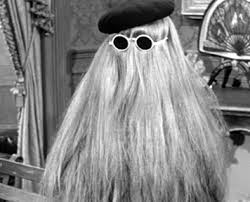
Yes, Cousin It, your hair strand test has come back positive for Creepy, Spooky and altogether Oooky.

The Judge says this :-

40. In my view, the variability of findings from hair strand testing does not call into question the underlying science, but underlines the need to treat numerical data with proper caution. The extraction of chemicals from a solid matrix such as human hair is inevitably accompanied by margins of variability. No doubt our understanding will increase with developments in science but, as matters stand, the evidence in this case satisfies me that these testing organisations approach their task conscientiously. Also, as previous decisions remind us, a test result is only part of the evidence. A very high result may amount to compelling evidence, but in the lower range numerical information must be set alongside evidence of other kinds. Once this is appreciated, the significance of variability between one low figure and another falls into perspective

41. I must say something about the reporting of test results as being within the high/medium/low range. In fairness to the testing organisations, this practice has developed at the request of clients wishing to understand the results more easily. The danger is that the report is too easily taken to be conclusive proof of high/medium/low use, when in fact the actual level of use may be lower or higher than the description. You cannot read back from the result to the suspected use. Two people can consume the same amount of cocaine and give quite different test results. Two people can give the same test result and have consumed quite different amounts of cocaine. This is the consequence of physiology: there are variables in relation to hair colour, race, hair condition (bleaching and straightening damages hair), pregnancy and body size. Then there are the variables inherent in the testing process. Dr McKinnon explained that there is therefore only a broad correlation between the test results and the conclusions that can be drawn about likely use and that it should be recognised that in some cases (of which this is in his opinion, one) there will be scope for reasonable disagreement between experts.

42. Furthermore, the evidence in this case shows that even as between leading testing organisations, the descriptions are applied to different numerical values. DNA adopts the figures set out in the relevant studies, while the two other organisations divide their own historic positive laboratory results into thirds (Alere) or use the interquartile range for medium (Lextox).
43. So it can be seen that there is variability in descriptions that are intended only to assist. As a case in point, the DNA Legal high figure for 2016 (1.50), which was itself significantly higher than that reported by the other testers, would only be described as falling into the medium range by two of the three organisations.

(Again, that’s not to say that one company is better than the others, or that one is getting it wrong, but you can see that a helpful label of high, medium or low use, is only helpful if you know what high, medium or low means FOR THAT company. It won’t necessarily be the same as for another company)

Hair strand testing has been considered in several previous cases:

In Re F (Children)(DNA Evidence) [2008] 1 FLR 328, a case involving DNA testing, Mr Anthony Hayden QC said this, amongst other things, at paragraph 32:

“The reports prepared for the court by the… experts should bear in mind that they are addressing lay people. The report should strive to interpret their analysis in clear language. While it will usually be necessary to recite the tests undertaken and the likely ratios derived from them, care should be given to explain those results within the context of their identified conclusions.”

In London Borough of Richmond v B [2010] EWHC 2903 (Fam), a case about hair strand testing for alcohol, Moylan J said this at paragraph 10, referring to the practice direction that became PD12B:

“10. I have referred to the Practice Direction because some of the expert evidence which has been produced in this case appears to have been treated as though it was not expert evidence. It may well be that results obtained from chemical analysis are such as to constitute, essentially, factual rather than opinion evidence because they are not open to evaluative interpretation and opinion. Although I would add that it is common for such analysis to have margins of reliability. However, the Practice Direction applies to all expert evidence and it will be rare that the results themselves are not used and interpreted for the purposes of expert opinion evidence.”

And further, at paragraph 22:

“When used, hair tests should be used only as part of the evidential picture. Of course, at the very high levels which can be found (multiples of the agreed cut off levels) such results might form a significant part of the evidential picture. Subject to this however, both Professor Pragst and Mr O’Sullivan agreed that “You cannot put everything on the hair test”; in other words that the tests should not be used to reach evidential conclusions by themselves in isolation of other evidence. I sensed considerable unease on the part of Professor Pragst at the prospect of the results of the tests being used, other than merely as one part of the evidence, to justify significant child care decisions;”

Bristol City Council v The Mother and others [2012] EWHC 2548 (Fam), Baker J was concerned with testing for cocaine and opiates. In that case, an unidentified human error in the process led to a false positive report. At paragraph 25, Baker J endorsed these four propositions:

“(1) The science involved in hair strand testing for drug use is now well-established and not controversial.

(2) A positive identification of a drug at a quantity above the cut-off level is reliable as evidence[1] that the donor has been exposed to the drug in question.

(3) Sequential testing of sections is a good guide to the pattern of use revealed.

(4) The quantity of drug in any given section is not proof of the quantity actually used in that period but is a good guide to the relative level of use (low, medium, high) over time.”

Baker J declined to go further, saying this at paragraph 25:

“The jurisdiction of the family courts is to determine specific disputes about specific families. It is not to conduct general inquiries into general issues. Occasionally, a specific case may demonstrate the need for general guidance, but the court must be circumspect about giving it, confining itself to instances where it is satisfied that the circumstances genuinely warrant the need for such guidance and, importantly, that is fully briefed and equipped to provide it.”

Most recently, Hayden J returned to the subject in London Borough of Islington v M & R [2017] EWHC 364 (Fam), a case of hair strand testing for drugs. He said this at paragraph 32:

“It is particularly important to emphasise that each of the three experts in this case confirmed that hair strand testing should never be regarded as determinative or conclusive. They agree, as do I, that expert evidence must be placed within the context of the broader picture, which includes e.g. social work evidence; medical reports; the evaluation of the donor’s reliability in her account etc. These are all ultimately matters for the Judge to evaluate.”

Peter Jackson J (as he then was) drew up 12 principles about hair strand testing (they are really useful). I hadn’t myself been aware of the principle that some hairs in a sample at any time won’t actually be growing (resting hairs – about 15%) which is why you can’t just test on a single hair, you need a large enough sample to make sure that you’ve accounted for hairs within the sample where there will not have been any growth. If you just tested one hair, that hair might be a resting growth hair, and would thus show you cocaine use from 4-6 months ago and fool you into thinking that it is a growing hair where that would mean recent cocaine use.

28. I next set out twelve propositions agreed between the expert witnesses from whom I have heard:

(1) Normal hair growth comprises a cycle of three stages: active growing (anagen), transition (catagen) and resting (telogen). In the telogen stage can remain on the scalp for 3-4 (or even 5 or 6) months before being shed. Approximately 15% of hair is not actively growing; this percentage can decrease during pregnancy.

(2) Human head hair grows at a relatively constant rate, ranging as between individuals from 0.6 cm (or, in extreme cases, as low as 0.5 cm) to 1.4 cm (or, in extreme cases, up to 2.2 cm) per month. If the donor has a growth rate significantly quicker or slower than this, there is scope both for inaccuracy in the approximate dates attributed to each 1 cm sample and for confusion if overlaying supposedly corresponding samples harvested significant periods apart.

(3) The hair follicle is located approximately 3-5 mm beneath the surface of the skin; hence it takes approximately 5-7 days the growing hair to appear above the scalp and can take approximately 2-3 weeks to have grown sufficiently to be included in a cut hair sample.

(4) After a drug enters the human body, it is metabolised into its derivative metabolites. The parent drug and the metabolites are present in the bloodstream, in sebaceous secretions and in sweat. These are thought to be three mechanisms whereby drugs and their metabolites are incorporated into human scalp.

(5) The fact that a portion of the hair is in a telogen stage means that even after achieving abstinence, a donor’s hair may continue to test positive for drugs and/or their metabolites for a 3-6 month period thereafter.

(6) Hair can become externally contaminated (e.g. through passive smoking or drug handling). Means of seeking to differentiate between drug ingestion and external contamination include:

(i) washing hair samples before testing to remove surface contamination

(ii) analysing the washes

(iii) testing for the presence of the relevant metabolites and establishing the ratio between the parent drug and the metabolite

(iv) setting threshold levels.

(7) Decontamination can produce variable results as it depends upon the decontamination solvent used.

(8) The SoHT has set recommended cut-offs of cocaine and its metabolites in hair to identify use:

(i) cocaine: 0.5 ng/mg

(ii) metabolites BE, AEME, CE and NCOC: 0.05 ng/mg

(9) Cocaine (COC) is metabolized into benzoylecgonine (BE or BZE), norcocaine (NCOC) and, if consumed, together with alcohol (ethanol), cocaethylene (CE). The presence of anydroecgonine methyl ester (AEME) in hair is indicative of the use of crack smoke cocaine.

(10) Cocaine is quickly metabolised in the body: therefore, in the bloodstream the concentration of cocaine is usually lower than that of BE. However, cocaine is incorporated into hair to a greater degree than BE: therefore, the concentration of cocaine in the hair typically exceeds that of BE. Norcocaine is a minor metabolite and its concentration in both blood and hair is usually much lower than either cocaine or BE.

(11) Some metabolites can be produced outside the human body. In particular, cocaine will hydrolyse to BE on exposure to moisture to variable degree, although high levels of BE as a proportion of cocaine would not be expected. It is very unlikely that NCOC will be found in the environment. The fact that cocaine metabolites can be produced outside the body raises the possibility that their presence is due to exposure: this is not the case with cannabis, whose metabolite is produced only inside the body.

(12) Having washed the hair before testing, analysis of the wash sample can allow for comparison with the hair testing results. There have been various studies aimed at creating formulae to assist in differentiating between active use and external contamination. In particular:

(i) Tsanaclis et al. propose that if the ratio of cocaine in the washing to that in the hair is less than 1:10, this indicates drug use.

(ii) Schaffer proposed “correcting” the hair level for cocaine concentration by subtracting five times the level detected in the wash.

The underlying fundamentals are that if external contamination has occurred (and therefore a risk of migration into the hair giving results that would appear to be positive) this is likely to be apparent from the amount of cocaine identified in the wash relative to that extracted from the hair.

An issue in the case was whether the existence of results that showed something, but below the cut-off levels, were evidence of anything

7. Having considered the evidence in this case, I arrive at the same conclusion as Hayden J in Re R, where (at paragraph 50) he preferred “a real engagement with the actual findings” to “a strong insistence on a ‘clear line’ principle of interpretation”. I accept the evidence of the witnesses for the testing companies that when one analyses thousands of tests, patterns can emerge that help when drawing conclusions. It would be artificial to require valid data to be struck from the record because it falls below a cut-off level when it may be significant in the context of other findings. That would elevate useful guidelines into iron rules and, as Dr McKinnon says, increase the number of false negative reports. What can, however, be said is that considerable caution must be used when taking into account results that fall below the cut-off level

The Court gave some practical guidance on the presentation of reports

Report writing and reading

57. The parties have made suggestions as to how the presentation of reports might be developed so as to be most useful to those working in the field of family justice. I will record some of these suggestions and some of my own. Before doing so, I note that each of the testing organisations already produces reports that contain much of the necessary information in one shape or another. It is also important to stress the responsibility for making proper use of scientific evidence falls both on the writer and the reader. The writer must make sure as far as possible that the true significance of the data is explained in a way that reduces the risk of it becoming lost in translation. The reader must take care to understand what is being read, and not jump to a conclusion about drug or alcohol use without understanding the significance of the data and its place in the overall evidence.

58. Comment was made during the evidence that certain courts, and in particular Family Drug and Alcohol Courts, are very familiar with the methodology of hair strand testing and the way in which reports are laid out. The objective must be for all participants in the system, professional and non-professional, to develop a similar competence, even though they do not read as many reports as the FDAC does.

59. There are currently nine accredited hair strand testing organisations working in the family law area. It is not for the court hearing one case to dictate the way reports are written by those who have intervened in this case or by others who have not taken part, but I include the following seven suggestions in case they are helpful.

(1) Use of high/medium/low descriptor:

This is in my view useful, provided it is accompanied by:

· A numerical description of the boundaries between high/medium/low, with an explanation of the manner in which the boundaries are set should be stated.

· A clear statement that the description is of the level of substance found and not of the level of use, though there may a broad correlation.

· A reminder that the finding from the test must always be set alongside other sources of information, particularly where the results are in the low range.

(2) Reporting of data below the cut-off range:

There is currently inconsistency as between organisations on reporting substances detected between the lower limit of detection (LLoD) and the lower limit of quantification (LLoQ), and those between the LLoQ and the cut-off point.

I would suggest that reports record all findings, so that:

· a finding below the LLoQ is described as “detected, but so low that it is not quantifiable”

· A result falling below the cut-off level is given in numerical form

and that this data is accompanied by a clear explanation of the reason for the cut-off point and the need for particular caution in relation to data that falls below it.

(3) Terminology

Efforts to understand the significance of tests are hampered by the lack of a common vocabulary to describe results in the very low ranges, Descriptions such as “positive”, “negative”, “indicates that” and “not detected” can be used and understood vaguely or incorrectly. The creation of a common vocabulary across the industry could only be achieved by a body such as the SoHT. In the absence of uniformity, reporters should define their terms precisely so that they can be accurately understood.

(4) Expressions of probability:

The Family Court works on the civil standard of proof, namely the balance of probabilities. It would therefore help if opinions about testing results could be expressed in that way. For example:

“Taken in isolation, these findings are in my opinion more likely than not to indicate ingestion of [drug].”

“Taken in isolation, these findings are in my opinion more likely than not to indicate that [drug] has not been ingested because….”

“Taken in isolation, these findings are in my opinion more likely to indicate exposure to [drug] than ingestion.”

(5) Where there is reason to believe that environmental contamination may be an issue, this should be fully described, together with an analysis of any factors that may help the reader to distinguish between the possibilities.

(6) The FAQ sheet accompanying the report (which might better be described as “Essential Information”), might be tailored to give information relevant to the particular report, and thereby make it easier to assimilate.

(7) When it is known that testing has been carried out by more than one organisation, the report should explain that the findings may be variable as between organisations.

And I think this line is likely to appear in written submissions from time to time

61. The burden of proof is on the local authority, which must prove its allegations on the balance of probabilities. As Ms Markham QC and Miss Tompkins rightly say, the presence of an ostensibly positive hair strand test does not reverse the burden of proof.

Ostriching and adverse inferences

The law in relation to decisions not to engage with assessments and the consequences that may flow from this

I ended up scratching my head about this issue about a month ago – where a parent doesn’t engage with assessments and doesn’t provide samples for drug testing, what can the Court do about it? It seemed a very obvious answer that the Court would be invited to draw adverse inferences from the failure to cooperate, but I couldn’t easily lay my hands on the authority for that proposition. It turned out to be more elusive than I had imagined, so having done the research and written it up, it was rather vexing to receive an email minutes later to say that the parent was now willing to engage rendering all my hard work pointless.

So, waste not want not. At the very least it might save someone else having to do all the legwork.

1. The starting point is that under the Children Act 1989 and civil proceedings generally, the burden of proof in any allegation falls upon the party making it, and the standard of proof is the balance of probability. Thus, in care proceedings, it will be the task of the Applicant to establish that it is more likely than not that the parent’s behaviour, history or failings amount to behaviour that it is not reasonable to expect a parent to provide and that it amounted to either causing the child significant harm or establishes a likelihood of significant harm in the future.

2. In a case where the allegation is, say, mental health instability or substance misuse, it is not a burden on the parent to demonstrate that their mental health is now fine, or that they are no longer using heroin. (This misapprehension works its way quite regularly into language used outside Court – “This mother needs to show me that she’s changed” and so on, but it is not a legal burden on the mother at all.)

3. If the Local Authority satisfy the Court that an assessment under Part 25 is necessary to establish the history and prognosis of mother’s mental health, or the current status of abstinence from or usage of substances in order to make confident predictions about the future, what happens where a parent declines to participate?

4. The Court of Appeal in S (Children) [2006] EWCA Civ 981 http://www.familylawweek.co.uk/site.aspx?i=ed1435 addressed particularly where the limits are in the family Court of compelling parents to produce evidence.

5. 23. I move, therefore, from the clear need for the court to receive the disputed evidence to the manner by which it should do so. I have no doubt that the submission is correctly made on behalf of the father, and today correctly conceded on behalf of the local authority, that the court cannot compel a party, against his will, to procure the evidence of a person not already a witness in proceedings. A party can be permitted to file evidence which he wishes to file; and, in civil proceedings, he can be compelled to file evidence from himself. He cannot, however, be compelled to file evidence to be collected by him from a third party; for he has no power to compel the third party to co-operate in enabling him to comply with the order against him. So, yes, the father is right: he should not have been subject to purported compulsion to file a report by his psychiatrist. The judge seems to have recognised as much when, in judgment, he observed “although it does not seem to me that the father can be forced to, the evidence from [the father’s psychiatrist] can be obtained now.” Notwithstanding his doubts the judge for some reason proceeded in his actual order to direct the father to file a report from the psychiatrist.

6. A parent can be compelled to provide a statement from themselves within care proceedings (there is no “right to silence” as a result of s98(2) and failure to produce a statement as directed could be treated as contempt and breach of an order and punishable by committal Re LR (Children ) 2013 http://www.familylawweek.co.uk/site.aspx?i=ed117035 )

7. There is, however, a right to silence, when the application is for committal, and the parent must be informed by the Judge that he or she does not HAVE to go into the witness box and is entitled to decline the option of giving evidence. The Court of Appeal confirmed in Khawaja v Popat & Anor [2016] EWCA Civ 362 that the Court can draw adverse inferences from the parents decision to exercise that right to silence (this is NOT the case in criminal law, but is the case in civil law)

http://www.bailii.org/ew/cases/EWCA/Civ/2016/362.html

27.As the proceedings led potentially to a criminal penalty, the appellant could not be compelled to give evidence. He could have remained completely silent and could have addressed submissions as to the strength or weakness of the evidence adduced by the respondent. However, he took a half-way course. He provided two affidavits in explanation, but he declined (as was his right) to have that evidence put to the test in cross-examination.

28. It might have been unwise for the judge to say to the appellant so bluntly that “…the reality is that if you don’t go in the witness-box it is likely that I will infer that you won’t go in the witness-box because you know you are lying…”. However, it seems to me that his overall remarks to the appellant, at the end of Mr Roseman’s opening of the case for the respondents, were correctly in accord with the law and practice as reflected in paragraph 81.28.4 of Civil Procedure 2015 Vol. 1 (p.2460) as follows:

“A person accused of contempt, like the defendant in a criminal trial, has the right to remain silent (Comet Products UK Ltd. v Hawkex Plastics Ltd. [1971] 2 QB 67, CA). It is the duty of the court to ensure that the accused person is made aware of that right and also of the risk that adverse inferences may be drawn from his silence (Interplayer Ltd. v Thorogood [2014] EWCA Civ 1511, CA…)…”
29.It is entirely clear from the transcript of the judge’s exchanges with Mr Roseman that he recognised fully the burden of proof that was upon the respondents and the standard of proof required to discharge that burden. The judge pressed Mr Roseman closely upon the evidence adduced in support of the application. I do not accept Mr Hendron’s submission that the judge concluded that the appellant’s silence on its own proved his guilt (contrary to the principles emerging from R v Cowan [1996] 1 Cr App R 1 at 7). The judge was conspicuously aware of the burden resting upon the respondents throughout. In my judgment, it seems clear that the judge recognised that the respondents’ evidence produced a case for the appellant to answer; he found the explanations given in the appellant’s affidavit evidence unsatisfactory and in the absence of oral evidence he drew the inference open to him that the appellant’s explanations were untrue.

30.It seems to me further that the law and practice as briefly stated in Civil Procedure (Loc. Cit. supra), and applied by the judge, is entirely consistent with the jurisprudence of the European Court of Human Rights, as reflected (for example) by the following passage from the judgment in Murray v UK [1996] ECHR 18731/91 at paragraph 47:

“On the one hand, it is self-evident that it is incompatible with the immunities under consideration to base a conviction solely or mainly on the accused’s silence or on a refusal to answer questions or to give evidence himself. On the other hand, the Court deems it equally obvious that these immunities cannot and should not prevent that the accused’s silence, in situations which clearly call for an explanation from him, be taken into account in assessing the persuasiveness of the evidence adduced by the prosecution.”

“Wherever the line between these two extremes is to be drawn, it follows from this understanding of “the right to silence” that the question whether the right is absolute must be answered in the negative.”

“It cannot be said therefore that an accused’s decision to remain silent throughout criminal proceedings should necessarily have no implications when the trial court seeks to evaluate the evidence against him. In particular, as the Government have pointed out, established international standards in this area, while providing for the right to silence and the privilege against self-incrimination, are silent on this point.”

“Whether the drawing of adverse inferences from an accused’s silence infringes Article 6 is a matter to be determined in the light of all the circumstances of the case, having particular regard to the situations where inferences may be drawn, the weight attached to them by the national courts in their assessment of the evidence and the degree of compulsion inherent in the situation.”

8. If a parent has within their possession and control documents or evidence, this can also be ordered to be produced. But the thrust of the passage in Re S 2006 above is that a parent cannot be compelled to participate in a psychiatric assessment if they do not consent. The Court has no power to compel them to do so.

9. However, the Court of Appeal provided a recommendation for such a scenario :-


24. It must be remembered, however, that the request for an order that the father should file a report from the psychiatrist was only the fall-back application made on behalf of the local authority. Their primary application was for an order for the disclosure of the records held by the psychiatrist and the linked records held by the father’s GP. Granted the relevance of the father’s psychiatric condition, that application was in my view unanswerable. In the ordinary case, in which the medical records are held by the doctors, the appropriate direction would have been to grant leave to the local authority to issue what in the Division we still have to call subpoenas duces tecum and ad testificandum, returnable either at the outset of the substantive fact-finding hearing or, surely more conveniently, at a prior review hearing, at which the doctor or doctors can produce the records to the court and answer such questions as will enable the parties both to make sense of them and, more broadly, to collect from them the focussed information about the parent’s likely condition at the time of the event. In this case, however, we are given to understand that the medical records are already in the possession of the father; and so in my view there is no impediment to a straightforward order for his immediate disclosure of them to all other parties. To that order I would attach permission to the local authority and the guardian, if so minded, to show the records to a psychiatrist of their own choosing; and, having studied the records and perhaps having instructed a psychiatrist to educate them about their significance, the local authority and/or the guardian will be free at the next review hearing to ask for leave to issue a subpoena ad testificandum against the father’s psychiatrist. I have to say that, once the court in care proceedings has decided in principle that such information should be obtained and once the parent has had the benefit of legal advice, this cumbersome method of obtaining it is usually circumvented by his agreeing, as a recital to the order, to procure a report from the psychiatrist upon the matters ruled to be relevant. Perhaps, now that this appeal is reaching its end and now that he can be given further and clearer advice, the father will be amenable to that elementary level of co-operation. But we should not count on it. It follows that I propose that the local authority’s cross-appeal and, insofar as it relates to the direction that the father should file a psychiatric report, the father’s appeal should be allowed; and that the orders which I have indicated should be substituted for the direction made by the judge. In all other respects the father’s appeal should in my view be dismissed.

9. The Court does, therefore, have jurisdiction to compel production of the medical records and can, if a party has made an application under Part 25 for an expert, direct that the expert report on a paperwork basis, considering said records. (And the Court of Appeal express hope that given that scenario, a parent would reflect that a report might be more favourable and balanced and nuanced if the expert has the benefit of speaking to them about these issues and thus change their mind about participation)

10.However, such an option is not available with drug or alcohol testing. If the parent is not consenting to the production of samples, alternate methods of collecting the samples cannot be used.

11. The issue therefore is whether the Court is entitled to draw adverse inferences or conclusions (specifically – does the decision by a parent not to consent to providing a sample amount to evidence that the tests if undertaken would demonstrate something unfavourable to the parents case?)

12. The High Court in RE O (CARE PROCEEDINGS: EVIDENCE)
[2003] EWHC 2011 (Fam) considered the issue of adverse inferences where a parent declined to give evidence at all or refused to answer particular questions

13. As a general rule, and clearly every case will depend in its own
particular facts, where a parent declines to answer questions or, as here, give
evidence, the court ought usually to draw the inference that the allegations are
true.

13. A decision not to consent to provide samples for the purpose of alcohol or drug testing is not strictly a parent declining to give evidence, but rather a parent declining to provide additional evidence which might establish things one way or another.

14. It might be analogous to the refusal to submit to DNA testing in paternity cases. The Court in those cases are entitled to draw ‘such inferences, if any, from that fact as appear proper in the circumstances’ (s23(1) Family Law Reform Act 1969) – the Court of Appeal ruled in Re G (Parentage : Blood Sample) 1997 1 FLR 360 that where a putative father refused to submit to blood tests then a forensic inference should be drawn and since the forensic process was advanced by the truth being told in court, those who obstruct that process will have an adverse inference drawn against them.

15. Whilst this is a helpful illustration, as the statute in question specifically provides in s23(1) the Court’s power to draw inferences, and the Children Act 1989 does not, it does not provide a definitive answer.

16. The Supreme Court, dealing with an ancillary relief case, considered the issue more broadly, in Prest v Petrodel 2013 https://www.supremecourt.uk/cases/docs/uksc-2013-0004-judgment.pdf

44. In British Railways Board v Herrington [1972] AC 877, 930-931, Lord Diplock, dealing with the liability of a railway undertaking for injury suffered by trespassers on the line, said:
“The appellants, who are a public corporation, elected to call no witnesses, thus depriving the court of any positive evidence as to whether the condition of the fence and the adjacent terrain had been noticed by any particular servant of theirs or as to what he or any other of their servants either thought or did about it. This is a legitimate tactical move under our adversarial system of litigation. But a defendant who adopts it cannot complain if the court draws from the facts which have been disclosed all reasonable inferences as to what are the facts which the defendant has chosen to withhold. A court may take judicial notice that railway lines are regularly patrolled by linesmen and Bangers. In the absence of evidence to the contrary, it is entitled to infer that one or more of them in the course of several weeks noticed what was plain for all to see. Anyone of common sense would realise the danger that the state of the fence so close to the live rail created for little children coming to the meadow to play. As the appellants elected to call none of the persons who patrolled the line there is nothing to rebut the inference that they did not lack the common sense to realise the danger. A court is accordingly entitled to infer from the inaction of the appellants that one or more of their employees decided to allow the risk to continue of some child crossing the boundary and being injured or killed by the live rail rather than to incur the trivial trouble and expense of repairing the gap in the fence.”

The courts have tended to recoil from some of the fiercer parts of this statement, which appear to convert open-ended speculation into findings of fact. There must be a reasonable basis for some hypothesis in the evidence or the inherent probabilities, before a court can draw useful inferences from a party’s failure to rebut it. For my part I would adopt, with a modification which I shall come to, the more balanced view expressed by Lord Lowry with the support of the rest of the committee in R v Inland Revenue Commissioners, Ex p TC Coombs & Co [1991] 2 AC 283, 300:

In our legal system generally, the silence of one party in face of the other party’s evidence may convert that evidence into proof in relation to matters which are, or are likely to be, within the knowledge of the silent party and about which that party could be expected to give evidence. Thus, depending on the circumstances, a prima facie case may become a strong or even an overwhelming case. But, if the silent party’s failure to give evidence (or to give the necessary evidence) can be credibly explained, even if not entirely justified, the effect of his silence in favour of the other party may be either reduced or nullified.”
Cf. Wisniewski v Central Manchester Health Authority [1998] PIQR 324, 340

17. It is suggested, therefore, that following the guidance in Prest v Petrodel (The ‘modification which I shall come to’ being very specific to ancillary relief cases and we can thus ignore it) , where the Local Authority have provided evidence which provides a reasonable basis for coming to a conclusion about substance misuse or alcohol misuse, a parent who chooses to be silent and not provide evidence by way of scientific testing (unless credibly explained) may have the Court determine that their silence turns a prima facie case into a strong or overwhelming one.

18. A Local Authority could not simply ask for a drug test as a fishing expedition and ask the Court to draw adverse inferences if a parent refuses to give one – they need to establish an evidential basis for suspicion that a test is necessary. (Previous history, allegation by a credible witness, evidence of the parent acting in a way which is consistent with drug misuse or so on)

(Why Ostriching? It’s lawyer slang for when a client is burying their head in the sand and pretending that it will all just go away if they ignore it. Actually, ostriches don’t do this – though they do dig holes in the sand to bury their eggs, and occasionally put their heads in those holes to turn the eggs hence the myth.)

Octavia, looking for Hartley and Topov

And all through my coffee break time

This is trivial. And that’s coming from someone who wrote a whole piece this week just so he could use a play on words about “kayak”. So yes, I know it is trivial. I do have a piece planned on the President’s Blood on our hands case, but that needs time to percolate, so to speak.

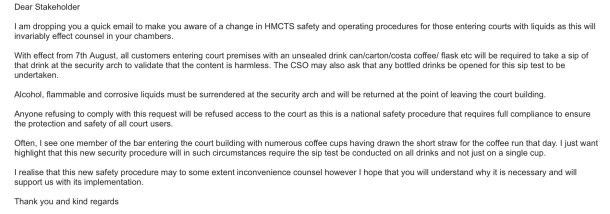
This is about the HMCS new security policy, on a national level, that anyone bringing liquid into Court has to take a sip of it, to demonstrate to security staff that it isn’t acid or some sort of hazardous liquid. That’s been going on for a while with bottled liquid, but it is now being extended.

I’m not sure why the product placement for Costa

(I didn’t write this and I already know that the author has misused ‘effect’)

Obviously, there are times when tempers run high in Courts, and of course sometimes people are attending Court where there’s a history of domestic violence and such, and one would never ever want a cup of acid to be thrown in such circumstances. And of course, one can only imagine the Daily Mail take if such a thing were to happen in a Court building – handwringing and demanding that heads must roll for not having anticipated it.

So I see where it comes from, particularly in light of the recent lurid headlines about acid attacks (and our own Home Secretary having not the slightest clue about what the actual sentencing provisions are for such offences are whilst playing to the “something must be done” gallery)

On the other hand, a minute application of common sense says that the reason why I and my colleagues and opponents don’t go about disguising acid as coffee and throwing it around at Court is NOT for fear of it being confiscated by Security guards (because hitherto we’d have got away with it) but because we’re not maniacs.

As an individual carrying a cup of coffee, the new scheme just causes a mild inconvenience – just taking a sip a little earlier than you anticipated. Not the end of the world.

This, however, does effectively put paid to the practice of coffee runs – where one person kindly goes to fetch coffees for a few other people. (Whilst the author of the email, who is not me, thinks that only counsel ever do this, of course others do it too. Doing a coffee-run, whilst you wait for the hearing to start, or wait for the windbags who went in first to finish, or for facts and reasons, is actually one of the few nice and civilised parts of attending Court. It seems a shame to lose it. )

If you have fetched four coffees and have to take a sip of each to demonstrate their safety, that’s going to rule out people like me who are happy to buy and fetch coffees for others but can’t drink them (because coffee is disgusting), or indeed anyone who prefers to drink their coffee untouched by the lips of others. It also avoids the prospect of someone saying “Does anyone fancy a coffee?” and you saying “ooh, me please” and then changing your mind as you realise that it is Malcolm Halitosis or Tina Moustache offering to fetch them…

(I would also point out that as a way of preventing “Alcohol” being brought in clandestinely, that asking the person bringing it in to sip it contains something of an exploitable loophole. Rather akin to asking the suspected heroin smuggler at an airport to go into a cubicle and do their own cavity searches)

Also, I’m not convinced that cardboard cups are a dream vehicle for transporting corrosive acid.

Cardboard goods are extremely sensitive to contamination. They must in particular be stowed away from colorants, acids, chemicals and fats/oils and be protected from dust and dirt.

How about polystyrene cups?

In the lab,polystyrene is melted and damaged by nearly every solvent.

Click to access MaterialsCompatability.pdf

I’m going to go out on a limb and say that anyone trying to transport corrosive liquid strong enough to injure a person is going to indeed injure a person with it if they try to do so in a coffee cup. That person will be themselves.

Glass bottles, and plastic bottles, possibly. And most Courts have been doing that at security for a long time, and it makes sense. Nobody is really going to object to that.

So if the coffee-cup sip test isn’t going to prevent alcohol (because the person bringing it is the person sipping it, and they will just stay silent) or corrosive liquids (because you’d detect that by the fact that the person’s shoes will be disintegrating) that only really leaves flammable liquids.

I think a sniff test would probably do the job there.

In the meantime, my loophole suggestion :- use a pen to write a message to the recipient under the lid, and assert your article 8 right to respect for private correspondence. (Suesspicious Mind note – this will not actually work, and will almost certainly make you late for Court whilst you argue Human Rights law with security guards, who will do their best to accidentally bang your shins with the metal detector wand and break the zips on your bag/suitcase every time they see you thereafter. So don’t do that)

“Oh my God, he’s got a pumpkin macchiato! Save yourselves! Get to cover” *(Not a coffee drinker, so is that even a thing?)

Benjamin Franklin, what do you want to tell us about whether the minute risk to our safety is worth sacrificing our freedoms?

If anyone wants to tell me in the comments section what the daftest thing they know has been confiscated by Court security, I’d love to hear it. I’ve been told this morning of peanut confiscation in case of nut allergy attack, and bike lights in case… you shine at the Judge??? Has anyone been asked to squirt perfume, or to apply spare lippy to make sure that’s really what it is?

You can’t have your kayak and eat it

(And yes, I did decide to write this one up because I couldn’t resist that joke)

Green v Adams 2017

This was a hearing following Mostyn J’s decision on mother’s application for financial provision for her child under Schedule 1 of the Children Act 1989. Mostyn J had made an order for such provision. The father appealed, unsuccessfully.

Subsequently, the father made an application to Court, aided by Dr Pelling (a name familiar to a lot of family practitioners he has actually had a lot of success as a MacKenzie Friend, including this somewhat pyrrhic victory but victory nonetheless of establishing that an assistant tipstaff assaulted him http://www.bailii.org/ew/cases/EWHC/QB/2004/492.html . I always enjoy a case with Dr Pelling in it – he really knows his way around the more obscure corridors of the law and when I refreshed my mind about the 57 cases that Bailli name-checks him in, he actually succeeds and is complimented for his manner and ability quite a lot of the time, and similarly, Mostyn J enjoys a good legal conundrum, so this had potential to be a fascinating judgment. Sadly, it disappoints, save for the kayak)

The father made an application that the Judge had in effect added things into the ‘pot’ that mother had not explicitly claimed for, that is the costs of a trip to China and the cost of a kayak. And that further, the figures that the Judge had calculated for these were too much, and that the lump sum father was ordered to pay was therefore too much.

http://www.bailii.org/ew/cases/EWFC/HCJ/2017/52.html

These two further points were, first, that the true cost of the trip to China referred to in my judgment of paragraph 1(iii) was £2,300 (which he had established by an email from the school) and, second, that the true cost of a kayak was no more than £500 (which he had established by Internet research). Therefore, he argued that in respect of these two items my assessment had been overstated by £350 and £300 respectively, a total of £650.

16.Accordingly, Dr Pelling argued that my lump sum of £20,600 was overstated by a total of £2,450 (i.e. £1,800 plus £650).

The Judge reminded himself that he did have the power to make awards for more than a person had actually sought.

However, I agree with Dr Pelling that if I was minded to go outside the field of battle as defined by the parties then the father should certainly have been given notice of my intention to do so. In any event, after having examined my memory, and even allowing for the considerable passage of time, I am satisfied that I did not intend to award the mother the full amounts and that I made a minor mistake. It is right that my judgment should be amended to reflect what I intended. Therefore paragraphs 1(ii) and (v) will be corrected to provide that the mother’s claim was for half the sums mentioned, namely £1,500 and £300.

19.However, on 13 July 2017, after the hearing and at a time when this judgment was largely completed, I received an email from Mr Holden which stated that the parties’ son had changed his mind about going on the educational trip to Israel this summer. Therefore, the mother would no longer pursue this head of claim and will repay the sum awarded.

20.The position is very different in relation to the claims concerning the China trip and the kayak. Here, the mother gave her best estimate of the historic costs. It was open to the father to challenge those figures and to adduce competing evidence. He did not do so and now is arguing that the court made its award on a mistaken basis. In my decision of DB v DLJ [2016] EWHC 324 (Fam) at paragraph 57 I stated at (ii) and (iii) that the claimant (that is to say the father in this case) must show that the true facts would have led the court to have made a materially different order from the one it in fact made, and that the absence of the true facts must not have been his fault. In my judgment, a correction in respect of these two items of £650 does not satisfy the criterion of a material difference and in any event I am not satisfied that the true facts could not have been placed before me by the father. I do not allow these corrections.

21.My conclusion is that the mother must repay to the father £3,300 (i.e. the full amount of the Israel trip – £3,000, and half the cost of the computer – £300) against which I offset her award of costs made above of £857, leaving the sum of £2,443 to be repaid.

There was also an application that the judgment should be anonymised, but we can all deduce what the conclusion of that was from the name of the case.

22.I now turn to the father’s application for further anonymisation of the main judgment. He says that the extent of anonymity given by me to the properties in paragraph 14 of my judgment is not enough, and that fictitious numbers and initials should be given. He says that there is a risk of jigsaw identification and a real danger of the people who live at those addresses been targeted by criminals. I am slightly surprised that this submission should be made by the father through Dr Pelling having regard to their trenchant resistance to any form of anonymisation in the proceedings in the Upper Tribunal heard by Mr Justice Charles and reported publicly as Adams v SSWP and Green [2017] UKUT 0009 (AAC). However, I am not satisfied that any further anonymisation is necessary, and this request is rejected.

(Seriously, I really did select this case on the basis of the kayak pun. I’m here all week, try the chicken)

Will you sign my petition ?

Don’t panic, I am not asking you to sign a petition. Although if I was, it would be for someone to make me some artwork of Sweep as a Transformer. Fighting MeGrimlock. And He-Man. That would be epic. Sweep would kick He-Man to bits. Despite not having legs. That’s how rock Sweep is.

Snap back to reality, oh there goes gravity….

This one covers something that comes up from time to time. Can a parent put a petition about their case online (notably on Change.org) and what can they / can’t they say in it?

Mr Justice MacDonald explains it all

“Ferguson!” (google it, or ask someone older)

Southend Borough Council v CO 2017

http://www.bailii.org/ew/cases/EWHC/Fam/2017/1949.html

10.The mother’s petition on the Change.org website is entitled “Please help stop the adoption of my 2 beautiful children”. It is directed to the United Kingdom Parliament and to the Prime Minister. In its original form, the explanatory narrative for the petition set out details of the final hearing before the District Judge, details of the orders granted by the court, the names, ages and disabilities of the children. The explanatory narrative also alleged that the social worker “lied under oath” and that the case was heard “without evidence” of emotional harm or neglect. Whilst, as I have already noted, there is no indication in the papers before me that the decision of the District Judge has been the subject of an appeal, but that certain information provided by the mother since the hearing suggests an appeal is at least contemplated, the explanatory narrative on the petition states that the mother is “applying to appeal to a higher court” to “put evidence before a judge to prove the social worker has lied under oath”. In its original form, the petition also exhibited a photograph of N and T, T being dressed in her school uniform.

If you’re not familiar with Change.org, it is one of those government initiatives like the Cones Hotline, aimed at empowering the public. In effect, anyone can set up a petition online at Change.org asking for others to sign it. If you get enough signatures (100,000 I believe), Parliament will debate your question.

(My prior experience with Change.org, other than it hosting petitions on behalf of parents who have lost their children in Court hearings, was Dave Gorman’s piece on it. http://voxpoliticalonline.com/2014/10/09/dave-gorman-on-government-e-petitions-hilarious-and-perceptive/ )

The Council issued Court proceedings, and the parents agreed at an interim stage to take down the portions of the petitions that would identify the children (their names, surnames, the photographs) but wanted the petition itself to stay up.

The Council considered that the petition, given that the signatories were all members of the extended family, still identified the family and hence the children, and sought removal of it in its entireity. Some of the responders also used the children’s names in comments when adding their signatures.

It is very clear that a parent can’t name the children or put photographs of them on the petition (and if for some reason you doubted that before, MacDonald J makes it very plain in this judgment) but the more difficult area is whether the petition is legitimate once those readily identifying features have been removed.

Here’s what the petition looked like at the start of the final hearing on this issue

11.Following the consent order of 25 May 2017, it took a little time for the parents to comply fully with the terms of that order. On 30 May 2017, the children’s names had been removed from the main page of the petition but the photographs of N and T remained visible and the other details were unaltered. On 8 June 2017, the photographs of N and T had been replaced with a photograph of all four children with their faces partially obscured. Ms Duxbury has confirmed that the parents have now complied fully with the consent order of 25 May 2017 with respect to the pictures, names and ages of the children that had been published on the main page of the petition on the Change.org website. As I have noted, friends and acquaintances of the parents have, on a limited number of occasions, identified the children by their forenames when responding to the petition and those posts remain. The current front page of the Change.org petition, which names the mother, reads as follows:

“In May 2017 family court granted, a full care order and placement order on all 4 of my beautiful children, despite me having solid evidence and this case was heard without evidence of emotional harm, neglect so I am applying to appeal to higher court so I can put evidence before a judge to prove to them i have never neglected my children , nor would i ever put them at risk of any sort of harm (i love my children with all my heart ❤ my focus on life is them) Having my children is my greatest achievement, they are my saviour they switched my focus from the outside to the inside. My children are gifts, they remind me of what's important. please help by signing this petition to reunite my family.<3"

That’s made me all nostalgic for 1337, I haven’t seen a “less than three” for ages and ages. I thought emojis had seen off 1337-speak. Aw, readers, I less than three all of you.

(And she managed to get a heart emoji in, so the less than three at the end is deliberate. Perhaps this mother is an uber haxxor who is keen to bring leet-speak back ?)

However, first, MacDonald J invites the usher to bring out the Naughty Step for the Local Authority and the legal department specifically.

before turning to the substantive issue, I must make some observations about an unfortunate course of conduct by the local authority following the granting of the order by consent on 25 May 2017.

7.Following the hearing on 25 May 2017, the mother contacted the court to alert it to the fact that the local authority was writing to members of her family in a manner that suggested that those family members were bound by the order of 25 May 2017 and prohibited from adding their names and comments to the Change.org petition. Having seen a copy of the letter being circulated by the local authority, I was satisfied that it does indeed read in that way and I notified the local authority through my Clerk that I would require an explanation.

8.The local authority now accepts that the letter it sent to family members does, wrongly, intimate that the order of 25 May 2017 prohibited family members from responding to the petition. Whilst the letter in question was written and sent by the allocated social worker, it would be wrong to criticise her. The social worker, as one would expect, sent the letter to the legal department of the local authority for checking before sending it out and the legal department returned the letter to the social worker un-amended for dissemination. The actions of this local authority legal department in permitting a letter in the terms drafted by the social worker to be sent are strongly to be deprecated. It is a matter of very grave concern that a local authority would seek to pass off an order of this court as something that it is not. There must be no repeat of this.

“All your naughty step are belong to us <3"

The legal framework (if petition is anonymised) boils down to article 10 (right to free expression) versus article 8 (child’s right to privacy)

20.The nature and ambit of the balancing exercise is well established. In considering whether to grant an order with respect to the publication of information the judge must balance the competing rights engaged. In many cases these will be the rights under Art 8 (respect for private and family life) and Art 10 (freedom of expression), although other rights may also have to be placed in the balance when reaching a decision regarding the publication of information. When conducting a balancing exercise between Art 8 and Art 10 (and any other rights engaged), the court applies the four propositions identified by Lord Steyn in Re S (A Child) (Identification: Restrictions on Publication) at [17], namely:

i) First, no article has, as such, precedence over the other;

ii) Secondly, where the values under the articles are in conflict, an intense focus on the comparative importance of the specific rights being claimed in the individual case is necessary;

iii) Thirdly, the justifications for interfering with or restricting each right must be taken into account;

iv) Finally, the proportionality test must be applied to each, referred to by Lord Steyn as “the ultimate balancing test”.
21.In applying what Lord Steyn described as the “ultimate balancing test” of proportionality the court must consider carefully whether the order that is being sought is proportionate having regard to the end that the order seeks to achieve (JXMX v Dartford and Gravesham NHS Trust [2015] EWCA Civ 96). This will involve an exacting analysis of the factual case advanced in defence of the measure in question (in this case the removal of the petition) to determine (a) whether the objective of the measure is sufficiently important to justify the limitation of a fundamental right, (b) whether the measure is rationally connected to the objective, (c) whether a less intrusive measure could be used and (d) whether having regard to these matters and to the severity of the consequences a fair balance has been struck between the rights of the individual and the needs of the community (Bank Mellat v HM Treasury (No 2) [2014] 2 AC 700 at [20]).

22.In A Local Authority v W, L, W, T and R (by the Children’s Guardian) [2006] 1 FLR 1 at [53], Sir Mark Potter P summarised the approach to the requisite balancing exercise as follows:

“The exercise to be performed is one of parallel analysis in which the starting point is presumptive parity in that neither article has precedence over or ‘trumps’ the other. The exercise of parallel analysis requires the courts to examine the justification of interfering with each right and the issue of proportionality is to be considered in respect of each. It is not a mechanical exercise to be decided upon the basis of rival generalities. An intense focus on the comparative importance of the specific rights being claimed in the individual case is necessary before the ultimate balancing test in terms of proportionality is carried out. Having so stated, Lord Steyn strongly emphasised the interest in open justice as a factor to be accorded great weight in both the parallel analysis and the ultimate balancing test …”
23.Within the balancing exercise, the child’s best interests are not paramount but rather are a primary consideration. Those best interests must accordingly be considered first, although they can be outweighed by the cumulative effect of other considerations (Re J (Reporting Restriction) [2014] 1 FLR 531 at [22]).

24.In undertaking the requisite balancing exercises, the impact of publication on the child must be weighed by the court (Re S (A Child) (Identification: Restrictions on Publication) at [25]). Whilst in many cases it will be demonstrated that publication will have an adverse impact on the child, this will not be the position inevitably. In Clayton v Clayton at [51] Sir Mark Potter P said:

“…given the existence of section 12 of the Administration of Justice Act 1960 which is apt to prevent publication or reporting of the substance of, or the evidence or issues in, the proceedings (save in so far as permitted by the court or as revealed in any judgment delivered in open court), I do not think that, as a generality, it is right to assume that identification of a child as having been involved in proceedings will involve harm to his or her welfare interests or failure to respect the child’s family or private life.”
25.In the circumstances, in each case the impact on the child of publication must be assessed by reference to the evidence before the court rather than by reference to a presumption that publication will be inevitably harmful to the child (see also R v Robert Jolleys, Ex Parte Press Association [2013] EWCA Crim 1135 at [16] and PGS (Appellant) v News Group Newspapers Ltd (Respondent) [2016] UKSC 26 at [73]).

26.Within this context, the court will require clear and cogent evidence on which to base its decision. Some of the evidence on which the requisite balancing exercise is undertaken will necessarily involve a degree of speculation (Re W (Children)(Identification: Restrictions on Publication) [2006] 1 FLR 1) although there comes a point where evidence is not merely speculative but pure speculation (Birmingham City Council v Riaz and others [2014] EWHC 4247 (Fam)).

MacDonald J also raised (but sensibly ruled that he didn’t need to decide the point) an argument about the Bill of Rights 1689. This seems a tricky point for a later Court to resolve. Brrrr.


32.The right of the subject to petition the Crown for redress for personal grievances was recognised in Magna Carta (although it probably dates to the Anglo-Saxon monarchs of England) and, more explicitly, in an Act of 1406 (Rotuli Paliamentorium 7 & 8 Hen. IV, No 63). The Bill of Rights of 1689 (1 William & Mary, session 2, cap 2) restated the right to petition the Crown, and the protection afforded to that right, in clear and unambiguous terms, stipulating that “…it is the right of the subjects to petition the King, and all commitments and prosecutions for such petitioning are illegal.” The Bill of Rights continues to apply in England and Wales. The right of the citizen to petition Parliament or the Government in respect of a personal grievance has thus been, and remains a fundamental constitutional principle (within the context of the right to Petition the European Parliament under Art 44 of the European Charter of Fundamental rights, the right to petition has been described as a fundamental right (see C-261/13 P Schönberger v Parliament)). Within this context, the House of Commons has a comprehensive body of rules that make provision for the submission of public petitions (see HC Standing Orders (Public Business) (2009)).

33.I did not hear detailed submissions on the operation of the Bill of Rights in this case and, specifically, on the effect (if any) of the prohibition it contains on “commitments and prosecutions” with respect to petitions seeking redress. Given the answer produced by the balancing exercise in respect of the ECHR rights engaged in this case, it has not been necessary to consider the point further. However, in a case where the balancing exercise were to come down in favour of injuncting a parent from circulating online a petition aimed at seeking redress from Parliament, it may well be necessary to go on to consider whether the fact that “all commitments and prosecutions for such petitioning are illegal” under the Bill of Rights of 1689 renders such a course unlawful.

(i.e is a petition to Parliament the same as petitioning the King, and prosecution for such petitioning is illegal, or is it only petitions to the King/Queen? In which case, Her Majesty is going to get an increased post-bag. )

In this case, the LA raised several arguments to say that publication of the anonymised petition would cause harm to the children, MacDonald J recognised each of these as having POTENTIAL to cause harm generally, but held that the LA had not produced evidence about the harm to these particular children

44.Turning in detail to the contended for justifications for interfering with the Art 10 rights of the parents relied on by the local authority, Ms Duxbury essentially submits that it is a matter of common sense that if C and W see online that their mother does not accept the outcome of the proceedings nor the validity of the care orders, this will act to upset the two children and undermine the stability and security of their respective foster placements. However, aside from this assumption, the local authority provides no specific evidence to support its contention that the presence of the petition, and its contents will cause emotional harm to C and W by means of causing them upset and potentially de-stabilising their respective foster placements.

45.Whilst it is the case that W’s foster placement has recently broken down, and Ms Duxbury informs the court that the foster carers feel that the precipitating issue was a level of anger and frustration being generated in W resulting from conflicting information being received from his birth family, there is no evidence before the court demonstrating that the breakdown resulted from the petition on the Change.org website (as opposed to, for example, exchanges during contact). Further, the assumption inherent in Ms Duxbury’s submission itself must be interrogated by reference to the nature of the information contained in the petition. W is 15 years old and C is 14 years old. Both children are fully aware that they were the subject of care and placement proceedings, that their parents do not agree with the decision of the court and that the parents wish the boys to be returned to their care. Within this context, the information set out in the petition will not result in the children becoming aware of views held by their parents’ regarding their placements of which they were previously oblivious. Whilst it may be said that, if it is permitted to remain online, the fact of, and the information contained in the petition acts to reinforce in the children’s minds their parents lack of acceptance of their placements following the outcome of proceedings, once again there is no evidence before the court that this is in fact the case.

46.Likewise, the local authority provides no specific evidence to support its contention that the presence of the petition, and its contents will disrupt efforts to find adoptive placements for T and N, or make an already challenging home-finding task more difficult, by discouraging prospective adopters from putting themselves forward. The highest that Ms Duxbury can put that submission is to assert that the online petition “could create anxiety with potential adopters”. Once again, whilst it may be said that it is a common-sense proposition that prospective adopters will be more reluctant to consider children who are the subject of an active online campaign, each case turns on its own facts and the assumption must be interrogated by reference to the evidence before the court. Within this context it is again important to look at the nature of the information contained in the petition. The petition makes clear that the children were the subject of proceedings, that the parents opposed to the plan of adoption and that the parents do not accept, and continue to oppose the outcome of the proceedings. All this is information that will be known to any prospective adopters. Within this context, the information set out in the petition will not result in prospective adopters becoming aware of information they would not otherwise be privy to. Whilst it may be argued that the presence of a petition indicating continued, active opposition by a parent following the conclusion of proceedings may act in more subtle ways on an adopter’s willingness to consider the children, once again this is an assumption rather than an evidenced fact. Indeed, information communicated to the court by the mother following the hearing tends to suggest that the local authority has now located adopters for T notwithstanding the existence of the online petition.

47.Finally, the local authority offers no evidence at all to support the alleged risk that the material already in the public domain will cause ongoing embarrassment and, potentially, emotional harm to the children as they get older in circumstances where it will remain on the Internet indefinitely in an easily and repeatedly accessible form. I accept that the fact that information is already in the public domain does not prevent injunctive relief where it can be shown that the repetition of known facts about an individual amounts to an unjustified interference with the private life of that person (see JIH v News Group Newspapers Ltd [2010] EWHC 2818 (QB) at [59]). However, once again, in this case the nature of the information is important.

48.The information contained in the petition setting out the mother’s objections and assertions regarding the fairness of the proceedings is, as I have outlined, relatively innocuous (once again, it does not contain details of the evidence before the court or details of the harm the court was satisfied that the children have suffered and does not seek to discuss the children’s individual needs), particularly when compared to other information that the courts have permitted to remain online (see for example Re J (Reporting Restriction), where the information in question was a video of the execution of an emergency protection order showing the child being removed in circumstances that were distressing, which video the court permitted to remain online subject to an order requiring the anonymisation of the name of the child). Further, the local authority offers no evidence to suggest that a petition placed online in response to a judicial decision in 2016, to which 160 people signed up and which received its last signature two months ago, is likely to be accessed in future years by others to the extent that it will result in embarrassment to the children, much less emotional harm. Again, whilst it is possible to speculate that this might be the case, given the nature of the information and the relatively small number of people who have accessed it at a time when it is relatively current, the court needs more than mere speculation before such a conclusion can be drawn. I also again bear in mind that the Administration of Justice Act 1960 does not act to prevent child being identified as having been the subject of proceedings.

49.In the circumstances, I am satisfied that there is very little cogent evidence before the court that each of the children or any of them will suffer embarrassment, much less emotional harm if the petition on the Change.org website remains in place online. Within this context, once again, it must be remembered that what the court is examining is whether there is evidence which amounts to a justification for interfering with the cardinal right of freedom of expression for the purposes of Art 10(2). Whilst it is, of course, possible to formulate a number of common-sense assumptions with respect to the potential impact on each of the children of persons accessing the online petition, the reality is that the justifications on which the local authority seeks to rely for interfering with the parents’ right to freedom of expression under Art 8 are poorly evidenced and largely speculative in nature.

The Judge’s conclusions are very plain that his decision (to allow the anonymised petition to stay up) is not one about the merits or otherwise of petitions and not a template to be followed in all future cases, but about the merits of THIS case and that the LA needed to show evidence about the impact or potential impact on these particular children which would have justified an interference with article 10 and that they, in THIS case, had not done so. It doesn’t mean that a Local Authority in another case would not be able to produce such evidence that would justify the petition being removed.

60.Finally, in respect of the contended for justifications for interfering in the Art 8 right of the children for respect for private life, in this case one of the main factors driving the interference in the children’s Art 8 right is the fact that the mother’s name appears on the front page of the petition and the children are referred to by their forenames in a limited number of the responses to that petition. Against this, the ability of a parent to make clear who is speaking out or seeking to petition for redress is self-evidently very important, it being very difficult, if not impossible, to effectively protest a contended for injustice or petition for redress of a personal grievance if the protester or the petitioner must remain anonymous and prevented from providing any salient details of their grievance that may breach that anonymity.

61.Having regard to the foregoing parallel analysis of the importance of the rights engaged in this case and the respective justifications for interfering with the same set out above, in which I have considered each of the children’s best interests as a primary consideration, and applying the ultimate balancing test of proportionality, I am satisfied that the local authority’s application for an injunction compelling the parents to take down their online petition must be dismissed.

62.Balancing the Art 10 right to freedom of expression of the parents (in the context of the importance of that right, the importance of parents who are the subject of state intervention being able to express their views about, the constitutional importance of the right to petition Parliament and the Government for redress with respect to a personal grievance and the importance of the ability of a parent to make clear who is speaking out or seeking to petition for redress) against the Art 8 right of the children to respect for their private and family life (in the context of the importance of that the right for the psychological integrity, personal development, development of social relationships and physical and social identity of the children and the court not being satisfied, having regard to the nature of the information and the children’s prior knowledge of it, that the evidence establishes that publication will cause emotional harm to C and W and potentially de-stabilising their respective foster placements, disrupt efforts to find adoptive placements for T and N or cause ongoing embarrassment to the children as they get older) leads me to conclude in this case the Art 10 right to freedom of expression outweighs the Art 8 right to respect for private and family life when it comes to the question of the online petition being taken down. Applying the ultimate balancing test of proportionality, in my judgment it cannot be said in this case that compelling the parents to take down their online petition directed at Parliament and Government, or compelling them to remove from the petition the mother’s name and the responses which utilise the forenames of the children, represents a proportionate response to the risk to the psychological integrity, personal development, development of social relationships and physical and social identity of the children presented by the limited amount of information concerning the children that the petition now contains.

63.For all the reasons I have given, the application of the local authority for an order compelling the parents to take down their petition on the Change.org website is accordingly dismissed. The order made by agreement on 25 May 2016 will continue in force.

CONCLUSION
64.I recognise that my decision will leave online a limited amount of information concerning the children in a format that has the potential to identify them as having been the subject of proceedings. However, cases dealing with the publication of information concerning children must be decided by the careful and rigorous application of the well-established legal principles articulated earlier in this judgment. As the President observed in Re J (Reporting Restriction), in the face of the challenges presented by the Internet we cannot simply abandon basic legal principles, as Lord Sumption observed in Prest v Petrodel Resources Ltd [2013] 2 AC 415, courts exercising family jurisdiction do not occupy a desert island in which general legal concepts are suspended or mean something different and as Hayden J observed in Re J (A Minor) [2016] EWHC 2595 (Fam), with respect to the balancing exercise required in cases of this nature, in a mature family justice system the weight afforded to the right to freedom of expression must be recognised and engaged with.

65.Within this context, cases dealing with the publication of information concerning children who are, or who have been the subject of family proceedings will necessarily involve competing interests. The court is required to balance a right that is important to the individual subject children, children who will often have been exposed to significant personal trauma, against a cardinal right that is important to parents, to children and to society as a whole. Where the court is required to strike this balance, a solution that comprehensively satisfies all interests is not possible.

66.Finally, I emphasise that this is a decision that turns on its own facts. It is not a judgment on the merits or demerits of online petitions generally, whether in the context of family proceedings or otherwise. Rather, it represents only the product of applying the required balancing exercise to the very particular circumstances of this case.

67.That is my judgment.

Superman or Green Lantern ain’t got nothing on me


This is just an update about the book. And if you don’t know that I’ve written a book, then you now have that valuable piece of information. Want to get a copy?

https://unbound.com/books/in-secure


Exciting bit. Every last i has been dotted and t crossed. The copy edit has come back and I’ve made all the necessary adjustments and signed the text of the book off.

Having not been through this process before, it was an eye opener – as well as just checking spelling and grammar, the copy editor goes through each line and scene to make sure it is consistent and working. They keep track of which characters are in each location during a scene and make sure that someone who I said a page earlier was in the kitchen isn’t saying anything in the breakout area unless I’ve shown them come back in. That’s really easy to lose when writing, especially when you are making changes and don’t spot that moving someone around on page 19 has ripples on page 24. Same with props – if I haven’t said that someone is holding a deck of cards on page 36, they can’t start shuffling it to pass the time on page 38.  Continuity, basically. Important.


I’m really happy with the way the book reads now. It isn’t perfect, because I’m not actually F Scott Fitzgerald (and even then, frankly, he didn’t hit home runs every time) but the flaws in it are my flaws and I’m content with how it is. Really looking forward to you all reading it.

In my acknowledgments at the end, I talk about the fact that you can’t use songs in a book without clearing the use of lyrics with the band/artist, which is time consuming and expensive, so I just haven’t done it. I then said that if anyone wanted to get in touch I’d give them a playlist.

Then I thought, what the hell, I’ll do a playlist for the book anyway (it is spoiler-free, I haven’t picked songs like “Turns out the Cuckoo Clock WAS the key, the whole time” or “Oh, so they’re SISTERS” – fake spoilers those)

If you have Spotify, this should take you to the playlist where you can listen to it.

https://open.spotify.com/user/moriartyyaffle/playlist/4CJEkYu2ag9UCmejhzDscB

If you don’t, here’s a track list – so they are songs that make me think about the characters and scenes and mood of the book – honestly, there aren’t any spoilers, and the track-listing is not a chronological order of the book, so you can listen without ruining everything. And yes, I cheated by having a Pixies cover of a Jesus and Mary Chain song so I could get JAMC in twice…

Enjoy

1. Sunshine Superman – Donovan

2. Superstition – Stevie Wonder

3. Opportunities – Pet Shop Boys

4. Work Bitch – Britney Spears

5. Sour Times – Portishead

6. Baby Driver – Simon and Garfunkel

7. Hurt – Johnny Cash

8. Head On – Pixies

9. Still Ill – The Smiths

10. Jailbreak – Thin Lizzy

11. Monster – Imagine Dragons

12. Boom! Shake the Room – Fresh Prince

13. Elastic Heart – Sia

14. I’m Coming Out – Diana Ross

15. Sometimes Always – Jesus and Mary Chain

16. Chillout tent – Hold Steady


You know what I’m saying dog
Like cats and dogs
It was raining
It wasn’t raining
We were raving

Fasting for Ramadan and Court of Protection


An interesting Court of Protection case which might prove useful for other professionals.


IH (Observance of Muslim Practice) 2017

http://www.bailii.org/ew/cases/EWCOP/2017/9.html


Cobb J was presented with an application by the Official Solicitor on behalf of IH, a man of Muslim background who lacked capacity, for a declaration that IH should not have to fast during the period of Ramadan as would be culturally usual for Muslims who had capacity.

At the same time, IH’s family sought a direction that IH’s body hair should be trimmed.


  • There is no dispute that IH lacks capacity to make the decisions which are the focus of these applications; the diagnostic and functional criteria contained in, respectively, sections 2 and section 3 MCA 2005 are clearly established on the evidence. Specifically, to have capacity to make the decision to fast for Ramadan, a person would be expected to understand (section 3(1)(a)):


i) What fasting is; the lack of food and liquid, eating and drinking;

ii) The length of the fast;

iii) If for religion, for custom (family or otherwise), for health-associated reasons, or for other reasons;

iv) If for religion reasons, which religion and why;

v) The effect of fasting on the body;

vi) What the consequences would be of making a choice to fast and the risks of choosing to not fast or of postponing the decision.


  • Dr. Carpenter is clear that IH is not able to understand any of the six points listed in [20] above. It is further agreed between the parties, having received Dr. Carpenter’s advice, that, given the nature of his disability, IH will not ever acquire capacity to make such decisions (section 4(3)).
  • To have the capacity to make a decision in relation to the trimming or removal of pubic or axillary hair for religious or cultural reasons, a person would be expected to be able to understand:


i) Which parts of the hair are being removed – pubic, axillary, perianal, trunk, beard, leg, torso, or head;

ii) Whether the reason for the hair trimming/removal is religious, for the maintenance of good hygiene, custom, or some other;

iii) If for a religious reason, which religion and why;

iv) What the consequences would be of making a choice to have hair trimmed/removed, and of not trimming/removing the hair.


  • Dr. Carpenter is clear that IH is not able to understand any of the four points listed in [22] above. He opined that while IH may give the superficial appearance of engaging in prayer, by responding to the familiar practice of the adults in the family turning to prayer (he holds his hands up, or places them behind his ears), he has no understanding of the purpose or higher meaning of the act of prayer. It is further agreed between the parties, having received Dr. Carpenter’s advice, that, given the nature of his disability, IH will not ever acquire capacity to make such decisions (section 4(3)).


Cobb J outlined the religious principles involved in these issues, and in particular that the Islamic faith already has provision for those who lack the ability to make their own decisions and who are therefore exempt from obligations that might be placed upon others.

Islamic religious observance for those without capacity.


  • The Five Pillars of Islam (‘shahada‘ [faith], ‘salat‘ [prayer], ‘zakat‘ [charity], ‘sawm‘ [fasting] and ‘hajj‘ [pilgrimage]) are the foundation and framework of Muslim life, and are regarded as obligatory for Muslims. Not all actions or observances within Islam, however, are obligatory; some are recommended, others optional, some actions are reprehensible, and others prohibited. In Islam, a Muslim will commit a sin if he/she violates something which is obligatory or prohibited, will be rewarded for carrying out something which is recommended; a minor sin is committed for not doing something which is recommended, and for doing something which is reprehensible.
  • Significantly for present purposes, Islam stipulates different arrangements for those who lack ‘legal competence’. ‘Legal competence’ in Islamic terms is defined by Dr. Ali as “a capacity or a potential for mental functioning, required in a decision-specific manner, to understand and carry out decision-making. Competence is always presumed; its absence or inactivity has to be affirmed by a court.” It is normal (per Dr. Ali) to defer to medical practitioners or experts on the issue of legal (mental) competence; their opinion would be likely to be deemed valid and authoritative in the Shari’a. The evidence filed in these proceedings, most notably from Dr. Carpenter, would be sufficient, I was advised, to form the basis in Islamic law to declare IH to be “legally incompetent”; all parties agree that IH is not legally competent under Islamic law.
  • Dr. Ali advises that the legally incompetent person (along with the terminally ill, the disabled and minors) is perpetually in a heightened state of spirituality, hence he or she is exempt from practising the major rituals of Islam including adherence to the Five Pillars.
  • On the specific issues engaged in this application, Dr. Ali advises as follows:


Fasting in Ramadan

i) Fasting during the daylight hours of Ramadan is one of the Qur’anically mandated obligations for all Muslims who are legally competent, and who are not exempt. Certain groups are exempt from fasting; they include the incapacitous, minors, the ill, pregnant women, those who are travelling. Those who are exempt are not morally culpable for not keeping the daylight fast.

Trimming or shaving of pubic and axillary hair

ii) Cleaning pubic or axillary hair is a religiously sanctioned practice deemed in Islam to be a normal human ‘right’ (‘fitrah‘);

iii) The rationale is founded in a quest for ritual purity and cleanliness; (the aphorism ‘cleanliness is next to godliness’ is of course familiar to many religions);

iv) The removal of pubic and axillary hair for the legally competent Muslim is ‘mustahab‘ or ‘recommended practice’; while it is not obligatory (‘wajib‘) it would be viewed as a ‘minor sin’ if unattended (see [26] above);

v) As IH does not have ‘legal competence’ it is not even recommended practice for him (see [28] above); there is no obligation on his carers to carry out the removal of IH’s pubic or axillary hair, and his religious rights are not being violated by not attending to this;

vi) It is highly recommended and praiseworthy for carers (of whatever religion) to shave or shorten a patient’s pubic or axillary hair, in the same way as it is for them to assist the incapacitous in other routine care tasks;

vii) There are differences of opinion between Islamic commentators as to the preferred manner of hair removal; any method would be deemed acceptable;

viii) The time limit within which the hair needs to be cleaned or trimmed or removed is also a matter of assorted opinion, though the majority of commentators favour a 40-day limit;

ix) While it would be not permissible for a competent Muslim to expose their genitals, it would not be contrary to the Shari’a for a Muslim without capacity who requires assistance with his care, for his carers to clean his genitals or shave them; that said, “carers must be sensitive that the client’s dignity is not violated”;

x) ‘No hurt no harm’ is a cardinal principle of Islamic bioethics; avoidance of harm has priority over the pursuit of a benefit of equal or lesser worth. Therefore it would be wrong to create a situation in which observance of Islamic custom would, or would be likely to, cause harm to the person (i.e. IH) or his carers; if there is a risk of harm, then this principle would absolve even the capacitated person from performing an obligatory requirement.

Is it in IH’s best interests to be relieved of his obligation to fast during Ramadan?


  • As indicated above ([29](i)) there is no Islamic obligation on IH to fast given his lack of capacity. IH has never been required to fast by his family, and has not fasted while in their care. He has not, thus far, fasted while in the care of the Local Authority.
  • If this had been a case in which IH had some appreciation of the religious significance of fasting in Ramadan (as a means to attaining taqwa, i.e. the essence of piety, protecting one’s self from evil) there may be said to be some benefit in him doing so. But he has no such appreciation.
  • IH, I am satisfied, would not in fact understand why food and water was being withheld for the daylight hours in the month of Ramadan; the absence of food/water would be likely to cause him stress, or distress; this may cause him to become irritable and/or aggressive in the ways described above ([13]) increasing the risks to staff and himself. There is some minor anxiety that fasting and/or mild dehydration would increase the side effects of any one of his multiple medications. It is plainly not in his interests that he should fast, and the declaration will be granted.


Is it in IH’s best interests for his pubic and axillary hair to be trimmed?


  • Health or social care bodies who make the arrangements for the care for adults who lack capacity owe an obligation, so far as is reasonably practicable and in the interests of the individual, to create a care environment and routine which is supportive of the religion of P, and to facilitate P’s access to, or observance of religious custom and ritual. All forms of liturgy should, where practicable, be accessible to persons with disabilities. This view is consistent with Article 9 of the European Convention on Human Rights, and the right enjoyed by those who lack capacity as for those who have capacity, to freedom of religion and freedom, either alone or in community with others and in public or private, to manifest his religion or belief, in worship, teaching, practice and observance. While no specific protection in this regard appears to be offered by the UNHR Convention on the Rights of Persons with Disability, the rights enshrined in the ECHR (above) “are for everyone, including the most disabled members of our community” (Baroness Hale in P (by his Litigation Friend, OS) v Cheshire West & Others [2014] UKSC 19).
  • The duty outlined above is consistent with the expectation that in best interests decision-making for someone who lacks capacity, the court will take account, so far as is reasonably ascertainable “the beliefs and values” of that person which would be likely to influence his decision if he had capacity (section 4(6)(b)); these must include, where relevant, religious beliefs and values. This is illustrated in the instant case by the fact that the Local Authority provides IH with a Halal diet even though IH himself would not know that the food he ate was Halal, or the significance of the source and/or preparation of the food. The Local Authority recognise the need to respect IH’s religion.
  • Of the “relevant circumstances” which require consideration in deciding on this issue, TH has placed the religious significance of the proposed procedure at the centre of the decision-making, and I turn to this first.
  • The frame of reference for consideration of the issue has altered since the start of the litigation. At a best interests meeting on 9 September 2016, TH advanced the proposition that there was a religious “duty” to remove or shave IH’s pubic and axillary hair. In the same manner, his early written evidence (see [14]) referred to the “very essential” and “compulsory” nature of the activity, a view pronounced apparently on the authority of an Imam. This indeed is how Roderic Wood J characterised the issue, in passing, in the case of A Local Authority v ED & others [2013] EWCOP 3069, in which he referred (at [12]) to a “duty” to remove the pubic hair of a Muslim woman (albeit recognising the exemption for the incapacitous). Dr. Ali’s evidence, on which he was not challenged, was to different effect.
  • In short, as is clear from [29](v) above, there is simply no religious duty, or obligation on a person who lacks capacity (‘legal competence’ in Islam) to trim or shave his or her pubic and axillary hair, or on his carer to do so for them. IH does not need to acquire this state of ritual cleanliness in order to derive spiritual benefit as he already occupies an elevated status by virtue of his incapacity. Moreover, I am satisfied that IH himself derives no religious ‘benefit’ by having the procedure undertaken, as he would not understand its religious significance. It is of no consequence to me, in the consideration of these facts, that the carers may be blessed in the eyes of Islam in undertaking a ‘praiseworthy’ activity by trimming the hair; their interests are not my concern.
  • I agree with TH, and with Mr. Jarrod, when they separately expressed the view that if IH had capacity he probably would have observed this custom.


And in conclusion

Conclusion


  • I have faithfully endeavoured to consider these issues from IH’s point of view, while ultimately applying a best interests evaluation. IH has a life-long developmental condition and has never had the capacity to understand the tenets of Islam; the benefits of adherence to such rituals do not obtain for him, but for others. The fact is that by reason of his disability IH is absolved of the expectation of performing this recommended procedure, and there is no other clear benefit to him. The trimming of the pubic and axillary hair would serve no other purpose. I am anxious that IH should be spared additional stresses in his life, and wish to protect him and the staff from the risk of harm – an approach which itself has the endorsement of Islamic teaching (see [29](x) above).
  • For those reasons, and having reviewed the circumstances extensively above, I have reached the conclusion that:


i) The parties are right in agreeing, and I confirm, that IH should be relieved of the obligation to fast during Ramadan;

ii) It is not in IH’s best interests that his pubic and/or axillary hair be trimmed in accordance with Islamic custom for capacitous followers of Islam.


Request for support

Quick trigger warning – if you’ve been through painful experiences yourself recently, then this post may be too raw and painful, and as it is not my intention to make life harder for anyone who is working through such trauma, the warning is here to suggest that you close this one down, and come back to the next post, which will probably be about 80s pop, or Mary Mungo and Midge or whatever.

Some of you may have read @SurviveCourts blog, Surviving Safeguarding, where she talks about her experiences of being on the hard end of the social work experience, rather putting all our gripes of trolleys with knackered wheels, or endless frustration with laptops and workloads into perspective. Some of you may have had the pleasure of seeing her speak, which is truly an inspirational experience.

I find myself lucky enough to have got to know her a little, and I’m proud and honoured to think of her as a friend. Though she be but little, she is fierce.

So it was a huge shock to learn that she’d gone through a recent tragedy, and like most of those who have come to know her and hold her in high regard, I wanted to do something, even a tiny something, to help.

Louise Tickle (or as we should now all call her “The Mail on Sunday’s Louise Tickle” as apparently they now own her, in some sort of Jonathan Pryce East India Company style arrangement) got the ball rolling on this, and she says everything that I wanted to say, but better. Because she’s a proper grown up writer, and not a hack like me.

If you can visit the link and help out at all, even in a small way, it would mean a lot to us all.

https://www.justgiving.com/crowdfunding/survivingsafeguarding

Reid ’em and weep

The peculiar goings-on in the case of Westminster v Associated Newspapers Ltd

 http://www.bailii.org/ew/cases/EWHC/Fam/2017/1221.html

This was a specific hearing arising from a set of care proceedings in which both parents were asserting forcefully that their son H was very ill indeed. The Court, having heard a great deal of evidence and had that evidence tested by lawyers, including lawyers acting for the parents, decided otherwise


I found, firstly, that the parents had misreported and exaggerated H’s medical symptoms. I concluded that this had led not only to his emotional harm but to his physical harm. In consequence, particularly of the exaggerated gastrointestinal pain, there was the unnecessary insertion and thereafter the prolonged use of a Hickman line, which exposed H not merely to the risk of short-term infection, but to the risk of liver failure in the long term. It perhaps requires to be underlined that in consequence of his parents’ actions H’s life was placed in peril.


4.I went on to find that the mother, through bullying and bombastic behaviour, had intimidated medical professionals and others to the extent that she confused and undermined their confidence in their own professional judgement. In the hospital it generated a febrile atmosphere in which there was an elevated risk of clinical error, I found this compromised H’s safety.


5.In particular, and this requires perhaps to be emphasised too, in April 2016, on the most compelling of evidence, I found that both parents had, on separate occasions, tampered with H’s TPN pump. The effect of this, though it did not immediately threaten H’s health was, again, to cause confusion and alarm on the ward and jeopardise professional objectivity.


6.The father has both directly and passively acquiesced in the mother’s distorted perspective of H’s health and medical needs. The mother presented H to the world as dying, in extremely alarming e-mails. Moreover, on the evidence, she inculcated in H himself, a view that he was dying. The parents’ actions led to prolonged stays in hospital, the consequence of which was that H has been robbed of much of his childhood and teenage years.


7.This is of course a desperate situation made all the more depressing by the fact that H has an outstanding, lively, irrepressible intellect and a keen and zany sense of humour. It is a tragedy that these talents have not been allowed to flourish and grow as they ought to have been. I reiterate, in order that the point is not lost in the detail of my judgment, the harm caused to H by his parents, protracted over many years, exposed him to significant harm at the most serious end of the spectrum, ultimately risking his life.


The parents, not being in agreement with the judicial decision, sought to involve some crusading journalists to fight their case in the court of public opinion. The Telegraph and the Mail ran sympathetic pieces.


I wrote a long passage here, but actually I’m not going to bother with it. My readers already know whether they think Christopher Booker is a champion for justice or something else, and they are all entitled to their own views.

So instead of the long passage where I try to be balanced and reasonable and just annoy everyone on both sides of the argument, here’s a a photo of a young Cat Stevens tasting some food. I can’t tell if the food in the pan is fish, chicken or even pigs (the curly bits could be tails?).   If you are only familiar with beardy old Cat Stevens, DAMN he was a handsome young fellow.


My own recipe for rough emotional week – First Cut is the Deepest swiftly followed by Father and Son, get it out and move on

Anyway, this secondary decision was as a result of the child being visited in hospital by a journalist and interviewed by said journalist, who had not been open and transparent about who she was when making the visit.


15.I was informed during the course of the hearing, by the local authority, that it suspected that a reporter from The Daily Mail had visited H in ‘Unit A’ on 8th May. That reporter, I was told, was thought to be a Ms Sue Reid, though the visitor book bore an inscription that a Susan Odette Brown, recorded as ‘a friend’, had visited that day. I indicated to the local authority that they should make inquiries to establish such facts as they could. In pursuance of that, they drafted the following questions which were relayed to The Daily Mail. They are succinct questions and they are responded to with equal clarity. They require to be set out:


“Do you (i.e. The Daily Mail) employ or commission a journalist called Sue Reid or Susan Odette Brown? Answer: yes.”


“Did this journalist visit [the unit] on 8 May 2017 or at all? Answer: Yes.


What was the purpose of this visit? Answer: Miss Reid has confirmed that she visited in order to see H and see his social situation.


How was the visit arranged?”


The response was as follows:


“A campaign group alerted Miss Reid to H’s living arrangements and asked her to pay him a social visit. H’s parents also wanted Miss Reid to visit him and accordingly they passed on H’s mobile phone number. Miss Reid rang the number and spoke to H, who invited her to visit him and gave her a suitable time to do so.”


The final question was framed thus:


“Did you have permission to talk to H, a young person aged 15, and if so who gave you permission? Answer: Yes, H and his mother.”


16.These questions had in mind the protection afforded to young people and particularly to those who are vulnerable, by the Codes of Practice (2016), Independent Press Standards Organisation (IPSO). It is convenient that the relevant guidance be set out here:


“Clause 8 protects patients in hospitals and similar institutions from intrusion. It requires journalists to identify themselves and to obtain permission from a responsible executive to enter non-public areas. The clause applies to all editorial staff, including photographers.


The clause covers the newsgathering process, so the Code can be breached even if nothing is published. The clause also requires that, when making inquiries about individuals in hospitals and similar institutions, editors need to be mindful of the general restrictions in Clause 2 of the Code on intruding into privacy.


[Some readers may remember certain press scandals about Russell Harty, a celebrity whom certain sections of the Press believed was hospitalised because of AIDS and reporters donning medical gowns in order to gain access clandestinely to the hospital. ]


Of particular relevance is:


Identification and permission


Journalists must clearly identify themselves and seek permission from a responsible executive to comply with the Code. The use of the term “executive” implies that permission can be obtained only from a person of sufficient seniority. A journalist who attended a London hospital after the Canary Wharf terrorist bomb photographed an injured victim in the company of a relative and another person who he thought had obtained permission from hospital staff.


When medical staff complained, the PCC found the Code had been breached. It said: “The Commission was not persuaded the reporter in this particular case had followed the provisions of the Code: it was not enough to assume that his identity was known or to rely on the comment of an individual who was clearly not a responsible executive, although the reporter had done so in good faith.” Hutchison v News of the World: http://www.pcc.org.uk/cases/ adjudicated.html? article =MTkwMA


What the Code says


  1. i) Journalists must identify themselves and obtain permission from a responsible executive before entering non-public areas of hospitals or similar institutions to pursue enquiries.


  1. ii) The restrictions on intruding into privacy are particularly relevant to enquiries about individuals in hospitals or similar institutions. A public interest exemption may be available.


Non-public areas


In most cases, what constitutes a non-public area will be clear and will certainly include areas where patients are receiving treatment.


See: Stamp v Essex Chronicle

A man v Daily Mail


17.The code purposefully set a strong objective to safeguard children. The following requires emphasis :


Clause 6


Children


The Code goes to exceptional lengths to safeguard children by defining tightly the circumstances in which press coverage would be legitimate. For the most part, this applies up to the age of 16 – but the requirement that pupils should be free to complete their time at school without unnecessary intrusion provides a measure of protection into the sixth form. In the absence of a public interest justification, pupils cannot be approached at school, photographed or interviewed about their own or another child’s welfare, or offered payment, unless consent is given by the parent or guardian.


The welfare of the child includes the effect publication might have.


A complaint from an asylum seeker was upheld after a newspaper interviewed and identified some of his children. The PCC said the article was likely to provoke a strong reaction in readers, which might affect the children’s welfare.


Kenewa v Sunday Mercury


There is a public interest defence available to editors, but here again the bar is raised in favour of protecting children and the Code states that “an exceptional public interest” would need to be demonstrated.


What the code says


  1. i) All pupils should be free to complete their time at school without unnecessary intrusion.


  1. ii) They must not be approached or photographed at school without permission of the school authorities.


iii) Children under 16 must not be interviewed or photographed on issues involving their own or another child’s welfare unless a custodial parent or similarly responsible adult consents.


  1. iv) Children under 16 must not be paid for material involving their welfare, nor parents or guardians for material about their children or wards, unless it is clearly in the child’s interest.


  1. v) Editors must not use the fame, notoriety or position of a parent or guardian as sole justification for publishing details of a child’s private life.


A public interest exemption may be available. See Page 96.


Consent


The press has to establish which is the competent authority to grant consent in each case.


See: A woman v Derby Telegraph

Brecon High School v Brecon and Radnor Express


18.In order to advance their own explanations, the parents both filed statements in which the broad thrust of the answers given by The Daily Mail were or appeared to be disputed. It has been necessary for me today to inquire as to what in fact led to the visit, which all agreed took place, between Ms Reid and H at the unit on 8th May.


19.As the evidence has unfolded it has funnelled into a very narrow area of agreement and disagreement. Today there were filed, on behalf of Ms Reid, a number of e-mail communications, which have been helpfully set out by Mr Browne QC and Mr Wolanski, who represent her through Associated Newspapers Limited. A key communication is an e-mail sent at 18:30 on 6th May by H’s mother to a Miss Miray Kester, whom she describes as a friend. It is clear from that email and the earlier discourse that it was intended to provide a summary of H’s situation from the mother’s own perspective. It is, characteristically, a gross distortion of the facts. It presents H, in melodramatic terms, brutalised and neglected by the system. Yet again the mother describes H as suffering from serious illness. As those reading my earlier judgment will appreciate and as time has now borne out, H is not suffering from any serious illness. Those conditions which he does have are not seriously debilitating.


20.It is unnecessary for me further to burden this judgment with the details of the email communications because a number of factors are clear. Firstly, I am satisfied that, in the context of the email communication as a whole, the email I have referred to above was written by the mother as a briefing document for the press. The document, which I do not propose to read into this judgment, speaks for itself. Secondly, Ms Reid obtained H’s telephone number and spoke to him directly before she spoke to the mother. This she agreed in evidence. Thirdly, Ms Reid later spoke to the mother on the telephone and the conversation lasted some 40 or so minutes. In that conversation Ms Reid plainly formed the view that the mother was at her wits’ end, very distressed and agitated. Much of the content of the e-mail of 6th May seems to have been replicated in that conversation, which Ms Reid agrees took place.


21.The mother asserts that the move to the unit is a tragedy for her son. As she puts it, it is ‘a violation of his human rights’. She refers to his ‘being locked away’ and she caricatures it as a focus on ‘mental disorder’ rather than the contemplated across the board evaluation of his needs that I have described. This is all deep-seated, the mother has been hostile to Great Ormond Street now for many years. It was very much a feature of her evidence in January and February of this year. The mother denies giving Ms Reid permission to speak to her son. However, she says: had this journalist asked me directly if she could have permission to speak to my son, I would have said yes. But, she says, ‘it was never asked’.


22.It is plain, having listened to the mother’s evidence and Ms Reid’s evidence, that the mother not only was enthusiastic about H having an opportunity to meet a journalist but never at any point in the conversation gave Ms Reid even the slightest suspicion that she had the remotest anxiety about it. The mother is highly manipulative, as Ms Reid has now plainly found out. I think it unlikely that she gave her express permission but I am quite clear that she enthusiastically contrived with Ms Reid to facilitate the interview. Ms Reid told me, and I accept, that the mother gave her the address and details of the unit.


23.In her evidence Ms Reid told me that she would “never trust anybody again”, by which she explained she meant those who organise and promote particular causes and agendas. This struck me as a somewhat bizarre observation from a journalist of Ms Reid’s seniority. She is the ‘Special Investigations Editor’ for the Daily Mail. I should have thought that a healthy degree of scepticism would underpin everything she does.


24.The facts are now, as I see it, uncontroversial. Ms Reid went to Unit A. She did not make herself known to the staff. She did not identify herself as a journalist and she did not seek permission from a responsible executive to enter these non-public areas. It is also clear and again she accepts that she was aware that H was subject to a Care Order (in fact it is an Interim Care Order but that is of no consequence here).


I’m going to repeat paragraph 23, because I think it is significant


In her evidence Ms Reid told me that she would “never trust anybody again”, by which she explained she meant those who organise and promote particular causes and agendas. This struck me as a somewhat bizarre observation from a journalist of Ms Reid’s seniority. She is the ‘Special Investigations Editor’ for the Daily Mail. I should have thought that a healthy degree of scepticism would underpin everything she does.


Long carefully balanced paragraph removed, because it even made me throw up a little.


Instead, who would like to see a picture of Cat Stevens and some kittens? Of course you would.


There are dog photos too, but this blog has been dog-centric, and time for cat-rebalancing


Only click on the link if you’re comfortable with being a bit sad for a few minutes whilst simultaneously awestruck. (And see – handsome…)


A stain on the reputation of the family justice system


There’s been legal chatter for a while about the issue of alleged perpetrators of domestic violence being able to cross-examine alleged victims.  There was a big press campaign, and our beloved Lord Chancellor got knee-jerked into issuing a ‘something will be done’ statement without actually getting any funding for it, which then got kicked into the long grass in the quest for strong and stable Government by calling a snap election.

Lucy Reed over at Pink Tape has written about it quite a lot, and well worth checking out Pink Tape if you don’t already read it.

Anyway, here is Hayden J’s pretty savage commentary when it arose in a case before him

A (A Minor : Fact Finding; Unrepresented Party) [2017] EWHC 1195 (Fam) (19 May 2017)

http://www.bailii.org/ew/cases/EWHC/Fam/2017/1195.html

  1. As I have made clear above it was necessary, in this case, to permit F to conduct cross examination of M directly. A number of points need to be highlighted. Firstly, F was not present in the Courtroom but cross examined by video link. Secondly, M requested and I granted permission for her to have her back to the video screen in order that she did not have to engage face to face with F. Thirdly, F barely engaged with M’s allegations of violence, choosing to conduct a case which concentrated on undermining M’s credibility (which as emerges above was largely unsuccessful).
  2. Despite these features of the case, I have found it extremely disturbing to have been required to watch this woman cross examined about a period of her life that has been so obviously unhappy and by a man who was the direct cause of her unhappiness. M is articulate, educated and highly motivated to provide a decent life for herself and her son. She was represented at this hearing by leading and junior counsel and was prepared to submit to cross examination by her husband in order that the case could be concluded. She was faced with an invidious choice.
  3. Nothing of what I have said above has masked the impact that this ordeal has had on her. She has at times looked both exhausted and extremely distressed. M was desperate to have the case concluded in order that she and A could effect some closure on this period of their lives and leave behind the anxiety of what has been protracted litigation.
  4. It is a stain on the reputation of our Family Justice system that a Judge can still not prevent a victim being cross examined by an alleged perpetrator. This may not have been the worst or most extreme example but it serves only to underscore that the process is inherently and profoundly unfair. I would go further it is, in itself, abusive. For my part, I am simply not prepared to hear a case in this way again. I cannot regard it as consistent with my judicial oath and my responsibility to ensure fairness between the parties.
  5. The iniquity of the situation was first highlighted 11 years ago by Roderick Wood J in H v L & R [2006] EWHC 3099 (Fam), [2007] 2 FLR 162. It was reiterated in Re B (a child) (private law fact finding-unrepresented father), DVK [2014] EWHC (Fam). Cross examination by a perpetrator is prohibited by statute in the Crown Court, in recognition of its impact on victims and in order to facilitate fairness to both prosecution and defence. In Wood J’s case he called for ‘urgent attention’ to be given to the issue. This call was volubly repeated by Sir James Munby, President of the Family Division in Q v Q; Re B (a child); Re C (a child) [2014] EWFC 31 and again in his ‘View from the President’s Chambers (2016): Children and Vulnerable Witnesses: where are we?
  6. In that document the President highlighted the Women’s Aid Publication: Nineteen Child Homicides. I too would wish to emphasise it:
    1. “Allowing a perpetrator of domestic abuse who is controlling, bullying and intimidating to question their victim when in the family court regarding child arrangement orders is a clear disregard for the impact of domestic abuse, and offers perpetrators of abuse another opportunity to wield power and control.”

Commenting on this, the President asked ‘who could possibly disagree?’ The proposition, in my view, is redundant of any coherent contrary argument.

  1. I understand that there is a real will to address this issue but it has taken too long. No victim of abuse should ever again be required to be cross examined by their abuser in any Court, let alone in a Family Court where protection of children and the vulnerable is central to its ethos.


Damn…


For my part, I am simply not prepared to hear a case in this way again. I cannot regard it as consistent with my judicial oath and my responsibility to ensure fairness between the parties.


If Hayden J’s hat was in the ring for replacement of our current President at the end of his term, he may just have lined the brim with lead.  The MOJ tend to be squeamish about Judges getting too outspoken. Although I may be wrong and that only happens in Judge John Deed. ( I’m still quietly hoping for Mr Justice Peter Jackson as next El Presidente, although my chief preoccupation is worrying that we might be trading down for  [REDACTED REDACTED REDACTED] )


Ha ha, my hat will be easier to pick out of the ring than Hayden J’s… putative President Oddjob


Oh man, I’m now going to be thinking about Mr Justice Knick-Knack all day….  That and imagining Sir James Munby delivering his next Benmusa judgment with a large white Persian cat on his lap.