Category Archives: Uncategorized

Fire-eating pilot


Thank you for coming everyone. As you may know, we have recently been trialling a fire-eating pilot in the Family Courts.  It is very simple – before an advocate addresses the Court on any issue, they must take a stick dipped in oil, set it a light, and plunge it into their throat, extinguishing the fire.  Once that is done, they simply address the Court in the usual way.


Q  –  we have some reservations about this scheme


That’s disappointing to hear. Have you been to see one of the fire-eating Courts? I’m sure you’d think very differently, if you had.


Q – we’re rather puzzled that this scheme seems to have come out of nowhere, with no discussion beforehand or attempts to engage with people who use the Courts to see what they thought

That’s disappointing to hear. Have you been to see one of the fire-eating Courts? I’m sure you’d think very differently, if you had.


Q – could you perhaps tell us a little about the safety precautions? For example, what training will we receive in relation to fire-eating?


Training is of course essential. I observed some Canadian circus performers undertake fire-eating and it all seems very straightforward. I’m sure you’ll all be able to pick it up


Q – did you talk to the Canadians about the safety precautions they used?


Oh I didn’t speak to them. I watched a video.  Dip the stick, light it, put flaming stick into mouth. Simple.  None of those circus performers have been injured. That must reassure you all


Q – that’s rather dispiriting.  What about fire-extinguishers, for example? First-aid kits in case of burns?  What if the fire catches someone else alight?


That’s disappointing to hear. Have you been to see one of the fire-eating Courts? I’m sure you’d think very differently, if you had.


Q – could you perhaps tell us the thinking behind the fire-eating Courts? Only, it sort of seems, from the outside, like the intention is to discourage lawyers from doing their job?


The pilot has a 70% success rate


Q – Could you tell us how you are defining success ?


70 per cent. That’s obviously successful, isn’t it? Any number higher than 50 is clearly good, and this is 70. Way above 50.  Wonderful.


Q  –  but success as in achieving better outcomes for children? Or running through batteries in Court smoke alarms faster? Or reducing the amount of times lawyers get to their feet? Or thae number of lawyers suffering third degree burns – which I accept many in the wider public would consider a success?


70 per cent


Listen, all of you seem to just be very negative about this new fire-eating pilot, which is currently being evaluated, but is being rolled out in other Courts whilst we wait for the tedious job of someone sexing up the evaluation to achieve the outcome of it being rolled out nationally.  If you had been to see one of the fire-eating Courts yourselves, you’d feel much more positive. Why, it is almost exactly the same as FDAC, and you all love FDAC, don’t you? Everyone loves FDAC, which is why we’ve designed this to be exactly the same, only with fire.


Cue retired District Judge Crichton…


Brave counsel, asking the Judge on behalf of others whether written submissions might be acceptable in the circumstances

Brave counsel, asking the Judge on behalf of others whether written submissions might be acceptable in the circumstances


Click to access fjc-transcript-of-10th-annual-debate-1-dec-2016-updated.pdf


It’s coming, it is happening and we almost certainly can’t stop it.  But we must do all we can to make it as safe and fair as possible. Genuine consent – no adverse inferences being drawn from failure to attend one or to reach agreement. No pressure – apparent or unspoken.  Proper adherence to article 6.  Proper judicial reading time.  Clear and easily understood principles about what is confidential and what isn’t  (if we have Judges speaking directly to parents, we need to all know whether the parent can reply in complete confidence or whether their answers are potentially evidence).  We must all speak up when this isn’t happening.   (From my reading into the Canadian model, there are a lot of positive things about it and I think that if it had been introduced here in a careful way with genuine safeguards and protections it could have a lot to offer – but the way this has been imposed without any genuine dialogue about addressing the very real concerns raised by Liz Isaacs QC and Martha Cover and the ALC has to be worrying – as is the obvious underlying motivation that this is a cost-saving device first, foremost and only)


Adoption law illustrated by way of passive-aggressive post-it notes on a student fridge


  1. You can take cheese out of this communal fridge if your best interests require it.   Yours, Act


2.Taking the cheese out of this fridge is a draconian resort and one that should only be done as a last resort. Having said that, if your best interests mean that you NEED to take the cheese, that’s fine.  Just, y’know, think about it first. Yours,  Caselaw


3.  But everyone, please remember that if you ARE going to take any cheese, you must be sure that it is proportionate and necessary.  Yours, HRA


4.  What the hell are you students doing with the cheese? If you don’t behave yourself with the way you take cheese or decide to take cheese or how much cheese, then we’ll have to come and put a bloody lock on the fridge.   Also, what’s with your fascination with cheddar?  Why not try some brie, or parmesan or Edam? Yours,  Y v UK

5.  Everyone, for goodness sake, you’ve seen what Y v UK said, but everyone’s ignoring it.  This is not cool. We are not being cool here.  Oh yes, ha ha, fridge related pun there, very funny. This is really really serious everyone.  Listen! The fridge is going to be locked if everyone doesn’t learn to be responsible about the cheese. We think the best thing is to have a snappy easy to remember sentence, then everyone can be really clear about when it is OKAY to take cheese and when it is very much not okay to take cheese.  Nothing ever goes wrong with snappy catchphrases (like, for example  “no return to boom and bust”  – that had literally no downside at all)  …. So from now on, just remember,  “Only take cheese from the communal fridge if NOTHING ELSE WILL DO”  .  Yours, Re B

6.  You all heard what Re B said, and we agree. And also, if you are going to take any cheese out of the fridge, you must leave a really detailed note explaining exactly why nothing else will do, and setting out all the other options that you considered  (going down the shops, going hungry, ordering takeway, taking hummus instead) and what the pros and cons are of each of those options and why if you DO decide to take any cheese, why NOTHING ELSE WILL DO”  Yours Re BS

7.  Why the hell is this fridge full of cheese? There’s no room for anything else.  We aren’t going to be able to close the fridge door soon if nobody takes any of this damn cheese out of it. We need to be getting much more of this cheese out of the fridge and into sandwiches, or grated onto pizzas.   We don’t understand this developing cheese mountain. What the actual heck, people? Who has been telling people not to take the cheese?   Yours,  The Government.

8.  Our fridge is full of cheese. It is very bad for cheese to continue to be sitting in the fridge, languishing there, when it could be forming meaningful happy relationships on top of a spag bol.  Listen, I know some of you mistakenly believe that recent passive-aggressive post it notes on the fridge have changed the rules and that it has become much harder to take cheese out of the communal fridge, but all of you are wrong. You fools.  Just go back and read the very first note, by Act, and do that.  And remember that the Government wants much more of this cheese gone, and they are weighing it once a month now to see if you’re managing.  If you don’t get it sorted, then the Government will get Capita to come in and run the fridge services for a lucrative fee.  Yours, Mythbusters  (oh also, the President agrees with this)

9.  I agree with all of that, only I don’t actually agree with it and I will undermine it subtly throughout this note.  However, if people are taking literally the test as being “NOTHING ELSE WILL DO” they are mistaken, because they simply didn’t understand that post-it notes 3, 4, 5 and 6 said.  I hope that’s all clear now. Sometimes it is the best thing for the cheese to be taken out of the fridge, and if so, people must not be afraid of doing it. But they should only do it if nothing else will do.   Yours The President Re R

10.  Once the fridge door has been open and the cheese is in your hand, there is no presumption that the cheese OUGHT to go back in the fridge rather than be grated onto spag bol. We have to start from a neutral position and consider what is really best for the cheese at that point.  Also, we slightly regret the “Nothing else will do” shorthand label referred to in post it note 5, but because Re B has been in the house longer than us, we can’t actually say they’re wrong.  Ignore it though once the cheese is actually in your hand, even if the fridge door is still open. It doesn’t count then. But more generally, of course “nothing else will do” applies. But, you know, just take it with a pinch of salt. (Not the cheese, the guidance)   Yours, Re W


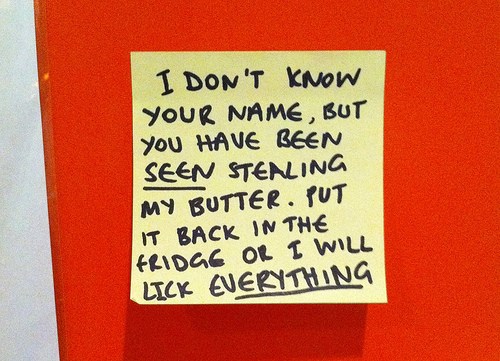
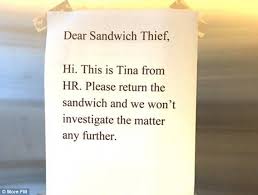
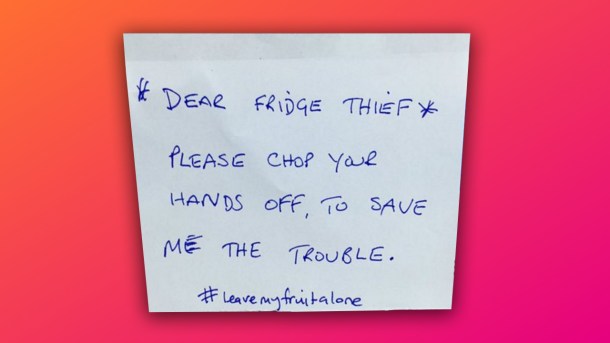
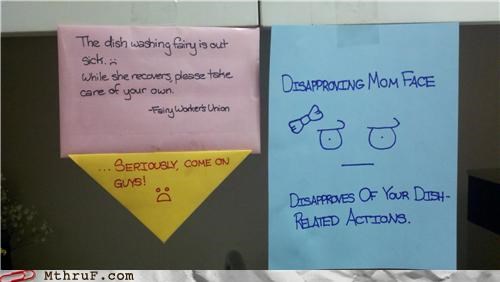
(Oh man, researching google image for passive aggressive fridge notes turns up some shockers.  Here are just four – because the first is more about dishes, I think)


I like on this both the neat triangular one and 'disapproving mum face'

I like on this both the neat triangular one and ‘disapproving mum face’


That's a strong retaliatory position. Though I would place smoked kippers in the fridge and sit back to watch the show

That’s a strong retaliatory position. Though I would place smoked kippers in the fridge and sit back to watch the show


I  don't know about you, but if I worked there, Tina from HR would be going hungry EVERY single lunchtime.

I don’t know about you, but if I worked there, Tina from HR would be going hungry EVERY single lunchtime.


Let's hope when the threats to maim co-workers goes to HR, it isn't Tina investigating it

Let’s hope when the threats to maim co-workers goes to HR, it isn’t Tina investigating it

The Re W rehearing (placement with grandparents versus adoption order)


You might remember the Re W case – in which the Court of Appeal surprised most family lawyers by saying that in care/adoption there was no presumption in favour of the birth family – maybe you remember the situation in which some of the brightest minds in the country talked vividly about see-saws for what seemed like an eternity.  You might also remember it as the case where one of the plans for moving the child from prospective adopters to grandparents was to engineer a chance meeting in a park and just have the grandparents leave the park with the child and the adopter leave without the child ?  Oh yeah, that one.


Re W – no presumption for a child to be brought up by a member of the natural family


This time round it is  Re Adoption : Contact 2016    (which is a pithy title, but it is rather like Orson Welles calling his film “Citizen Kane – it’s a sledge”  or  M Night Shyamalan calling his  “The Sixth Sense – Bruce is a ghost”.    I mean, it’s really obviously not called Re A : Return to grandparents 2016, so the judgment lacks that vital component of suspense)

http://www.bailii.org/ew/cases/EWHC/Fam/2016/3118.html


The fulcrum is positioned dead centre   – no party starts with any advantage before the evidence is heard  (either the family on “nothing else will do”  OR the prospective adopters on “status quo”)      [At least, that’s the position in law TODAY….  over the last three years adoption law has developed a habit of tilting this way and that like well a see-saw]


18.There is no presumption in this case one way or the other; the fulcrum is positioned dead centre. I apply a straight welfare test. Significantly, I note that there is no right or presumption in favour of a placement of A within her natural family; at [71] of [2016] EWCA Civ 793 McFarlane LJ said:


“The only ‘right’ is for the arrangements for the child to be determined by affording paramount consideration to her welfare throughout her life (in an adoption case) in a manner which is proportionate and compatible with the need to respect any ECHR Art 8 rights which are engaged.”


He added at [73] that the phrase “nothing else will do” (from Re B [2013] UKSC 33):


“… does not establish a presumption or right in favour of the natural family; what it does do, most importantly, is to require the welfare balance for the child to be undertaken, after considering the pros and cons of each of the realistic options, in such a manner that adoption is only chosen as the route for the child if that outcome is necessary to meet the child’s welfare needs and it is proportionate to those welfare needs”.

19.Equally, there is no presumption in favour of a ‘status quo’, notwithstanding the powerful words of Ormrod LJ in D v M (Minor: Custody Appeal) [1982] 3 All ER 897, recently cited in Re M’P-P [2015] EWCA Civ 584 at [67]. That said, important in the welfare evaluation is the fact that A has been in her prospective adoptive home for approximately 4/5ths of her life. As the Court of Appeal said at [65] ([2016] EWCA Civ 793), the welfare balance to be struck must inevitably reflect these particular circumstances, which of course are different from the circumstances when the placement order was made. The balance at the placement stage naturally would have tilted towards a family placement if relatives had been assessed, as these grandparents would probably have been, as being able to provide good, long term care for a child within their family.


You may recall that this was the case where the Court of Appeal expressed hope that the case might not be an ‘all or nothing’ and that the child might have a relationship with both sets of important people, so contact was an important aspect  (again you’ve guessed that from the  “Rocky – he wins in the end” title   *     – actually Rocky doesn’t win at the end of the first movie, common misconception.  Even now, many of you are saying  “Of course he does, he wins the title”  – nope, he wins in Rocky 2. All he really wanted to do was go the distance with Apollo Creed – the Master of Disaster, which nobody else had ever done. And he did that. But lost on points. Nobody remembers that)

 

Okay, so THIS guy also remembers the result of the fight.

Okay, so THIS guy also remembers the result of the fight.


From the first four Rocky movies  (I cannot accept the later ones as part of canon), the fights we actually see Rocky have, his record is Loss, Win, Draw (with Hulk Hogan), Loss (Clubber Lang), Win (Clubber Lang), Win (Ivan Drago).  It’s not that great.  His win rate is 1:1.  He won 1 fight for every fight that he didn’t win.  To put that in context, Herbie Hide won ELEVEN times as many fights as he lost.  Yes, I am claiming here that Herbie Hide would have had a chance against Rocky.  Even Audley Harrison had a win rate of 5:1.


I’ve digressed.  Back to law.

46.Direct and indirect contact: When they first made their application, Mr. and Mrs X had agreed to indirect contact taking place between A and the birth parents once per year, albeit not to include photographs, gifts or celebration cards. This stance was, at least in part, attributed to the standard preparatory pre-adoption training which they had received, where this is described (according to Mrs. Gaskin) as the ‘norm’. Over the course of this protracted litigation, and particularly recently, their position has changed in significant respects. They told the adoption social worker:


“When we first thought about the adoption process, we did not envisage direct contact with any birth family. However, with circumstances as they are, we see the advantages of contact with siblings. We think the challenges are the emotional aspect but in time [this] will get easier”.


And more recently still in their written evidence:


“We are also very aware of the importance of [A] having some knowledge of her birth family and importantly some relationship with her siblings. Whilst we have acknowledged to the experts our commitment to some level of direct contact if that is felt in the best interests of [A], we do not wish such contact to be disruptive to her continued placement with us, or confusing to her in her development and security. The purpose of the direct contact needs to be carefully considered and the contact tailored to that end”.


Mr. X augmented this in his oral evidence, speaking for himself and his wife:


“We would like A to have contact with the [birth] family if possible… We do genuinely understand the pain… If the chance of contact is available, then this needs to be explored for us and for A so that she can have the right to know her birth family and have a good life.… It’s not about the adults, it is about the children. We have to put her needs first. Happy to do the contact; it would be great for A and her brothers; hopefully we can have a bond (with the paternal grandparents); we can ask them for advice and go to birthday parties…”.

47.I was quite particular in my attempts to establish whether Mr. and Mrs. X felt pressurised by their rather vulnerable situation to agree an arrangement with which they did not feel entirely comfortable; having listened to Mr. X in his oral evidence, and having read and heard the evidence of those with whom they have spoken frankly about this issue away from the court room, I was satisfied that he and his wife genuinely had come to appreciate the benefit to A in there being direct contact between A and her birth family. Mrs. Gaskin spoke of them as people with integrity (see below); from all that I could see and read of them, I concur.


The ISW, Ms Gaskin said this on the issue of contact :-


“Mr. and Mrs. X have suggested that initially they feel they could cope with four times per year, rising to six times in the light of positive progress. Of course in time, Mr. and Mrs. X would be the final arbiters of the frequency and duration of contact, and they would make this decision on the basis of [A]’s needs. I am of the view that they are people of integrity and truly want what is best for [A]. They are very clear that they believe that [A] should have a relationship with her birth family and this is something that they have always considered to be the case… They believe that it is important for [A]’s emotional well-being in the long term that she has a relationship with her brothers and paternal family.”


61.The obligation on me to consider “whether there should be arrangements for allowing any person contact with the child” (section 46(6) of ACA 2002) is accentuated in this case by the real prospect (accepted by the prospective adopters, as in A’s interests) of direct contact between A and her birth family post-adoption. This indeed adds a new and important dimension to this difficult case. The proposal to introduce a relationship between an adopted child and her birth family after adoption by way of direct contact is in my own experience unique. I was not at all surprised to hear from the adoption team manager that it was unprecedented in this authority’s experience, and in the experience of Barnardo’s (with their wealth of adoption knowledge) whom they consulted on the issue. This proposal reflects the resourcefulness of all those involved – coupled with the creativity of the professionals, and the selflessness of the proposed adopters – to divine an outcome for A which best meets her needs. As I have indicated above, if contact were to happen in the way proposed, it would be likely to play a highly material part in neutralising A’s possible sense of rejection by her birth family, while remaining in the Xs care, at the stage of her development when she is considering more maturely the difficult issues around her identity.


That is a very unusual amount of contact for prospective adopters to be proposing, and it was clear that everyone had taken on board the hope of the Court of Appeal, which is good to see.  (


Discussion and Conclusion

52.No one can doubt the colossal pressure which this litigation has heaped on the prospective adopters and the paternal grandparents over a sustained period of time, and through two rounds of litigation; while commendably uncomplaining about the legal process, it is reasonable to conclude that they have found the repeated forensic scrutiny of their lives unacceptably intrusive, and the uncertainty as to the outcome unbearable. Doubtless each of them has had to develop strategies of self-preservation to protect themselves from the outcome that A is not ultimately to be in their care. All the adults will have found it hard to be assessed and reassessed, but I sensed that each recognised why this needed to happen; to their great credit, and I believe A’s ultimate benefit, they have all engaged fully.


53.I have listened with great care to the evidence. I was impressed by the ability of Mr. X and the paternal grandmother to reflect generously and sincerely their concern for the other in these difficult circumstances; they all strike me as people of integrity with a deep respect for family. I have been struck by the thoughtfulness of those professionals who have endeavoured to chart these very uncertain waters. I was greatly assisted by the high quality of professional expertise in this case, in a way which, it is clear, Bodey J was not. Mrs. Gaskin described how she had “agonised” over the assessment – “this has been one of the most difficult cases I have had to deal with”. Dr. Young offered appropriate and helpful expert advice; the Children’s Guardian’s report was one of the best of its kind I have seen. She for her part observed that “this has been one of the most testing and difficult cases that I have been asked to report on in my 29 years of practice as a Social Worker…”.


54.A is, and has been, at the centre of my decision-making. I do not propose to repeat my description of her set out above; it is sufficient for me to record at this point that she has in my judgment had her global needs met in a safe and secure way for the whole of her life thus far; her security and her attachments have enabled her to explore, socialise, and master developmental stages confidently and appropriately. A has attached to Mr. and Mrs. X whom, according to Dr. Young, she identifies as her secure attachment figures.


55.I am satisfied that both sets of applicants have something genuine and valuable to offer A now and throughout her life. I am of course influenced in reaching my conclusion by the fact that A is securely attached to Mr. and Mrs. X, whom she regards as her parents, and is embedded in their family whom she has come to know as her natural relations. She will have little knowledge or recollection of any life which is different; the continuity and high level of care which she has received has nurtured a strong sense of security with these primary attachment figures. I am influenced too by the knowledge that the paternal grandparents, rightly described by the Guardian as “child-centred people”, are currently raising their grandson with evident love and skill; that they would – I accept – have been more than likely to have been favourably assessed to care for A had they been considered over two years ago, and had that been so, then A would be living with them now. Their belief that A would be best placed in their care is both sincere and passionately held. If A is placed with the grandparents, she would have the considerable additional benefit of being raised in a household with one of her siblings, and in close proximity to the other.


56.I am equally satisfied that risks are attached to each outcome for A. In evaluating the respective cases, it has been necessary to make some informed predictions about the future, conscious of my obligations to consider the issues by reference to A’s whole future life. In the home of the Xs, there is a clear and identifiable risk that A will feel, perhaps strongly, a sense of rejection when she comes in due course to realise that her brothers are cared for within the birth family, and she is not. This may have significant implications for her sense of identity and self-esteem. This risk, if it materialises, will not arise for a number of years. If it does, it is likely to be moderated by a number of factors, including:


  1. i) That A and the Xs have developed a secure attachment over the last 24 months, which it is reasonable to expect will continue to grow and consolidate; this will operate as an inherent protective defence against disruption of placement;


  1. ii) The ability and willingness of the Xs to be open with A about her adoptive status as she is growing up; Dr Young believed that the “key” is in how Mr. and Mrs. X support A to make sense of her status, and advocated adoption ‘talk’ with her from an early age;


and


iii) The introduction and maintenance of a direct relationship between A and her birth family, namely siblings and other relatives, through contact.


57.The risks of medium-term or long-term damage to A by her making her primary home with the paternal grandparents flow directly from the consequences of a move. No question is raised about short-term harm; it is assessed as being inevitable. The professionals spoke of the serious possibility of medium-term and long-term emotional and psychological damage to A by the traumatic severing of the secure attachments which she has formed with the Xs, with the consequent risk of disruption to her placement if these risks materialise and are not adequately addressed. Dr. Young opined that “a significant move such as this at this stage of her development will have a significant detrimental impact on her, of which the long term consequences would be uncertain, and thus any decision must proceed with this knowledge in mind” (emphasis by underlining added). While I am satisfied that there would be no shortage of love, and willingness on the part of the paternal grandparents to assuage the evident hurt for A in the event of a move, which may help A to some extent, the ability (or inability) of the adults around A to address the risk of deeper damage would be affected by a combination of the following factors:


  1. i) A real possibility that A simply does not forge attachments, let alone secure attachments, with new carers, having suffered the traumatic severance of secure attachments with the Xs; there is limited optimism that she will be able to deploy her “an internalised blueprint” (see [27] above);


  1. ii) Helplessness on the part of any of the adults around her to explain, in language which a 2½ year old will understand, why this change has been foisted upon her;


iii) The lack of experience on the part of the paternal grandparents to deal with the sophisticated and complex challenges facing A in these circumstances, and the evidence, which I accept, that they somewhat underestimate those challenges;


and


  1. iv) A possible adverse reaction by J to the arrival into the family home of A, and by A who would no longer be an only child in placement, and the risk that the grandparents may be overwhelmed by having to cope with challenging behaviour from A and/or J, or that A will become withdrawn and this will not be detected.


The risks of long-term damage are likely to be exacerbated (though in what ways, and to what extent it is difficult to assess confidently) by the fact that none of the transition plans are deemed by the experts to be in A’s best interests. The least bad alternative, which the experts reluctantly favoured among them, would involve summary (and so far as A is concerned unplanned) removal from the Xs care. It is hard to imagine, as Mr. Richardson emphasised, how an infant will react to having lost all her emotional and practical reference points overnight.

58.I should say at this stage, that I was extremely impressed with the way in which the Xs have already displayed many of the qualities which the professionals would advocate in order to mitigate the risk of harm if A were to remain with them; they have prepared a thoughtful, child-friendly, life-story book for A which I have seen, which identifies honestly and in age-appropriate terms who are the key people in her life – birth parents, foster parents and prospective adopters all featuring with explanations of their roles and importance to A. They have maintained contact with the foster carers who looked after A for her first seven months, allowing A to develop a real appreciation of her life-journey; I felt that this ability to embrace wider aspects of A’s life would be likely to carry through into an ability to involve the birth family in A’s life. They have developed in their own adoption ‘journey’ to a position of accepting direct contact between A and her birth family. The risk that A may develop a sense of rejection may be further mitigated by it being explained to her as she grows older – when the language would then be available to explain what has happened to her in a way which an adolescent will understand – that the difference between her situation and her brothers is not about her, but about the context and circumstances in which they each respectively began their lives.


64.In reviewing the competing options for A I have of course considered the proportionality of the outcomes proposed, particularly where one outcome, namely adoption, involves the creation of a new legal identity for A, and the court’s affirmation of a permanent, enduring relationship between her and a couple with whom she has no blood ties. Drawing all of these powerful factors together, I have reached the clear conclusion that it is in A’s best interests that she should live with Mr. and Mrs. X, where she has established solid, loving, and secure emotional foundations; from that ‘secure base’ she will be able in a wider and more general sense (as she did in a more limited and specific sense when Dr. Young visited her home earlier this year) to explore the world, and importantly with confidence explore and embrace new relationships, including those with her birth family. This outcome is the one which, looked at in the round, is most likely to contain and mitigate the risk of harm which is feared (section 1(4)(e)), and permit A to preserve and enjoy all of the important relationships in her life, including those with the people who she has come to know as her parents, and her birth grandparents and siblings. This outcome most faithfully promotes “the likelihood of” the continuation of important relationships for A and the “value to [A] of [them] doing so” (section 1(4)(f)(i) ACA 2002).


The Judge decided that there should be contact at least twice per year but that given that the prospective adopters were in agreement, there should not be an order.

“Silky briefs” (not to be read whilst drinking hot coffee)

Penelope Golightly drew out a cigarette from the silver case she kept at her bedside for these occasions and lit it. The young barrister that she had instructed was weary from his final submissions. He looked at her with his deep ice-blue eyes, flecked with hazel and flecked again with jade green and flecked still more with steely gray (there was perhaps altogether far too much going on with his eyes).

“May I…  hand in my FAS form?” he asked her in a throaty voice.

She examined it closely.  “I’m not entirely sure that your timings are accurate here. I can’t allow it. You greatly overstated the time estimate in the first place. “

“But,” protested young Tarquin Snaresbound, “I attended an hour before the appointment for…. discussions. As directed. “

“So be it,” she said and she began to melt the candle-wax into a small delicate porcelain bowl.

“However,” she added with a wry smile, “You have ticked the box here that said that two experts were involved. And by my reckoning, there was certainly only one present. I’m afraid that until you are as good off your feet as you are on them, there will be meagre pickings from this tribunal.”

His high cheekbones coloured with shame, “Have some charity,” he said, “This form is my very livelihood.”

Penelope dipped the seal into the hot wax and applied it to the paper “My dear Tarquin, if you wanted the maximum uplift on the Form, you needed to deliver the same.”

Noting that he was crestfallen, she added, “Perhaps next time you should bring along a McKenzie Friend?”


(Be grateful that I didn't go down the "I put it to you" route...)

(Be grateful that I didn’t go down the “I put it to you” route…)


[I am SO sorry.  I partially blame Garfield and Pauline for the suggestion that my next novel should be a legal bodice-ripper. As you can see here, I think not.   I also apologise for now having the idea that FAS in this context is a F_____ Assessment Survey and making the next time you have to hand a genuine FAS form up in Court a somewhat awkward experience. ]

Update about the book

So this is what is happening at the moment with the book.  I finished my own edit at the end of October, and I reached the point where I’m happy with the book. Or at least, the point where I don’t think I myself can see anything else that needs fixing. You can just be too close to it to be able to be as clinical as you need to be to push through and strive for improvement.

That edit went off to Unbound and they have the manuscript with an editor who is going to go through it in both a small scale (sentence by sentence, word by word) way and a big picture way (would it be better if this character did this, or that this incident that happens here was instead this different scene)

That’s quite a daunting prospect – because now I’m waiting for the annotated edited manuscript to come back, and it will be someone really getting under the bonnet of the book and really scrutinising it to see where it works, where it doesn’t work and how to make it better.


editing

The only thing I can really compare it to is that bit in Trinny and Susannah where they get some poor woman down to her undies and discuss her body and what are her best bits and how she should dress better (hopefully without the groping element that always seemed to happen).   It’s more than a little terrifying, but the idea is that someone from the outside without an emotional attachment to the book will be in the best place to make constructive suggestions to make it be the best it can be.

That process is going to take a couple of months, then it comes back to me and I go through the suggestions – some will be really easy, I think – the sentence level stuff, and some might be hard – this character isn’t believeable, or this bit of the plot doesn’t work at all might be very hard. I then work through the book again, deciding how to make those fixes and do the rewrites to get it to work better.  (I get final say, obviously, but I’m going to try very hard to be open-minded and not defensive about my little darlings)

When we have a finished version of the book it then goes off to a proof-reading editor, who will be fixing typos and grammatical issues, and I know in advance that they are going to be cursing me for sprinkling my prose with commas and taking loads of them out.

When that’s done, it is galley-proofs and choosing a cover and doing the blurb about the book – the really fun stuff.

All in all, that’s probably going to be about 3 months, though it is hard to call exactly how long it will take, because it depends how much of the next stage is about fixes that are like replacing a lightbulb and painting the radiator and how much is about installing a new kitchen or replacing the roof.

People can still pledge and get copies, so if you haven’t got round to it yet, get stuck in.


https://unbound.com/books/in-secure

Thank you to everyone for their support, it means a huge amount to me and I honestly can’t express how much I appreciate it.

Resident music (not a law post)


It is roughly a year since I stumbled into an independent record shop in Brighton. Something in the window caught my eye, and I’m thankful that it did. When I went in, as well as rows of records and the new releases, the shop had their ten albums of the year on display. And more than that, they had a write up about each of them, and an annual in which the people who staff the shop wrote with passion, style and charm about their favourite records that had been released that year.

That’s my sort of record shop. And I haven’t had that sort of relationship with a record shop in a long time, not since I left Lincoln and Radio City.  A shop where people don’t just sell music, they love it. And they want to help you find stuff you’re going to love too.

I bought the release that had caught my eye, and two other albums from the top ten. Artists I’d never heard of and they blew me away. Over the last six weeks of 2015 I bought everything from their top 20 choices in the annual, and didn’t regret any of them.

Every week Resident send me a newsletter by email about the new albums coming out on a Friday, and a little pen portrait of each.  I usually end up buying three or four a week, and put them on my ipod and listen to them on my way to work, on my way to Court, on my way to meetings, on my way home. It makes it a treat to be travelling, because I’m accompanied by music.

So since I found Resident Music in Brighton, I’ve bought about two hundred albums that they recommended – some very obviously right up my street and some that pushed me into new corners, different places. Of those two hundred, there have been two that I didn’t like  (and I didn’t HATE those, I just didn’t get that fast connection that I’ve had to anything else they recommended)

Resident are publishing their next annual tomorrow, and are having a little party to celebrate. If you like music, and feel like you’ve gotten a bit rusty, or a bit predictable in what you listen to, or you’ve lost touch with what’s going on out there, pick up the annual and read the little reviews, and take a chance on a couple that grab your attention.

If you don’t live in Brighton, you can still get in on the action by visiting their website http://www.resident-music.com  and you can order from them and sign up to the newsletter.


Here are a few of my favourite albums of this year. Whilst it has been an utterly terrible year for politics and losing talented humans (see below, which is NOT SAFE FOR WORK ) it has been a GREAT year for music


Not in any particular order, just albums that I really really liked.


Drive-by Truckers –  American Band

If what’s happening over in America at the moment is making you feel pretty down on the country, then this is a bit of an antidote – punchy, crunchy, full of hooks and ideas and damn political too.  It’s a great listen, and my best description is Springsteen and Michael Stipe getting drunk in a bar that is playing GOOD country music and decide to write songs about the state of the nation. It’s not bleak or worthy, it is medicine for the soul.


http://www.resident-music.com/productdetails&product_id=43498


The Avalanches – Wildflower


If you want an album to listen to whilst drinking beer or wine and lying in a field feeling like you’re in love and everything’s going to be fine with the world (or even just something that makes you FEEL that way, in the bleak midwinter) this is a fine choice. This is an album by a band who were throwing away more ideas than most ever come up with – don’t like this song? Don’t worry, the next one sounds nothing like it.

http://www.resident-music.com/productdetails&product_id=42647


Honeyblood – Babes Never Die


There are loads of ways to make a great album – one of them is to push the boundaries and stretch what the form is capable of. Another is to just write ten songs that are absolute bangers and put them in a good order.  You may already have heard “Ready for the Magic” as a car advert, particularly if you watch Sky, because that ad is on a LOT.  You know when you’re listening to an album and you say “Oh, turn it up, I love this one” ?   Well, that’s the whole album. You’re just going to want to keep turning it up. Resident’s description of a “Scottish take in Courtney Barnett” is a cracking one, and if Courtney Barnett doesn’t mean anything to you, then you’re in for another treat when you discover her.

http://www.resident-music.com/productdetails&product_id=43315


Car seat Headrest – Teens of Denial

As a big fan of Pavement and Flaming Lips but wanting a modern take on it, I was always going to like this – lo-fi pop about peculiar themes and people on the edges of society and the edges of their lives. Clever, full of ideas and funny as hell. Loads of tunes you’re going to really want to wig out to, and it is almost impossible to resist the “Friends are better with drugs are better with friends are better with drugs” hook that is the centrepiece. Love it love it love it

http://www.resident-music.com/productdetails&product_id=43315


Kate Tempest – Let them eat Chaos

I can’t think of anything I dislike much more than spoken word poetry, so when I read the description of this in the newsletter I had decided to give it a miss. Thankfully, when I went into the shop it was playing, and I stood rooted to the spot listening to it, heard three tracks, bought it, and it didn’t come off the playlist for a month.  And I listen to it at least once a week, in full.  It’s an album that made me feel okay about Southern Rail cancelling trains because I’d get to hear this again whilst I was waiting.

It is so sharp, and vivid and occasionally vicious, but it is shot through with kindness and decency of spirit and hope. The best storytelling I’ve heard on an album in years – the characters in the songs have distinctive voices and Kate changes her style around throughout and makes all of them real – flawed and battered but real.  In a year of sensational music, this one is my absolute favourite. It makes me grin like a wolf, it brings tears to my eyes, it makes me punch the air, it makes me laugh out loud.  The closest I can get is that it makes me feel the way I felt when I was first listening to the Streets Original Pirate Material – that this was bringing the streets to life in a fresh, funny,  interesting and occasionally challenging way.  You can’t get a taste less you’re taking a bite.   And it is damn funky. The beats in it really work and her voice is a delight. It’s a truly outstanding record, and I am really looking forward to seeing her do a live set next Wednesday.


http://www.resident-music.com/productdetails&path=12966&product_id=43810


(I don’t work for Resident, nor do I have anything to gain by this piece – it is just that if we want people to carry on making great music then we need to put money in the pockets of the artists making it – the internet has made us all think that content should always be free, but if you hear music and love it and want more of it, then it is cool to give the people who make it and bring it to the attention of listeners some money to help them keep doing it. Sermon over)


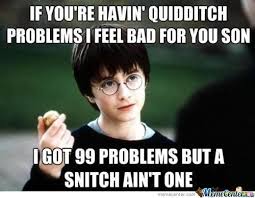
99 problems but a book ain’t one

Aren't you sharp as a tack? you some kind of law or something?

Aren’t you sharp as a tack? you some kind of law or something?


Thank you all of you fabulous people. 3 weeks to go on the crowd-funding for the book, and we just hit 99%. It has been amazing how kind and generous people have been.

Where we are at now is that I just need £30 to get the book funded, and out there to all of the wonderful supporters. I’m pretty sure we can make that. And payday is here, or looming.

The next stage, after it is funded is for me to finish the hard rewrite  – that’s where you’ve left a book completely alone for 3 months so that you’re not so close to it and you can make the cuts. What Fitzgerald refers to as ‘killing your darlings’ – that sentence or image you’re so proud of but that in the cold light of day doesn’t move the scene forward or slows the pace, you’ve got to cut it.  If a whole scene doesn’t quite deliver, you might have to cut it out, or rewrite the whole thing.  The early chapters before your characters took on their own life where you were just dragging them round like wardrobes – you need to rewrite those bits now that she starts, she moves, she seems to feel the stir of life along her keel.

You can’t do that until you’ve got some professional distance from the book you’ve written, because whilst on rewrites adding new words and moments is really easy, cutting them is the hard bit. It really is killing your darlings.

I like rewrites generally, but cuts are hard.  That’s hopefully the bit that turns an okay book into a good one, and with an authors eye, boy can I spot when a published writer wasn’t able to do it. It is those bits in a book that make you wince with clunkiness and pull you straight out of the scene and ruin the whole willing suspension of disbelief that’s so vital.  (If you’re not sure what I mean, pick up a copy of the Da Vinci Code, turn to any page at random and read it. The first sentence that you read that makes you go “oh, that’s awful”  is the bit that should have been cut or rewritten.

I’m a naked and unashamed fan of Raymond Chandler, and one of the true joys of his work is that if you get a second copy and a red pen, you can pick any page at random and try to cut a passage or a line or a word to improve the work, and it is extraordinarily difficult or even impossible. Every word there is doing work, it carries its own weight, and it is necessary.

[Mark Twain]

“When you catch an adjective, kill it. No, I don’t mean utterly, but kill most of them–then the rest will be valuable. They weaken when they are close together. They give strength when they are far apart.”


[Damn right. Similarly be brutal with all the  ‘she exclaimed’, ‘he retorted’ ‘she sneered’ ‘Michael roared’  – use only very sparingly, if at all]

After that, I get to work with the Unbound editor, and that’s when we really start the polishing process, and then when that’s done, all the sexy exciting stuff like working on a cover and getting the final version and the proofs and an Amazon listing gets going!

Thank you again so much, and if you haven’t funded yet but keep meaning to get round to it, this is a really good time.


In the words of Jay-Z himself, “Thank you thank you thank you, you’re far too kind”


https://unbound.com/books/in-secure

An offer for Sunday


The people publishing my book, Unbound, are doing an offer today for the Olympics.

If you go to the site and use the code Rio16  you will get a £10 pledge for free.   If  you wanted the book, but have no money, this would be your chance.  As the tenner doesn’t go to the fundraising total, what would be even better  is if you use the code to turn a £10 pledge into a £20 one.

But I know that some of my readers are on very tight budgets, so if you wanted the book but couldn’t afford it, this is your chance. Today only, though.


The fund-raising is going really well. I reached the half-way point of the campaign (45 days of 90) yesterday, and we are at 78%.  Every single Pledge now helps get us over the line, and makes the book happen.  Thank you so much for everyone who HAS pledged, it’s an incredibly kind and thoughtful thing to do and is massively appreciated. If you’ve been meaning to do it but haven’t got around to it yet , let this be a tender, loving, nudge in the ribs   (much like an old married couple where one of them is hoping for breakfast in bed)

https://unbound.com/books/in-secure

Paperback writer, paperback writer


The pledging for the book is going really well, and as we start a second month it is looking very positive for getting my book published.

So two bits of news today.

The first is that I have found a way to get a limited number of paperbacks produced once the book is published – and everyone who pledged at Launch Party level or above will get a copy!  And the next twenty people to pledge at Super Patron or above will get one as well.  (If you don’t live near to me, I’ll get it posted to you and we’ll sort out the details nearer the time.  I will sort Norma out with a hard copy too, as I know she wanted one)


The second is that I’m putting up a bit more of a sample – so this contains the bit of the background of where the book is set (which was in the first sample section), and we get to meet some more of the characters – including some of the female characters.


So if you like it, and you want to read the whole thing – please visit and Pledge. Particularly if you want to hold a paperback copy and be able to write comments in the margins or (Heaven forbid) bend the pages backwards, fold over corners to mark your place and crack the spine.  Today is a great day to get it done! Next TWENTY Pledges get a paperback copy.


https://unbound.com/books/in-secure


Saffron Park


In 2015, over two hundred children in England and Wales were placed in Secure Accommodation, meaning that they could be locked up for their own welfare without having been convicted of or charged with any criminal offence.  Basically, a prison for their own good. Many of the basic freedoms that most children take for granted – being able to go out with friends, to go outside when you choose to, being able to make calls on a mobile phone, being able to use the internet, the ability to sleep in a bedroom that doesn’t have a locked door, these are all things that have to be earned in a Secure Accommodation Centre.  These children are locked up because they usually have a history of running away from other sorts of care, from their parents, from foster homes or children’s homes, and when they run away they do things that put themselves, or other people at risk.

Ten such children at a time could be accommodated at Saffron Park, a state of the art Secure Accommodation Centre.  Saffron Park had walls that could not be scaled, gate system that could only be released by staff inside a sealed Gatehouse building, which cannot be accessed from outside.  Complete security. Complete peace of mind. Built in 2007, located in Dartmoor. Remote location, meaning that in the unlikely event of an escape, the young person will always be quickly recovered – no bus stops or train stations within nine miles. No neighbouring villages where refuge could be sought.

On site educational facilities, even the ability to conduct examinations. Recreational facilities including a gym. All meals provided and cooked on site. In house therapist to deliver bespoke packages of treatment for any form of difficulty. Five trained and qualified members of staff on hand at all times, even during the night. Staff rotated once per week, to maintain freshness and vigilance.

Expensive? Well yes, places like Saffron Park are always very expensive. Managing risks like these doesn’t come cheap, and for the sorts of problems they are dealing with, there’s very limited competition. Children don’t come to places like Saffron Park if there’s a cheaper solution, if their problems can be fixed or contained another way. Saffron Park is the place where they send children who can’t be managed in other Secure Units. The worst of the worst. Saffron Park is where they send you just before they give up on you completely.

It’s where they send the deeply troubled. The runners, the cutters.


All of that, of course, could be read on the Saffron Park website, on their glossy promotional brochure. The thing they didn’t boast about, because they had utterly no idea of it; was that they didn’t routinely have ten prisoners. They had eleven.  That eleventh having been in prison for decades longer than Saffron Park had even existed. A prisoner who was hungrier for freedom than any of the children who came and went, and more disturbed and damaged than any of them.


____________________________________________________________________________________________________________________________________


Three


Lauren


Monday 26th October 7.30pm


Lauren looked up to make sure that Mr King’s attention was elsewhere  – it was, of course. It being the meal-time, Mr King [12 stone 5 pounds, has gained 2 pounds in the last fortnight] had to keep a careful eye on Sharp to make sure that no knives surreptitiously left the serving table to come into his possession. He also had to watch Boo, to make sure that she didn’t do anything too unusual.  Lauren quickly and with practised ease scraped all of the mayonnaise [90 calories, 24 minutes walking] from her lettuce [15 calories, 6 minutes walking]  onto a knife, scraped it off the knife and onto her thumb and then smeared the mayo from her thumb onto the underside of the table where it would not be found.

She dragged her thumb along the wooden slats of the picnic style table, enjoying the roughness of the wood. The closest she got to nature these days was this picnic table, which had probably never seen a forest. That was pretty dispiriting, she thought. She would have given anything to walk in a wood, hear a wood pigeon, feel her foot snap on a twig, look at the oranges and reds of autumn leaves. Hell, she would even settle for a seagull. No nature in Saffron Park. Apart from some scrubby grass and the little herb garden outside. No proper garden. She could understand, to be fair, why a Secure Unit wouldn’t be too keen on giving children access to shovels. That didn’t stop her having pangs for not being able to see nature. Beyond the walls, sure, there was a national park, but what good was that? The walls were too high to see over.

Sheets of glass loomed above them. They’d built Saffron Park to be light and airy, to have this pointed glass roof, like a cross between a church and a greenhouse, so that they could see the sky and not feel squashed and imprisoned. Everything was supposed to make it feel as little like a prison as they could manage. Lots of light, lots of glass, no bars, little discreet pads near the door that the staff would open with a pressed fingerprint. When it was sunset and you could see shrimp streaks of clouds in the sky and the sun hung there like a swollen peach, it was quite a good view looking up, but not in the winter. There were the stars, of course, but she’d never really been good with stars.  They just made her feel inadequate. More so.

You could do all sorts with a building, but the fact remained that the only real way to make a building not feel like a prison was to have doors that everyone inside could open any time they liked.

Lauren ate the lettuce which was cold and crisp. She would have preferred celery, but it had been a struggle to even get them to let her have salad at all.  She pushed at her prawns [22 calories each, 9 minutes walking] with a fork, pulling a face.

Brick leaned over.  His skin was the colour of wine-bottle glass. He was the oldest of all of them, but even allowing that, he looked like an adult. He could grow a beard within a week, and the same day as a shave, he would have re-stubbled. He looked like an adult. Lauren thought sometimes like a younger Idris Elba.  Especially in his eyes. Such deep eyes. Went with his tuba of a deep voice, very London, very Street.

“You gonna eat that?”

“Help yourself,” she said, “Just don’t get caught.”

“Lauren, when was the last time I got caught doing anything?” he said, popping four prawns into his mouth with one bite.

Making the vodka in the toilet cistern, getting those mucky films smuggled in, becoming the fifth Daisy tattoo on Sharp’s right arm , cheeking Mr Veal and Miss Litton,  trying to germinate cannabis seeds in the airing cupboard, staying up way beyond lights out, dismantling the fan, doing leapfrogs over the sundial and misjudging the height, throwing the soft-ball bat on the roof, the home-made hair dye which accounted for both Brick and Boo currently sporting ink-blue crops and having to wait for it to grow out,  borrowing Al’s deodorant without asking, putting a saucepan lid in the microwave and hoping for lightning, she thought.  In fact, pretty much anything that Brick attempted to do without Robin being there to plan it tended to go wrong. He had a lot of qualities, Brick, but being discreet or subtle was not on the list.

He read her expression. “Okay, sometimes I get caught. But that’s probably because I’ve not been getting enough seafood to fuel my massive brain”

She laughed. “Massive biceps, I get. Massive brain is news to me.”

“You ain’t seen me code,” said Brick, “If they would let me loose with a computer in here. I’d make the screen dance for you. Blow your mind, what I can make happen.”

She shrugged. Computers didn’t do much for her. Settling down somewhere to be quiet and still to watch birds would be more her thing. Blurring herself into the background, pressing into a hedge, lifting up strings of barbed wire and squeezing through the gap.  God, she even missed getting dog muck on her shoe and having to scrape it off with leaves or sticks. How pathetic was that, to be missing dog muck? She scuffed the heel of her shoe along the vinyl tile on the floor to enjoy the sound it made, imagined that she was cleaning the soles. She was day-dreaming about having dog muck on her shoes. Pathetic.

“I’m guessing you’re not going to eat that chocolate pudding,” he said to her.

157 calories, she said in her head. What she said out loud was, “I’d really owe you one. I’ve been feeling sick thinking about it.”

“Load it onto a spoon, and give me a second,” Brick said, “Watch for Jen to make her move.”

Brick gave Jen the signal that a distraction was needed. Jen was too pretty, made-up older than her years but unlike Brick her eyes said that she was young even under the weight of the Maybelline. It was hard for Lauren to look at her without thinking of a six year old tottering around in mum’s high-heeled shoes. Jen yelled out, “Mr King! Boo’s stolen my lipstick!

Mr King came over to her, looking concerned. “Are you sure? When did you see it last?”

“I had it right here,” Jen whined, “It’s a cerise pink. It’s very expensive. My boyfriend bought it for me, it was a special present. It’s not right that she should steal it.”

“Elizabeth,” said Mr King, looking at Boo, “Is this true? Have you taken Jen’s lipstick?”

Boo looked sulky, under her ink-blue fringe, “I wouldn’t touch it. I certainly wouldn’t use it. If it’s been all over her lips, god knows what else has touched those.”

“Oy!” yelled Jen, “You cheeky cow!”

“Could you stand up please Elizabeth?”

Boo  stood up and Mr King got her to turn out her pockets to check whether there was any trace of the lipstick. Boo was wearing a cowboy hat complete with sheriff’s badge, a Scooby Doo T-shirt and black and white chequered chef’s trousers. They had given up trying to make sense of Boo’s outfits. At the same time as Mr King was frisking Boo for the non-existent lipstick, Brick finished off the chocolate pudding, and Lauren dipped a finger into it and smeared a tiny amount [5 calories, tops] onto her teeth. Don’t taste it, don’t swallow it.  Just enough so that if King checks your mouth, he’ll see that you’ve been eating the chocolate.

“Hey,” said Brick, “You know there are two beds free.”

“Well duh,” said Lauren, “Maths is not a problem for me. Do you know how much maths I have to do in my head every day? How many calories in this, how many carbs in that? How much have I burned by doing 30 crunches? How many chin-ups can I do at night in the time between Litton passing by my door to when she’ll swing back on the next patrol? So yeah, I know that we’re two beds free. They’ll fill them soon enough. Two more boys. Joy.  Brilliant. Well, I suppose girls are even worse. At least you boys don’t talk all the time. I’d gladly take two more Caseys. That would be perfect.”

“I rang Robin today,” said Brick, with a big dumb grin on his face, “He’s coming home.”

Banged up

I thought I’d write a little about the setting for In Secure, my book that you can pledge for here

https://unbound.com/books/in-secure

(Hope you enjoy – if you do, please visit and support, and share this with others. We are nearly half-way to the Pledge target – and this is week 3 of 13, so huge thanks to all of those who have helped)


My book is set in a Secure Accommodation Centre, called Saffron Park, which is located on Dartmoor. Secure Centres are a special sort of children’s home where children can be locked up – they aren’t the same as a juvenile prison or Borstal, in that a lot of the children there won’t have committed any crime – they are there because they run away from home generally. Sometimes their own home, sometimes foster homes or other children’s homes. And because when they run away they put themselves in danger, they hurt themselves or other people hurt them, or sometimes they hurt other people.

These places really exist, and there are children much like the ten children that I write about in them.

I was interested in writing a book where, well, if you imagine the Harry Potter series but now imagine that Draco Malfoy would be considered the goody-two-shoes of the book. A lot of fiction for young people, the characters are heroic – sometimes with flaws, but nonetheless straight heroes. You know Katniss is going to stand up for the weak, you know Harry is going to fight evil, you know Cyril and Robert and Anthea are going to try to pay for the ginger beer they drank when they were stuck in the Church after their wings wore off.

I thought it would be more interesting to read about characters where you weren’t sure, perhaps could never be sure which way they might react in a given circumstance – because their circumstances mean that they aren’t heroic or noble. They might be capable of those things, but they each might be capable of out-Voldermorting Voldemort, if the opportunity arose.  Especially if wicked author that I am, I put tools and power and temptation in front of them.   (There were quite a few times when writing it that I wasn’t sure what particular characters might do, and when they did it, they’d faked me out too)

So, a set of children all with problems and worries and flaws and secrets – big secrets, all locked up together seemed like a good starting point.

And then I was thinking about two memories I had.

The first was being seven years old. My bathroom had a lock on it. A chubby silver lozenge of a lock that you would turn to the right and it would lock the door. Turn it back to the left, and it would unlock. Easy peasy, lemon squeezy.

I was always told not to lock the door – the lock was for grown-ups and I wasn’t to use it. I don’t really remember what was in my mind when I did lock it. I remember how scared I was when I tried to unlock it and the lozenge was too stiff and heavy to move back. I remember panic that went up through my feet, made my chest pound like something inside was knocking to get out and gave me the taste in my mouth I’d only ever got from accidentally eating a bit of Kit-Kat that had a shard of tinfoil still stuck to it.  (Michael Stipe was right – aluminium really does taste like fear).

I waited and waited. I tried the lock again. And again. I wrapped a towel round my hands, hoping that I’d get more leverage and the dampness of my hands would be counteracted. It didn’t work. I took off my shoes – trainers that were yellow and black and had pictures of jungle cats around the outside just above the sole (cheetah, lynx, puma, leopard), and hit the lock with those. What I didn’t do was shout for help, or bang on the door.

Because as scared as I was of being locked in that room, of never getting out, of being in there, I was just as scared as having to tell my parents that I’d turned the lock. Broken the rule, and not only that, been too weak to get away with it.

Eventually, it emerged that I was trapped in there. I think someone came to try to use the bathroom, found it locked and asked a series of questions that didn’t take away that tinfoil taste on my tongue one bit. None of the suggestions for how to get out worked.

And then my dad got his window-cleaning ladders and climbed up to the bathroom window, which I had to open. I was too scared to climb down the ladder so he had to climb in and open the lock.

I left that house 12 years later, and I still never wanted to look directly at the lock the whole time.

THEN the second memory. I was about 26, and starting out as a care lawyer. One of the things I had to do from time to time was advise on Secures – should such and such a child be locked up for their own good, were the tests met, was it the right thing to do. And my boss decided it would be a good thing for us all to visit a Secure home, to see what it was like. I really didn’t want to go. I knew I wouldn’t like it. Like I know without having to do it that I wouldn’t enjoy sword-swallowing.

I had to go. We got there, and a member of staff took us to the first door. She opened it up with two keys, and we went into a little vestibule. Ten of us in there, a rectangular room with that door at one end, and another door at the other. Nothing else there.  The member of staff locked the first door with those two keys and moved past us to the other door.

And I thought, “I can’t get out of here. I can only get out if that person wants me to get out.”

Obviously I crushed that down with “She’s going to open the door now, you’re not really locked in, she’s opening it right now with two different keys”

But really I was just that seven year old stuck in the bathroom again.

There are all sorts of fears to write about or think about – you can scare people with snakes, or falling, or men with hooks for hands hiding in the back seat of your car – my friend Matt is so afraid of sharks he can’t take a shower without putting the plug in (yes, because sharks can obviously come up through the plug hole, that’s exactly how sharks work). But I knew that I understood the fear of being locked in, and I think most other people can react to it too.

So, that’s why the book is set in something like a prison.


lock