Category Archives: stuff that isn’t law at all

You already know Spotify – now meet “Justify”

The Minister speaks


Ladies and gentlemen, you will by now have seen my leaked proposals for introducing the benefits of private sector enterprise to every part of the Court system save for the judiciary, and I know that you are thinking to yourselves,  “Minister, such timidness! Why can’t you bring the world of commercialisation to the judiciary too?”

Well believe me, we tried hard. Our original proposal, to make judicial robes available for sponsorship much like the overalls of the Formula One drivers, was not popular. But we now have a better approach. You already know Spotify – now meet “Justify”

Just as Spotify delivers its service (delivering music) in two forms – one where a fee is paid and you just get what you want, and one where you pay no fee and have your service but interrupted frequently by advertising, so Justify will do the same. Of course rich people and firms will get their judgments as nature intended, advert free, but the vast majority of cases will know come with short advertisements interposed, being triggered by key phrases which the judiciary will be… ah encouraged to use.

By way of example, take this pilot judgment, delivered recently by Mr Justice League.


“This is a case involving two children, A (aged 4) and B (aged now nine months). B was presented to hospital with suspicious injuries, and the issue for this Court to determine is whether those injuries were caused by one or other of his parents, or by accident  [IF YOU’VE HAD AN ACCIDENT IN THE WORKPLACE, AND IT WASN’T YOUR FAULT, INJURY LAWYERS FOR YOU CAN HELP] . In doing so, it will be important to consider the accounts given by the parents with the analysis of the medical experts instructed in the case, and to carefully compare them [GO COMPARE, GO COMPARE, GOLLY GOSH, SAVE YOUR DOSH AT GO COMPARE] .  In cases of this kind, small factors, the minute detail can become important, every little fact can help the Judge reach a conclusion  [TESCOS – EVERY LITTLE HELPS].  The Court is aware, from the clear and precise timing of events, that in this case there was a window of time between the parents saying that they discovered the child was unwell, and them deciding to seek medical attention, that window was fifteen minutes [WONGA.COM CAN GET YOUR MONEY INTO YOUR BANK ACCOUNT IN JUST FIFTEEN MINUTES] and it may be that only later on in the consideration of the totality of the evidence that the Court can decide what this means [BEANZ MEANZ HEINZ].  There are complexities to the medical evidence, there are non-accidental cases that are complex, and there are others which are  [SIMPLES! ] and this is one of the former.

When the Court considers any serious injury, whether that be bruising, a skull fracture, or as in this case, they take into account a break  [TAKE A BREAK MAGAZINE – AMAZING STORIES AND JUST 99p] they have to consider the factual matrix extremely carefully, we know from the authorities that people, particularly children are beautifully and fragily made, and that Mother Nature can be strange indeed  [DON’T LET MOTHER NATURE RUIN YOUR DAY – USE TAMPON PEARL] . The Court approaches all of these difficult tasks having in mind that the welfare of the child is paramount, although I know to parents going through this ordeal, that fact comes as little comfort [COMFORT FABRIC SOFTENER – BRING SOME MOUNTAIN AIR FRESHNESS INTO YOUR DAY] “


Now, I know that you barely noticed those, but rest assured, we will endeavour to get more value for money into the next tranche, by expanding the keywords and interposing more advertisements, the pilot showing that we had if anything not been sufficiently bold  [DON’T JUST GET CLEAN, GET REALLY CLEAN WITH BOLD TWO IN ONE]

Four minute warning [or “last night the plans for a future war, was all I saw, on Channel Four” ]

Not law, rambling nonsense about the four minute warning.  Warning, warning, this post contains nuclear war, excessive amounts of 80s pop culture and possible references to Sting.

I realise, as one of the markers of getting old, that a cultural touchstone of my life, the “four minute warning” might well mean nothing at all to younger people, so before I start, I’ll explain what it is.

 Back in the days of the Cold War, where we were worried about Russians and nuclear war rather than Al Qaeda and suicide bombers, the Government had an early warning defence system. They would know, from monitoring at Jodrell Bank (a big telescope observatory station) if missiles had been launched, and then the Government would bring into play klaxons, sirens and alarms to let everyone know that we had four minutes before the missiles would strike.

Growing up in the 80s, particularly in a city that was within a five mile radius of several RAF bases, and with left leaning teachers who were all signed up to “Save the Whale” and “CND”,  I spent most of my formative years having these three facts drilled into me :-

(a)   You will need a degree to get a job, even a job stacking shelves, when you leave school, and there won’t be any jobs, thanks to “Mrs Thatch”

(b)   If you have sex with anyone ever, you will almost certainly catch Aids and die

(c)   You won’t know when nuclear war will come, and any day could bring that four minute warning, but it WILL come   [oh, and living where we do, you WILL be vapourised, no mutants and rebuilding society from the ashes for you, you will BE the ashes]

The school further emphasised point (c) by showing us the film “Threads” in which we saw a shopping centre not all that far from us get devastated by a fictitious nuclear war.  That certainly made going shopping at the weekend a much more haunting and terrifying experience. If there’s one thing worse than knowing you could be vapourised any moment, it is that you could spend your last moments alive trying on far too tight shoes in Clarks or looking in bad mirrors in Concept Man trying to work out if burgandy and mustard go together.

What a cheery adolescence that was, alleviated only by “Axel F”,  Gauntlet, Star Wars figures, Nike trainers, New Order,  the Um Bongo advert, Wilma Deering’s lipgloss on “Buck Rogers”  and Frank McAvennie’s blonde perm [these things not necessarily in order of preference]

So, it suddenly struck me the other day, that having lived under the shadow of nuclear war, and the four minute warning, an existential horror so incomprehensibly unfathomable in modern society that the only way I can explain it is to suggest that it made certain sections of the British public think that Sting of all people, was very wise, provocative and deep in his song “I hope the Russians love their children too”

that I hadn’t thought about the four minute warning for years. Does it still exist?

 Would we get more time now, as with satellites and better computers we might know earlier that the nukes were being warmed up?  Or would we get less, because technology in rockets has advanced and they would fly quicker?

This, by the way, is the message that would have been read out on all radios and on the BBC.  It is, you will agree, a great comfort.

http://news.bbc.co.uk/1/shared/bsp/hi/pdfs/03_10_08nuclearattack.pdf

 Here is the cheeky opening which comes right out with the important bad news, just in case you were watching “Telly Addicts” and cursing that it had been interrupted by a party political broadcast. Don’t touch the “hoofer doofer” pops, this is it!

This is the Wartime Broadcasting Service. This country has been attacked with nuclear weapons. Communications have been severely disrupted, and the number of casualties and the extent of the damage are not yet known. We shall bring you further information as soon as possible. Meanwhile, stay tuned to this wavelength, stay calm and stay in your own homes.


Remember there is nothing to be gained by trying to get away. By leaving your homes you could be exposing yourselves to greater danger.


If you leave, you may find yourself without food, without water, without accommodation and without protection. Radioactive fall-out, which follows a nuclear explosion, is many times more dangerous if you are directly exposed to it in the open.

That’s pretty bleak stuff.

I have to say, I personally find the idea of this warning being more comforting if I imagine it being read out by Hugh Grant’s character from “Four Weddings and a Funeral”   – done with much more beating around the bush and nervous embarrassment at having to say it at all.

“Not quite sure how to say this, and I’m sure it comes as a bit of a shock to you all, it did to me, certainly, and I don’t really know why Mr Cameron asked me of all people to tell you, but the fact of the matter is… gosh, this is awkward. Hard to really know how to start. Is it best, all things being equal to break it gently, or just dive right on in there.

Imagine for me, if you will, the really absolutely worst thing I could be about to tell you. Imagine a bit harder. Are you thinking about mushroom clouds? If not, you’re not quite imagining the right thing… try again. In the words, perhaps of Michael Stipe, while he was still with REM in fact, it’s the end of the world as we know it. Erm, sorry.”

So, the news is, we no longer get a four minute warning. All of the klaxons and sirens have been dismantled (apart from, oddly, the one at Broadmoor). A combination of cost, difficulty of organisation, the realisation that the Electromagnetic Pulse that will accompany the nuclear missiles falling on nearer targets will probably wipe out electronic communication anyway, and oddly, the prevalence of double-glazing meaning that most people wouldn’t now hear the sirens, led to it being put to bed in the mid 1990s.

[Only in England could Safestyle UK  “I say you buy one, you get one free” be the driving force behind ending the public’s right to know that nuclear annihilation was imminent]

Judging from the conversations that we always had in the 80s about what we would do if the four minute warning came, cancelling it did not so much stop people carefully stockpiling water and salt and tinned fruit, as prevent a wave of pimply teenaged boys trying to cop off with any female in sight and “driving a yellow Lamborghini Countach at 160 miles an hour”

 I suspect that the reality of the situation would be that if we did get a four minute warning, there would just be utter panic, looting, a complete collapse of the internet and mobile signals as everyone tried to ring their loved ones/tweet something jaded and pithy about the war, and gridlock on the roads as everyone tried to either get home or get the hell out of the city.  [Or even more depressingly, people spending their last minutes watching that last episode of Broadchurch that they Skyplussed, on 16 x speed so they can die knowing who did it]

Just forty truck drivers blocking our supply of petrol for five days achieved much the same thing, so it doesn’t seem unfathomable that we’d get similar if not worse meltdown from a genuine actual crisis.

 I suspect, that given that all that seems to be gained from a warning is panic and misery, that the Government wouldn’t actually get Hugh Grant on the television to tell you to stay indoors (using the protective power of your double glazing) and to save your tinned peaches for later.

 Which means the only survivors of a nuclear attack on Britain would be pensioners (who are inside anyway, and have loads of tinned fruit), politicians (who get the secret warning and grabbed their expenses forms and headed to their bunker and drew up the Duck drawbridge), the inmates of Broadmoor, and people who were at home watching “Loose Women”.   What a glorious future we will have, when things are rebuilt.  Britain will be great again.

That was all a bit depressing. Who would have thought that nuclear war could be a bit of a downer, all in all? 

Here’s a picture of a yellow Lamborghini Countach, to cheer you up.

Brrrrrrrrmmmm

Brrrrrrrrmmmm

And if you are still feeling a bit blue, here’s Wilma Deering out of Buck Rogers.  If that doesn’t cheer you up, I’m out of suggestions. Perhaps find a clip of loveable TV scamp (and falsely rumoured “he’s an adult with a kidney disorder” ) Gary Coleman asking Willis what he is talking about.

Not quite enough frosted lipgloss in this one

“It’s not rocket science”

A not-law piece, about… rocket science.


That phrase, “It’s not rocket science” is one that people, including myself use all the time. I am broadly aware of the general principles of rocket science – you have a fuel, an ignition source and the fuel burns producing a downward thrust force, which drives the rocket forward.

What I didn’t know, until I happened across a marvellous book about the development of the fuel and ignition source, was just how much was involved in it, and how dangerous the whole history of rocket science really was.

This book is called “Ignition!” by  John D Clark, a bona fide rocket scientist, and a man who was involved in the process of identifying, inventing, and testing, chemicals to be used in rocket science, both in terms of missiles to be shot at people   (he didn’t deal with the payload stuff, just the ‘how to get the missile to fly about’ bit) and the space race rockets.

It is an incredible book, packed with not only hard science (if you want to know the ins and outs, you will find it there), but the human stories of how things came about, the competing interests of various groups, some idiotic bureaucracy, and lots and lots and lots of explosions.  And I just love the writers style, and as a science geek, I found it funny as hell.

This passage, for example


The old destroyer gun turret which housed our card-gap setup had become a bit frayed and tattered from the shrapnel it had contained (The plating on a destroyer is usually thick enough to keep out the water and the smaller fish ) So we had installed an inner layer of armor plate, standing off about an inch and a half from the original plating

 And, as the setup hadn’t been used for several months, a large colony of bats —yes, bats, little Dracula types —had moved into the gap to spend the winter

 And when the first shot went off, they all came boiling out with their sonar gear fouled up, shaking their heads and pounding their ears They chose one rocket mechanic —as it happens, a remarkably goosy character anyway—and decided that it was ail his fault. And if you, gentle reader, have never seen a nervous rocket mechanic, complete with monkey suit, being buzzed by nine thousand demented bats and trying to beat them off with a shovel, there is something missing from your experience.


The book is pretty expensive if you try to buy it  (I can see why, if I owned a copy, I would not part with it) . But it is available for free here (and as it is out of print, you aren’t depriving the author of any income)

http://library.sciencemadness.org/library/books/ignition.pdf


There were some major problems that they had to solve. They had to produce a fuel that would burn well, and efficiently (and that was easy to produce and cheap), and an oxidising agent that would make that fuel burn (again, that would do the job well and efficiently, and that was easy to produce and cheap)

They then needed also to have both of those chemicals be reasonably stable. If you are burning the hell out of tonnes of fuel to make a rocket go, you want that burning process to be safe and controlled and not to just blow up on the launchpad.

You also want the oxidising agent and the fuel to be safe – safe to store, safe to have sat in a rocket , safe to move about, safe to pour.

You also need the liquids not to boil too quickly and turn into gas. That would be bad. You also need them not to freeze too easily and turn into non-burning solids.


[This is a pretty big deal, both for space, and for firing rockets at the sort of places the Americans and British were thinking of firing rockets at during the forties and fifties, which were pretty cold places…]

And you want these chemicals not to react with the rocket itself, not to dissolve it, or undergo any sort of chemical reaction, or turn to tar or sludge or what have you.

A fundamental problem with all that being – in order to have a really efficient fuel and a really efficient oxidising agent  (because every pound of fuel has to be lifted, you want them to be doing a good job of producing thrust) tend to be lively, reactive and insanely dangerous chemicals in their own right, and what you are doing in rocket science is putting both in close proximity. So the stuff that works is dangerous, the stuff that is safe doesn’t work, and making the dangerous stuff still work but not kill everyone around it means inventing new stuff, so not cheap.

The book really recounts all of the work that went into solving these multiple problems; most of which were resolved by finding, or even inventing, the most dangerous sorts of chemicals you could imagine (generally putting as much nitrogen, hydrogen or fluorine as possible into them), making them blow up a lot and then trying to find something you could add to them that would make them safer without ruining their efficiency too much.

There really are LOTS of explosions.

If you remember any of your chemistry from school, the fact that the early rocket scientists hit upon nitric acid as their liquid oxidising agent might make you a bit nervous. The fact that the brands of choice of nitric acid were known as “Red Fuming Nitric Acid” and “White Fuming Nitric Acid” even more so.

“The only possible source of trouble connected with the acid is its corrosive nature, which can be overcome by the use of corrosion resistant materials.”

 Ha! If they had known the trouble that nitric acid was to cause before it was finally domesticated, the authors would probably have stepped out of the lab and shot themselves.


This is Clark’s description of one early trial, WFNA is the White Fuming Nitric Acid I spoke of a second ago

Came the day of the first trial. The propellants were hydrazine and WFNA. We were all gathered around waiting for the balloon to go up, when Uncle Milty warned, “Hold it —the acid valve is leaking!”

 “Go ahead —fire anyway!” Paul ordered.

 I looked around and signaled to my own gang, and we started backing gently away, like so many cats with wet feet.

 Howard Streim opened his mouth to protest, but as he said later, “I saw that dogeating grin on Doc’s face and shut it again,” and somebody pushed the button.

 There was a little flicker of yellow flame, and then a brilliant blue-white flash and an ear-splitting crack. The lid to the chamber went through the ceiling (we found it in the attic some weeks later),the viewports vanished, and some forty pounds of high-grade optical glass was reduced to a fine powder before I could blink.


And Red Fuming Nitric Acid?


The RFNA of 1945 was hated by everybody who had anything to do with it, with a pure and abiding hatred. And with reason. In the first place, it was fantastically corrosive. If you kept it in an aluminum drum, apparently nothing in particular happened —as long as the weather was warm. But when it cooled down, a slimy, gelatinous, white precipitate would appear and settle slowly to the bottom of the drum.

 This sludge was just sticky enough to plug up the injector of the motor when you tried to fire it. People surmised that it was some sort of a solvated aluminum nitrate, but the aversion with which it was regarded was equaled only by the difficulty of analyzing it.

 If you tried to keep the acid in stainless steel (SS-347 stood up the best) the results were even worse. Corrosion was faster than with aluminum, and the acid turned a ghastly green color and its performance was seriously degraded. This became understandable when the magnitude of the change in composition was discovered. Near the end of 1947, JPL published the results of two acid analyses.

 One was of a sample of RFNA fresh from the manufacturer, which had scarcely started to chew on the drum in which it was shipped. The other was a sample of “old” acid, which had been standing for several months in a SS-347 drum. The results were eloquent And, if my own experience is any criterion, there was a bit of insoluble matter of cryptic composition on the bottom of the drum. Acid like that might have been useful in the manufacture of fertilizer, but as a propellant it was not.*

 So the acid couldn’t be kept indefinitely in a missile tank — or there wouldn’t be any tank left. It had to be loaded just before firing, which meant handling it in the field.

 This is emphatically not fun. RFNA attacks skin and flesh with the avidity of a school of piranhas. (One drop of it on my arm gave me a scar which I still bear more than fifteen years later.) And when it is poured, it gives off dense clouds of NO2, which is a remarkably toxic gas. A man gets a good breath of it, and coughs a few minutes, and then insists that he’s all right. And the next day, walking about, he’s just as likely as not to drop dead.

 So the propellant handlers had to wear protective suits (which are infernally hot and so awkward that they probably cause more accidents than they prevent) and face shields, and frequently gas masks or self-contained breathing apparatus


Things didn’t go much more smoothly when they tried using peroxide as the oxidising agent instead of nitric acid


But here an unexpected complication showed up. The peroxide was to be stored aboard airplane carriers in aluminum tanks. And then suddenly it was discovered that trace quantities of chlorides in peroxide made the latter peculiarly corrosive to aluminum. How to keep traces of chloride out of anything when you’re sitting on an ocean of salt water was a problem whose solution was not entirely obvious.


And there was always the problem of gross pollution. Say that somebody dropped (accidentally or otherwise) a greasy wrench into 10,000 gallons of 90 percent peroxide in the hold of the ship. What would happen —and would the ship survive? This question so worried people that one functionary in the Rocket Branch (safely in Washington) who had apparently been reading Captain Horatio Hornblower, wanted us at NARTS to build ourselves a 10,000-gallon tank, fill it up with 90 percent peroxide, and then drop into it —so help me God —one rat. (He didn’t specify the sex of the rat.) It was with considerable difficulty that our chief managed to get him to scale his order down to one test tube of peroxide and one quarter inch of rat tail


And chlorine trifluoride  (which even my 25 years ago recollection of chemistry just makes me go “NO! what are you thinking? Don’t open that bottle”  ) didn’t go a whole lot better     [hypergolic by the way, means spontaneously igniting – a very very good quality in rocket fuel, bad for people testing it who like to have a full complement of fingers]


Chlorine trifluoride, ClF3, or “CTF” as the engineers insist on calling it, is a colorless gas, a greenish liquid, or a white solid. It boils at 12° (so that a trivial pressure will keep it liquid at room temperature) and freezes at a convenient —76°. It also has a nice fat density, about 1.81 at room temperature.

 It is also quite probably the most vigorous fluorinating agent in existence— much more vigorous than fluorine itself. Gaseous fluorine, of course, is much more dilute than the liquid ClF3, and liquid fluorine is so cold that its activity is very much reduced.

 All this sounds fairly academic and innocuous, but when it is translated into the problem of handling the stuff, the results are horrendous. It is, of course, extremely toxic, but that’s the least of the problem.


It is hypergolic with every known fuel, and so rapidly hypergolic that no ignition delay has ever been measured. It is also hypergolic with such things as cloth, wood, and test engineers, not to mention asbestos, sand, and water —with which it reacts explosively. It can be kept in some of the ordinary structural metals — steel, copper, aluminum, etc. —because of the formation of a thin film of insoluble metal fluoride which protects the bulk of the metal, just as the invisible coat of oxide on aluminum keeps it from burning up in the atmosphere.

If, however, this coat is melted or scrubbed off, and has no chance to reform, the operator is confronted with the problem of coping with a metal-fluorine fire. For dealing with this situation, I have always recommended a good pair of running shoes.


And even if you don’t have a fire, the results can be devastating enough when chlorine trifluoride gets loose, as the General Chemical Co. discovered when they had a big spill. Their salesmen were awfully coy about discussing the matter, and it wasn’t until I threatened to buy my RFNA from Du Pont that one of them would come across with the details.


It happened at their Shreveport, Louisiana, installation, while they were preparing to ship out, for the first time, a one-ton steel cylinder of CTF. The cylinder had been cooled with dry ice to make it easier to load the material into it, and the cold had apparently embrittled the steel. For as they were maneuvering the cylinder onto a dolly,

it split and dumped one ton of chlorine trifluoride onto the floor. It chewed its way through twelve inches of concrete and dug a threefoot hole in the gravel underneath, filled the place with fumes which corroded everything in sight, and, in general, made one hell of a mess.


If you want to know more about chlorine trifluoride, I can recommend the wonderful In the Pipeline blog, where Derek Lowe talks about it in his wonderful column “Things I won’t work with”

http://pipeline.corante.com/archives/2008/02/26/sand_wont_save_you_this_time.php


Let’s put it this way [Derek says]: during World War II, the Germans were very interested in using it in self-igniting flamethrowers, but found it too nasty to work with.


And points out that it is so reactive, it cheerfully sets fire to wet sand. To wet sand. The stuff that you keep in labs to throw on chemicals that are reacting too violently, to get the reaction to stop. Not much sets wet sand on fire.


If you are even more curious, you can see some footage of some insanely brave French scientists testing out how reactive chlorine trifluoride is here


http://pipeline.corante.com/archives/2013/04/05/chlorine_trifluoride_some_empirical_findings.php


A seriously seriously scary chemical.


And back in the Fifties, the author of Ignition was not only using that chemical, but working out how it could be mixed with liquid hydrogen and how quickly it would burn…


There’s a lovely passage where he is advising a fellow scientist not to go near a chemical called Ethyl Perchlorate   (frankly, if Clark of all people is telling you that a chemical is too dangerous to use, you really really really should listen to him, but they didn’t)


I read in a Wyandotte report that they intended to do this, and phoned Bill to read to him what Sidgwick, in “Chemical Elements and their Compounds,” had to say on the subject of the ethyl compound.


“Hare and Boyle (1841) say [Sidgwick wrote] that it is incomparably more explosive than any other known substance, which still seems to be very nearly true. . . . Meyer and Spormann (1936) say that the explosions of the perchlorate esters are louder and more destructive than those of any other substance; it was necessary to work with minimum quantities under the protection of thick gloves, iron masks [Ha, there, M. Dumas!], and thick glasses, and to handle the vessels with long holders.”


But Cuddy (presumably investing in leather gloves and an iron mask first) went ahead anyway. He told me later that the esters were easy enough to synthesize, but that he and his crew had never been able to fire them in a motor, since they invariably detonated before they could be poured into the propellant tank. It is perhaps unnecessary to add that this line of investigation was not further extended.


The chemicals would detonate during the act of POURING it into the fuel tank. That is some lively stuff.


Anyway, “Ignition!” is a great book (and if any book earned the right to have an exclamation mark at the end of its title, it is this one) whether you are a hard scientist or you just like reading about really brave men making things blow up in dazzlingly different ways.


It has given me a new found respect for rocket science, as well. I had thought it was largely maths and engineering, but it was clearly proper lunacy going on too. Perhaps our job isn’t as tough as we imagine.


 

David North – a peculiar story you have probably never heard of

Let me take you back to 1950s America, and specifically Illinois.  At EasternIllinoisStateTeachers College, classes were run in Home Economics.  Twelve students would live in a home on campus and learn how to run a house and how to manage the domestic science aspects of doing so. 

 One of the College administrators [Dr Schmalhausen – and yes, if you are thinking that this name reminds you of Allo Allo, you may be right *] had the bright idea that if there was an infant to care for, that would be a really good way of replicating the task of a mother caring for a child and working the domestic duties around that.  (This was the 1950s, remember, and those sorts of concepts which seem overtly sexist to us now, were not viewed as peculiar at those times)


*[It was Von Smallhausen, Herr Flick’s sidekick…]

 von smallhausen


The College duly acquired a baby, who would otherwise have been given up for adoption; the very first one was called “Margaret Ann” and was given the surname “North”  – another later followed, this time a boy , who they called “David North”.  This was in 1952.


By the way, in case you are thinking that the baby came into the campus for a few hours a week, or a couple of days a year, no, this infant lived there full time, and all of their needs were met by the students.


So these infants lived in the campus homes, and received care from the twelve students who would be studying domestic science that year. There would be three students each academic quarter, so the child would have three primary carers and then acquire three brand new ones after three months, and so on. Nobody really seemed to have given any thought to what being used as a teaching prop would do for a child who needed a permanent and stable home.

 http://rmc.library.cornell.edu/homeEc/lg/C9_5_Domeconpg130.htm


[Note in this prospectus the proud boast that “Each of Cornell’s two practice departments is equipped with a real baby”  – also that the babies were given nicknames and weren’t even addressed by consistent names]


This came to the attention of Illinois child welfare services, and their boss Roman Haremski  [yes, that does look a lot like Roman Harem… this story is packed with good names]  after a newspaper article appeared, which was generally positive about the scheme, and they were exceedingly unhappy about the arrangement.


This is what the paediatrician who looked at the case thought   “The infant boy is in excellent physical condition. He has received physical care which is far superior to that given in the best foundling homes and in most American homes. Furthermore he is loved, which is the basic factor in the healthy developmental environment. This child has benefited tremendously from the good start he is receiving and will show it for years to come…”

The controversy was a clear two sided argument. Haremski and the Child Welfare Services believe that a child’s environment in the first year of life was pivotal to its development of character. They argued that being separated from its mother would be damaging to a child’s personality, but to be surrounded by twelve mothers would be even more confusing. Haremski thought the baby was being used like a textbook as an experiment in the study of home economics. He was also extremely concerned with the lack of a male father figure in this baby’s situation, especially for a baby boy. He threatened to intervene legally, arguing that Eastern Illinois State Teacher’s College did not hold a license to act as a child welfare agency.

Dr. Schmalhausen’s argument countered each of Haremski’s points. The love and care the baby was receiving from its “twelve foster mothers” would be much less damaging to his overall personality than being returned to its unwed mother only to be placed in a group home. She indicated that the problem of not having a father figure would still exist in either situation. David’s condition on campus at least provided him with the care of doting mothers


The nation’s media, including Time magazine, the New York Times ran with the story and it became something of a national controversy. [With the passage of time, it seems a bit inconceivable now that there were people stacking up behind the College and feeling that it was a good thing , but there was a division of opinion as to who was right]


Despite all this controversy, baby David stayed at the College and his care continued to be provided by batches of four mothers at a time, for three month periods, before having a fresh batch of four student mothers.  Because the College had entered into a private arrangement with David’s birth mother, it was not an adoption, and they did not need the licence.  The furthest the Illinois Welfare department was able to go was to say that they would not assist the College in finding any more babies for the teaching programme.


More babies were acquired, as it was newborn infants that the College really wanted, and even after the national publicity, it wasn’t until 1960 that the College stopped having live babies as a teaching aid for their students.

It doesn’t seem that anyone ever did any follow up studies on the children who spent their infant years receiving primary care from 12 different carers who would come and go, and were providing this care as part of their education rather than any desire to provide the infant with a home. 

Having said that, the medical studies that were being done in America  about whether children were being screwed up or damaged were not terribly great or accurate in the 1960s  – for example David Reimer (who suffered genital damage in some surgery, and a psychologist, John Money, recommended that he be instead raised as a girl and never told that he had been born a boy. This was exciting for the psychologist, because he believed that gender identity was entirely a product of environment and learned behaviour and even more so because David had a twin brother as a control.)

 John Money over many years wrote all sorts of research on how gender identity is not innate or biological but learned… unfortunately, John Money was utterly wrong about how wonderfully easy it would be for poor David to adjust to this fundamental change.  That didn’t stop his theories on the malleability of gender being the prevailing medical view for several years because he was misreporting how awfully the experiment was actually playing out for this poor child, and indeed his sibling.

 http://www.shb-info.org/reimer3.html

Would we want The Truth to be out there?


A bit of a thought experiment  / debate about ethics, and whether finding the truth is the be all and end all of Court cases.

In Douglas Adams series of “Hitchhiker’s Guide to the Galaxy” books  [which also contains the immortal line “the ships hung in the sky in much the same way that bricks don’t”]   there is a minor character named Prax.  Prax is about to give evidence in a trial which is interrupted by an attack, just as Prax is being administered a dose of truth serum. As a consequence, he is given too much, much too much, just before he is told to “tell the truth, the whole truth, and nothing but the truth”


This leads to him telling the Court everything about the universe  (on the same sort of basis of Neil Gaiman’s theory that we all know how to fly, and in dreams we just remember how to do it, but we always forget on waking) and sending everyone in the vicinity completely insane. A lot of it turns out to be about frogs.


So, here is my thought experiment.


If a new chemical is invented, which does this: –   “Absolute 100% guarantee, clinically tested, incontrovertible evidence, that it compels a person to answer questions truthfully, it lasts for one hour, it has no side-effects either during or afterwards, it causes no pain or discomfort and is completely safe”


Would it be okay to give that truth chemical to a parent in care proceedings who is suspected of having caused very serious physical injuries to a child, before you hear their evidence?


You can go on, if you like, to consider whether the truth chemical should be administered to social workers and Guardians – I’m happy to be an equal opportunity administer of Truth Drugs, I was just starting with the strongest case I could think of in a family Court setting.


[This obviously has similarities to the ‘you’ve captured a terrorist, and he knows where a bomb is, would you torture him?’ debate, but my answer to that is always unequivocally no, I wouldn’t; so I tried to capture something where the process itself was (a) guaranteed to produce a truthful answer and (b) harmless to the recipient]


Assume for this thought experiment that the Truth Drug is administered by a trained professional and that the Judge has rigorous control over the questions that are asked, to keep them pertinent and on point and not into other prurient areas.  And that section 98(2) utterly applies and that no evidence given in the care proceedings would be admissible for any criminal offence   [The only one it is admissible for is perjury, and that then becomes an impossible offence to commit]


On the plus side of administering the Truth Serum would be this:-


  1. The Court want to get to the absolute truth of what happened to the child.
  2. Our current process allows us to get an approximation of the truth, often very close, but never to get a definitive version.
  3. It would be able to absolutely exonerate either the witness or other people under suspicion
  4. If there really was an assault on the child, knowing the exact circumstances and the triggers allow for much greater protection in the future, and probably increase the chances that the child could be in the care of the parent and the risks safely managed.
  5. It dramatically cuts down on the time delay of obtaining all of the records, expert reports, waiting for a hearing, and gets the Truth of the case established quickly, so that things can move on.
  6. If the parent is exonerated, because they did nothing wrong, all lingering doubt and suspicion goes, and there’s no residual worry. And it gets resolved quickly.
  7. Judge time is spent effectively hearing a proper truthful account of the events in question, rather than a forensic dissection of reams of paperwork and conflicting accounts.
  8. If one parent did cause the injury, the other hears that ‘from the horses mouth’ and has no doubt whatsoever about what happened, as opposed to the present situation where sometimes a Judge’s findings are not really accepted.
  9. We clearly WANT a person to tell the truth in evidence, that’s why the offence of perjury exists, that’s why they are given an oath and promise to tell the truth, if this is harmless, you’re not asking the person to do anything more than they are expected and asked to do when giving evidence anyway
  10. We would never end up getting it wrong about serious allegations of physical abuse or sexual abuse, the Court would never have to make an informed deduction and risk getting it wrong. No miscarriage of justice about the facts any longer.


On the negative side :-


1. Free will    (this is a big one, and goes to the heart of it really).   It is akin to Anthony Burgess’ debate in “A Clockwork Orange” about Ludovico’s Technique – if you could MAKE people behave properly and remove the choice for them to behave in appalling ways, is that worse than having the free will to behave awfully and exercising it? 


I.e is giving people the power to lie, even about the things that would absolutely be unequivocally better to know the truth about such as how a child came to have a broken leg, more important than always knowing the Pure truth?


2. The risk that someone might, potentially, feel guilty and feel that they had caused the injury, and thus confess to something they genuinely believed to be true, but that wasn’t objectively true.  


3. The risk that an off-topic question gets blurted out and answered – for example, a father is in the midst of giving evidence and the mother shouts “Did you have sex with Miriam Margolyes?”  and the father answers, or  “Do you still love me?”


4. That in some way it reverses the burden of proof – it is suddenly up to the parents evidence to exonerate them, not up to the Local Authority to prove what happened.


5. It takes the need for lawyers out of finding of fact hearing cases  (you wouldn’t need lawyers to ask the questions, the Judge could just ask what she wanted to know).    Some might, I know, consider that not to be a negative but a positive.


I’m struggling to think of other negatives, and that’s not because I’m wanting to stack the deck in favour of Truth Serum.  I actually feel, in my heart, that I would be against Truth Serum, even though I absolutely believe in the advantages of getting to the real truth, rather than the fumbling in the dark that we have to do, even with all the best forensic scrutiny we can, asking questions aimed at deducing the truth is nowhere near as good as asking questions and KNOWING that the answers given are truthful.


I’d be very interested to know if others feel the same, or if the Truth Serum really had the certainties and safety features I’ve speculated about in the thought experiment, whether others would prefer to just have it administered and get to the absolute Pure truth and not our judicial approximation of it.


[Digression alert!]


That has now led me to a quick exploration of our existing “truth serum drug”, which is sodium pentothal.

There’s clearly such a huge political/military/law enforcement interest in a Truth Serum which works in the sort of way I have described that it is not necessarily merely a thought experiment. If it is possible for a chemical to do this – and sodium pentothal gives a glimpse that it might conceivably be, there’s huge money involved in anyone who can make it.  Maybe in a hundred years time, the concept that you just asked people questions and they promised on a book they didn’t believe in that the answers would be true, will seem utterly ridiculous.


The developer of sodium pentothal Dr Robert House, was originally using it in sedation on women in the midst of childbirth, and when he noted that they became not only voluble but responded to any question in a frank manner, he started thinking of other applications.   [I do want to know what he was asking them, other than “does this really hurt?”]


His original thought was to use it in the exoneration of wrongly accused criminals.  It then became used in a therapeutic treatment of shell shocked soldiers, allowing them to talk about their feelings and fears without shame or worry, and to ventilate those locked-down emotions.  [It got badly tangled up in the Flora multiple personality case, where the girl undertaking therapy was just reflecting back everything the therapist was putting to her and embroidering it]


It can also be used to treat phobias, and still is.


The chemical has been much beloved by the CIA [allegedly] and spy novelists alike.

However, one of the problems with it as it currently works, is not that it gets people to talk, but that it has the sort of problem Douglas Adams touched on at the beginning – it gets people to talk about far too much, and makes them so suggestible and amenable to what is being put to them that sorting out fact from fiction is impossible.  You can get someone on Sodium Pentothal to be loquacious and cooperative, but what you don’t know is whether anything they are telling you is the truth, or whether they are just telling the questioner what they want to hear.


Sodium Pentothal is not so much the Truth Serum of the spy novels, but more of a “Talkative Agreeableness Serum”.  Which is not much use to us at all, either in our thought experiment or in using it to get certainties.  Nor is it a very snappy title.


 poor Superman... still, I expect he gets out of it somehow

So, to be abundantly clear, I am not for a second advocating using Sodium Pentothal on witnesses – it would have exactly the opposite effect than we desire, they would just be putty in the hands of a skilful cross-examiner who could lead them down the garden path of their choosing.


And as I say, I’m actually even opposed to using my wonder Truth Serum that actually works and does no harm, because at the end of the day, Free Will is more important to me than Truth.  I don’t claim that this is the only answer or the right answer, it is just my answer.

Hop off the bus Gus, don’t need to discuss much

THE MUPPETS


A not law post.

One of the first songs I can remember singing a lot (by which I mean relentlessly), when I was about six, was Paul Simon’s Fifty Ways to Leave your lover.  It is a bouncy, happy, funny song, taking as its core subject how simple it is to completely destroy the life of a loved one by walking out on them without a word, providing you do it in a way that rhymes with your name.  (Helpful hint – try to find a partner with a name that doesn’t rhyme with much – Rupert, Julian, George are all starts)

This song, triumphing both desertion and adultery, is really a helpful guidance when setting out the facts that lead to grounds for divorce – I would argue that ending a relationship by Dropping off a key, does not make it reasonable behaviour simply because your name is Lee, so we can get a third fact in there too.

What a peculiar song for a six year old to be singing, even against the backdrop of a father who had taken Paul Simon’s tenets as Buddha-like codes to live by.  I realise now that the song being on the Muppets had a lot to do with its popularity amongst children at the time.  Its a very curious juxtaposition of children’s favourite characters, a happy upbeat song, and a subject of human misery being treated lightly.

So, no need to be Coy, Roy, just give them the link

http://www.youtube.com/watch?v=aVXX6NFpcT8

I wish they all could be California girls


 Utter nonsense. How to construct your perfect wish if a genie comes along and offers you one wish.


Obviously, the genie will feel that he’s been locked up tight, for a century of lonely nights, but after you release him, and he grants you one wish, take care. I advise you not to lick your lips and blow kisses his way, because that don’t mean he’s going to give it away. Baby, Baby, baby.


Your obvious starting point will be a cheat.  Genies cannot grant wishes about wishes.  So you may think you are smart and beating the system by “I wish for ten more wishes”  or  “I wish for infinite wishes”  or  “I wish that all my wishes came true”


But those are all meta-wishes and cannot be granted. You will just irritate the genie, who finds this sort of thing tiresome in the extreme.


So, one wish, not allowed to be about wishes. 


Now, take care. A detailed study of genies has shown that they will attempt to construe your wish in a way  that you didn’t intend, being obtuse and/or ludicrously literal, and a way which candidly, and to put it bluntly  “f**ks you over”


You can see this in King Midas  (I wish for everything I touch to turn to gold. But he didn’t intend that to include food and people  – although technically, air touches his mouth on the way to his lungs, so he is lucky he didn’t asphyxiate fairly instantly. Yes, this is going to be THAT geeky, bail now if it is already too much),  the Five Children and It, or even more vividly and scarily, “The Monkey’s Paw”


[If you haven’t read “The Monkey’s Paw”, I really would remedy that. It’s really short, you can probably read it online for free, and it will give you the proper Fear.  In fact, here it is :-  http://gaslight.mtroyal.ca/mnkyspaw.htm.    It’s okay, I’ll wait.   Taps foot… looks at watch.. ah, you’re back]


We were talking about how genies are legitimately allowed, whilst granting your wish, to interpret it in a way that makes you utterly miserable.


Let me give you an illustration. 


“I wish to be incredibly attractive to women”


(The genie is immediately thinking, “I can turn him into a diamond necklace, or a cute kitten, or I can make him a walking magnet, or I can make him genuinely irresistible to women but to all women including pensioners and women he wouldn’t find desirable and that they won’t take no for an answer”  and all of those options are available to the genie, who HAS to grant your wish, but has leeway to mess with you within the ambit of what you asked for, or omissions you made in being specific)


Another one


“I wish I had a billion pounds” 


(The genie is immediately thinking  along these lines – A billion pounds of.. what, exactly?  Or that you didn’t specify when, so can get it on your deathbed. You didn’t specify that it was legitimately yours, so you can have it and immediately get arrested for stealing it. Or the monkey paw route where you get the money, but by inheriting it from the savings and life insurance policies of everyone you know and love, all on the same day.   I told you to go and read it, at the top of the page, don’t complain about spoilers now.)


Or to take the Beach Boys lyric – of course any girl could be a California girl, simply by moving to California, so the genie can fulfil that without doing anything; OR he could imbue on every female in the country, nay the world,, a desire to move to California and become a “California girl”, probably wrecking the local infrastructure and irretrievably breaking the San Andreas fault, and sending their beloved State into the ocean.    [Note, my scientific underpinning of this is based entirely on Gene Hackman’s evil plot in the film Superman, and may not withstand any proper scientific rigorous testing]


There are now no girls in China, India, or Brazil, or anywhere else. This leaves the population of those places to riot, cease work  and  eventually die out, and there’s no production of any of the world’s vital resources, because every female living on the planet is in California, who will now have no chocolate, or coffee, or alcohol, or rice, or meat. Life in California will be crowded, and bereft of life’s essentials.  Everywhere else will be half-empty and bereft of life’s essentials.  Let us hope that none of the Beach Boys ever come across a genie in a bottle.  


So, how can you construct your one and only wish in such a way that you (a) get what you want, and (b) don’t get screwed by the genie being incredibly literal, or seeking a loophole or deliberately misconstruing your intention?


If a genie comes along and you get your once in a lifetime chance of a wish, you don’t want to blow it by wishing for something that will backfire on you or not deliver what you want, or end up being something really wimpy just so that you know it will happen without ill-consequence  (like  “I wish I had a really cold bottle of beer in my hands right now”)


Well, if you want to construct a binding clause with no way to weasel out of it, a lawyer is just the sort of person you want to talk to about it.  Looking for loopholes and absurdly literal interpretation of what a sentence could mean are the sort of thing that really float my boat. I could probably go into the genie business. I wish (!) that there were genies granting wishes and that  I had invented the Safe Wish Drafting business, as it is the sort of thing I could cheerfully do all day.


Sadly for me, someone has already come up with the concept of Open Source Wishing, where a bunch of like-minded people polish and hone wishes and look for loopholes that an evil genie (who is duty bound to grant wishes) would misuse, with a view to producing your perfect (and safe) wish, just in case.  Really, I’m not kidding.


http://homeonthestrange.com/phpBB2/viewforum.php?f=4&sid=ff22bddadb9da4dfbae7649b72b59777


They are interesting, in a weird sort of way, to just look at how detailed you would have to construct a Wish to make it work, but also you get into some really unusual tangents.  The generic ‘nice’ wish of world peace, gets you into some pretty dark areas about freedom of choice and Ludovico Technique about what sort of world we live in if people don’t have the ability to make horrible choices.


And the ‘wish for happiness’ one prompts all sorts of debates about what makes people happy, whether happiness can ever be achieved (when it is part of our nature to dream and desire and strive for the unattainable)


Anyway, here is the draft wish for finding the person of your dreams:-


”I wish to meet the person who will give me the most fulfilling, satisfying, and happiest sexual relationship in my life in a fashion that would be conducive to us having that relationship as soon as possible – someone who is:

a) Living and will not die until at least the moment of my own death,
b) Currently available to commit to a sexual and emotional relationship with me,
c) Physically attractive to me in this state and time,
d) Someone who would find me more physically and mentally attractive than either anyone else she currently knows or anyone else she would meet in the course of a relationship with me,
e) Someone who my friends and immediate family (or, alternatively, you could list a bunch of people whose judgement you trust) would currently deem acceptable for me to date once they knew the true history and background of that person,
f) Currently not suffering from any long- or short-term diseases or handicaps that would significantly disrupt our relationship,
g) Located in a place that I could move to.”


Have fun finding the loopholes. There are still plenty.  My immediate one is that without any of the stomach lurch of whether a person will love you back or whether they will keep loving you, or how you could make them happy – without their freedom of choice to stop loving you at any moment, is what you have here love, or is it slavery? I think that would nag away at you and corrupt the whole thing.  I would much rather that the woman of my dreams had a headache, than was compelled to frolic as a result of forces beyond their control.


Mine would be, by the way :-


I wish that I, at time of my choosing and for the duration of my choosing, could have the super powers and abilities of any fictional superhero I intentionally select, those powers manifesting themselves in the real world and under my full control,  without my  ever coming to any personal harm (physical, mental or emotional), deprivation of liberty  or inconvenience as a result, and for that to begin NOW and continue for as long as I desire it to continue.

 Some annoying people are going to want to give me a wide-berth when I am Superman, Spiderman and Wolverine all rolled into one. Snikt.

[I’m sure this ends with me heat-visioning my own foot off, somehow] 

And let’s end with a lovely bit of Steve Martin, back when he was funny.


 Steve Martin: If I had one wish that I could wish this holiday season, it would be that all the children to join hands and sing together in the spirit of harmony and peace.


 If I had two wishes I could make this holiday season, the first would be for all the children of the world to join hands and sing in the spirit of harmony and peace. And the second would be for 30 million dollars a month to be given to me, tax-free in a Swiss bank account.


You know, if I had three wishes I could make this holiday season, the first, of course, would be for all the children of the world to get together and sing, the second would be for the 30 million dollars every month to me, and the third would be for encompassing power over every living being in the entire universe.


And if I had four wishes that I could make this holiday season, the first would be the crap about the kids definitely, the second would be for the 30 million, the third would be for all the power, and the fourth would be to set aside one month each year to have an extended 31-day orgasm, to be brought out slowly by Rosanna Arquette and that model Paulina-somebody, I can’t think of her name. Of course my lovely wife can come too and she’s behind me one hundred percent here, I guarantee it.


Wait a minute, maybe the sex thing should be the first wish, so if I made that the first wish, because it could all go boom tomorrow, then what do you got, y’know? No, no, the kids, the kids singing would be great, that would be nice. But wait a minute, who am I kidding? They’re not going to be able to get all those kids together. I mean, the logistics of the thing is impossible, more trouble than it’s worth!


So — we reorganize! Here we go. First, the sex thing. We go with that. Second, the money. No, we got with the power second, then the money. And then the kids. Oh wait, oh jeez, I forgot about revenge against my enemies! Okay, I need revenge against all my enemies, they should die like pigs in hell! That would be my fourth wish.


And, of course, my fifth wish would be for all the children of the world to join hands and sing together in the spirit of harmony and peace. Thank you everybody and Merry Christmas.

“So he was all, like, Pride, and I was all, like – nuh-uh, Prejudice?


It’s totally true, right, and everyone like knows,  it’s like well obvious, that a bloke with  like loads of bling, like as if  he’s totally minted, needs fixing up with a girl?


If this bloke with loads of dollar, like, moves somewhere new,  even if he doesn’t know he needs to hook up with like, a girl, all the families in the area are all like, hello here’s a rich geezer we need to like get him to get off with our daughter before someone else like bags him first.  It’s all like, he belongs to us already, he’s like our property?


So, right, Mrs Bennett turns round to Mr Bennett and just goes “yeah, no, do you know what? NetherfieldPark has been snapped up”


And Mr Bennett is like, whatevs.


And then right, Mrs Bennett turns round and goes, “well yeah, it has been, and Mrs Long, she was all like, yeah Netherfield Park has been bought, and I was all, no way, and she was all like yes way, and I was all, not even, and she was like I totally mean it, and then I was all god, I must tell Mr Bennett”
And Mr Bennett is like, whatevs. Like he’s not really like into it, but Mrs Bennett can totally see through that, and she’s all, yeah right, like you’re really not bothered.


So she turns round and goes, “Don’t you, like, not even want to know who has bought it?”


And he’s all, “No,yeah, whatevs, you want to tell me, and I’m not even bothered either way, sup to you, innit?”


This was invitation enough.


[Clearly, I have reached the point of grumpy middle age, where the speech patterns of young people have ceased being fascinating and amusing and just annoy the hell out of me. It does worry me that the generation who have grown up talking  in this way will be addressing Judges and  like, have these horrible little verbal tics slip out?   I do already, I have to say, see a lot of advocates who are under the impression that if you read out a long assertion and then raise your intonation slightly at the end, that somehow constitutes a question… which is the opposite of the young people who give the inadvertent  impression that every statement is a question by doing the same thing]

The Great Starvation Experiment

(not law, but it is something that I found to be interesting, and wanted to share)

In 1944, towards the latter part of the Second World War, Nazi scientists wanted to know what the physical and psychological impact of starvation on human beings was. They devised an experiment in which conscientious objectors who did not want to fight in the war were given a diet in which their calories were cut to a level of 1800 kCalories per day, consisting of potatoes, turnips, dark bread and macaroni. This starvation diet lasted for 24 weeks. The idea was that the subjects would lose, over that period, one quarter of their body weight. These conscientious objectors were also made to exert themselves, so that they were burning 3000 KCalories per day, walking 22 miles per week.

The effects of this were dramatic – one of the subjects cut off three of his fingers with an axe – it is not certain whether that was deliberate, or an accident brought about by the effects of hunger. Another began having violent dreams of cannibalism and suffered a full nervous breakdown.

Right now, you are thinking how awful it was for the Nazi’s to do this.

Only that’s not what happened. That’s not what happened at all.

The experiment was exactly as I have described, except that the scientists were from Minnesota, America, and the conscientious objectors had volunteered.

There’s an excellent article about it here  http://jn.nutrition.org/content/135/6/1347.full.pdf+html

The experiment came about not from any desire to inflict horrors on people to see what would happen out of sick curiousity, but because the US Government was aware that as Europe was being liberated, that there were hundreds of thousands, if not millions of people, who had been under-nourished, and who would struggle to get food. What would be the impact on them, what was the best way of restoring them to health, what would be the long-standing consequences for them?

Nobody knew the answers to any of these questions, which were going to become massively important in the real world.  Ancel Keys therefore devised an experiment in which volunteers would undergo a period of starvation, and then a variety of methods be used to assess the impact on them and a variety of approaches aimed to nurse them back to health to see which worked well and which didn’t.

One of the greatest killers of World War II wasn’t bullets or bombs, it was hunger. During just one battle, the Siege of Leningrad, a thousand people a day died of hunger. So finding out how starvation could be remedied, what you would need to do to save the victims of it was desperately important.

Obviously, you can’t do a starvation experiment, even on volunteers, on children or people who are already ill, so they needed healthy fit men to undergo it. But during a war, almost all healthy fit men were already in the Army, so the supply was short.

Conscientious objectors, who were fit and healthy but were not willing to take up arms and kill other human beings, were undertaking a variety of public services. Many of them wanted to do their part, short of taking a life, to help the war effort   (there’s an obvious difference between not wanting to shoot Germans and being opposed to the war against Nazi Germany, and many conscientious objectors wanted to help the war effort, just not by shooting guns).

Some were therefore recruited.  4000 volunteered, and 36 were chosen. It was made very plain to them that the process was going to be horrible, that the scientists had no idea what impact the process would have on them, and that nobody knew if there might be long lasting adverse consequences.

They explained what was going to happen. There was nothing held back. They explained that they could not assure me that there would be no permanent damage . . . They did not know what would happen. This is what they were trying to find out . . . really they emphasized the discomfort . . . this was not going to be an easy task down the road

I think it is already pretty brave to stand by your principles and refuse to join the army in a time of war (especially if you can see that the war is about freedom and oppression rather than land and wealth and self-aggrandisement as is traditionally the case), but these volunteers went beyond even that.

Here’s a quote from the study where those volunteers who were still alive talked about their experiences sixty years later.

Participants were supposed to lose _2.5 lb (1.1 kg)/wk to reach the desired 25% weight reduction by the end of the semi-starvation period.


The amount of food each man received at mealtimes depended on how well he was progressing toward his weekly goal. Usually reductions and additions were made in the form of slices of bread. Daniel Peacock remembered that emotions could run quite high in the cafeteria when one man received even just a little bit more food: “We were given our food along a cafeteria line and if the guy ahead of you is given five slices of bread, that’s pretty hard to conceal. And if you’re only getting three, that’s pretty touchy.”


He also spoke of the anxiety that accompanied the Friday night posting of the upcoming week’s rations: “. . . every Friday late in the day . . . they would post a list of all our names and what our rations would be for the following week . . . [the] calories . . . either minus or plus . . . Some of us . . . we’d go off to a movie. In other words, we delayed seeing that list; we dreaded seeing that list for fear that it was certainly going to reduce our rations . . . It’s pretty darn certain that it’s going to be bad news because we’re supposed to be descending.


Food became an obsession for the participants. Robert Willoughby remembered the often complex processes the men developed for eating the little food that was provided: “. . . eating became a ritual . . . Some people diluted their food with water to make it seem like more. Others would put each little bite and hold it in their mouth a long time to savor it. So eating took a long time.” Carlyle Frederick was one of several men who collected cookbooks and recipes; he reported owning nearly 100 by the time the experiment was over.


Harold Blickenstaff recalled the frustration of constantly thinking about food:

“I don’t know many other things in my life that I looked forward to being over with any more than this experiment. And it wasn’t so much . . . because of the physical discomfort, but because it made food the most important thing in one’s life- . . . food became the one central and only thing really in one’s life. And life is pretty dull if that’s the only thing. I mean, if you went to a movie, you weren’t particularly interested in the love scenes, but you noticed every time they ate and what they ate.”


Whatever one thinks of the ethics of the experiment, and I have to say that I lurch quite a bit from it being an inspirational testament to human spirit that healthy people would undergo such deprivations purely in order to inform scientists to be better able to help the starving masses, and it being something I find quite ethically uncomfortable, the experiment did produce meaningful results.

Ancel Keys found that when treating people who had been the victims of starvation, putting them on a normal calorific intake  (say 2,000 kCalories per day) would do no good at all, and that they really needed 4000 kCalories per day for several months, and that the nutritious quality of the food – mineral and vitamins etc, made relatively little difference unless there was that sheer volume of calories accompanying it. This was dramatically different to what had been predicted, which was that nutritious food and at a normal level would be what would be needed.   [It is obviously massively important, since the immediate consequence is that on liberating any city, you would need twice as much food as you thought you were going to need, in order to restore the starving citizens to health]

A great deal was also learned about the psychological impact – most of the subjects suffered periods of extreme emotional distress and depression during the experiment.

There are some interesting results which have pertinence for anorexia and bulimia, for example that many of the psychological effects associated with those conditions are actually a result of the lack of calorific intake rather than the condition per se, and that work on addressing those problems can only really stick if the calories are consumed. Many of the men, although they were painfully thin, with their bones protruding, thought that they were not thin, but that others around them were sickeningly fat. They began to view their own physiques as normal, rather than thin.

Many of the subjects found the recovery portion of the experiment, where the calories were built back up to be even harder than the starvation period – many continued to lose weight and that psychologically there was no release from the constant feelings of hunger.

Some of the men were kept on after the recovery period, and were allowed to consume what they wanted. Some consumed up to 11,500 kCalories in a single day, reporting that nothing could satisfy their hunger.

At times, the men seemed almost apologetic about the relative medical safety, wanting to make clear that they distinguished their hunger from that of those starving in unmonitored environments. Samuel Legg’s concluding comment related to this issue: “The difference between us and the people we were trying to serve: they probably had less food than we did. We were starving under the best possible medical conditions. And most of all, we knew the exact day on which our torture was going to end. None of that was true of people in Belgium, the Netherlands, or whatever.”


I found that incredibly moving and courageous, frankly.

Many of the subjects went on to continue in public service, devoting their lives to helping others and all of them report that they consider the Great Starvation Experiment to be the most important and meaningful things they ever did in their lives.

An Emperor and an Empress

(Nonsense, unrelated to law)

 I did declare, when I started this blog, that the subjects would be “law, nonsense and the nonsense of the law”,   and I’ve got stuck into the first and third, but have entirely neglected the second. 

 Luckily, my head is full of nonsense, which I am more than happy to share.

So, this is a little essay of nonsense, about an Emperor who wasn’t, and an Empress who was (but who didn’t do it well).

Honestly, no law in this at all, so don’t feel cheated to get to the end and find no legal information, nor any skilfully drawn parable pertaining to law. I tell these stories because I like them, and for no other reason.

Emperor Norton I of America

Joshua Norton was an inhabitant of San Francisco. He had been a successful businessman, having by the end of 1843 amassed a fortune of nearly a quarter of a million dollars.   (and that’s an incredible amount of money for those days).   He sadly lost it all in an attempt to corner the rice market, buying up every bit of rice that came in, with a view to then being able to sell it later at a profit, but two completely unexpected loads came in, and went on sale at a regular price, leaving him with far too much rice to be able to sell.

(As the late Mitch Hedberg once said “I love rice – any time you’ve got to eat a thousand of something, I’d go for rice”)

In 1859, Joshua Norton decided that he was in fact, the Emperor of the United States of America, and made this proclamation

At the peremptory request and desire of a large majority of the citizens of these United States, I, Joshua Norton, formerly of Algoa Bay, Cape of Good Hope, and now for the last 9 years and 10 months past of S. F., Cal., declare and proclaim myself Emperor of these U. S.; and in virtue of the authority thereby in me vested, do hereby order and direct the representatives of the different States of the Union to assemble in Musical Hall, of this city, on the 1st day of Feb. next, then and there to make such alterations in the existing laws of the Union as may ameliorate the evils under which the country is laboring, and thereby cause confidence to exist, both at home and abroad, in our stability and integrity

NORTON I,
Emperor of the United States.

17th September, 1859.


He later became the Protector of Mexico too. 

What I most like about the Emperor of America story is that rather than being ignored, or sectioned, or mocked, the people of San Francisco embraced Norton’s belief and allowed him to continue as though he were indeed the Emperor. 

He wanted for very little, was much beloved and had the freedom of every restaurant in the city. The inhabitants provided him with regal garments, including a fetching beaver-skin hat, and he lived at the Eureka Lodging House, in not terribly palatial surroundings.


He gave proclamations, collected taxes, attended sessions of government, and when in need of money obtained it by selling his own currency.

He only once found himself challenged about his authority, when a newly appointed and over-zealous deputy arrested him and took him before the Commissioner of Lunacy.   (commissioner as in ‘in charge of it’ rather than the modern local government meaning of ‘in charge of going out and procuring it’  – that would be a whole different story)

The Evening Bulletin wrote: “In what can only be described as the most dastardly of errors, Joshua A. Norton was arrested today. He is being held on the ludicrous charge of ‘Lunacy.’ Known and loved by all true San Franciscan’s as Emperor Norton, this kindly Monarch of Montgomery Street is less a lunatic than those who have engineered these trumped up charges. As they will learn, His Majesty’s loyal subjects are fully apprised of this outrage. Perhaps a return to the methods of the Vigilance Committees is in order.

“This newspaper urges all right-thinking citizens to be in attendance tomorrow at the public hearing to be held before the Commissioner of Lunacy, Wingate Jones. The blot on the record of San Francisco must be removed.”

He was immediately released, with perhaps the most beautiful judgment I’ve ever seen  (okay, there is some mild law geekery here)

‘that he had shed no blood; robbed no one; and despoiled no country; which is more than can be said of his fellows in that line.”

In the 1870 census, Joshua Norton is logged as a resident of San Francisco, and the handwritten entry shows his occupation as “Emperor”

Ten thousand people attended his funeral, and there’s a lovely plaque in his honour on the Golden Gate bridge.

(For more on Emperor Norton, I recommend heartily Neil Gaiman’s short story “Three Septembers and a January”   in Fables and Reflections.  He tells it, obviously, far better than I have, and if you don’t have a tear in your eye at the end, then you’re made of stern stuff.  Also, Mark Twain wrote about him in newspaper columns, so in merely attempting to retell his story, I’ve gone up against two proper titans of literature)

The Empress Dowager Cixi

Unlike Norton,  Cixi, really was an Empress, an Empress of China, who ruled for about 50 years, dying in 1908.  She died the day after her bitter enemy, who would have become the Emperor died of terrible stomach pains (which we now know to have been massive arsenic poisoning. She remains a hot suspect for that).  She was the last Empress of China, and was suceeded by the Last Emperor.

Her dying words were “never again allow a woman to hold the supreme power in the State”  

(I suspect Dowager Cixi is not a feminist icon, as a result of that not-too-sisterly final sentence. As last words go, it is not quite up there with Oscar Wilde’s  “My wallpaper and I are fighting a duel to the death, one or other of us has got to go”   but it was clearly heartfelt, and not self-aggrandising)

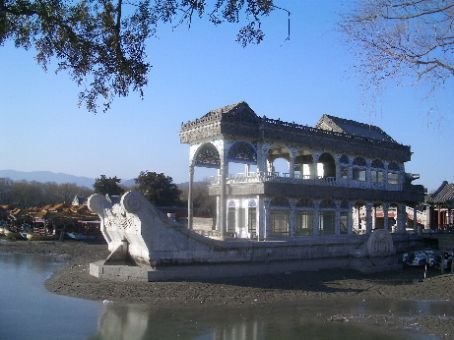
One of the more interesting decisions that Dowager Cixi made, and the reason I’ve heard of her at all, was that when weighing up how to spend the naval budget, given that China was at the time in a running conflict with Japan and had lost almost its entire navy in the 1894 first Sino-Japanese war, instead of opting for spending the money on boats or sailors, decided to spend it all on refurbishing a summer palace.

Let’s imagine that meeting.

“Here’s the naval budget. Our navy has been largely wiped out by a superior force. We need a new navy. The money has all been spent on a summer house.  Well, that will really help when Japan’s navy comes back for round two.  I think that may, perhaps, have been a bad decision…”

 “Who’s Empress?”  

“Ah, you are, your worshipfulness majesty. I love the summer palace. A masterstroke, if I may humbly suggest so”

To be fair, she did make the palace LOOK like a boat.   (and the Chinese navy put a sign on the Marble Palace saying that it was a Chinese naval training academy)

 not actually a boat, incapable of participating in a naval battle

 You will note that, this, the only vaguely naval thing that the Empress spent the entire naval budget on, is a boat made out of marble. Marble has many fine qualities – seaworthiness, is not amongst them.

This was an unpopular move at the time, and became even more so a few years later, when Japan’s navy kicked the living heck out of China’s beleaguered navy.

To be fair, many historians now believe that if Dowager Cixi had spent the money on battleships, they would have all just been sunk by the Japanese Navy anyway, countless more lives would have been lost, and there wouldn’t now be the fantastic marble palace boat to look at, so maybe she was not the worst military planner in history, but simply ahead of the curve.

The cost of running her Court was $6.5 million per year  (which is reported as being an ‘astronomical amount at the time’ )  and each of her birthdays was celebrated with the release of 10,000 caged birds. She is reputed to have once eaten a 150 course meal at a banquet. 

This made me feel rather sorry for her – after her death, her tomb was raided  (probably that Lara Croft) and the pearl that had been placed in her mouth to prevent evil spirits from getting in was stolen.

But gosh, the Empress wasn’t the last person to try to build ships out of manifestly unsuitable material. 

The US navy decided during World War I, to build 12 battleships out of concrete. Yes, concrete, that notably buoyant substance.  How did that experiment go?

The SS Atlantus is pictured below.  Apparently, the experimental material “proved impractical due to weight”    [astonishingly, this happened after ‘several transatlantic voyages’]

Undaunted by this, the US Navy had another crack at it in WWII.  Rather than build 12, they went for 24.  Well, why not, as they worked so well first time.

[Sad geeky fact – you can build a boat out of concrete, provided it is the right shape – it just has to displace more weight of water than the weight of the ship. Steel isn’t exactly light, but steel battleships can float]